Are you a team member in a veterinary practice?
Are you a pet parent planning a trip with your furry pal?
Can Cats Fly? What Air Travel Really Means for Cats
Cats can't fly on their own, but they can travel by plane under airline rules. Félicette's 13-minute suborbital mission reached about 157 kilometers, yet the cat herself never powered that flight.
So, can cats fly? The playful answer is no. The practical answer is yes, cats may travel as passengers, usually in an airline-approved carrier in the cabin or as special baggage in a heated, ventilated hold.
That difference matters. A cat's body is built for jumping, climbing, and landing, not for staying airborne. A plane, meanwhile, brings its own questions about carrier space, cabin pressure, health, paperwork, and welfare.
This guide starts with the biology, then moves into the decision: should your cat travel by air, and if so, which option is the kindest and safest fit? You'll find a side-by-side look at cabin and checked-hold travel, a health and paperwork checklist, and practical examples for common trips.
If you're planning a move, the guide to traveling with a cat by plane can help you think through the journey before you buy a ticket.
Introduction That Answers Can Cats Fly Right Away
A cat can't flap its paws and take off like a bird. Cats lack wings and the other adaptations needed for biological flight, so “flying” only becomes accurate when an aircraft carries them.
One cat did go higher than any ordinary pet traveler. France launched Félicette on 18 October 1963 aboard a Véronique rocket. Her suborbital flight reached about 157 kilometers, lasted 13 minutes, and ended with recovery by parachute. That was a remarkable space mission, not powered flight by Félicette herself. The U.S. Department of Transportation's pet-travel guidance treats cats as animals transported on aircraft under airline rules, not as creatures capable of flight.
For most owners, the real question isn't “Can my cat grow wings?” It's “Can my cat travel on this airline, on this route, in this carrier, without creating an avoidable health or stress problem?”
The question behind the question
Air travel may make sense for a relocation or another necessary journey. It may be a poor choice for an optional trip when your cat is happier at home with a trusted caregiver. The right answer depends on your cat's health, temperament, age, breed, destination, and the transport options available.
Airlines also make the decision more specific. A carrier may allow cats in the cabin but not on every route. Another may accept pets in a hold only under particular conditions. Rules can change, and a pet reservation often needs separate confirmation.
The simplest answer is therefore two parts: cats cannot fly independently, but some cats can travel by airplane when the owner plans carefully and follows the airline's current requirements.
Why Cats Cannot Fly on Their Own
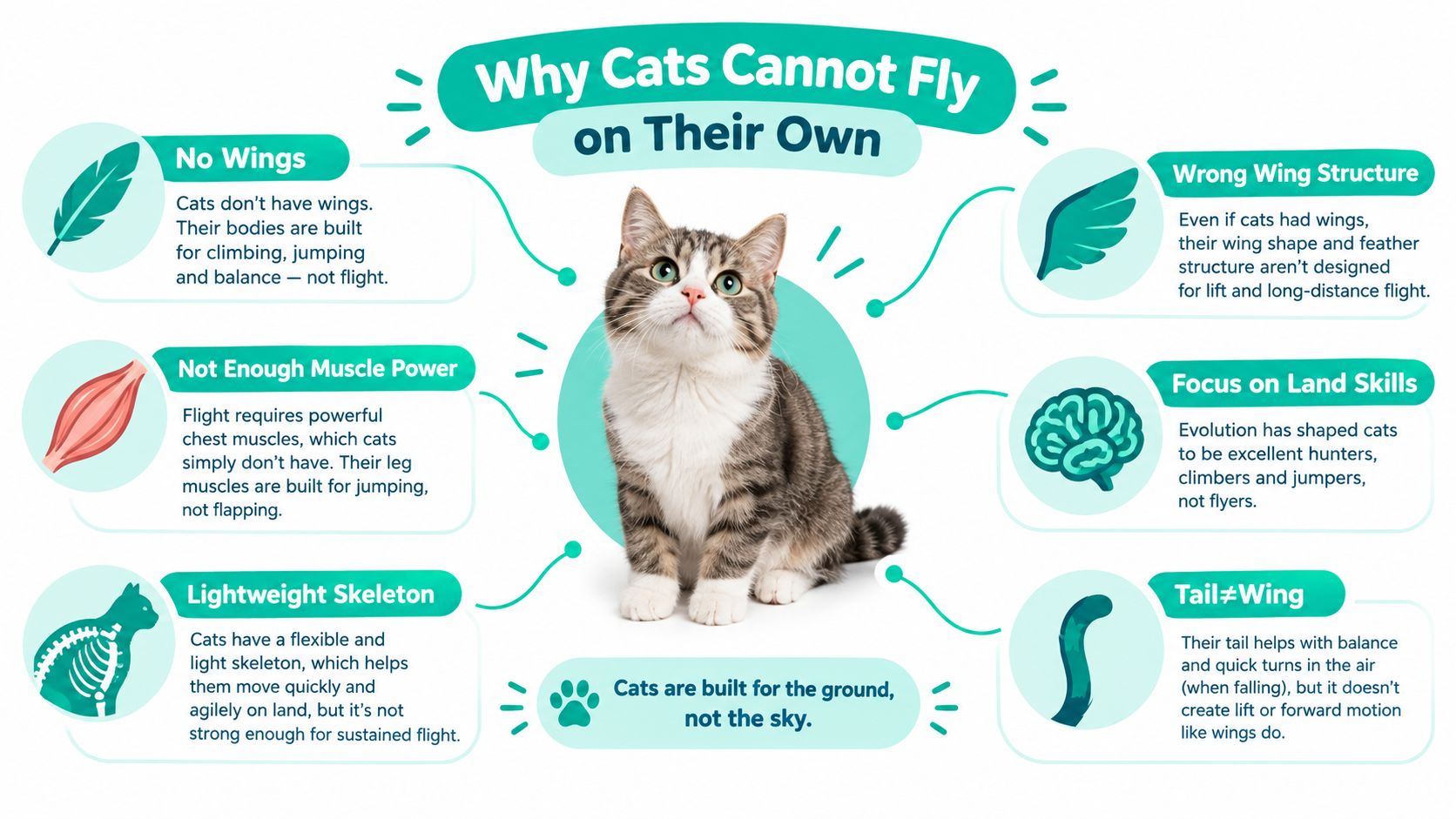
Powered flight needs more than a leap. An animal must generate lift, create thrust, and control its body while airborne.
Birds use wings to push air downward and create lift. Their bodies also include lightweight skeletal and respiratory adaptations that support sustained flight. Bats solve the problem with wing-like forelimbs made from stretched skin. Cats have neither structure.
Built for the pounce, not the runway
A cat's muscles and bones support quick acceleration, climbing, jumping, and controlled landing. Those talents can look almost magical. A cat may spring onto a shelf, twist in midair, or leap across a gap with impressive accuracy.
But a jump is a short burst of motion. The cat starts with force from its legs, travels through the air, and then returns to a surface. It doesn't produce the ongoing lift and thrust needed to remain airborne.
The basic anatomy of feline movement explains the central point: cats lack wings, wing-like appendages, and the low-mass skeletal and respiratory adaptations that help birds and bats generate lift and sustain airborne movement. Their musculoskeletal system is specialized for movement across surfaces, not for powered flight.
The memorable rule: A cat can jump, glide briefly during a fall, and land with skill. It can't generate powered flight with its own body.
No amount of training can change that anatomy. A costume with wings won't provide the muscles, shape, or control needed for flight, and attaching a gadget to a cat would create a serious welfare concern. The safest “flight equipment” for a cat is a secure carrier that lets an aircraft do the flying.
How Cats Actually Fly on Airlines
Air travel turns the question into a transport problem. Your cat remains inside an approved carrier, while the airline decides whether the animal may travel in the passenger cabin or in a designated hold.
In-cabin travel generally places the carrier under the seat in front of you. Your cat stays inside the carrier for the journey, and the carrier must fit the airline's size and design rules. Cabin pet space is limited, so you usually need to request the pet spot before travel rather than assuming it will be available at check-in. Air-travel guidance for flying with a cat describes these under-seat limits and the need for advance reservations.
Checked-hold travel is different from putting a carrier on an ordinary baggage belt. Some airlines transport pets as special baggage in a heated and ventilated hold, subject to route, aircraft, weather, breed, and carrier restrictions. The hold option may be unavailable even when cabin travel is allowed.
Travel Option | Where Cat Rides | Key Airline Rule |
|---|---|---|
In cabin | In an airline-approved carrier under the seat in front of you | The cat generally stays in the carrier, and the airline limits the number of cabin pets |
Checked hold | In an approved travel crate in a heated, ventilated aircraft hold when offered | Availability depends on the airline, route, aircraft, conditions, and pet restrictions |
What the comparison means
Cabin travel lets you remain close to your cat and may be the preferred option when the airline permits it and your cat can tolerate the journey. It still involves airport noise, security procedures, unfamiliar smells, and restricted movement.
A hold may be the only air option for a larger carrier or a route that doesn't permit cabin pets. It requires more careful checking because the physical environment, handling process, and airline conditions differ from the passenger cabin. Read the cargo hold guidance for pet flights before treating a hold as a simple backup.
Don't book your own seat first and sort out the cat later. Check the airline's current pet policy, route eligibility, carrier dimensions, reservation process, and any restrictions before paying for the trip. A plane ticket doesn't automatically include a place for your furry passenger.
Health and Welfare Checks Before You Book
A cat may be allowed to travel and still not be a good candidate for that particular journey. The useful question isn't only whether the airline says yes. Ask whether your cat's health, temperament, and the trip's conditions make air travel a sensible choice.
Start with age. The U.S. Department of Transportation says dogs and cats must be at least eight weeks old and weaned for at least five days before air travel, while American Airlines also lists 8 weeks as the minimum for cats traveling within the United States and Puerto Rico. Check the current rule for your carrier and route rather than relying on a general internet answer.
Health factors that deserve a veterinary conversation
Aircraft cabins are pressurized to an equivalent altitude of about 6,000 to 8,000 feet, with inspired oxygen partial pressure around 15.1 to 17.1 kPa, according to this veterinary review of hypobaria during air transport. Most healthy cats may manage that environment, but it isn't a zero-risk setting for an animal with respiratory or cardiovascular compromise.
Ask your veterinarian for an individual assessment if your cat has breathing trouble, heart disease, serious anxiety, a history of motion sickness, or another condition that could worsen with stress or reduced oxygen availability. Flat-faced cats deserve particular care because breathing can already be more difficult for them.
Keep vaccination records and your cat's medical history together. The cat vaccination record guide can help you organize information your veterinarian or airline may request.
A wider welfare decision
Air transport has a documented safety history that deserves an honest look. The Animal Welfare Institute reports 379 animal deaths, 208 injuries, and 56 losses in air-travel reports from 2005 to 2017 in its air-transport information. Those figures cover animal air travel reports broadly, not a prediction of what will happen to your individual cat, but they show why cabin, hold, ground travel, and postponing a trip shouldn't be treated as interchangeable choices.
Use a pause-and-check approach:
Cabin: Consider it when your airline permits it, your cat can remain calmly secured, and the route is manageable.
Checked hold: Treat it as a specialized option requiring careful airline confirmation and veterinary discussion.
Ground transport: Compare the longer travel time with the possibility of more control over stops, temperature, and handling.
Postponing or staying home: For optional travel, a familiar home and trusted caregiver may be kinder for a highly stressed or medically fragile cat.
Documents and Airline Notifications Your Cat Needs
Paperwork works best as a timeline, not a last-minute folder grabbed while you're heading out the door. Start with the destination, then confirm the airline, then schedule the veterinary work that supports those requirements.
Begin with the destination
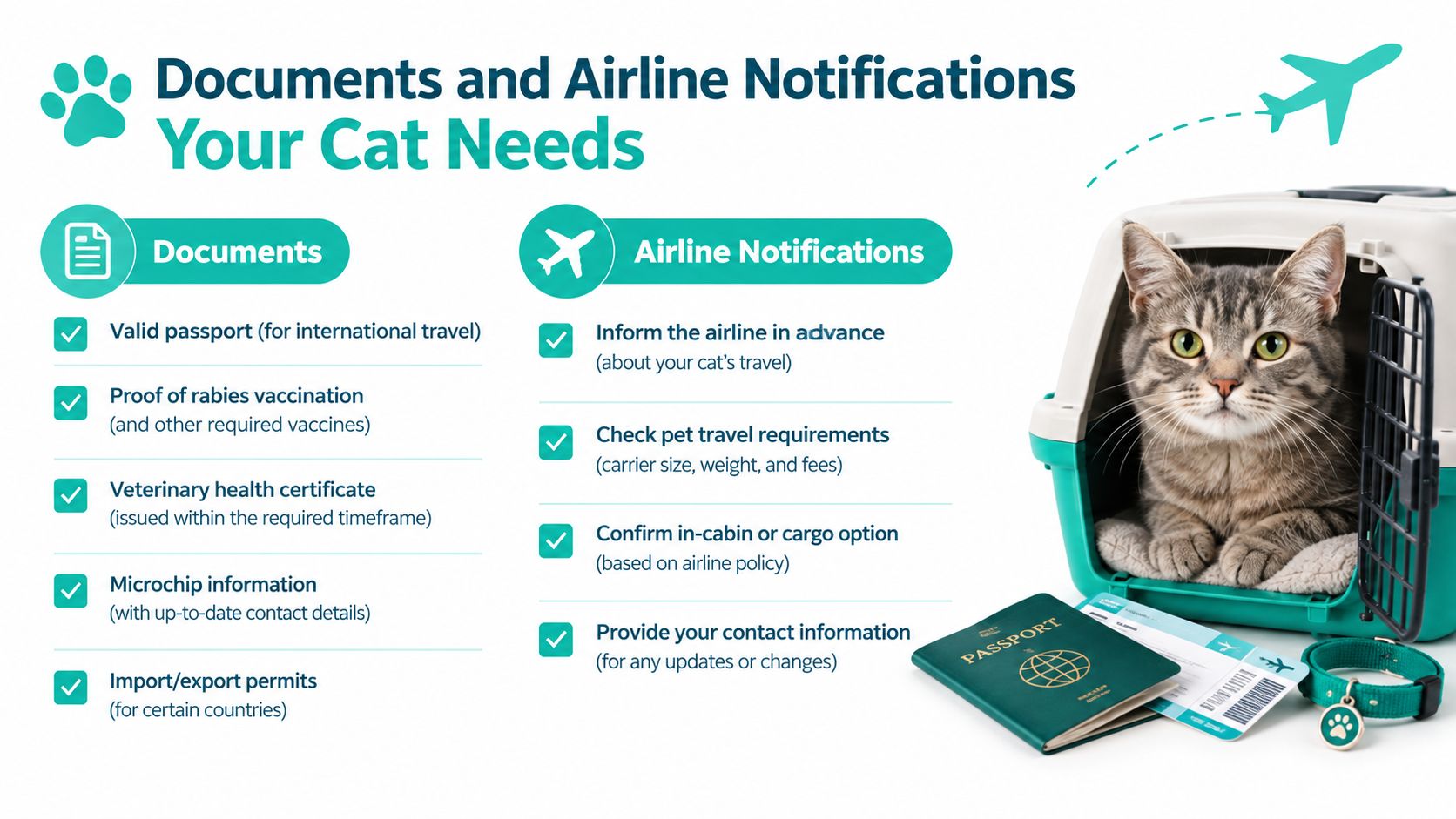
Destination rules may ask for different health documents, identification details, vaccinations, or timing. Requirements can also differ for domestic and international journeys. Use official destination guidance and the airline's own pet page, then save the relevant instructions so you can compare them with your veterinarian's records.
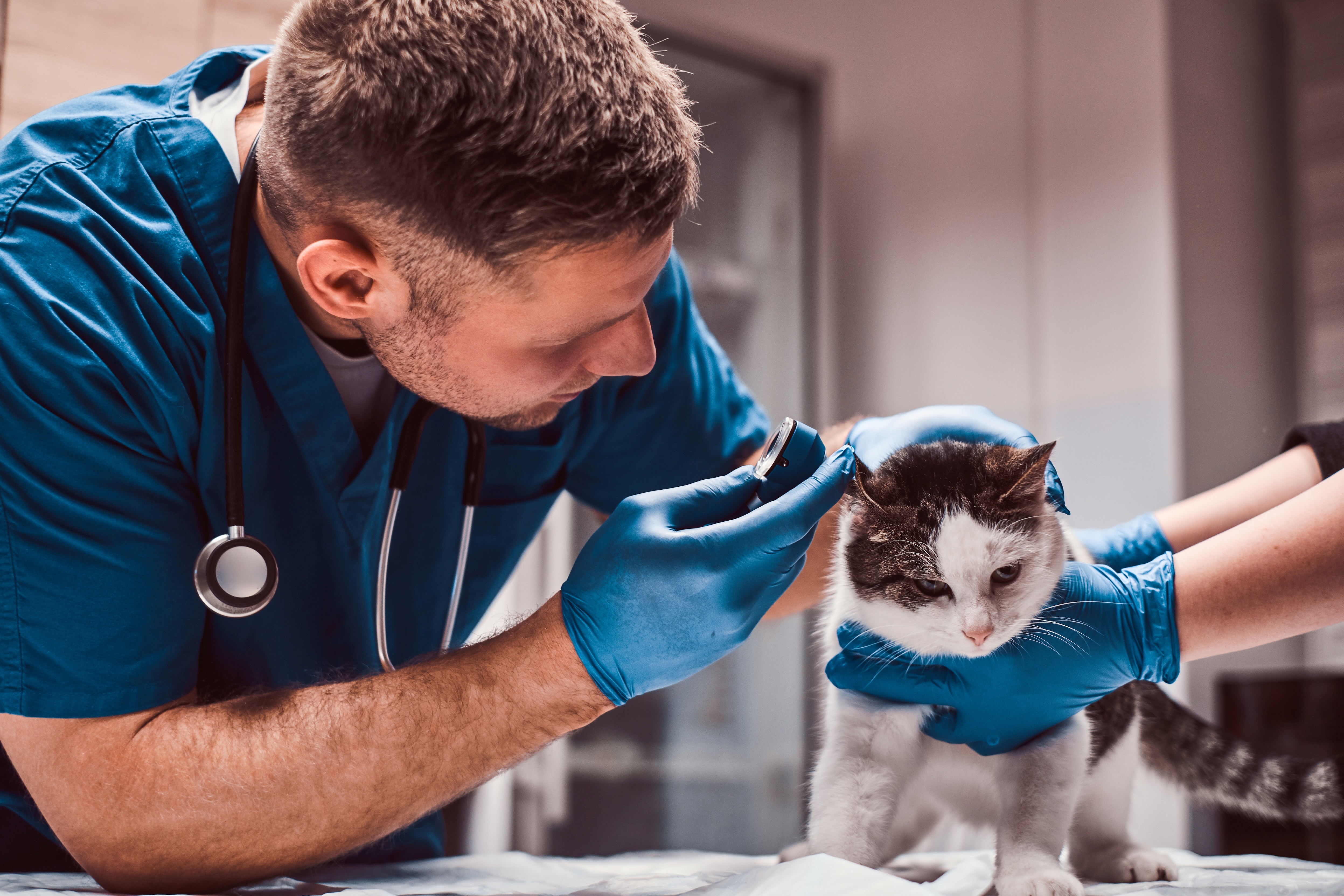
Next, contact a veterinarian familiar with travel paperwork. For international journeys, an accredited veterinarian may need to examine your cat and complete a health certificate in the required format. Some documents may need review or endorsement, so leaving the appointment until the final days can create a tight squeeze.
Build a document folder
Keep paper and digital copies where possible:
Health certificate: Confirm the correct form, examination window, signatures, and any endorsement process.
Vaccination records: Make sure dates and identifying details match your cat's other documents.
Identification details: Check that the microchip or other identification information is recorded consistently.
Destination approvals: Save permits, import paperwork, or other documents the destination authority requests.
Airline confirmation: Keep the pet reservation, carrier approval, and route details with the rest of the file.
The pet travel documents guide offers a useful way to think about the paperwork as a coordinated set rather than isolated forms.
Notify the airline early
Airlines may limit cabin pet space, and a reservation for you doesn't necessarily reserve space for your cat. Ask the carrier to confirm the pet booking, the allowed carrier dimensions, the seat restrictions, and the check-in process.
Before travel day, compare every name, date, route, and identification detail. Small mismatches can cause delays even when the underlying health information is correct. Your cat won't care about your filing system, but your future self will be grateful for a tidy one.
Real World Examples of Flying With Cats Done Right
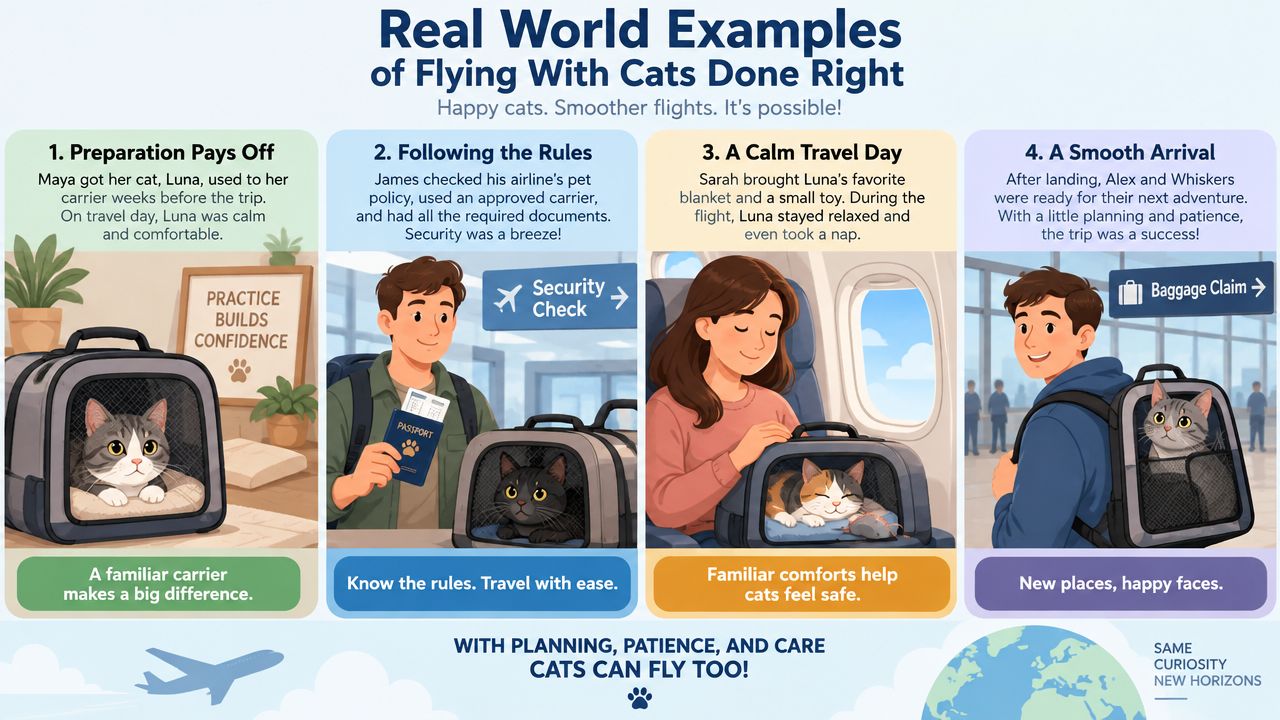
A short domestic move can be the simplest scenario. An owner checks that the route accepts cabin cats, confirms a pet spot before booking, and chooses a carrier that fits under the seat. At home, the carrier stays open with familiar bedding, and the cat receives calm practice sessions before the airport day.
At check-in, the owner keeps the documents accessible rather than buried in luggage. During security screening, the cat remains secured according to the airport's instructions, and the carrier goes back under the seat for the flight. The success doesn't come from making the trip glamorous. It comes from removing surprises.
When breed restrictions change the plan
Consider a family relocating with a flat-faced cat. They don't assume that a cabin policy applies to every form of transport. American Airlines says it doesn't accept brachycephalic cats of any mix as checked pets, including Burmese, Persian, Himalayan, and Exotic Shorthair cats, as described in its pet travel policy.
That family might investigate in-cabin travel, a ground route, or a different schedule. Their checklist starts with the cat's breed and health, not with a preferred ticket. Careful planning earns its whiskers.
When driving may be kinder
A senior cat who panics during every car ride may not become relaxed because the vehicle changes into an airplane. The owner compares the full journey, including airport crowds, security, carrier time, connections, and the cat's recovery afterward.
If the trip is optional, staying home with a reliable caregiver may win. If the move is necessary, a veterinarian can help the owner assess the available route and prepare a plan for stress, feeding, medication, and warning signs. The best outcome isn't a cute airport photo. It's a cat that arrives stable, secure, and ready to settle.
Final Takeaways for Smooth and Safe Cat Travel
The answer to “can cats fly” depends on which meaning you intend. Cats can't fly under their own power, but an airline may carry them in the cabin or, under specific conditions, in a heated and ventilated hold.
Before booking, make five decisions:
Confirm the route: Check the airline's current pet policy and destination requirements.
Choose the transport mode: Compare cabin, hold, ground travel, and staying home.
Check health readiness: Discuss age, breathing, heart health, anxiety, motion sickness, and breed with your veterinarian.
Reserve the pet spot: Ask for written confirmation and verify the carrier's size and placement rules.
Organize the documents: Keep health records, certificates, identification details, destination paperwork, and airline confirmation together.
The welfare data also supports a measured approach. The Animal Welfare Institute's reports of 379 deaths, 208 injuries, and 56 losses from 2005 to 2017 don't tell you that your cat will experience harm, but they do remind owners that air travel deserves planning rather than wishful thinking.
A calm cat in a suitable carrier, a confirmed airline reservation, and complete paperwork can make a necessary journey much smoother. If your cat is medically fragile, extremely fearful, or facing a complex route, pausing may be the most caring choice. Sometimes the kindest travel plan has four wheels, and sometimes it has a trusted sitter and a familiar windowsill.
Passpaw helps pet owners and veterinary teams manage international health certificates and travel documents in one place. Visit Passpaw to organize requirements, track deadlines, and keep communication clear before your cat's journey gets underway.

More articles
From regulatory changes to best practices for veterinarians and pet owners, our resources keep you ahead of the curve.