Are you a team member in a veterinary practice?
Are you a pet parent planning a trip with your furry pal?
Traveling Pet Groomer: Start Your Business in 2026
You've probably seen the same scene from both sides of the leash. A client wants a calmer grooming day for an older dog, a doodle with a thick coat, or a nervous rescue that hates the car ride, and you're the one who can turn that headache into an easy front-door handoff. That's the strong appeal of a traveling pet groomer service, convenience for the owner, less stress for the pet, and a business model that can fit busy neighborhoods if it's set up right. The U.S. pet grooming and boarding industry is still a huge, established space, and IBISWorld projects it will reach $11.3 billion in 2026 with nearly 200,000 businesses, growing about 8.2% annually between 2021 and 2026 (IBISWorld industry outlook). If you're trying to build a route-based business that feels local, personal, and profitable, this offers the initial path.
A smart next step is to study how nearby salons attract recurring customers and turn that into your own referral engine with automated referrals for pet salons. The best mobile operators don't just clip and rinse, they build systems that make every stop easier to book, easier to repeat, and easier to recommend.
Introduction to Traveling Pet Grooming
A curbside pickup for grooming solves a very specific problem: the pet stays closer to home, the owner saves the trip, and your schedule can still support repeat visits if the route is built well. That is why a traveling pet groomer can work in neighborhoods where clients want consistent coat care but do not want to build their day around a salon appointment. In the U.S., 81% of dog owners reported grooming their pet in the previous 12 months in 2020, which shows grooming is routine care, not an occasional luxury (PMC study). The same source breaks down where that care happens, with 41% at-home grooming, 30% full-service salon use, 9% mobile grooming, 8% retailer grooming, and 6% self-service centers.
That split matters at street level. It shows owners already accept several grooming formats, and it leaves room for a mobile service that combines professional handling with less disruption for the pet and the client. A groomer who can keep the van moving through a dense route, avoid long gaps between stops, and keep first-time clients comfortable has a real advantage.
The premium side is there too. In 2020, dog owners spent an average of $197 on professional salon grooming and $161 on professional mobile grooming (PMC study). That spend reflects a service people return to when the experience feels easier and the pet handles it better. Mobile pet care also sits inside a meaningful broader market, with one analysis showing the category rising from USD 640.8 million in 2022 to USD 722.7 million in 2024, while grooming services accounted for USD 391.9 million in 2025 within that segment (Grand View Research market overview).
The operator's job is more operational than it first looks. You are balancing route density, van readiness, pet comfort, booking flow, and timing, while also keeping the day organized with tools that do not slow you down. Many successful groomers use a booking calendar tied to route planning, a client intake form that flags behavior notes and coat history, and reminders that confirm the stop before the van rolls. That kind of workflow helps the day stay tight instead of turning into guesswork. Automated referrals for pet salons, through automated referrals for pet salons, can also support repeat business once the client side is running smoothly.
A mobile setup works best when the pet stays calmer, the client gets time back, and the route is dense enough to keep the day efficient.
Business Setup and Compliance
Start with the business shape before you buy the shiny stuff. A mobile grooming business can run as a sole proprietorship or an LLC, but the better choice usually comes down to risk separation, banking clarity, and how you want to present yourself to clients and vendors. Keep your books separate from day one, open a business bank account, and choose an accountant who already handles service businesses with travel-heavy expenses, because fuel, supplies, and vehicle costs need clean records.
Licensing and local rules come next. Grooming shops and mobile operators don't all face the same requirements, so you'll need to check city, county, and state rules for business registration, sales tax accounts if applicable, and any local permits tied to vehicle-based service. If you're also handling pet travel records or working alongside veterinary offices, keep that paperwork organized from the beginning with a system built for veterinary record keeping requirements. Even if your day job is clipping coats, you still need the habit of file discipline.
Insurance is where many new operators cut corners, and that's a mistake. You'll want liability coverage suited to grooming work, vehicle coverage that reflects a business-use van, and protection that makes sense for the equipment you're carrying. If your van breaks down or a dog gets injured during a bad transfer, vague coverage language won't help you much.
Build the administrative base before launch
A clean setup keeps the business from wobbling later.
Choose the entity first: Set up the business structure before buying equipment so invoices, taxes, and insurance all line up.
Register early: File business registrations, tax accounts, and any local permits before you advertise.
Match insurance to reality: Tell the insurer you're running a traveling grooming service, not a personal vehicle with hobby gear.
Separate receipts by category: Fuel, blades, shampoo, dryers, van repairs, and marketing should each have their own trail.
The practical rule is simple. If you can't explain where the money goes, you can't tell whether the route is profitable.
Preparing Your Mobile Salon
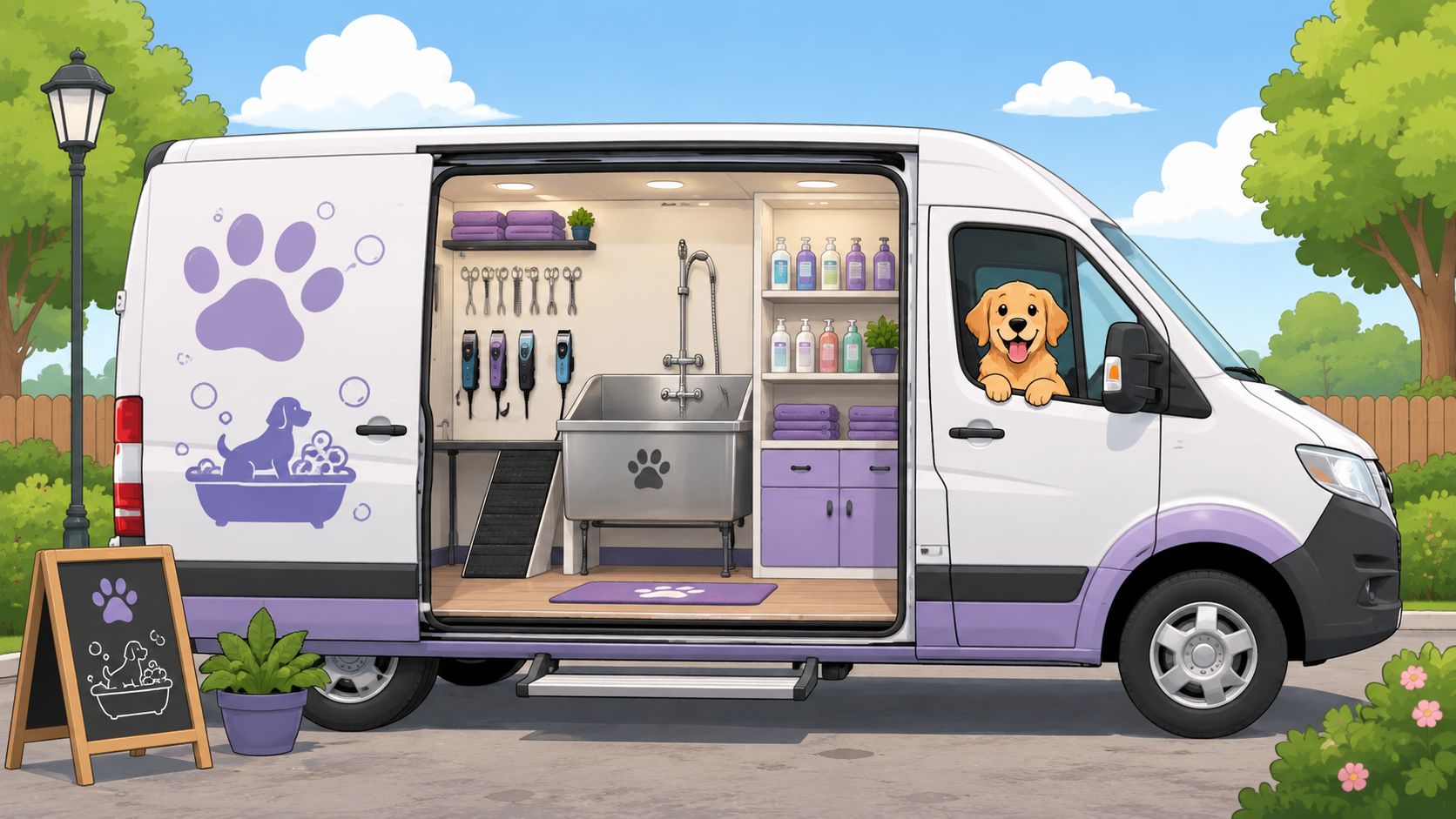
The van is your shop, your storage room, and your back office all in one. Mobile grooming relies on fully equipped vans or trailers, and one industry report says 48% of deployments use van-based models outfitted with tubs, tables, and power supplies to serve as a rolling salon (Intel Market Research). That matters because the vehicle choice shapes everything else, from what you can carry to how long each appointment really takes.
Design the interior for flow, not just storage
Put the grooming table where you can reach it without twisting around the whole cabin. Keep shampoos, towels, blades, and dryers in the order you use them, not the order they fit. A cluttered van slows every single stop, especially when the dog is moving, wet, or nervous.
A good layout also protects the power and climate systems. You'll need a plan for water heating, drying, ventilation, and temperature control, because a rolling salon has far less forgiveness than a fixed shop. If you're comparing used gear and new fixtures, buy the items that affect safety and uptime first, then fill in the rest with second-hand pieces if they're in good shape.
Treat maintenance like a business habit
Practical rule: if the van misses a maintenance check, the schedule gets punished twice, once by the repair and once by the lost route time.
That means tires, fluids, electrical systems, water systems, and floor cleanup all need recurring attention. Keep a log in the van and check it before the first appointment of the day, not after the first problem appears. For crate handling and safe transport between stops, keep the equipment flow tight and use a set process for every pet, which helps when a dog arrives already worked up. A dedicated guide on pet crate use for travel is useful if your workflow includes drop-offs, pickups, or transfer points.
Branding matters too. Your van should be easy to identify, readable from the street, and clean enough to signal professionalism before you open the door. A traveling pet groomer sells trust before the first bath, and the van is the first proof point.
Pricing Services and Ensuring Profitability
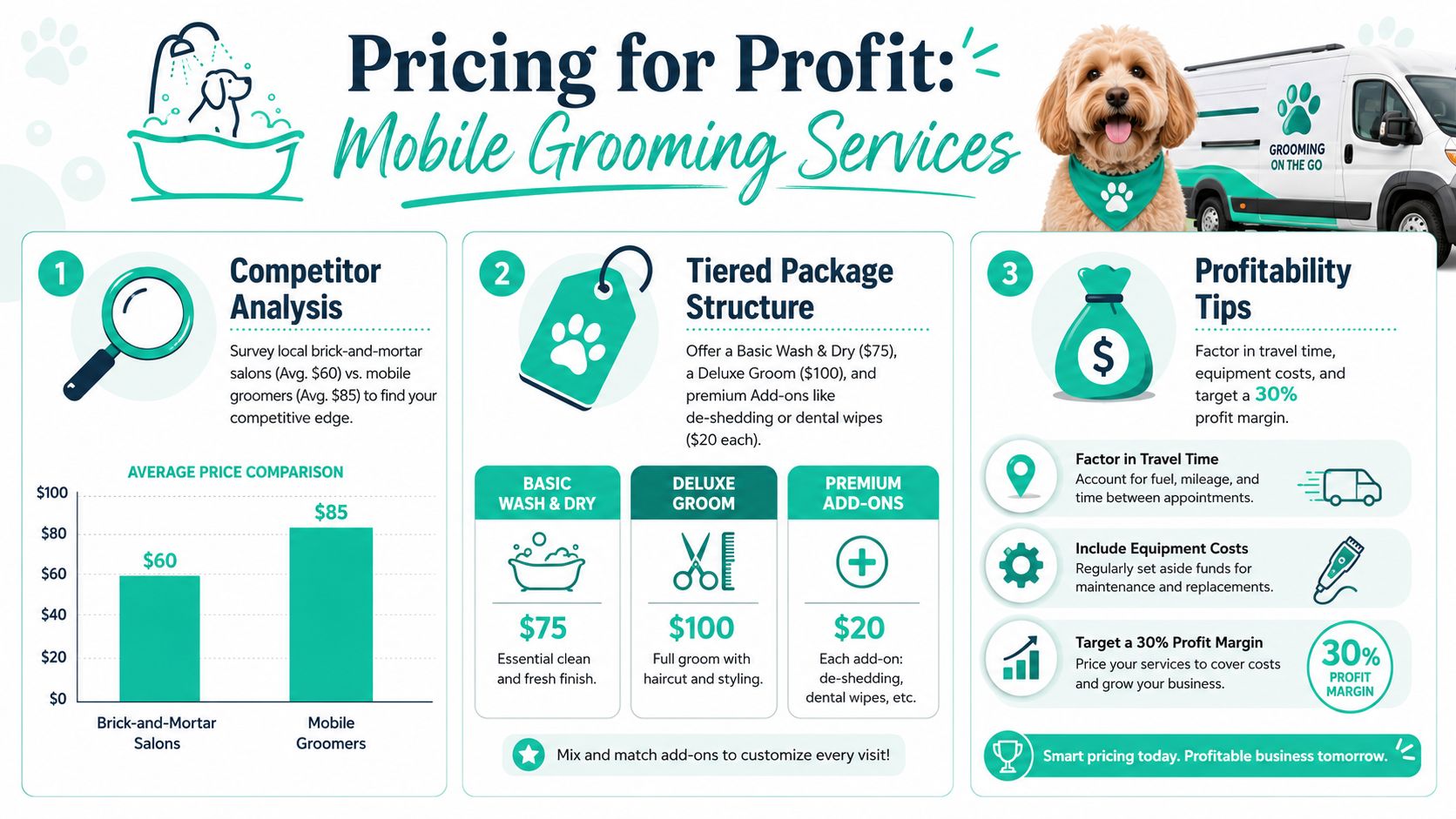
A van can be fully booked and still lose money if the pricing is too soft. Mobile grooming should cost more than studio work because the service carries travel time, setup time, fuel, water, equipment wear, and a one-to-one appointment model. That premium needs to be visible in the price, or every busy day will feel productive without paying well.
Price from your route, not from your feelings
Start by comparing local salons and local mobile groomers, then decide where your service belongs in that market. A route-heavy business also needs a clear test for marketing spend, so Sendvo's direct mail ROAS tool is useful when you want to see whether postcards, flyers, or a neighborhood drop are bringing in enough booked appointments to justify the cost.
Build packages after that. A simple structure is easier for clients to understand and easier for you to quote without hesitation:
Basic bath and tidy: Best for short coats and maintenance visits.
Standard groom: Best for regular full-service appointments.
Premium add-ons: De-shedding, specialty coat work, or extra time for anxious pets.
The goal is not to create a long menu. The goal is to make the right service obvious, while keeping price changes tied to real work instead of guesswork.
Protect margin with a floor, not a guess
Planning tools for mobile pet businesses help you check whether your rates can support fuel, supplies, and the labor that goes into every stop. A calculator like Passpaw's practice revenue calculator is helpful because it forces you to look at service volume, ticket size, and the point where a full calendar still supports healthy income.
Practical rule: underpricing travel is the fastest way to fill your calendar and empty your bank account.
Keep an eye on operating trade-offs too. A van with poor route density, too much dead drive time, or constant setup changes can make a fair-looking price turn weak in practice. That is why pricing has to match the way you work, not the way a storefront salon works.
A mobile groomer also needs room for real-world pressure. Weather can slow a route, parking can shorten a visit, and extra coat work can stretch the day, so rates should leave space for those frictions instead of assuming every appointment runs cleanly. That usually means building in a cushion for labor, fuel, and wear on the van, then reviewing whether the schedule still supports the same margin after a few weeks in the field.
If you use direct mail to fill open days, treat it like any other cost center and measure the return against the appointments it produces. A flyer that looks cheap can still miss the mark if it brings in low-value jobs, while a smaller campaign can be worth it if it fills a dense route with regular clients. Keep the math tied to booked work, not just response rate.
A traveling pet groomer who watches pricing this way protects both cash flow and the van itself. That leaves more room to handle long coats, anxious pets, and the slow weeks without turning every booking into a risk.
Optimizing Routes and Scheduling
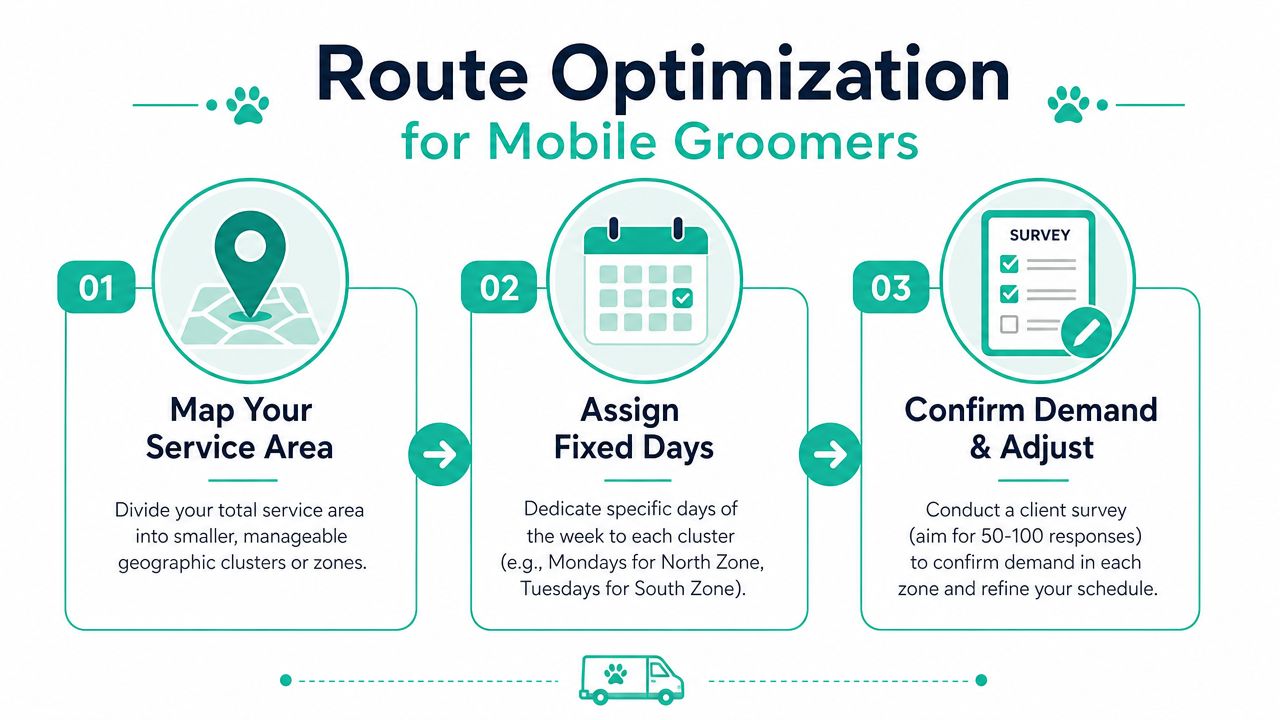
A traveling pet groomer lives or dies by route density. If your day is built on random stops across town, you'll spend too much time driving and too little time grooming. The better model is to assign fixed days to geographic clusters, then keep each zone tight enough that the van spends more time earning than circling.
Build your schedule around neighborhoods
Start with a map and divide the service area into manageable zones. One day can belong to one cluster, and clients in that cluster learn to book on that day. That habit reduces guesswork for you and makes it easier for the client to remember when you're coming.
Route density only works if the area can support it. Before launch, check whether each zone can really fill a dedicated day, using a survey or another simple demand check to see if the route will hold up in practice. A local survey sample of 50–100 responses is enough to tell you whether a zone is worth its own day or should be folded into another route, as noted in the Jim.com business guide. That number is not magic, but it is practical. It gives you enough feedback to avoid building a dead route.
Plan for friction before it hits
Mobile groomers face cancellations, traffic delays, parking constraints, and weather, so route-planning software and flexible scheduling tools are part of the daily workflow, not extras (YouTube discussion on mobile grooming operations). A good booking calendar should sync with your route map, block travel buffers, and make same-day reshuffles less painful. If a client cancels, the next appointment should already be within reach, not twenty minutes away in the wrong direction.
A tool that helps you optimise your transport routes is worth testing if you are serious about keeping drive time under control. The hidden cost in mobile grooming is not always gas, it is the gap between stops.
Use the schedule to protect the groom
Fixed days, route buffers, and centralized booking all support the same thing, calmer work. When you are not scrambling for the next address, you can spend more attention on the pet in the tub and less on the clock. That usually means smoother handoffs, fewer missed windows, and a day that does not feel like a chase scene.
Client Engagement and Vet Partnerships
A traveling pet groomer keeps the van busy by keeping the relationship easy to manage. Clients do pay more for mobile grooming because the visit removes transport hassle, lowers stress for the pet, and gives them one-on-one attention, as noted earlier. That premium is easier to hold when people feel remembered, know what to expect, and can reach you without a back-and-forth chase.
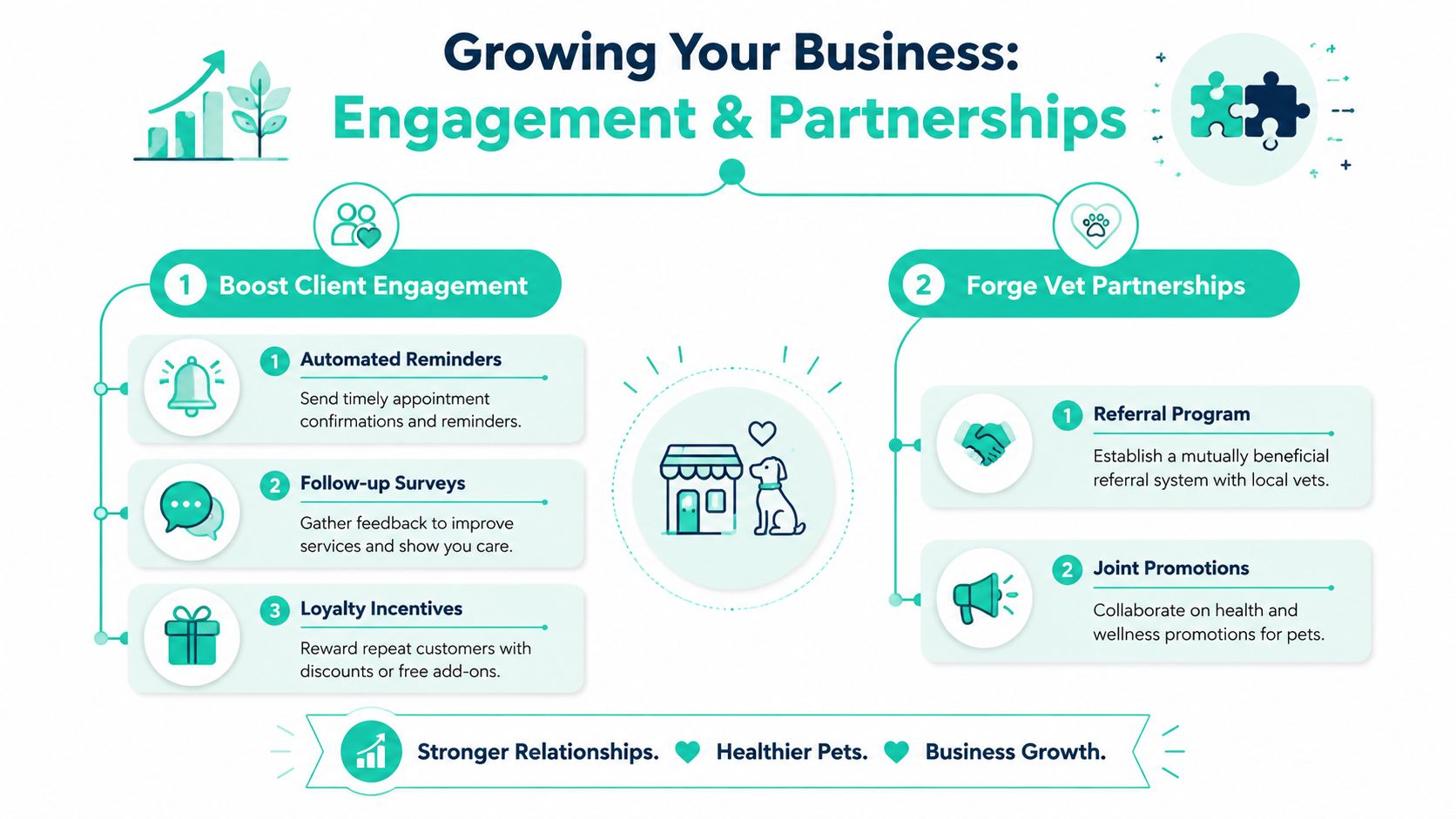
Turn good service into repeat bookings
Reminder systems do more than cut no-shows. They keep the route steadier by reducing last-minute gaps and making the booking process feel organized. A quick confirmation when the appointment is set, a reminder before arrival, and a follow-up after the visit give the client clear touchpoints without adding much admin work. Follow-up surveys are especially useful after a first appointment, because they show whether the pet stayed comfortable and whether your timing matched what the client expected.
Loyalty offers do not need to be complicated. A small benefit for repeat clients, or a priority slot for regulars, can steady the calendar better than constant discounting. Discounts may bring attention, but they can also teach people to wait for a sale instead of booking on time.
Regular communication also helps clients understand why mobile grooming carries a premium, and why that premium holds when the experience feels personal and dependable. Mobile grooming works as a more private, lower-stress service, and many owners are willing to pay for that level of convenience. If your reminders are clear and your follow-through is consistent, the price feels easier to justify.
Add veterinary partnerships without making it awkward
Veterinary partnerships work best when they solve a real client problem. Groomers and vets often hear the same concerns, especially when a pet needs travel paperwork, special handling, or a calmer grooming setup before a trip. A useful reference point is why pet travel is a smart business strategy for veterinary practices, because it shows how grooming and veterinary care can support each other when the handoff is clear.
A partnership usually works best in a simple format:
Referral flow: Vets send grooming clients who need low-stress, at-home service.
Joint promotions: Both sides mention seasonal care, travel prep, or wellness checks.
Client handoff: The groomer shares timing and service notes so the vet side knows what the pet has already handled.
Keep the conversation plain. Local veterinarians do not need a sales pitch, they need a partner who communicates clearly, respects the client's time, and shows up when promised.
A groomer who answers the phone, confirms appointments, and follows through can become the easiest referral in town.
The strongest mobile businesses treat each booking as the start of a longer relationship. That mindset keeps repeat clients coming back and makes referrals easier to earn.
Conclusion and Next Steps
A strong traveling pet groomer business starts with the unglamorous work, legal setup, van layout, pricing, route design, and client communication. In the first 30 days, lock in the filings, outfit the vehicle, set your service area, test the schedule, and pre-book your first appointments before you open the doors. If the route is tight and the van is ready, the rest gets much easier. Pick your zone, book the first few clients, and start rolling.
A CTA for Passpaw.

More articles
From regulatory changes to best practices for veterinarians and pet owners, our resources keep you ahead of the curve.