Are you a team member in a veterinary practice?
Are you a pet parent planning a trip with your furry pal?
Pet Travelers International Guide to Smooth Trips
Moving abroad or booking a long trip with your pet often starts out sweet. You find a flight, check hotel options, and picture your dog snoozing by your feet or your cat inspecting a new window view. Then the paperwork trail appears, and suddenly you're comparing vaccine dates, microchip records, airline crate rules, and government forms at midnight with a slightly offended pet staring at you.
That moment is common in pet travelers international planning. It feels like one task, but it's really a chain of small tasks that have to line up in the right order. The good news is that this process is usually much calmer when you plan backward from travel day instead of trying to gather documents at the last minute.
Introduction to Stress Free International Pet Travel
A lot of travelers begin with the flight. Then they learn the pet part works differently.
A family might book tickets for summer, call their veterinary clinic a few weeks later, and hear an important question: “Was the microchip placed before the rabies vaccine?” If the answer is no, the whole travel timeline may need to shift. That's the kind of detail that catches good pet parents off guard. It doesn't mean the trip is impossible. It just means the order matters more than most expect.

For many dogs, cats, and ferrets, international travel is manageable when the preparation starts early and the details are checked one by one. A pet owner may need help understanding a destination's health certificate window. A veterinary team may need a cleaner way to track timing. A pet shipper may need to confirm that documents and crate setup match the route. Everyone is trying to solve the same puzzle, just from different sides of the carrier door.
What usually causes the stress
Most confusion comes from three places:
Date order: A document can be correct on its own but still unusable if it was issued too early or too late.
Different rule makers: The airline, the destination country, and the veterinary authority each check different things.
False sense of readiness: Having vaccines on file doesn't always mean a pet is travel-ready.
Start early enough that a surprise doesn't become a cancellation.
If you're sorting out pet passports, health certificates, or route-specific documents, this guide on how to get a pet passport is a helpful starting point.
What makes the process feel simpler
The easiest way to think about pet travelers international planning is this. Don't ask only, “What papers do I need?” Ask, “What needs to happen first, and how close to travel day must the final steps happen?” Once that clicks, the process becomes much less hairy.
How International Pet Travel Really Works
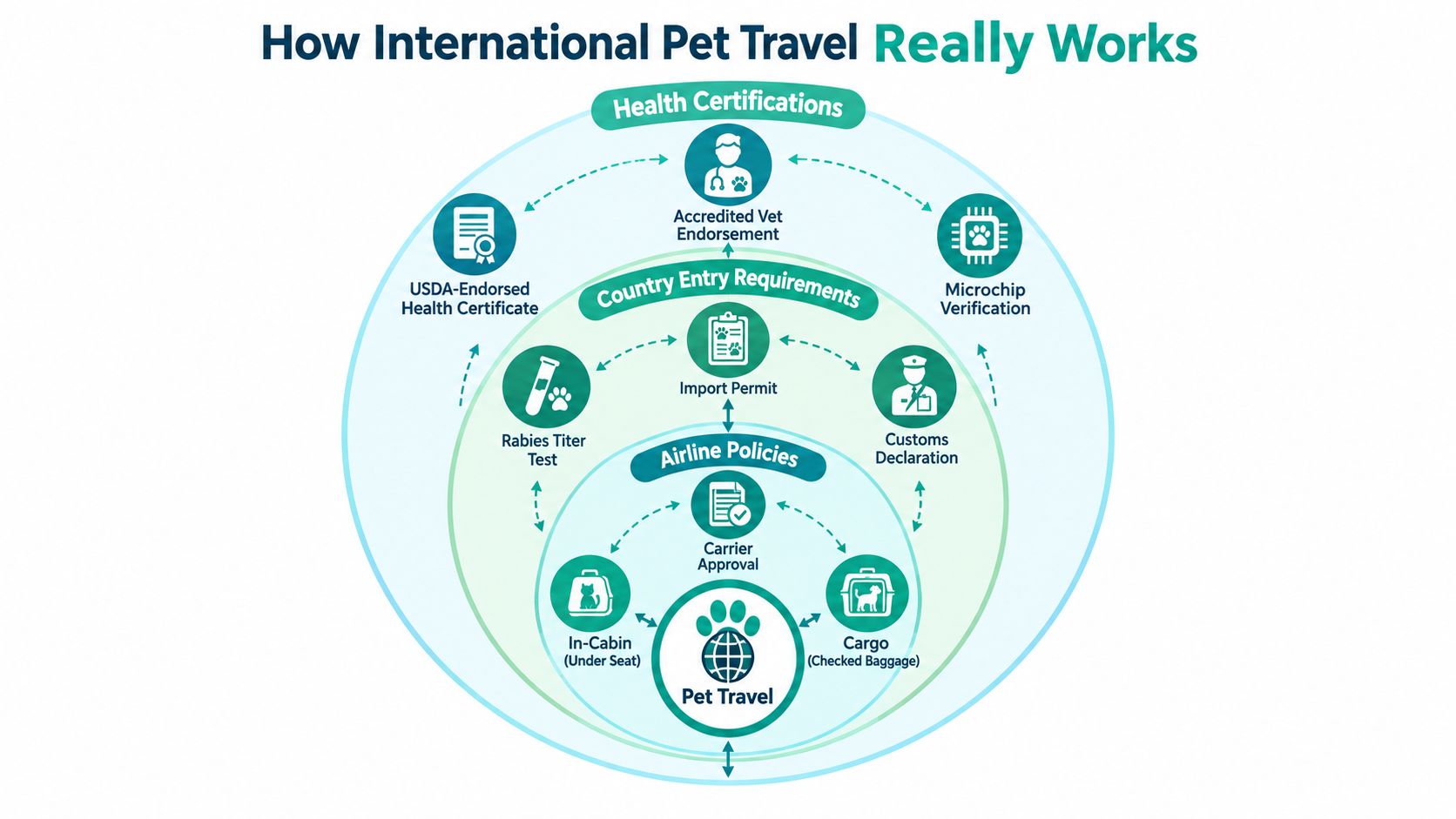
International pet travel isn't one permission slip. It's a layered system.
Your pet needs the right travel setup, the right country entry documents, and the right veterinary records. If one layer doesn't match the others, the trip can stall before takeoff.
The airline layer
Airlines don't only look at the animal's health paperwork. They also look at transport conditions.
IATA's Live Animals Regulations are the worldwide standard airlines use for transporting live animals by air, and that matters because acceptance can depend on crate design, labeling, and handling conditions, not just medical records. IATA also says a green Live Animals label or tag is mandatory on live-animal consignments, and cats and dogs may travel in the cabin only if they meet Container Requirement 1 criteria and the airline allows it, as outlined in IATA's live animal transport guidance.
That means a healthy pet can still be refused if the travel container or labels aren't right.
The country layer
The destination country decides who may enter, what vaccines or tests are needed, whether a treatment is required before arrival, and how recent the paperwork must be. This is why one route can feel straightforward while another feels like a maze with paw prints.
Some owners get stuck because they treat “international pet travel” like one category. It isn't. The rules for one country may be very different from the rules for the next, even if the flight time is similar.
The veterinary layer
Your veterinary team connects the first two layers. They verify records, check sequence and timing, issue the right certificate when the route requires it, and help spot problems while there's still time to fix them.
A simple way to picture the stack:
Airline acceptance: Can the pet travel on that route, in that crate, under that policy?
Destination entry: Does the country allow entry with those vaccines, tests, and forms?
Clinical documentation: Can the veterinary records prove all of that clearly and in the right order?
A health certificate is important, but it isn't a magic boarding pass.
If you want a route-by-route overview, this guide to international pet travel requirements can help you compare what changes from one destination to another.
Timing Is Everything for Vaccines Microchips and Paperwork
If there's one place where pet travelers international plans go sideways, it's timing. Not because owners don't care, but because the dates have to work together like train connections. Miss one, and the whole trip may shift.

The sequence that matters most
For many major routes, the most important order looks like this:
Microchip first
Rabies vaccination after the microchip
Wait the required number of days
Complete any route-specific testing or treatments
Issue the health certificate inside the allowed window
Get endorsement if the route requires it
USDA guidance for EU export says the pet must have a working microchip before rabies vaccination and must wait at least 21 days after a primary rabies vaccination before travel. The same guidance notes that dogs entering Finland, Malta, Ireland, or Norway need tapeworm treatment 1 to 5 days before entry, as described in USDA APHIS guidance for pet travel to Croatia and EU-linked requirements.
That's a lot of date math. It's also why “my pet already had the shot” isn't always enough.
Why one wrong date can change the whole trip
Here's a simple example. A dog gets microchipped after a rabies vaccine. For some destinations, that vaccine may not count for travel timing. The dog may need a new vaccine after the chip is in place, then the waiting period starts from that later date.
The UK government also says pets must wait at least 21 full days after the first rabies vaccination, or after the last dose of the first vaccination course, before traveling. It adds that the wait depends on the rabies vaccine used, so manufacturer guidance can matter too, according to the EU travel rules for pets used by UK travelers.
Practical rule: Write down the travel date first, then count backward for every medical and paperwork step.
Extra timing traps people miss
Some routes add more than vaccines.
UK rabies-titer guidance requires one submission form per animal, microchip reading before sampling, and a minimum 1 mL serum sample per animal. For dogs entering the United States from high-risk countries, the CDC says foreign-vaccinated dogs need serology or they face a 28-day quarantine at a CDC-registered facility. That guidance also requires a Certification of Foreign Rabies Vaccination and Microchip form, a valid rabies serology titer report from a CDC-approved laboratory, a reservation at a CDC-registered animal care facility, a detectable universal microchip implanted before the rabies vaccine, and for a first rabies vaccine, the dog must be at least 12 weeks old and vaccinated at least 28 days before U.S. entry, as outlined in CDC guidance for dogs entering the United States by origin risk.
A calendar can save a lot of tail-chasing. If you need help organizing due dates, this guide on common application deadlines is useful for building a backward plan.
Country Entry Rules and What Changes by Destination
A dog flying to Paris and a cat flying to London can start at the same airport, check in on the same morning, and still need very different medical steps. That catches families off guard. The route decides the rules, and the rules decide your calendar.
The easiest way to stay out of trouble is to plan backward from travel day for the exact destination, not for “international travel” in general. One country may accept a straightforward vaccine-and-certificate path. Another may require a microchip to be placed before the rabies vaccine, a waiting period after vaccination, or extra testing that has to happen months earlier. If you switch countries late, your whole timeline can wobble like a crate with one loose wheel.
The biggest differences by destination type
A few destination patterns come up again and again:
EU travel: The EU uses a structured document system. For some travelers, that means a pet passport. For others, it means an animal health certificate and close attention to rabies timing and microchip order. The rule set is organized, but it is not forgiving if the sequence is wrong, as noted in this summary of EU and UK pet movement rules.
Great Britain travel: Great Britain follows its own pet entry path. Owners often assume it works just like the EU, then discover late in the process that the documents and timing checks are different.
Rabies-controlled destinations: Some countries focus heavily on proving rabies protection in the correct order. That is where the “microchip first, vaccine next, then wait” sequence matters most.
Biosecurity-heavy destinations: Places such as Japan, Australia, and Singapore may add blood testing, import permits, or quarantine decisions tied to paperwork dates. Small timing errors can create big travel headaches.
How entry requirements usually change by route
Destination Type | Typical Requirements | Timing Risk |
|---|---|---|
EU country to EU country | Pet passport for eligible EU residents traveling with dogs, cats, or ferrets, with current rabies entries | Medium if vaccine records or document updates are incomplete |
Non-EU to EU | Microchip, rabies sequence, country-specific health certificate, possible endorsement | High because date order and certificate timing must line up |
Great Britain | Route-specific documents, rabies compliance, and entry checks | Medium to high if records are close to their deadlines |
U.S. from high-risk rabies country | Microchip, rabies records, serology, CDC forms, and extra pre-travel steps | High because one missing item can trigger quarantine or rebooking |
Biosecurity-heavy destinations | Additional testing, permits, and possible quarantine depending on the route | High because planning often has to start much earlier |
One detail causes more last-minute problems than almost any other. Travelers hear “my pet is vaccinated” and assume they are ready. Many destinations care just as much about when the microchip was placed, when the rabies vaccine was given after that chip, and how many days must pass before entry. Then the health certificate often has its own short validity window near departure. It is a three-part clock, and if one hand is off, the whole trip can slip.
Why destination changes are so disruptive
Changing from one country to another can mean more than swapping forms. It can reset whether a rabies vaccine still counts for that route, whether a lab test is needed, and whether your certificate appointment must happen sooner or later. Airline rules may change too, especially if the pet is traveling in cargo rather than in cabin.
For pet travelers international planning, the safest question is simple: do my pet's records match this exact country and this exact travel date? If the answer is unclear, the veterinary team should review the route before anyone books the final flight.
Getting the International Health Certificate Without the Headache
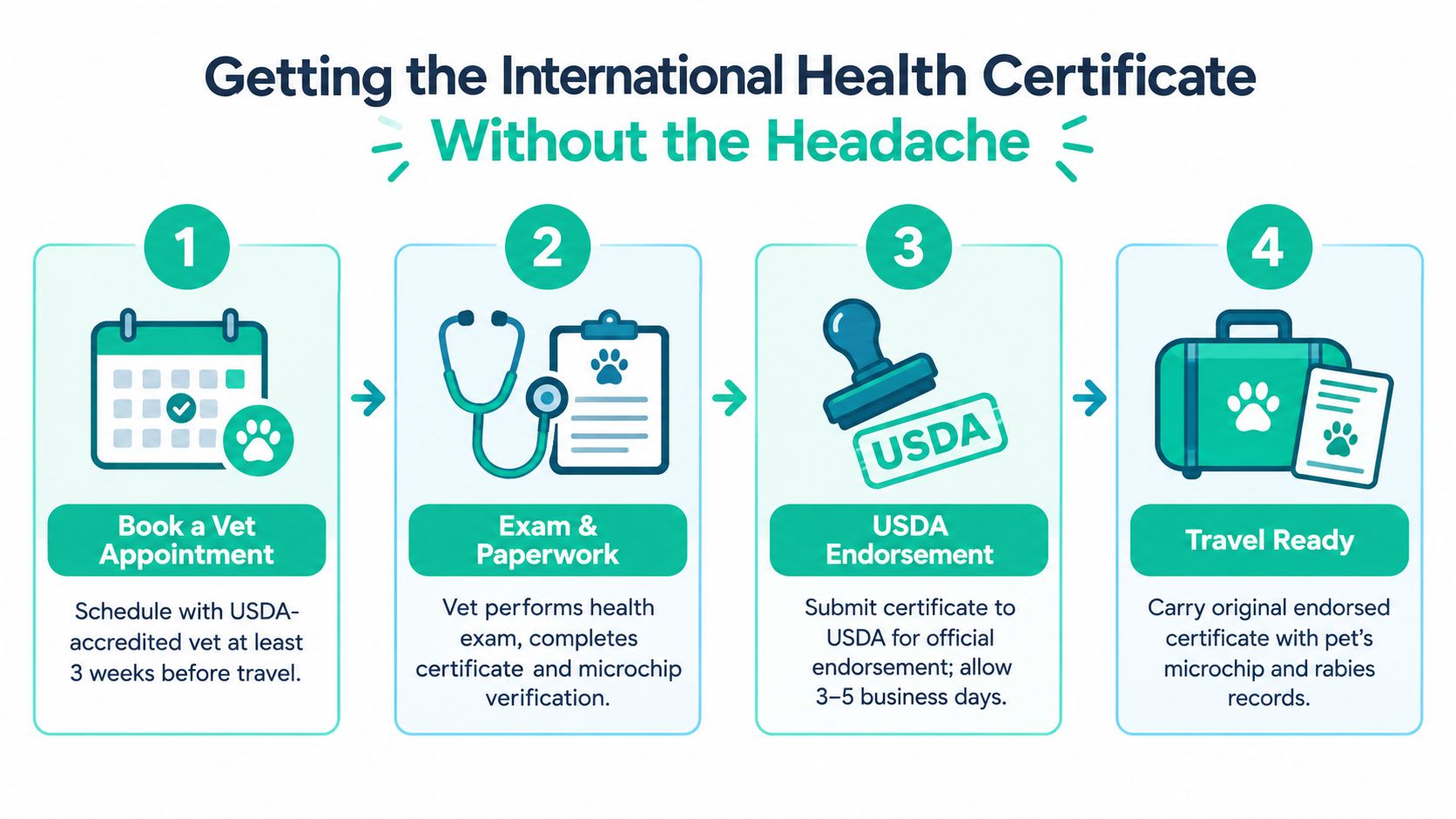
The international health certificate works best when it's treated as a team process. Owners bring the travel details. The veterinary team checks records, timing, and route fit. If endorsement is needed, the paperwork has to move in the right order and within the right window.
That sounds fussy, but it becomes much easier when everyone is working from the same travel date.
What a smooth certificate workflow looks like
A realistic example helps. A family plans to travel with their dog in early summer. Instead of asking for “whatever certificate we need,” they send the destination, airline, and proposed travel date to their clinic first. That gives the clinic a chance to check whether the route needs a USDA-accredited veterinarian, whether any lab work is still pending, and whether the certificate must be issued close to departure.
From there, the workflow usually looks like this:
Travel details come first: The clinic needs the destination country, dates, species, and whether the pet will travel in cabin or as manifest cargo.
Records are reviewed before the appointment: The team checks microchip history, vaccine sequence, and whether any treatment windows are approaching.
The exam happens in the right timing window: Too early can be as unhelpful as too late.
Endorsement is handled if required: Some routes need government endorsement before travel.
The underserved part of the market isn't basic pet travel advice. It's route-specific compliance management. That matters even more as the pet travel services market is projected to reach roughly USD 2.6 billion in 2025 and about USD 3.9 billion by 2030, with CAGR estimates around 8.9%, according to Grand View Research's pet travel services market report.
Tools can reduce avoidable mistakes
Veterinary teams often use checklists, shared calendars, and document review steps to keep applications moving. Some also use software to validate records, track timing, and flag route-specific tasks before the final certificate is prepared.
One option is Passpaw, which helps veterinary teams manage international health certificate workflows with destination-specific planning, real-time document validation, and task prioritization by travel date and pet information.
Bring your route, your dates, and your pet's records to the first appointment. That's how a vet team can help before the clock gets tight.
If you're preparing for the certificate step now, this overview of the international pet health certificate process can help you gather the right details before you contact your clinic.
Why Preparation Matters More Than Ever for Pet Travelers
Your flight is three weeks away. Your pet already has a rabies vaccine on file, so everything looks fine until someone notices the microchip was scanned after that vaccine, not before it. Now the clock resets, the 21-day wait starts over, and a trip that looked neatly packed suddenly spills across the floor.
That kind of snag is why preparation matters so much now. Pet travel has become more common, but the process has not become simpler for owners. IATA reports that millions of pets travel by air each year, and its 2025 Global Passenger Survey found that many travelers still feel unsure about pet eligibility, airline policy, and the overall process, according to IATA's release on clearer and more consistent in-cabin pet travel guidance.
The hard part usually is not love or effort. It is timing.
International pet travel works a bit like baking with a strict recipe. You cannot swap the order and expect the same result. A microchip often must come before the rabies vaccine. Some destinations require a waiting period after that vaccine. The final health certificate usually has its own short validity window, often measured in days, not weeks. If one step lands out of order, the paperwork may look complete while the trip is still noncompliant.
More pets are crossing borders now, which means more owners are trying to fit medical rules, airline rules, and government deadlines into one family calendar. As noted earlier, cross-border movement has grown sharply in recent years. That increases the odds of crowded appointment books, tighter review timelines, and less room to fix a preventable mistake.
Preparation also protects against the expensive problems people tend to picture only after they happen. Denied boarding. A delayed departure. Extra kennel fees. In some cases, quarantine on arrival. Those outcomes often trace back to one missed detail in the sequence, not a big dramatic failure.
A clear plan solves a lot of this. Start with the travel day, then count backward. Build in the microchip check first, then the vaccine date, then any waiting period, then the certificate exam inside the final document window. Veterinary teams do this every day because a calendar is often the compliance tool. The records matter, of course, but the order matters just as much.
That is why the calmest trips usually begin months before the airport. A little early planning gives your pet the best chance at a tail-wagging takeoff instead of a last-minute paperwork hairball.
Your Next Steps for Confident Compliant Travel
A smooth trip usually comes from one habit. Start with the destination and travel date, then build everything backward from there.
That one shift changes the whole experience. It turns paperwork from a last-minute scramble into a timeline with clear checkpoints. It also helps owners, veterinary teams, and shippers work from the same plan instead of guessing from separate lists.
A practical checklist for pet owners
Use this as your starting point:
Confirm the route: Finalize the destination country before scheduling the last steps.
Gather the core records: Find the microchip information, rabies history, and any past travel documents.
Check sequence, not just presence: Make sure the microchip and vaccine order supports travel eligibility.
Count backward from departure: Leave room for waiting periods, tests, treatment windows, and certificate timing.
Ask the airline early: Confirm whether your pet may travel in cabin or under another transport method, and what container rules apply.
Book the veterinary review before the deadline crunch: Early review gives you time to fix missing details.
A practical checklist for veterinary teams and pet service providers
The most effective teams don't wait for the final exam to begin problem-solving.
Collect route details up front. Destination, departure date, species, and travel mode shape the whole file.
Review vaccine and microchip order early. This catches the issue that causes many delays.
Track deadlines in one place. Certificate windows, lab steps, and treatments are easier to manage when they're visible together.
Keep the client involved. Owners respond faster when they know which date matters next.
Early planning doesn't remove every surprise, but it gives you room to handle them calmly.
Pet travelers international planning gets easier when you stop treating it like one form and start treating it like a timed sequence. Once the order is right, the rest tends to follow more smoothly.
Passpaw helps veterinary teams and pet owners manage the moving parts of international pet travel, including destination-specific planning, health certificate preparation, and deadline tracking. If you want a clearer path from microchip to final paperwork, visit Passpaw and explore tools built to make pet travel compliance easier to organize.

More articles
From regulatory changes to best practices for veterinarians and pet owners, our resources keep you ahead of the curve.