Are you a team member in a veterinary practice?
Are you a pet parent planning a trip with your furry pal?
Pet Travel Italy: Your Complete Guide
You've found the perfect Tuscan apartment, your dog is already inspecting the suitcase, and the flight confirmation is sitting in your inbox. Then you notice the airline's pet rules, the rabies timing, and the words “official certificate.” A dream trip can suddenly feel like a paperwork obstacle course.
Good pet travel to Italy planning is less about collecting forms and more about putting each step in the right order. Entry rules, veterinary deadlines, airline limits, train journeys, accommodation, and the difference between commercial and non-commercial movement all affect the plan. Get those pieces aligned, and the process becomes much more manageable for you, your dog, or your cat.
Your Companion to Adventure
Italy rewards thoughtful planning. You might cross the Alps by car, fly into Rome or Milan, take a train through Tuscany, or move between islands and mainland cities. Your pet experiences every part of that route, not just the border inspection, so a useful plan has to cover comfort and logistics alongside official requirements.

A standard checklist usually starts and stops with a microchip, rabies vaccination, and certificate. Those items matter, but they won't tell you whether your airline accepts your breed, whether your pet can travel in the cabin, or whether the person carrying the animal changes the paperwork route. They also won't help you choose a hotel with easy outdoor access after a long journey.
Start with the whole route
Before booking, write down:
Departure country: Rules can change depending on whether the origin is inside the EU or in a country subject to additional rabies controls.
Transport plan: Note every airline, train operator, ferry, and transfer. Each may apply its own conditions.
Person accompanying the pet: You, a family member, an authorized person, or a relocation professional may affect how the movement is classified.
Pet details: Record species, age, microchip number, vaccination history, size, breed, and temperament.
That simple route map exposes problems early. A young puppy may meet one part of the plan but miss the required immunity window. A large dog may satisfy Italy's entry conditions but fail an airline's cabin policy. A cat may be legally ready yet unable to travel on a carrier that accepts only dogs and cats under specific conditions.
Practical rule: Treat the journey as one connected itinerary. The border, the airline desk, the train platform, and the hotel all need a workable plan.
The rest of your preparation should answer three questions: Can my pet enter Italy, can my pet travel by the chosen route, and can my pet cope comfortably with the journey? That approach turns bureaucracy into a series of decisions instead of a last-minute game of cat and mouse.
Understanding Official Entry Requirements
Italy's baseline framework follows EU movement rules. For non-commercial travel, an owner or authorized person can generally move up to five pets during a single movement, with an exception when the animals are entering for an event such as a competition and are over six months old. Confirm the classification and current destination guidance before travel through the Italian Ministry of Health's pet travel guidance.
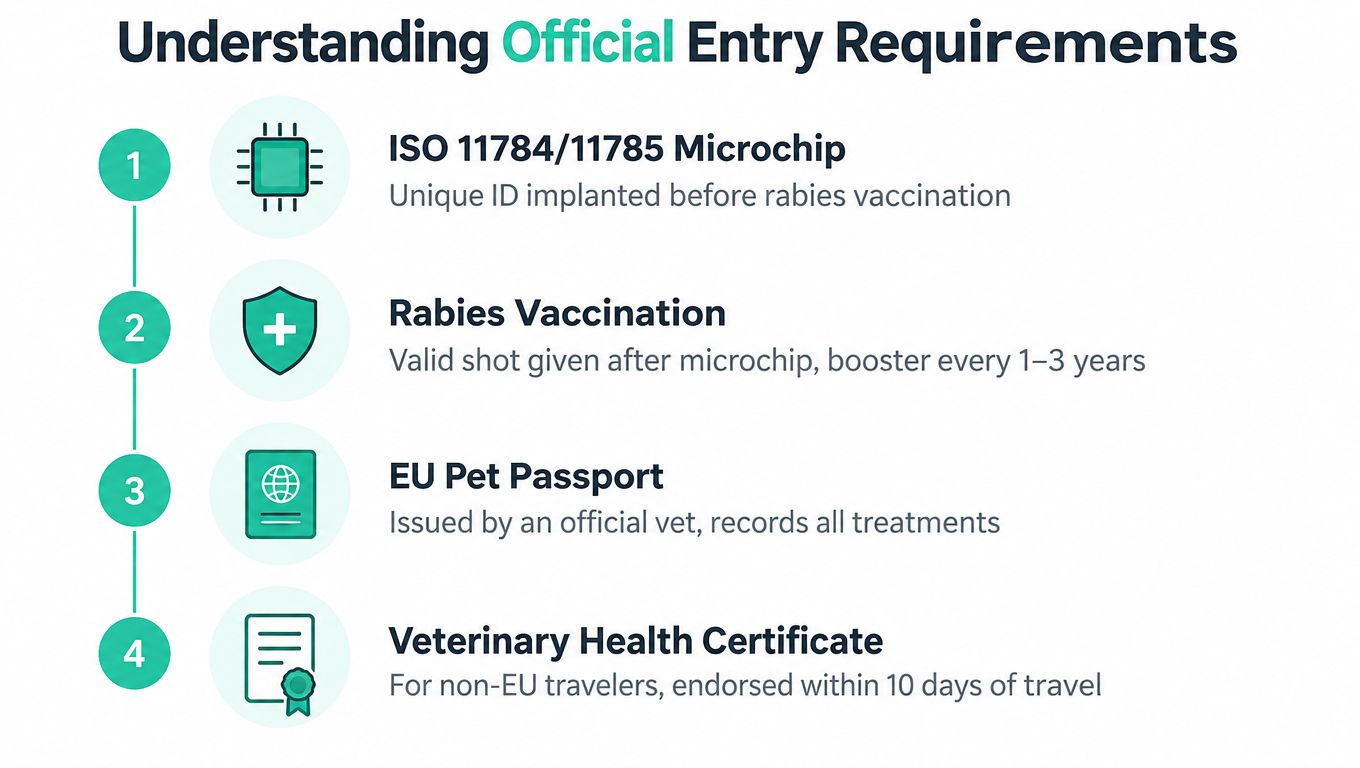
For dogs, cats, and ferrets, the core preparation starts with identification and rabies protection. Italy requires a microchip and a rabies vaccination, and the rabies shot must be given at least 21 days before travel. The sequence matters in practice, so ask your veterinarian to verify that the identification record and vaccination record clearly belong to the same animal.
The basic documents
Your document pack should be built around:
Microchip record, with the number matching every form.
Rabies vaccination record, showing the date and validity.
Pet passport or applicable health certificate, depending on the origin and route.
Owner or authorized-person declaration, where the movement is non-commercial and someone other than the owner carries the pet.
The five-pet limit applies to non-commercial movement, so don't assume that a larger group automatically fits the same route. If animals are being transferred, sold, transported for a business purpose, or moved through a relocation arrangement, the classification may differ and the documents may change. Ask the competent authority or your veterinarian to assess the exact circumstances rather than relying on a generic checklist. A broader guide to pet travel in Europe can help you frame the questions before that appointment.
Italy also restricts entry for dogs, cats, and ferrets younger than 12 weeks if they haven't been vaccinated against rabies. Age and vaccine timing therefore belong at the start of the itinerary, not as an afterthought. A compliant adult pet and a young puppy may need very different departure dates even when they're traveling together.
The practical lesson is simple. Entry eligibility is a timeline, not a single document. The microchip, vaccination, waiting period, origin country, number of animals, and person accompanying the pet must all fit the same movement.
Navigating Health Documentation and Timelines
Health paperwork causes trouble when owners treat it as a final form to collect just before departure. Your veterinarian needs a clear travel brief early enough to check the pet's identity, vaccination history, origin country, route, and movement type.
For an EU-compliant route, begin by confirming the microchip and rabies record. If the pet is coming from a country subject to a rabies titration requirement, official Italian guidance sets the minimum acceptable antibody result at 0.50 IU/ml, and an official veterinarian must issue the certificate. The blood draw should happen no sooner than 30 days after vaccination, according to the timing guidance summarized in the official material and supporting veterinary guidance.
Build the calendar backward
Use the departure date as the fixed point, then work backward:
First, review the microchip. Make sure the number scans correctly and appears consistently in the veterinary record.
Next, verify rabies status. Check the vaccination date, validity, and whether the primary vaccination has completed the required waiting period.
Then, assess the origin country. A pet from a rabies-risk country may need titration, an approved laboratory result, and extra lead time.
Finally, schedule the certificate appointment. The certificate format and endorsement path depend on where the pet starts and who is issuing the document.
The titration step is where rushed itineraries often fail. A blood sample taken too soon won't solve the problem, and a booster may only avoid delay when the previous vaccination was still valid. Keep the laboratory result, vaccination record, microchip details, and travel itinerary together, with matching names and numbers throughout.
Italy doesn't consider immunity established for a vaccinated animal between 12 and 16 weeks when the primary vaccination hasn't been followed by the required 21-day period. That makes a young pet's age, vaccination date, and departure date inseparable planning details.
Ask the veterinarian the right questions
Bring a written itinerary rather than saying only “we're going to Italy.” Include transit countries, flight numbers if known, the person accompanying the pet, and whether the trip involves relocation or another commercial element. A veterinarian using an international certificate workflow can also compare the required forms with the actual route. For background on that process, see this guide to the veterinary international health certificate.
If the pet is entering from outside the EU, Italian consular guidance says a European Community veterinary certificate is mandatory for each pet. For pets from Australia, an official certificate from a certified veterinarian in the country of origin must be issued no more than 30 days before departure, as explained by the Italian Consulate in Sydney's pet guidance.
Keep paper copies and secure digital copies. A tidy file won't replace an incorrect document, but it makes corrections faster and keeps the airport morning from becoming a full-blown paperwork safari.
Planning Your Journey and Accommodations
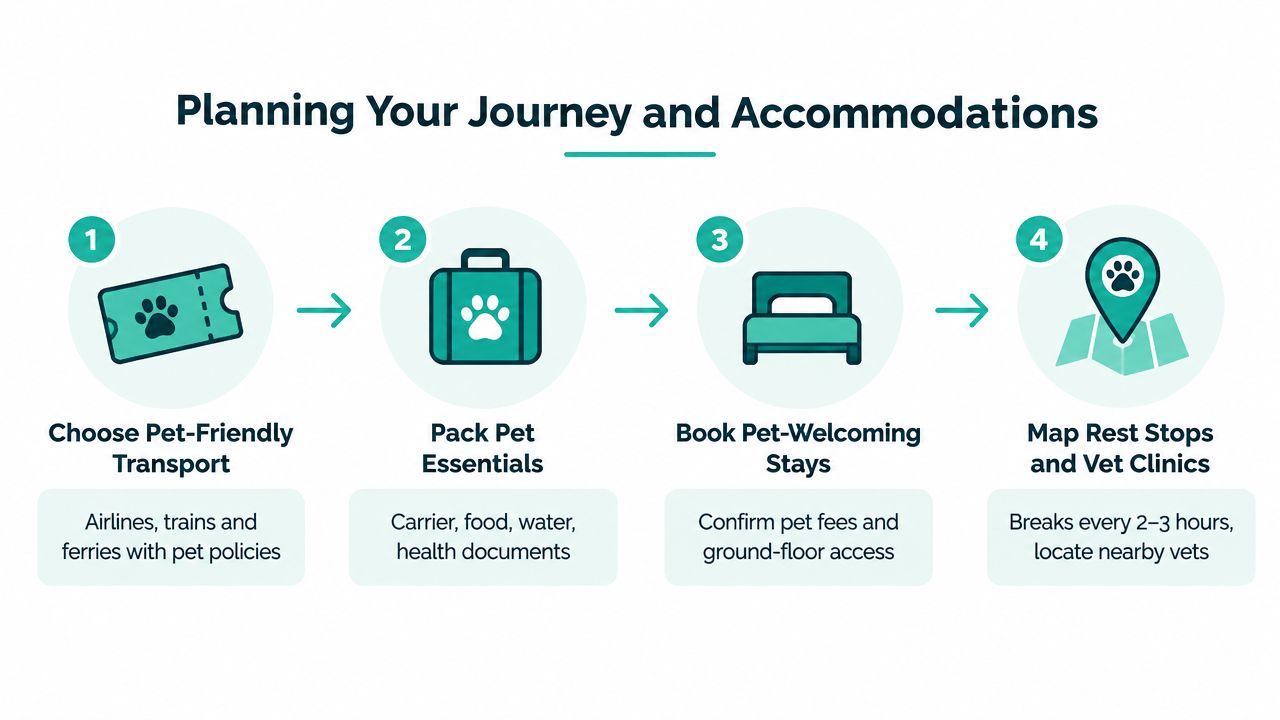
A pet can be eligible to enter Italy and still be unable to board your chosen flight. Airlines set their own rules for cabin space, carrier dimensions, species, breeds, seasonal conditions, and hold transport. Check the operating carrier, not just the company that sold the ticket.
Italy's aviation authority, ENAC, says the cabin weight limit for pets was raised from 8 kg to 10 kg in 2024, and that demonstration flights were underway in 2025 for medium and large dogs up to 25 kg in the cabin under controlled conditions. Those developments don't create a universal right to cabin travel. They show why you must check the carrier, route, aircraft, and booking conditions for your specific journey. Review the ENAC pet travel guidance before treating a national change as an airline guarantee.
Compare transport choices honestly
Option | What can work | What needs checking |
|---|---|---|
Cabin flight | Suitable for pets within the airline's carrier and weight limits | Cabin availability, carrier dimensions, route restrictions, and breed rules |
Hold transport | May suit some larger pets when the airline accepts it | Breed exclusions, aircraft conditions, kennel requirements, and booking limits |
Train travel | Useful for onward travel after arrival, especially on a slower itinerary | Operator rules, ticket requirements, muzzle expectations, and carriage access |
Car or private transfer | Gives you more control over breaks and noise | Heat, rest stops, secure restraint, and access to veterinary care |
ITA Airways says that from December 1, 2025, only cats and dogs may travel as pets on its flights. It also lists a maximum in-cabin weight of 12 kg on domestic flights and 8 kg on other flights, carrier included. The same airline information says it may carry up to two pets of the same species, provided the combined weight and size limits are met. ITA Airways also suspended hold transport for brachycephalic breeds from October 26, 2025. Treat these as carrier-specific conditions, not as a substitute for checking your own booking.
Book the stay, not just the room
Ask accommodation providers whether “pet-friendly” means one small dog, any size of dog, cats, multiple animals, or just animals allowed in a carrier. Confirm fees, lift access, outdoor space, flooring, quiet rooms, and whether pets may stay alone. A ground-floor room near an exit can be worth more than a glamorous view after an overnight journey.
For help comparing practical lodging factors, this guide to animal friendly accommodations from Approved Experiences Traveler offers a useful starting point. You can also use a focused resource on dog-friendly lodging to shape questions for hotels and holiday rentals.
Within Italy, plan realistic days. Trains, ferries, city transport, crowds, heat, and cobbled streets can tire a pet quickly. Carry water, food, familiar bedding, the document pack, and a secure carrier or leash setup. The best itinerary leaves room for a slow morning and an unscheduled sniff, which is often your pet's favorite attraction.
Avoiding Common Travel Pitfalls
The most dangerous assumption is that an airline booking confirms pet travel. It doesn't. Your ticket may be confirmed while the pet reservation remains unavailable, or the airline may apply a breed, size, aircraft, or route restriction that wasn't visible during the initial purchase.
Check the operating carrier directly and ask for written confirmation of the pet booking. Send the pet's species, breed, weight including the carrier, dimensions, and travel method. If the answer changes after a codeshare or aircraft change, recheck immediately.
Timing errors are usually sequence errors
A rabies vaccination given at the wrong point in the identification record can create avoidable questions. A titration blood draw taken too early can push the entire departure date. A young animal may appear vaccinated but still fall inside the period when legal immunity hasn't been established.
Keep a one-page timeline with:
Identification date: When the microchip was implanted and scanned.
Vaccination date: Which vaccine was used and when it remains valid.
Titration date: If the origin country requires testing, record the blood draw and result.
Certificate appointment: Allow time for the veterinarian to complete the correct form.
Departure and arrival: Include every country and transport change.
Commercial and non-commercial movement also deserves careful attention. An owner traveling with a pet for a private trip isn't automatically following the same path as a business transporting an animal, and an authorized person carrying the pet may need a written owner declaration. A relocation agent or family member can change the practical document workflow even when the animal itself hasn't changed. If the purpose, ownership, or carrier role is unclear, ask for a destination-specific review. A resource on common documentation gaps can help identify questions before the veterinary appointment.
Border-ready means consistent: The pet's microchip, vaccination record, certificate, itinerary, and accompanying person should tell one clear story.
Finally, don't rely on an old airline email or a guide saved months ago. Italy's official guidance and U.S. export guidance were updated in late September 2026, and USDA indicates that new non-commercial health certificates for U.S. travelers become effective October 1, 2026. Verify the applicable version close to departure, while leaving enough time to correct anything that doesn't match.
Essential Tips for a Smooth Trip
A calm Italian journey usually starts with a boring document folder. Put the microchip record, rabies details, titration result if required, certificates, declarations, airline confirmation, accommodation emails, and emergency contacts in one place. Keep a printed copy with you and store a digital backup that you can open without an internet connection.
Before leaving home, scan the microchip if your veterinarian recommends it and compare the number with every document. Measure the carrier, weigh the pet with it included when the airline uses a combined limit, and let your pet rest inside the carrier before travel. Familiar bedding and a measured food routine are more useful than a suitcase full of new gadgets.
On the road, protect the basics:
Keep the routine recognizable: Feed and walk at familiar times where possible.
Carry a backup leash and bowl: Small failures are easier to solve before they become travel dramas.
Plan veterinary access: Save clinics near your arrival city and each longer stay.
Check local transport before boarding: Rules can differ between operators and cities.
Watch the pet, not just the schedule: Stress, heat, nausea, and fatigue deserve a slower plan.
A good pet travel Italy itinerary has flexibility built into it. If a flight change affects the pet booking, pause and confirm before heading to the airport. If a train station is crowded, choose a quieter connection when possible. Your pet doesn't need to see every landmark. They need a safe route, familiar care, and a human who has left enough margin for real life.
For owners and veterinary teams managing several dates, documents, and route decisions, Passpaw can generate a trip-based checklist, support document collection and validation, and help organize tasks around the pet's travel details. Visit Passpaw to turn your Italy plan into a clearer, shareable preparation workflow before the first ticket is booked.

More articles
From regulatory changes to best practices for veterinarians and pet owners, our resources keep you ahead of the curve.