Are you a team member in a veterinary practice?
Are you a pet parent planning a trip with your furry pal?
Choose an International Pet Shipper: Your 2026 Guide
Your flights are being priced, your lease is signed, and then major stress lands on your lap. How do you move your dog or cat across borders without getting tripped up by paperwork, airline rules, or a crate problem at check-in?
That's the moment many individuals start looking for an international pet shipper. They're not just buying transport. They're hiring someone to manage a chain of details that can unravel fast if even one date, form, or routing choice is off.
A good shipper brings order to a process that feels anything but tidy. A weak one adds noise, generic promises, and last-minute surprises. The difference matters because pet travel rules don't sit still, and a route that worked one month can become much harder the next. That's the part many guides leave out. This one won't.
What Is an International Pet Shipper
An international pet shipper is a specialist who coordinates pet relocation from one country to another. Think of them as a project manager for your pet's trip. They don't just book a flight. They line up the veterinary timeline, crate standards, airline acceptance rules, import paperwork, and arrival handling so your pet can travel with fewer nasty surprises.
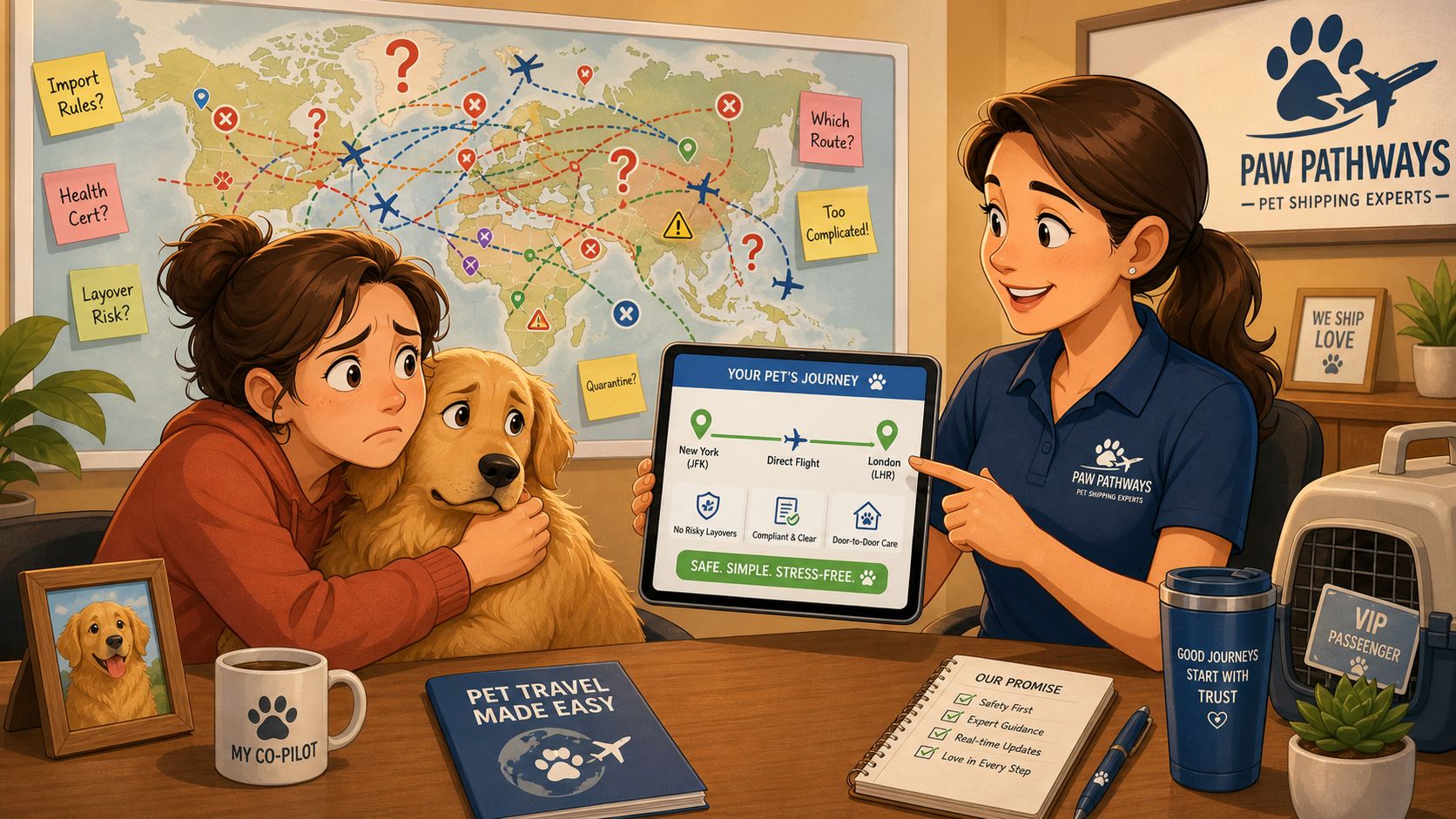
That specialization exists for a reason. The market for these services was valued at USD 2.8 billion in 2025 and is projected to grow at a CAGR of 8.6% through 2034, driven by pet adoption, pet humanization, and more international travel after the pandemic, according to Data Insights Market's international pet shipping services report. More families are choosing to move pets with them instead of rehoming them. That's good news for pet families, but it also means more people are entering a process that has very little wiggle room.
What the shipper actually manages
At a practical level, a shipper usually handles a mix of:
Route planning: Choosing an airline and itinerary that fits the pet, season, and destination rules.
Paperwork coordination: Tracking the documents needed before departure and at arrival.
Crate compliance: Making sure the travel kennel meets airline and IATA standards.
Timing control: Lining up vet visits, endorsements, flight acceptance windows, and handoff points.
Arrival logistics: Coordinating customs, cargo release, or onward ground transport.
Some owners can do this themselves. Some shouldn't. If you're dealing with a simple route, lots of lead time, and a cooperative airline, DIY may be realistic. If you're handling connecting flights, strict import rules, changing destination requirements, or a nervous pet, professional help usually earns its keep.
Practical rule: An international pet shipper should be able to explain your trip in a timeline, not just a sales pitch.
The best ones also explain what they won't control. They can't overrule border officers, and they can't turn an outdated health document into a valid one by wagging a magic tail. What they can do is reduce avoidable risk by getting the sequence right.
If you want a plain-language overview of service types before comparing providers, this guide to an animal transportation service is a useful starting point.
Key Services Provided by Pet Shippers
When owners hear “pet shipping,” they often picture only the flight. In reality, the flight is just one slice of the pie. A capable shipper builds the whole travel chain around it.

Core services most pet shippers offer
Here's what a full-service international pet shipper commonly provides:
Initial consultation and route review
The shipper examines your origin, destination, species, breed, travel window, and whether your pet will travel accompanied or unaccompanied.Airline booking strategy
Not every airline handles pets the same way. A good shipper matches your pet to an airline and route that fits the destination rules and the pet's needs.Veterinary coordination
The shipper usually tells you what your vet needs to prepare and when. That can include health documents, vaccination timing, testing, and final exams.Document support
This is often the most valuable part. A shipper helps you assemble the right certificates, declarations, labels, and shipment records in the right order.Crate sourcing or crate checks
Some clients already own a kennel. Others need one supplied. Either way, the shipper should confirm it meets airline standards before travel day.Pickup and delivery options
Service may be door-to-door, airport-to-airport, or a hybrid setup where the owner handles one leg and the shipper handles the rest.Customs and arrival handling
On many routes, someone must receive the pet, submit the paperwork, and release the animal from cargo handling.
What the paperwork side often includes
The paper trail is where many trips either glide or grind. IATA requires a Shipper's Certification for Live Animals in English, signed in duplicate, at least one compliant Live Animals label on the container, and an Air Waybill with a 24-hour emergency contact number in the Handling Information section, as outlined in IATA's questions and answers for shipping live animals by air.
That sounds bureaucratic because it is. But these details matter. If your pet is delayed in transit or held at cargo, the emergency contact and shipment labeling aren't decoration. They help airport staff act fast.
Service tiers aren't all the same
A quote that looks cheaper may cover less. Ask which of these you are buying:
Service level | What it usually means |
|---|---|
Airport-to-airport | The shipper books and documents the air movement, but you handle pickup and drop-off |
Door-to-airport | The shipper collects the pet and gets it to departure cargo, but arrival is on you |
Airport-to-door | You handle departure, while the shipper manages arrival clearance and delivery |
Door-to-door | One team coordinates the full trip from home pickup to final handoff |
A side-by-side look at pet transport services can help if you're comparing those models. The key is to get the scope in writing. If a quote doesn't spell out who handles each handoff, the tail can end up wagging the owner.
Understanding Pet Travel Rules and Timelines
Most failed pet moves don't collapse because of bad intentions. They collapse because someone assumed the rules were static, simple, or forgiving. They aren't.
A legally acceptable travel file usually depends on sequence. Identification, vaccines, lab work, vet exams, endorsements, and flight timing often have to happen in a specific order. If the order breaks, the whole plan can wobble.
Timing is the real challenge
One of the biggest traps is underestimating how early the process must begin. Many countries require a rabies antibody titer test (RNATT) followed by a mandatory 180-day waiting period after the blood draw before the pet can enter, which means some trips need at least six months of planning, according to Pet Adventures' overview of pet shipping.
That single requirement changes everything. It affects when the rabies vaccine is given, when the blood sample is taken, and whether the intended travel date is even realistic. Owners often discover this too late, especially when they've already booked their own move.
The documents that tend to trip people up
The health certificate is a classic pain point. The broad industry baseline is a veterinarian-validated health certificate issued within two weeks of travel, a requirement described in the pet shipping overview on Wikipedia. On certain routes, the exact certificate type also changes depending on whether the pet is traveling with the owner or unaccompanied.
That's why “my vet can fill out a form” isn't enough of a plan. The right form matters. The issue date matters. Whether the pet is accompanied matters. The destination may care about entry date rather than departure date, and a connecting itinerary can tighten the margin further.
Start with the destination country's import logic, then work backward to the vet appointment. Not the other way around.
Why owners need a working timeline, not a checklist
A checklist is helpful, but it's not the same as a schedule. A checklist says what exists. A timeline shows when each item becomes valid, expires, or must be endorsed.
Use this as your planning mindset:
Confirm the import path
Is the pet entering as accompanied, unaccompanied, commercial, or non-commercial? That choice changes paperwork.Map the medical sequence
Microchip, vaccine history, any required blood test, and final health exam need to fit the destination rules.Protect the final week
Leave room for corrections. Last-minute document edits are common, especially on complex routes.Match booking to validity windows
Don't book a route first and hope the paperwork catches up.
If you're trying to understand what usually belongs in that travel file, this overview of international pet travel requirements gives a solid baseline. The missing piece is almost always timing. That's what turns a document set into a travel-ready document set.
How to Choose the Right Pet Shipper
Plenty of companies say the right things. Fewer can prove they've handled your route, your type of shipment, and your timing pressures. That's where owners need to stop being polite and start being specific.
One fact stands out here. Only 12% of industry guides explicitly tell owners to ask how many transports a shipper completed on their specific route in the past 12 months, even though that's a critical reliability indicator, according to Pet Cargo's guide on choosing a pet transport company. Generic experience is helpful. Route-specific experience is better.
Ask about your route, not just their company
A shipper may be excellent on one corridor and shaky on another. Customs habits, airline handling, transfer airports, and destination release procedures can vary a lot.
Ask direct questions like these:
How many pets have you moved on this exact route in the past 12 months?
Which airline programs do you typically use for this trip?
Where do delays usually happen on this route?
Who handles the pet at destination, your team or a partner?
What is your backup plan if the first flight falls through?
If they answer with broad reassurance instead of specifics, keep shopping.
Verify claims instead of trusting logos
IPATA membership can be a good signal, but it isn't a substitute for judgment. It also shouldn't be accepted at face value. Ask the company to share the exact business name and office handling your trip, then verify that against IPATA's public directory yourself.
You should also look at how they communicate. Strong shippers tend to send timelines, document lists, and responsibility breakdowns in writing. Weak ones rely on scattered messages and “don't worry, we do this all the time.”
A reliable shipper makes the process feel organized before you pay, not after.
If you're also weighing cabin travel or personal carrier choices for smaller dogs, Nandog has a practical flying with your dog guide that complements the shipper questions below.
Essential Questions to Ask a Potential Pet Shipper
Category | Question to Ask |
|---|---|
Route experience | How many pets have you transported on my exact route in the past 12 months? |
Membership claims | Are you an IPATA member, and which exact office should I verify in the directory? |
Flight planning | Which airlines and transit airports are you proposing, and why? |
Documentation | What documents do you prepare, what do I prepare, and what does my vet prepare? |
Communication | Who updates me on departure, transfer, arrival, and any disruption? |
Crates | Will you provide the crate, or inspect mine before booking is finalized? |
Arrival | Who clears my pet at destination, and what happens if customs asks for a correction? |
Contingencies | What is the backup plan for weather holds, aircraft changes, or missed connections? |
Costs | What is included in the quote, and which third-party charges are not included? |
The best shipper for you may not be the cheapest or the biggest. It's the one that can answer clearly, document its process, and stay steady when the trip gets hairy.
Crate Requirements and Ensuring Pet Safety
Crates aren't an accessory. They're a safety system. If the crate is wrong, the trip can stop before it starts.
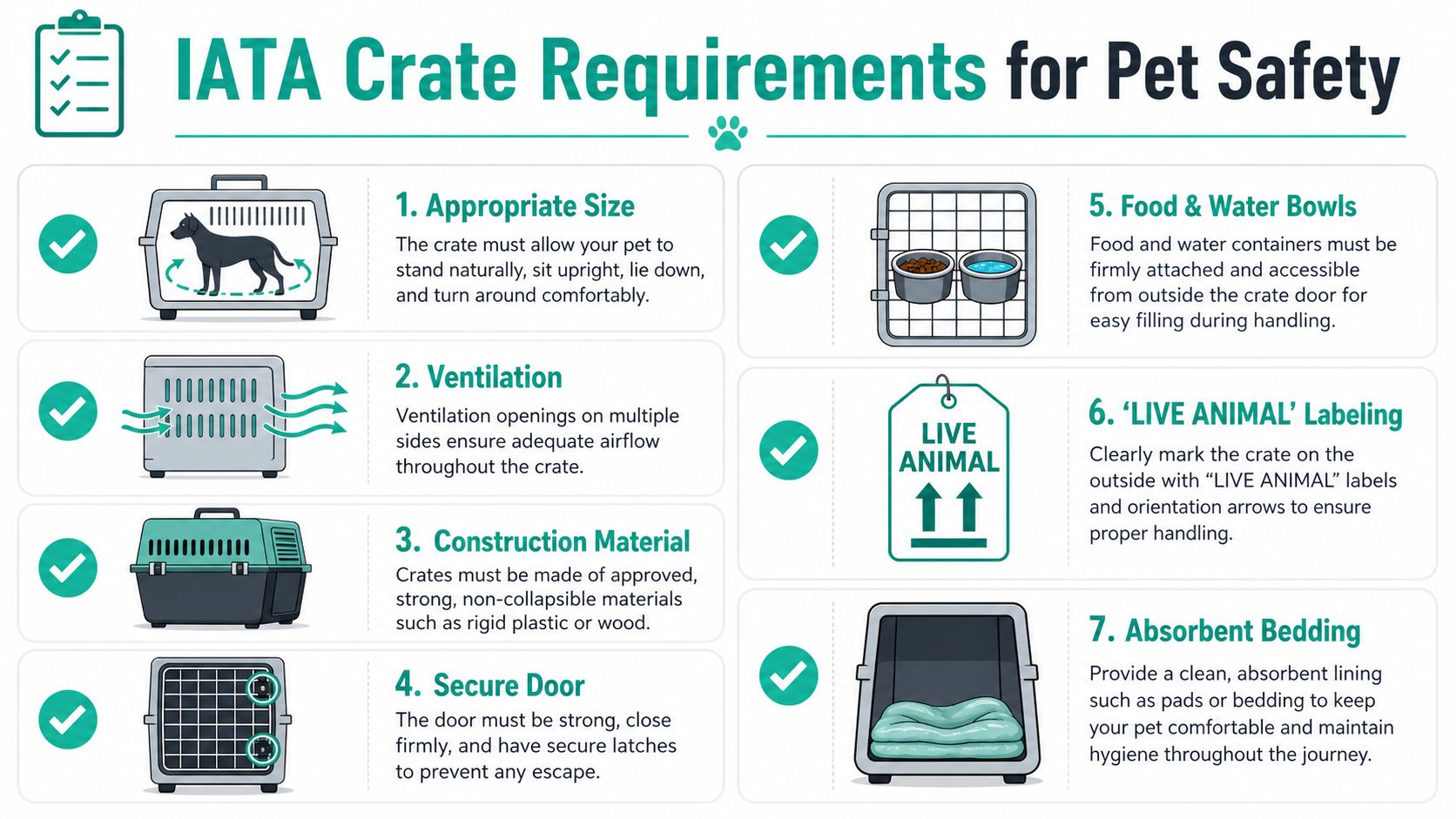
IATA crate rules are more detailed than many owners expect. The pet must be able to stand naturally with head clearance and without elbows feeling jammed, and the crate must have 50% ventilation on at least three sides with wire mesh no larger than 10mm diameter to prevent paw entrapment. Non-compliant crates can lead to immediate cargo rejection or forced quarantine, and they can trigger an average $1,200 to $2,500 in re-handling cost per incident, according to IATA's pet container requirements document.
What a compliant crate needs to do
At a minimum, the crate should do these jobs well:
Fit the animal properly
Your pet should be able to stand, turn, and lie down without being folded up like laundry.Allow good airflow
Ventilation is a mandatory safety requirement, especially during airport handling and warm-weather movements.Stay secure under stress
Door hardware, fasteners, and the body of the kennel need to hold up if the pet paws, leans, or startles.Support care in transit
Food and water arrangements need to work for the airline and the handling team.
Sedation usually causes more problems than it solves
Owners often ask whether they should sedate an anxious pet. In most air transport cases, the answer is no. IATA explicitly endorses recommendations not to sedate or tranquilize pets during transit because of risks including panic attacks and destructive behavior. If sedation is medically necessary, it must be done under veterinary direction and the drug name, time, and dosage must be recorded on the health certificate, as explained on IATA's pet transport guidance page.
That's a serious point. Sedation isn't a calming shortcut. It can create handling and acceptance issues if it's done casually.
Don't aim for a sleepy pet. Aim for a prepared pet.
What helps before travel day
Crate acclimation works better than last-minute fixes. Let the pet eat near the crate, rest in it, and spend short periods inside well before the trip. Familiar bedding and calm repetition do more than a rushed “test run” the night before departure.
If you're evaluating kennel types and sizing, this guide to a pet crate for travel is worth a look. The safest crate is the one that's both compliant and familiar to the animal using it.
Streamlining Pet Travel for Vets and Agents
Veterinarians and travel agents often get pulled into pet travel long before a shipper is chosen. The owner asks the clinic what paperwork is needed. The travel advisor gets asked whether a route is pet-friendly. Both are trying to help, but both can get burned by stale information.
That risk is growing. Seventy-eight percent of pet travel guides mention checking import rules, but none explain how to monitor country-specific changes that can happen within days of booking. Recent data from IATA shows that 23% of live animal shipments in 2024 to 2025 were delayed or denied because documentation requirements had been updated and static guides hadn't caught up, according to Transcon's essential guide to international pet shipping.
Where professionals get stuck
The pain points are usually the same:
Vets manage moving targets
A certificate may be correct in principle but wrong for the date, route, or shipment type.Agents don't control the medical side
They may book the owner's travel while waiting on pet documents that could change the whole timing plan.Clients expect certainty too early
Professionals are often asked for yes-or-no answers before all route details are known.
What smoother workflows look like
The most effective teams don't rely on memory, inbox threads, or static PDFs. They use systems that keep destination requirements current, flag date-sensitive tasks, and show everyone what still needs attention.
For vets, that means fewer rushed certificate rewrites and fewer awkward calls after a border issue. For travel agents, it means setting realistic timelines before the owner commits to a route that may not fit the pet's compliance window.
Static checklists age fast. Live workflows age much better.
That's the shift worth making. Pet travel support becomes far more practical when the clinic, owner, and travel coordinator are all working from the same current record instead of three different versions of the truth.
Common Pet Shipping Questions Answered
How much does international pet shipping cost
It depends on the route, the size of the pet, the crate, whether the trip is accompanied or unaccompanied, and how much service you're outsourcing. Costs also change based on customs handling, ground transport, airline choice, and whether documents need government endorsement or correction.
The most useful way to compare quotes is to ask what isn't included. A lower quote can leave out crate supply, destination handling, customs release, or document support.
Can my pet be quarantined
Yes, it can happen if paperwork is wrong, timelines are missed, or the destination country requires it under its rules. Quarantine risk is one reason planning needs to start early and why route-specific advice matters.
Some failures happen before departure. Others happen on arrival when officials see a date mismatch, the wrong certificate format, or missing lab evidence.
How early should I start
For some routes, a few weeks may be enough. For others, it can take many months because testing, waiting periods, and endorsement windows have to line up. If there's any chance your destination requires lab work or a long waiting period, start immediately.
Owners rarely regret starting too early. They often regret assuming they had more time.
Can my pet fly in the cabin instead of cargo
Sometimes, yes. That depends on the airline, the route, the pet's size, and the destination country's rules. Cabin travel may work for smaller pets, but it isn't available on every itinerary or every border entry path.
If cabin travel isn't possible, that doesn't mean the trip is unsafe. It means the planning needs to shift to compliant cargo handling and a good crate setup.
Are flat-faced breeds harder to move
Yes, they often are. Brachycephalic breeds can face tighter airline restrictions, especially in warm weather or on longer routes. Owners of these pets should ask shippers very direct questions about airline acceptance, seasonal limitations, and routing choices.
This is not a detail to sort out late. It affects whether the trip is possible at all on some carriers.
Should I book my own flight first and sort my pet later
Usually, no. Your pet's compliance timeline should shape the travel window, not chase it. Booking your own trip first can box you into dates that don't work for vet documents, tests, or airline pet acceptance.
If you must book early, make sure the person handling your pet has reviewed the timeline before you commit.
What's the biggest mistake owners make
Treating the process like ordinary travel. It's not. Pet relocation is part logistics, part veterinary coordination, and part border compliance. When owners rely on old blog posts, verbal assumptions, or rushed appointments, small mistakes can snowball.
A calm, well-documented plan usually beats a heroic last-minute scramble.
If you're a veterinary practice, pet travel agency, or owner trying to keep pet paperwork on track, Passpaw helps simplify international pet health certificate workflows with real-time document validation, task tracking, and clearer communication across the whole travel process.

More articles
From regulatory changes to best practices for veterinarians and pet owners, our resources keep you ahead of the curve.