Are you a team member in a veterinary practice?
Are you a pet parent planning a trip with your furry pal?
IATA Live Animal Regulations for Pets: A Practical Guide
By 2023, the manual had grown to more than 3,412 scientific names and 56 distinct container requirements across approximately 500 pages, according to IATA's history of the Live Animals Regulations. That's the first thing to understand about the IATA Live Animal Regulations. They're not one short rule for a dog crate. They're a large system for moving many kinds of animals by air, and your pet's trip sits inside that system. Once you see it that way, the checks stop feeling random. Size, airflow, labels, papers, routing, and timing each answer a different question, and a different person may check each one.
What the LAR Covers and Why It Matters for Pets
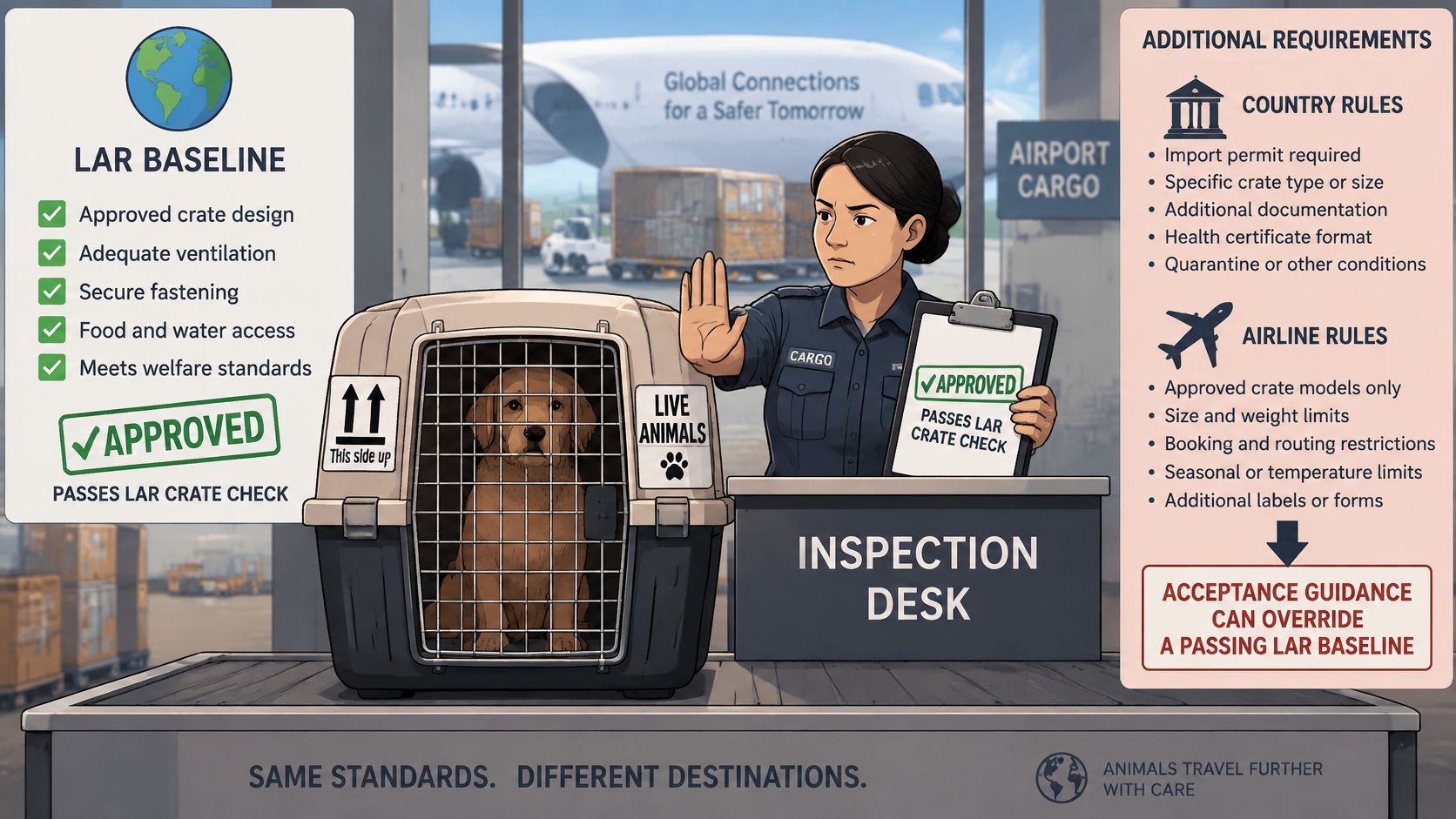
A dog's crate can meet IATA's requirements and still be refused for a particular flight. The Live Animals Regulations, or LAR, provide a shared framework for transporting animals by air, while airlines and destination authorities may add rules that affect whether a pet can travel on a chosen route.
The LAR covers more than crate construction. Its guidance addresses animal classification, labeling, marking, packing, handling, loading, and documentation. Each requirement answers a different question: what the animal needs, how staff should identify and handle it, and what information must accompany the shipment.
One part of a much bigger animal map
The manual includes guidance for many kinds of animals, from dogs and cats to horses, fish, bees, livestock, laboratory animals, and protected species. Their needs differ, so the guidance is organized by animal type rather than treating every shipment alike.
For a dog or cat, that means checking the requirements that apply to that species and shipment. A crate may look suitable at home but still need changes to its labels, documents, or route arrangements before an airline accepts it.
A baseline, not the final word
The LAR is a common starting point, not a guarantee of acceptance. An airline may set conditions for its aircraft or route, and a destination may impose additional entry requirements. A crate that meets the LAR can therefore still fall short of the rules for a specific trip.
If your cat is new to your home, travel preparation is just one part of the transition. This guide can help you help your new cat settle in while you work through the travel checks.
The LAR Areas That Apply to Your Pet
Most confusion starts when people treat the LAR as only a crate-size rule. Size matters a lot, but it's one of seven areas that can affect a dog or cat shipment. Think of them as seven different doors. Your pet needs a clear path through each one, and a yes at one door doesn't automatically open the next.
Keep this list open while you prepare. Tick each area off in order, and don't book anything final until you've at least skimmed the airline and routing area too.
Container size: Sets the minimum internal length, width, and height, based on the largest animal in the crate. This is the tape-measure part of the job.
Ventilation and openings: Controls airflow and checks that gaps are nose- and paw-safe. A crate can be big enough and still have an opening that's too wide.
Food and water: Covers fixed or attached receptacles and feeding arranged before the crate is sealed. The aim is calm, simple care without opening the box in transit.
Labels: Covers the green Live Animals label and where it sits. A label must be easy to see and must not block vents.
Documents: Covers health certificates, permits, CITES papers where relevant, and quarantine arrangements made before shipment.
Responsibility: Names who signs, checks, and submits each item. Many trips wobble at this point because everyone assumes someone else checked.
Routing and acceptance: Covers airline, route, transit, and timing rules. This area can say no even when the first six areas look good.
A crate can pass every size check and still be refused for a route or airline reason. Read the routing rules before you buy tickets, not after.
For a wider view of country rules that sit next to these crate checks, our guide to international pet travel requirements by destination helps you place the LAR areas beside entry rules. Use it as background, then come back to this list with your own pet's details. The list works best when it's tied to one animal, one route, and one departure date, not a vague future move.
How to Measure and Size a Dog or Cat Crate
Measuring your pet sounds easy until your cat decides the tape measure is a toy. Take your time, use a flat floor, and let your pet stand in a normal way. You're not looking for a show pose. You're looking for the space your pet uses to stand, sit, lie down, and turn around.
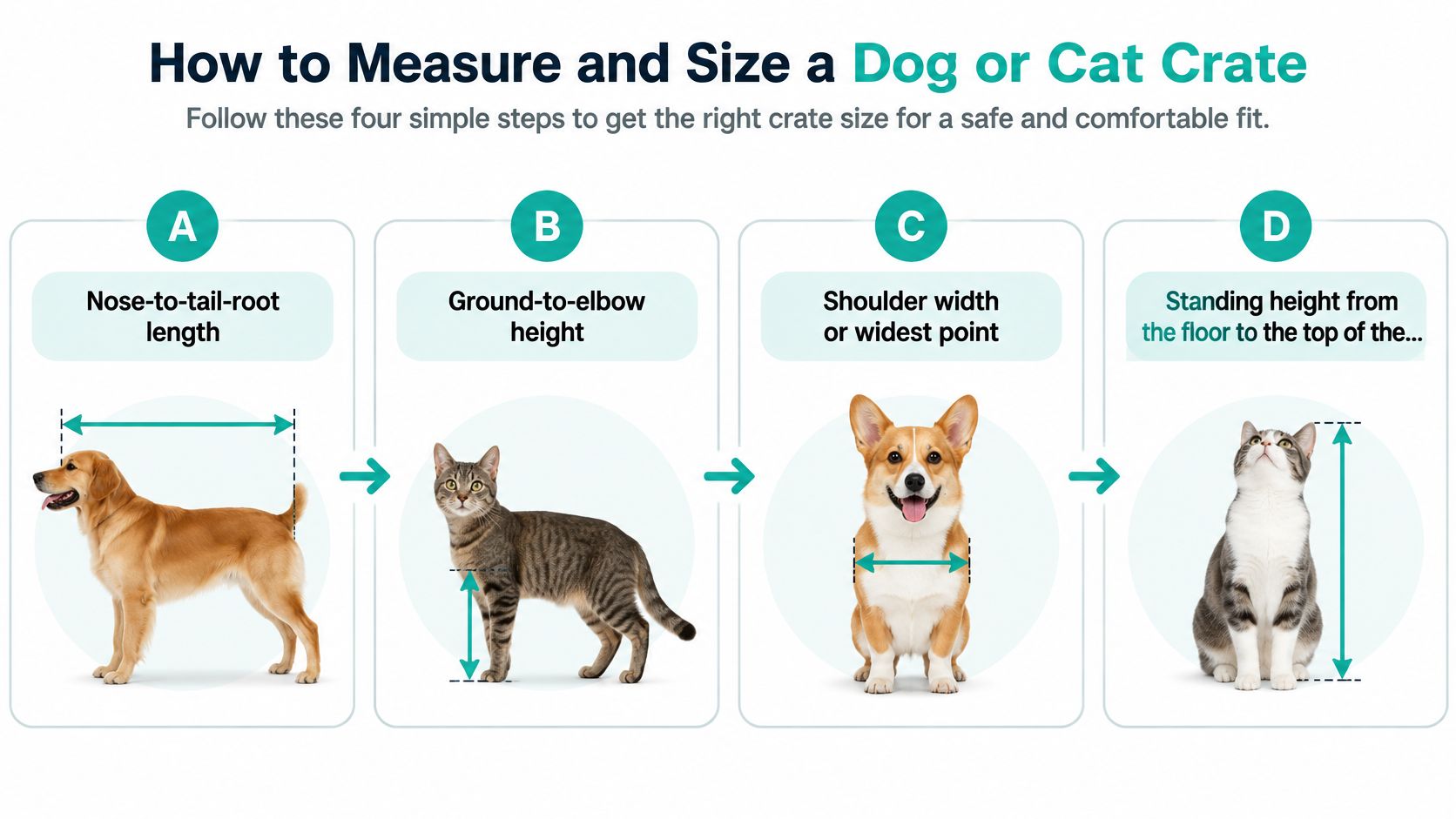
IATA's pet container sizing guidance uses four measurements. A is nose-to-tail-root length, B is ground-to-elbow height, C is shoulder width or the widest point, and D is standing height from the floor to the top of the head or ear tip, whichever is higher. The formulas are length = A + half of B, width = C × 2, and height = D plus bedding thickness.
The five steps in order
Stand your pet on a flat floor: Measure while your pet stands normally, not stretched, curled, or crouching.
Record A, B, C, and D: Write down each number right away, plus the depth of bedding you'll use.
Apply the three formulas: Work out the minimum internal length, width, and height. These are inside sizes, not the outside of the crate.
Add space for snub-nosed breeds: Snub-nosed breeds need a container 10% larger than the calculated minimum.
Compare before you buy: Check your result against the airline's container sheet before you buy or build anything.
Use the largest animal in the container as your base. If two animals share where sharing is allowed, the smaller one doesn't set the size. The bigger animal needs room to move without squeezing the other, so its numbers lead.
A worked example with a beagle-sized dog
Say your dog measures A 70 cm, B 30 cm, C 20 cm, and D 45 cm, and you'll add 5 cm of bedding. The length is 70 plus half of 30, so 85 cm. The width is 20 times 2, so 40 cm. The height is 45 plus 5, so 50 cm. Your minimum internal size is 85 cm by 40 cm by 50 cm.
Step | What to measure or calculate |
|---|---|
A: nose-to-tail-root length | Measured from the nose to the base of the tail |
B: ground-to-elbow height | Measured from the floor to the elbow |
C: shoulder width | Widest point across the shoulders |
D: standing height | Floor to top of head or ear tip, whichever is higher |
Minimum internal length | A + half of B |
Minimum internal width | C × 2 |
Minimum internal height | D + bedding thickness (5 cm) |
Snub-nosed breeds | Calculated minimum plus 10% |
If that same dog were snub-nosed, the length alone would rise from 85 cm to 93.5 cm. Breeds such as pugs and bulldogs are the obvious examples, and that's not a rounding detail. It's breathing room, in the plainest sense.
Breed size charts can help you sanity-check your result, but they don't replace measuring your own animal. Our comparison of dog crate sizes by breed is a useful cross-check after you've done the math. If you're also reading up on day-to-day care for an active sporting breed, this overview of American Water Spaniel grooming and exercise gives helpful context on the dog behind the measurements.
End with a practical test. Inside the crate, your pet should be able to stand, sit erect, lie naturally, and turn around normally. If your pet has to duck, fold, or shuffle sideways to turn, the numbers and the crate aren't matching yet.
Ventilation, Openings and Food Access
Good airflow isn't a feeling. Under IATA's dog and cat container guidance, it's something you can measure with a ruler, a simple gauge, and a bit of patient counting. That's good news. It means you don't have to guess whether a crate looks airy enough. You can check.
IATA's pet container requirements document states that openings must be nose- and paw-proof, with a maximum size of 25 mm × 25 mm for dogs and 19 mm × 19 mm for cats. It also requires total ventilated area of at least 16% of the surface area of the container's four sides. Smaller openings may be needed where an animal could still get a nose or paw through.
Airflow you can count
Start with the largest opening you can find, not the average one. Measure it across and down. If one gap is too wide, that one gap is the problem, even if every other gap looks fine. Cats get a tighter limit than dogs because a smaller paw or nose can slip into a smaller space. It's a small number with a very practical job.
Then add up the open ventilated area across the four sides and compare it with the total surface area of those sides. You don't need fancy tools for a first check. Measure each side, estimate the open parts realistically, and write the math down. If you're close to the edge, ask the shipper or airline to review it before travel day. Close is where mistakes like to hide.
General IATA guidance says containers should generally be ventilated on three sides, with most ventilation in the upper portion. Species-specific container requirements can override that general rule, so treat it as a starting point. Your goal is steady airflow without weak spots or openings your pet can worry at with teeth, nose, or paws.
Check | Dogs | Cats |
|---|---|---|
Maximum opening size | 25 mm × 25 mm | 19 mm × 19 mm |
Opening safety | Nose- and paw-proof | Nose- and paw-proof |
Minimum ventilated area | 16% of the four sides | 16% of the four sides |
Ventilation placement | Generally three sides, most in the upper portion | Generally three sides, most in the upper portion |
Food and water without opening the crate
For cargo shipments, food and water must be supplied in fixed or attached receptacles. Feeding should be arranged at origin so the sealed container doesn't need to be opened during transport. In plain terms, set up the bowls while you're still at the start of the trip. Don't leave a loose dish rattling around and hope someone fixes it later.
Before the crate is closed, run three quick checks.
Measure the biggest gap: Use a ruler or gauge on the widest opening, including door mesh.
Add up the vents: Note the open area on each side and confirm the total reaches the stated minimum.
Tug the receptacles: Confirm food and water containers are fixed or attached and won't tip with normal handling.
That turns a vague idea, plenty of air, into a short yes-or-no check. Your pet gets airflow and access to water, and handlers get a crate that stays closed and calm. No one has to wing it at the airport. Well, except the plane.
Labels, Documents and a Pre-Shipment Checklist
This is the point where a good crate meets the paperwork trail. Labels tell handlers what they're moving. Documents tell officials who the animal is, where it's going, and whether the needed health and permit steps were done. Both jobs matter, and both are easier to check as yes-or-no items than as one big fuzzy task.

Labels that handlers can actually see
A green Live Animals label is the key label for pet shipments. A red Laboratory Animals label is used for lab animals instead. Place labels where handlers can spot them fast, and make sure they don't cover ventilation openings. A label that blocks airflow solves one problem by creating another, which isn't a trade you want.
Documents and animal records
Group the papers before you seal anything. You'll usually need a veterinary health certificate that matches the destination, any export or import permits that apply, CITES permits where a protected species is involved, and quarantine arrangements made before shipment. Airlines also expect shipping paperwork such as a shipper's certification, a dedicated air waybill, an emergency contact they can reach, and a completed Live Animal Acceptance Checklist.
Check the animal's own records with the same care. Confirm the rabies certificate, vaccination dates, and a readable microchip before any submission. Users must independently verify all pet, owner, and travel information for accuracy before submission, including confirming microchip readability. A chip that doesn't scan on the day can turn neat papers into a last-minute scramble.
For a document-by-document walkthrough, our guide to travel documents for pets helps you keep certificates and permits in order. Use it beside your vet's advice for your destination, not instead of it.
Crate checks before handover
Two physical checks are easy to forget. Wooden containers shipped internationally must meet IPPC standards, and wheels must be removed or immobilized. Confirm both points against the current LAR text before booking, because crate builds vary and airlines may read the details closely.
Tick-off test: If any label, document, record, or crate item is missing or unverified, the crate isn't ready to book yet.
That test sounds strict, but it's kinder than finding a gap at cargo acceptance. Slow down here, tick each box out loud with your vet or shipper, and keep copies where you can reach them. Calm paperwork makes for a calmer travel day.
Who Verifies Each LAR Requirement
Start with a crate that passes inspection. The size math works, the vents add up, the label is clear, and the bowls are fixed. Then the airline says it doesn't accept that species on that route, or the aircraft type can't take the booking as planned. The crate didn't fail. The wider acceptance check did, and that's where roles matter.
IATA's questions and answers for shipping live animals by air states that countries and airlines may impose additional requirements beyond the global baseline. Acceptance also calls for confirmed routing, suitable transit facilities, correct labeling, an emergency contact, a shipper's certification, a dedicated air waybill, and a completed Live Animal Acceptance Checklist. Operator variations can limit which animals an airline accepts, even when permits and certificates are available.
Six parties, six different jobs
No single person sees the whole trip. The owner knows the pet. The vet knows the health certificate. The shipper knows the crate. The airline knows its own aircraft and route limits. Transit staff know their facilities, and destination officials know entry rules. Trouble starts when one party assumes another party checked a shared-looking item.
Party | Main responsibility | Verifies before acceptance |
|---|---|---|
Pet owner | Provides accurate pet and travel information and arranges vaccinations | Microchip readability and vaccination dates |
Veterinarian | Examines the animal, signs and submits the health certificate | Certificate content and match with destination rules |
Shipper | Prepares the container, labels and shipper's certification | Container size, ventilation, openings and labels |
Airline | Accepts the animal under its own operator rules | Species, route, aircraft and cabin or hold category |
Transit station | Handles the animal at transfer points | Suitable facilities and confirmed transit arrangements |
Destination authority | Sets entry conditions, permits and quarantine | Permits, certificates and quarantine status |
The pet owner goes first because every later check depends on accurate starting details. Names, dates, microchip details, vaccination records, and travel dates need to match across documents. If the owner's details are wrong, the vet and shipper may build perfect paperwork on a faulty base.
The veterinarian then checks the animal and the health certificate against destination rules. The veterinarian remains the submitter, signer, and party of record for all health certificates. That role can't be handed to an owner, an airline desk, or a shipping agent. If the certificate and the destination rules don't line up, the vet is the person who needs to spot it.
The shipper owns the physical setup. Container size, ventilation, openings, labels, feeding receptacles, and the shipper's certification sit here. If you prepare the crate yourself, you're wearing the shipper hat for these checks, even if you also happen to be the owner. Naming the hat helps you take the checks seriously.
Where a correct crate can still stop
The airline applies its own operator rules on species, route, aircraft, and cabin or hold category. The transit station checks whether facilities and transfer arrangements suit a live animal. The destination authority checks permits, certificates, and quarantine status at entry. Any one of these parties can stop a shipment that looked fine at the kitchen table.
Give every requirement one named person and one date. Someone checks it, by this day, for this route. That's the whole trick.
Write those names and dates on one shared list. When a detail changes, update the list and tell the person who owns that item. It isn't fancy, but it closes the gap where most mix-ups live. Think of it as passing a baton, not tossing paperwork over a fence and hoping for the best.
What Changed in Recent LAR Updates
IATA's 2025 press release on LAR Verify reported close to 200,000 live-animal shipments worldwide in 2024, an 11% increase compared with 2019. The figure covers commercial air-cargo shipments of domestic animals, laboratory animals, livestock, and other live species.
The LAR is updated periodically, so guidance from an older edition may no longer apply. Requirements also differ by route: a shipment may be subject to destination and transit-country rules, airline variations, import licenses, animal classifications, container specifications, labeling, or temporary restrictions. A crate that meets general LAR guidance may still fail an airline's or destination authority's requirements.
IATA launched LAR Verify in 2025 as a digital portal giving airlines, shippers, and freight forwarders access to destination- and operator-specific requirements drawn from the LAR. Check that the guidance you rely on reflects the current edition, then confirm the requirements for your route with the relevant airline and destination sources.
Destination countries may change entry, health, documentation, quarantine, or import-permit requirements at any time, with or without notice. Record when you last checked each requirement, then check again as travel approaches. That gives you a clear way to spot changes before they affect the shipment.
Airline Rules, Timing and Your Next Steps
A crate can satisfy IATA guidance and still be rejected for a particular flight. Airlines may set their own limits by route, aircraft, and whether the pet travels in the cabin or cargo hold. Check the exact flight with the airline, including every transit point. Our guide to airlines that take dogs in cargo is a starting point, not confirmation that a specific flight has space for your pet.
The calendar matters just as much. Each destination country sets the timing for the pet examination, and the health certificate cannot be submitted to the USDA before that permitted window. An exam too early may fall outside it; an exam too late can leave little time to correct a document. Ask your veterinarian to map the destination's timing against your departure date, then reconfirm the airline booking a few days before travel.
Your next steps in order
Measure and size the crate: Measure your pet, apply the A-to-D formulas, and choose a crate that meets the result.
Check airflow and feeding: Measure openings, calculate ventilation, and confirm that fixed food and water receptacles are present.
Ask the airline directly: Confirm its policy for your pet's species, route, and travel date. Name each transit point.
Map the veterinary window: Ask your veterinarian to schedule the examination and certificate steps around the destination's timing.
Verify identity records: Confirm the microchip is readable and check vaccination records while there is time to correct errors.
Reconfirm the booking: Contact the airline a few days before departure and check that your pet is still confirmed.
Re-check after changes: If the flight, date, or route changes, check the destination requirements again before relying on the old plan.
When requirements differ, the strictest applicable rule may determine whether the trip can proceed. A shorter route is not necessarily the simpler choice if an airline or transit point will not accept the pet. Confirm each leg before settling on an itinerary.
Passpaw helps veterinarians and pet owners manage travel documents and check destination requirements. It maintains a proprietary rules engine and regularly monitors the USDA APHIS Pet Travel website and relevant foreign government sources. Passpaw does not guarantee entry, provide veterinary or legal advice, or submit health certificates to USDA on a veterinarian's behalf. The veterinarian remains responsible for reviewing, signing, and submitting the certificate, and users must independently verify pet, owner, and travel information before submission.
If you are coordinating crate details, certificate dates, and airline confirmations, Passpaw can help you manage travel documents and deadlines with your veterinarian. Confirm the final details with your veterinarian and airline before departure.

More articles
From regulatory changes to best practices for veterinarians and pet owners, our resources keep you ahead of the curve.