Are you a team member in a veterinary practice?
Are you a pet parent planning a trip with your furry pal?
ESA Dog on Flights: 2026 Rules, Paperwork & Tips
You've booked the flight, told the airline about your dog, and started gathering paperwork. Then you discover that an ESA dog on flights may no longer receive special cabin access in the United States. An ESA letter, health certificate, or carrier reservation may address one part of the trip, but none automatically settles every requirement.
Use three separate tracks to assess the journey: cabin access, airline acceptance, and destination compliance. Your dog's support status may matter to one track, while the airline's policy and the destination's entry rules control the others. Passpaw can help organize the records and requirements, but it cannot guarantee boarding or entry.
This practical guide is not legal advice. It helps you sort the three questions clearly, without the guesswork.
Why Flying with an ESA Dog Feels Confusing in 2026
The confusion starts because people use ESA, psychiatric service dog, and pet as if they describe the same travel path. They don't. A dog may provide essential emotional comfort at home and still need to fly under ordinary pet rules. A different dog may perform trained tasks for a psychiatric disability and follow the airline's service-animal process instead.
That distinction became especially important after U.S. airline policies changed. If you're planning a domestic trip, an international itinerary, or a connection through another country, you'll need to check more than your dog's letter. You'll also need to confirm the aircraft's cabin space, the airline's carrier and breed rules, and the destination's entry requirements.
Practical rule: Treat the ESA label as one piece of your travel records, not as a boarding pass.
Dogs of every size should keep reading. A tiny dog that fits comfortably in an approved carrier may have a straightforward cabin-pet route. A large dog, a brachycephalic breed, or a dog traveling on a complicated international itinerary may need a different plan. The safest choice can depend on the route rather than the dog's support status.
Airline pages also change, and policies can differ between carriers, aircraft, and destinations. Reviewing recent changes in pet travel can help you understand why older advice may no longer fit today's booking process.
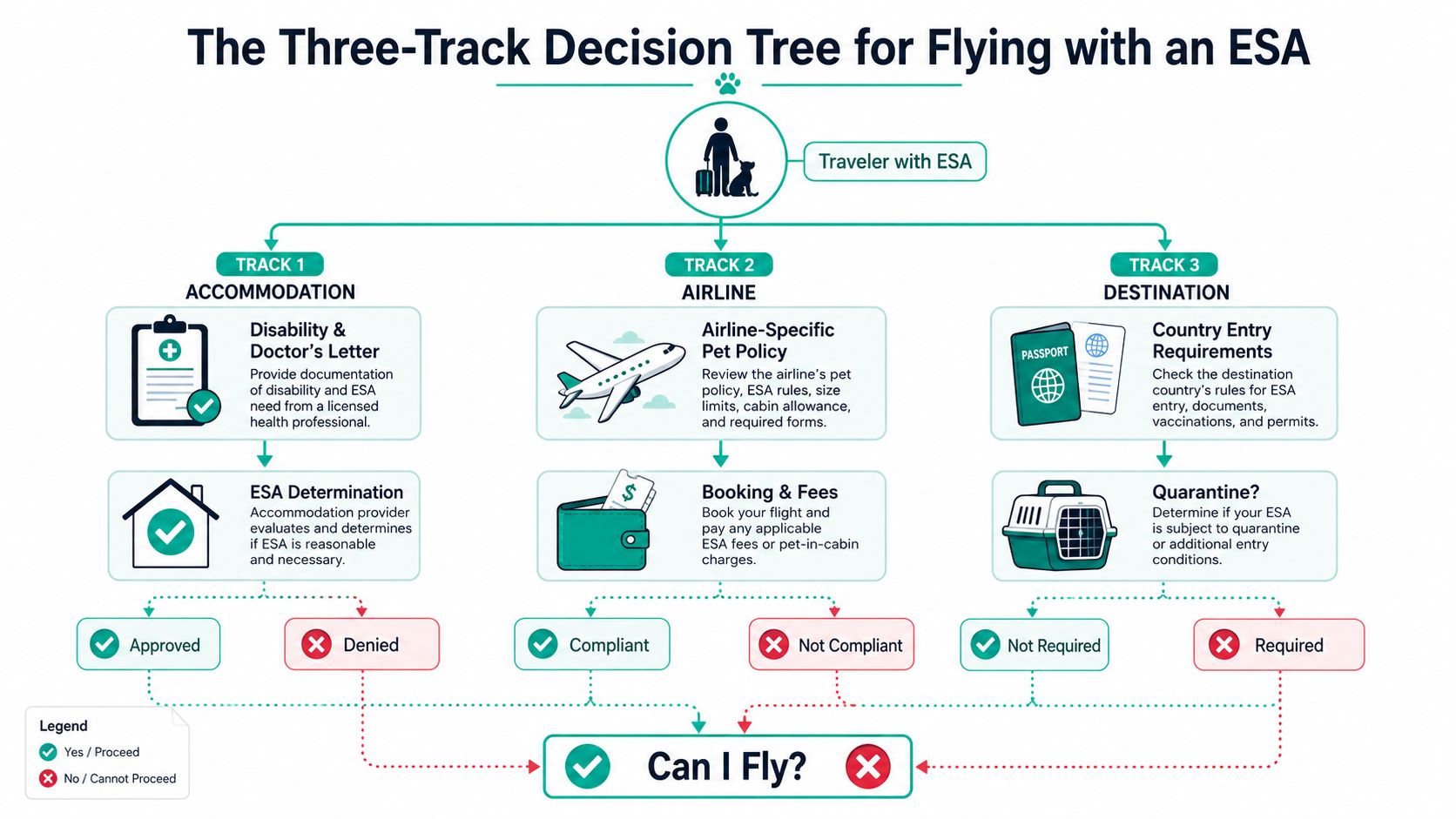
The clearest way to organize the trip is a three-track decision tree. Track one covers disability accommodation. Track two covers airline acceptance. Track three covers destination compliance. Once you separate those paths, the paperwork becomes less of a fur-raising mystery.
What an ESA Actually Is and What It Is Not
An emotional support animal provides comfort, companionship, or emotional support. The animal doesn't need specialized task training for that role. An ESA letter from a licensed mental health professional can document a person's need for the animal in settings where that type of documentation is relevant, but the letter doesn't automatically turn the dog into a service animal for air travel.
A useful comparison is this: an ESA is like a calming companion identified by a licensed professional, while a service dog is like a trained coworker with a specific job. The companion may help by being present. The coworker must reliably perform trained work or tasks connected to a disability.
The U.S. Department of Transportation finalized its service-animal rule in December 2020, and the rule took effect on January 11, 2021. Under that rule, emotional support, comfort, or companionship doesn't count as a trained task for U.S. air travel. Airlines may treat ESAs as pets, while service animals are limited to dogs individually trained to perform disability-related work or tasks. You can review the DOT final service-animal rule.pdf) for the underlying wording.
The psychiatric service dog distinction
A psychiatric service dog may support someone with a psychiatric disability, but the dog's defining feature is task training. Examples might include interrupting a harmful behavior, guiding a handler to an exit, or performing another specific action connected to the person's disability. Comfort from the dog's presence alone doesn't establish that service-dog category.
That's where many travelers get tripped up. An ESA letter, a diagnosis, or a statement that a dog reduces anxiety doesn't replace the need for trained tasks when someone is seeking service-animal treatment on a flight. Airlines can also require DOT health, behavior, and training forms for a trained service dog. For a flight scheduled at 8 hours or more, they may require a relief attestation as well, according to IATA guidance on service dogs.
For an ESA, the practical result is different. The airline may require an under-seat carrier, a pet reservation, standard pet fees, and compliance with size or breed restrictions. An airline's own policy page, such as American Airlines' service-animal information, can show how the carrier separates ESAs from trained service animals.
The Three-Track Decision Tree
Most questions about flying with an ESA mix together three different decisions. Think of them as three suitcases moving through three checkpoints. A complete plan needs all three, even when one track seems easy.
Track one covers accommodation
Start by asking what role the dog performs. If the dog provides emotional comfort without trained disability-related tasks, the U.S. airline process generally points toward pet travel. If the dog is individually trained to perform disability-related work or tasks, the service-dog process may be relevant, along with the airline's required forms.
This track concerns the person's disability-related need and the dog's function. It doesn't decide whether a particular aircraft has room for the dog or whether another country will allow entry.
Track two covers airline acceptance
The airline track is practical and route-specific. Check whether the fare allows pets, whether the aircraft has an under-seat location, what carrier dimensions apply, and whether the airline restricts certain breeds. You'll also need to ask whether the pet reservation must be made by phone and whether cabin-pet capacity is available for that flight.
A dog can qualify for an ESA letter and still fail this track because the carrier won't fit, the fare excludes pets, or the aircraft lacks the required cabin space.
Track three covers destination compliance
Destination rules form a separate checklist. International travel may involve health certificates, rabies records, microchip documentation, vaccinations, import permits, parasite treatments, or other country-specific requirements. A destination can require documents even when the airline accepts the dog.
A letter may explain why your dog supports you. It doesn't replace the airline's pet policy or the destination's import rules.
The final question, “Can I fly?”, comes only after all three tracks are checked. This structure keeps you from asking one document to solve three unrelated problems. Resources such as Passpaw's British Airways pet policy guide can help with the airline track, but you'll still need to confirm the current policy directly with the carrier and destination authorities.

Preparing Bookings, Cabin Logistics, and the Day of Travel
Begin with the ticket, not the letter. Some basic economy fares exclude pets, so check the fare conditions before paying. If you're choosing between flights, compare the aircraft, connection points, pet availability, and total travel time rather than selecting only by price or departure time.
Next, open the airline's current pet policy. Look for carrier dimensions, weight language, booking instructions, fees, breed restrictions, and rules for regional aircraft. Don't assume that approval on one airline transfers to another. The pet carrier guidance for air travel can help you think through fit and setup, but the carrier dimensions published by your airline control the booking.
Measure the dog and test the setup
Your dog generally needs to remain inside the approved carrier during the flight. Measure the dog and compare those measurements with the airline's stated carrier size. A dog that can technically enter a carrier may still be unable to stand, turn, or settle comfortably, which matters for welfare as well as acceptance.
Brachycephalic dogs need extra care. Their short noses can make breathing more difficult, and airlines may apply additional restrictions. Ask your veterinarian about the dog's individual health and the risks of air travel, especially if the route is long, warm, stressful, or involves a connection.
Reserve space and prepare the routine
Cabin pet space is limited on many U.S. carriers, so contact the airline early and confirm that the pet reservation is attached to your booking. Keep the confirmation accessible, along with vaccination records, health documents, and any forms the airline has requested.
Plan feeding, water, medication, and relief well before airport day. Don't give a sedative unless your veterinarian specifically advises it. Service dogs on flights scheduled at 8 hours or more may need the DOT relief attestation mentioned earlier. An ESA traveling as a pet follows the airline's pet process instead.

At the airport, keep paperwork in an easy-to-reach folder rather than buried in checked luggage. Arrive with enough time for an airline agent to inspect the carrier and documents. Give your dog a calm walk before entering the terminal, follow security staff directions, and avoid turning the airport into a surprise obstacle course. A quiet, prepared routine is kinder to both of you.
What Happens When Your Dog Does Not Fit Under the Seat
Consider a medium-sized ESA booked on a regional jet. The owner arrives with an approved-looking carrier, but the aircraft's under-seat space is smaller than expected. The dog can't fit safely, so the ESA label doesn't solve the immediate problem. The airline's cabin and pet rules determine whether the dog can travel on that flight.
Now consider a large ESA traveling with an anxious owner who hoped to avoid cargo. If the dog can't fit within the required cabin carrier, the owner may need to look at another aircraft, another airline, a different travel date, ground transport, or a professional pet shipper. The question has changed from “Is my ESA allowed?” to “Which route is safest and compliant for this dog?”
A snub-nosed dog adds another layer. The airline may restrict the breed in the cabin, place seasonal limits on transport, or apply rules connected to temperature and breathing risk. A dog's emotional-support status won't override those safety conditions.
Below-wing transport needs careful review
Some airlines transport pets in pressurized areas below the passenger cabin, but availability and conditions vary. Weather embargoes can stop transport during periods of unsafe heat or cold. The dog may also face more handling, waiting, noise, and separation than it would in the cabin.
Cargo isn't automatically wrong, but it isn't automatically suitable either. Discuss the dog's age, health, temperament, breed, and itinerary with your veterinarian. Ask the airline exactly where the dog will travel and what happens during connections.
If the under-seat option fails, pause before improvising at the airport. A rushed workaround can create more stress than changing the itinerary.
For complicated routes, a pet shipper or pet travel agency can coordinate carrier selection, veterinary appointments, airline communication, and customs preparation. Families managing a large dog, a restricted breed, multiple connections, or international documents may find professional coordination worth considering. The right plan may be less glamorous than cabin travel, but it should be safe, realistic, and kind to the dog.
Paperwork, Health Certificates, and Where Passpaw Helps
International pet travel often requires more than an airline booking. Your paperwork stack may include an international health certificate, a USDA endorsement when applicable, rabies certificates, microchip records, and destination-specific additions such as titer testing, parasite treatment, or import permits. The exact list depends on the destination and the route, so start with official destination requirements rather than an old social-media checklist.
A USDA endorsement fee may apply when the certificate needs federal endorsement. Errors can force a repeat veterinary visit, delay submission, or require changes to the itinerary. That's why the paperwork plan should begin as soon as you know the destination.
Build the document set in layers
First, confirm the destination requirements and timing windows. Then schedule the veterinary appointment early enough to complete examinations, vaccinations, laboratory work, and endorsements. Ask the veterinarian which records must be original, signed, uploaded, or carried with the dog.
Keep every record together. A useful folder might include:
Identity records: Make sure the microchip information matches the dog and the travel documents.
Vaccination records: Keep rabies information and other required vaccinations together.
Health certificate materials: Confirm the certificate format, issuing veterinarian, signatures, and endorsement process.
Destination add-ons: Track permits, laboratory results, parasite treatments, and other country-specific items.
Airline records: Store the pet reservation, carrier details, and any airline forms separately from destination paperwork.
International health certificate guidance for veterinarians and owners can help frame the veterinary side of the process. Passpaw is one cloud-based workspace that lets veterinary practices and pet owners store travel documents, track destination requirements, validate documents in real time, and prioritize tasks against the travel date. It's a coordination tool, not a legal shield, so travelers still need to verify requirements with the airline, veterinarian, and destination authorities.
The most useful workflow is to verify before spending money. Confirm the route, check the destination's current rules, ask the veterinarian about timing, and use a shared document system if several people are handling the trip. Good organization won't change an airline's decision, but it can reduce missed tasks and prevent avoidable rework.
ESA, Service Dog, Pet Travel, or Pet Shipper
Traveling families have four practical paths. Choosing one deliberately is better than assuming the ESA label determines everything.
Path | Cabin Access | Typical Cost | Best Fit |
|---|---|---|---|
ESA travel | Usually under standard pet rules, if the airline accepts the booking | Airline pet fees and related travel costs | A dog that fits the carrier and a family managing a simple route |
Trained service dog | Cabin travel under the airline's service-animal process, with required forms and behavior standards | Travel-related costs and preparation expenses | A trained service dog traveling with its handler |
Pet travel | Cabin or below-wing options, depending on airline, aircraft, size, breed, and destination | Airline pet fees, carrier, veterinary, and destination costs | Owners who can manage the airline and destination checklists |
Pet shipper or agency | The provider helps arrange the available transport path | Service fees plus travel, veterinary, and destination costs | Large dogs, complex itineraries, or owners with limited time |
For a very small ESA dog on a short domestic route, cabin pet travel may be the simplest option if the fare, aircraft, carrier, and pet space all work. The ESA paperwork may not be used for boarding because the dog is traveling as a pet.
A service-trained dog follows a different path. The dog needs reliable disability-related task training, and the airline may request DOT health, behavior, training, and relief forms. A mental health letter alone doesn't replace the airline's service-animal documentation.
Large dogs often need more planning. If cabin fit is impossible, compare another flight, ground transport, airline cargo options, and a professional shipper. A shipper can coordinate details, but the owner should still ask questions about welfare, handling, timing, and contingency plans.
Common Pitfalls and Quick Answers
Five mistakes cause a large share of travel-day stress:
Assuming an ESA letter overrides airline rules: Treat the dog as a pet unless the dog qualifies as a trained service animal under the airline process.
Booking basic economy without checking pet eligibility: Confirm that the fare permits pets before payment.
Missing the USDA endorsement window: Ask the veterinarian when the certificate must be issued and endorsed for the destination.
Ignoring breed and size restrictions: Check the airline's aircraft-specific carrier and breed rules, especially for brachycephalic dogs.
Forgetting destination paperwork: Review health certificates, rabies records, microchip requirements, permits, and other entry conditions.
Does a psychiatric service dog letter make an ESA eligible for cabin access? Not by itself. The relevant distinction is whether the dog performs trained disability-related tasks and can complete the airline's required service-animal forms.
Do layovers change the rules? They can. Each airline, aircraft, transit country, and final destination may add requirements, so check every part of the route.
Is a microchip alone enough for international entry? Usually not. It may be one required record, but destinations can also require vaccination evidence, health certificates, permits, laboratory work, or treatments.
Preparation is the difference-maker in 2026. Keep the plan tidy, ask direct questions, and don't let one hopeful document wag the whole itinerary.
Passpaw helps veterinary practices and pet owners organize international health certificates, destination requirements, document validation, and travel-date tasks in one workspace. For a clearer planning process before you book or visit your veterinarian, explore Passpaw.

More articles
From regulatory changes to best practices for veterinarians and pet owners, our resources keep you ahead of the curve.