Are you a team member in a veterinary practice?
Are you a pet parent planning a trip with your furry pal?
Dogs in Cyprus: A Complete Guide for Owners for 2026
Cyprus often starts as a lovely idea. Sun most of the year, sea views, outdoor meals, and your dog stretched out under the table looking pleased with life.
Then the practical questions arrive. Can your dog fly in the hold? How early do you need the rabies blood test? What happens after arrival? Why does Cyprus seem stricter than other places?
That last question matters more than most guides admit. With dogs in Cyprus, the rules aren't just paperwork for paperwork's sake. They sit on top of a very specific local reality. The island has a large stray dog population, a long history of disease control, and a registration system that puts identification front and center. If you understand that, the process stops feeling random.
If you're planning a move, a long stay, or regular travel, the good news is that this is manageable. It just rewards early planning and careful timing. If you're still at the broad planning stage, this guide on moving pets overseas is a useful companion before you start booking flights.
Welcome to the Island of Dogs
Most owners I speak with begin in the same place. They've found a rental near the coast, they've checked the weather, and they're already picturing early morning walks before the heat builds. That part is real. Cyprus can be a very enjoyable place to live with a dog.
But dogs in Cyprus are part of a more complicated local picture than many newcomers expect. You'll see family pets, working dogs, rescue dogs, and in some areas, loose-roaming dogs that clearly belong to the island's wider welfare problem. That affects how authorities think about identification, licensing, and travel health checks.
The good part and the real part
The good part is easy to love. Outdoor living suits many dogs well. There are designated places to exercise, dog-friendly routines are possible, and daily life can feel relaxed once everything is in place.
Successful dog ownership in Cyprus depends on doing the admin properly. Microchip details need to line up. Registration isn't a one-step task. Travel documents have to be timed carefully, especially if you're coming from a country that triggers extra rabies testing rules.
Cyprus is very enjoyable with a dog once the groundwork is done. The stress usually comes from late planning, not from the island itself.
Why owners get tripped up
The biggest problems tend to be ordinary ones. A vaccine was given before the microchip was recorded. A blood test was booked too early. An owner assumed airline rules and country-entry rules were the same thing. They aren't.
Cyprus rewards the owners who start early and keep a clean paper trail. If you do that, you're far less likely to end up chasing signatures and scanning documents while your dog looks at you as if to say, "You had one job."
Making It Official Cyprus Dog Registration
Once your dog is living in Cyprus, registration isn't a nice extra. It's part of responsible ownership and part of how the island tracks dogs in a challenging local environment.
Every dog in Cyprus over two months old must be microchipped by a licensed veterinarian and registered in the national pet database. This process involves three stages: a vet visit for the microchip, registration with the State Veterinary Service for a central register certificate, and submission to the local municipality for the annual license, according to the guidance on dog ownership control and rules in Cyprus.
The three-stage process
The easiest way to handle this is in order. Don't skip ahead.
Microchip first
A licensed veterinarian implants the microchip. This is the foundation record for everything that follows.State Veterinary Service registration
The microchip is then entered into the national system so you can obtain the central register certificate.Municipal license
After that, you take the relevant documents to the local municipality for the annual dog license.
If owners struggle here, it's usually because they think the microchip itself completes the process. It doesn't. The chip is the start, not the finish.
What to bring and what to check
Bring every identification and veterinary document you have, even if you think one of them won't be needed. In practice, tidy files save time.
A good checklist includes:
Microchip record: Make sure the number is legible and matches every other document.
Vaccination paperwork: Keep recent veterinary records together with the chip details.
Owner identification: Municipal processes often go faster when personal ID and address records are ready.
Existing travel documents: If your dog has moved internationally, keep those papers on hand.
Practical rule: Check the microchip number character by character on every document. One wrong digit can create a surprisingly stubborn paperwork headache.
Annual license costs and higher-risk categories
The annual license isn't priced the same for every dog. The difference is significant, so owners need to know which category applies.
The property and lifestyle guide from DOM notes that the annual dog license in Cyprus costs €20.50 for standard breeds but jumps to €170 to €171 for dangerous breeds, which also require mandatory sterilization and a "Beware of Dog" sign at the property entrance. The same guide states that owners of undeclared dangerous breeds face a €1,000 fine, while walking a dangerous breed without a leash and muzzle incurs a €2,000 penalty, and the license is typically renewed by the end of January, as outlined in this Cyprus dog ownership article.
Annual Dog License Costs and Requirements in Cyprus 2026
Requirement | Standard Breeds | Dangerous Breeds |
|---|---|---|
Annual license cost | €20.50 | €170 to €171 |
Sterilization requirement | Not stated in the cited guidance | Mandatory |
Sign at property entrance | Not stated in the cited guidance | "Beware of Dog" sign required |
Annual renewal | Required | Required |
Penalty for undeclared status | Not stated in the cited guidance | €1,000 fine |
Walking without leash and muzzle | Not stated in the cited guidance | €2,000 penalty |
What works and what doesn't
What works is booking one vet visit specifically to review chip status, registration status, and licensing documents together. What doesn't work is treating each task as a separate errand with weeks in between. That approach is where details get lost.
If you're moving with a breed that may attract additional scrutiny, ask the question early and get the answer in writing from the relevant local authority or your veterinary clinic. In Cyprus, assumptions are rarely your friend.
Your Dog's Passport to Cyprus Travel and Docs
Travel into Cyprus is where owners most often feel overwhelmed. That's understandable. The sequence matters, and timing mistakes can force you to delay travel plans.
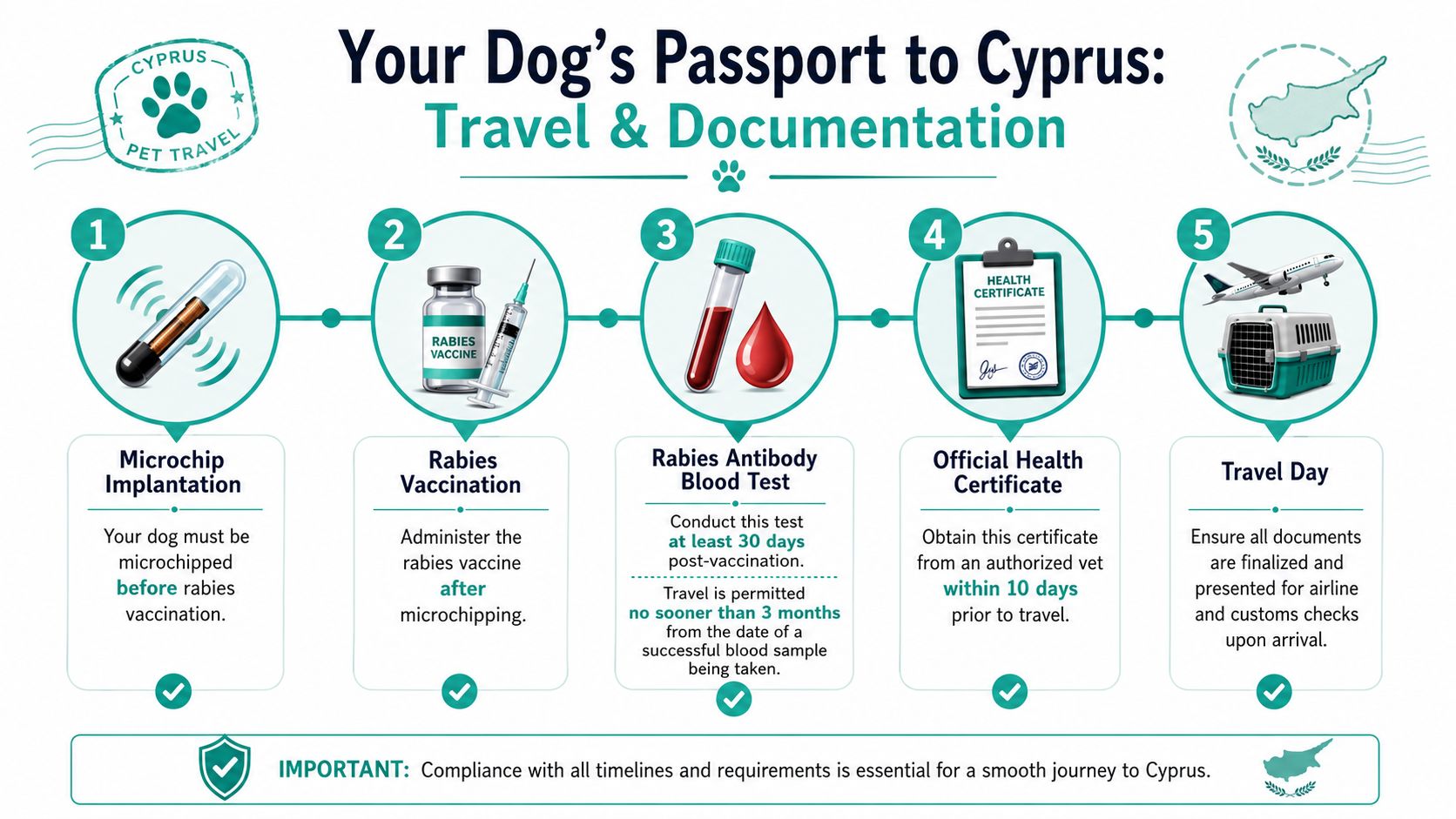
For many routes, the critical issue is the rabies antibody test. For non-commercial entry from many third countries, the mandatory rabies antibody titration (RNAT) test requires a serum titer of at least 0.5 IU/ml, performed in an EU-approved lab no less than 30 days post-vaccination and at least 3 months prior to movement, creating a minimum 4-month pre-travel timeline, as set out in the EU animal movement guidance used for Cyprus entry.
The sequence that has to stay in order
Owners get into trouble when they focus on dates instead of sequence. The right order matters just as much.
Microchip before rabies vaccine: If the dog is vaccinated before the identification record is in place, you may create a documentation problem.
Rabies vaccine before RNAT blood draw: The blood test depends on a valid prior vaccination.
Wait at least 30 days after vaccination before sampling: Testing earlier can make the result unusable for travel purposes.
Wait at least 3 months after the successful sample before movement: Many travel calendars fall apart at this stage.
That's why people talk about a 4-month pre-travel timeline. It isn't padding. It's built into the way the process works.
A practical travel calendar
If your dog is traveling from a country that falls into this route, work backwards from the intended flight date.
Start with the flight month, then reserve space for:
the three-month waiting period after the blood sample,
the blood draw appointment,
the thirty-day gap after rabies vaccination,
and the initial vaccination itself.
Leave yourself breathing room. Labs, clinic scheduling, and document reviews all take real time.
For owners trying to understand the wider paperwork trail, this overview of how to get a pet passport helps put the Cyprus-specific timing into a broader travel context.
The RNAT test isn't hard. The hard part is starting early enough that the result is still useful when your travel date arrives.
Age limits and vaccine standards
A few points deserve special attention. The same Cyprus entry guidance states that entry of dogs under 3 months old is prohibited, and the rabies vaccine must meet the stated technical standards in the official rules. Those details matter because owners sometimes assume a very young puppy can travel with extra paperwork. For Cyprus, that can lead to disappointment very quickly.
Airline rules are separate from entry rules
Country permission and airline permission are two different gates. You have to pass both.
Cyprus Airways states that all snub-nosed dog breeds are prohibited in the aircraft hold for safety, though they may travel in the cabin if they meet PETC requirements of a maximum 8 kg pet weight and 10 kg total with carrier. The airline also states that Cyprus bans importing specific high-risk breeds entirely, while existing dogs of these breeds are regulated with special documentation, and that service dogs are allowed in public spaces but emotional support animals are not automatically recognized for public access, according to its traveling with pets policy.
What actually helps on travel week
Keep one digital folder and one paper folder. Put the microchip record, vaccination record, lab result, health certificate, and airline confirmation in both.
Don't rely on your inbox at the airport. Wi-Fi fails. Attachments go missing. A neat paper file still saves many a dog's day.
Local Veterinary Care and Health Concerns
Once your dog has arrived, the medical conversation changes. You're no longer trying to satisfy border rules. You're trying to build a sensible health plan for life on the island.
That means choosing a licensed local veterinarian and asking questions that go beyond routine boosters. Cyprus has local parasite patterns that may not match what owners are used to elsewhere.
Why parasite planning needs a Cyprus lens
One detail stands out. Dogs in Cyprus have a confirmed autochthonous filarial infection with Acanthocheilonema reconditum at a prevalence of 4.5%, while heartworm, Dirofilaria immitis, seropositivity is 0.5%, indicating Cyprus is an emerging risk zone for non-heartworm filariasis, as reported in this PubMed-indexed study on canine filarial infection in Cyprus.
That matters because some owners hear "filarial infection" and think only of classic heartworm risk. Cyprus doesn't fit neatly into that assumption. A dog can need parasite screening and prevention planning that is more specific than a basic, generic heartworm conversation.
Questions worth asking your vet
Bring a list on the first visit. Good questions include:
Screening: Ask whether your dog needs testing for local filarial infections based on lifestyle and travel history.
Prevention: Ask which preventives cover the parasites your vet is concerned about in Cyprus.
Seasonal routine: Ask whether your dog's outdoor habits change the recommended schedule.
Travel crossover: Ask how local treatment history should be recorded if your dog will travel again later.
A prevention plan should match the island your dog lives on, not the country you moved from.
What works better than copying your old routine
Owners often arrive with a prevention routine that worked well back home. Sometimes it still fits. Sometimes it doesn't. The mistake is assuming the old plan automatically covers local risks.
A better approach is to review three things together at the first Cyprus appointment: travel history, previous parasite prevention, and expected lifestyle on the island. A town dog with short leash walks may need a different plan from a dog hiking rural areas every week.
Rabies planning also deserves an organized schedule, especially for dogs that may travel again. This guide on how often dogs need rabies vaccination is a useful refresher when you're mapping future travel and local vet care together.
Understanding the Stray Dog Landscape
To understand dogs in Cyprus, you have to understand the stray dog situation. Without that piece, the rest can feel oddly strict. With it, the rules make much more sense.
Cyprus has an estimated stray dog population exceeding 200,000, with approximately 85% to 90% of dogs entering shelters identified as abandoned hunting breeds. This crisis directly influences public health concerns and the strict veterinary protocols for all pets on the island, as described in this report on hunting dogs and abandonment in Cyprus.

Why this shapes official policy
This isn't just an animal welfare story. It's also a public health and control story. When a country deals with a large roaming dog population, officials prioritize traceability, vaccination records, and movement controls.
That's why Cyprus places such weight on microchipping, formal registration, and carefully timed travel compliance. Those systems help separate a documented pet from the wider population of untracked dogs.
Hunting breeds and shelter pressure
A lot of people assume stray populations are mostly mixed-breed street dogs. Cyprus is different in an important way. The shelter intake pattern described above points heavily to abandoned hunting dogs.
That changes the local picture. You may see dogs that look fit, purpose-bred, and human-familiar rather than what many people think of as typical strays. For new residents, that can create confusion about whether a roaming dog is lost, abandoned, or loosely managed.
Not every loose dog you see is safe to approach, and not every approachable dog is truly ownerless.
The 2026 law change and what it may mean
A major recent issue is the 2026 amendment law abolishing euthanasia for healthy strays, with stray surrender to shelters instead of euthanasia after 15 days, as explained in this 2026 Cyprus dogs amendment law explainer.
The practical effect is that owners and travelers should expect shelter capacity and local visibility of stray dogs to remain an active issue. Many travel guides don't address that. They list entry rules and stop there.
On the ground, this can influence:
Shelter availability: More dogs staying in the system can put pressure on capacity.
Adoption routes: Rescue and adoption pathways may become more important for long-term management.
Street encounters: In some areas, visitors may remain more aware of roaming dogs than they expected.
This doesn't mean panic is needed. It does mean awareness matters. A calm, leashed walking routine and sensible distance from unfamiliar dogs are part of everyday common sense in Cyprus.
Living the Dog Life in Cyprus Pet Friendly Places
Once the paperwork is sorted and your vet routine is established, Cyprus becomes much more fun. This is the part owners usually pictured from the beginning. Morning walks, sea air, and a dog who thinks every outing was arranged solely for their benefit.
The main thing to know is that beach access isn't a free-for-all. General sanitary rules restrict animals on public beaches except in designated areas. If you stick to the correct spots, life gets easier.

The official dog beaches
Cyprus has five official dog beaches where animals are permitted: Kassianes or Spiros in Larnaca, Prolimnos Beach in Limassol, Karavopetra near Pyrgos, Glyki Nero in Ayia Napa, and Stiradzios Beach near Kato Pyrgos in Paphos, according to this guide to pet-friendly places in Cyprus.
Those named beaches are the safest starting point for new arrivals because they remove the guesswork. You don't want your first seaside outing to become an argument about local rules.
What a good daily rhythm looks like
A practical Cyprus dog routine usually looks like this:
Early walks: The cooler parts of the day are kinder on paws and far more comfortable.
Planned water breaks: Bring water even for outings that seem short.
Lead awareness: In unfamiliar areas, keep your dog close until you understand the local flow of dogs, traffic, and people.
Beach choice: Use designated dog beaches rather than hoping a quiet public beach will be tolerated.
Cafes, promenades, and staying welcome
Outside beaches, dog-friendly life tends to work best when owners keep things low drama. A calm dog under a table gets welcomed more often than an overexcited greeter with sand on their nose and everyone else's trousers.
If you're booking longer stays or relocating in stages, it helps to choose accommodation that already expects canine guests. This list of dog-friendly lodging is a sensible place to start when you're trying to line up practical day-to-day life, not just the flight.
A final local tip. Ask other dog owners which places are consistently dog-friendly rather than officially dog-friendly in theory. In Cyprus, local habit often matters almost as much as written policy.
Your Next Steps for a Smooth Move
A smooth move with a dog to Cyprus comes down to doing a few things well, in the right order.
Start with identification and registration. Get the microchip and local records handled cleanly. Build one folder for every dog document and keep it updated. For travel, work backwards from your intended date and give the rabies timeline more space than you think you'll need. Last-minute fixes rarely work with international pet paperwork.
For daily life, don't treat Cyprus like a copy of your previous country with better weather. Local parasite risk, local walking conditions, and the stray dog situation all shape good decisions. Owners who settle in well usually do the simple things consistently. They use a local vet early, keep their dog identifiable, and avoid casual shortcuts.
The other important mindset shift is this. The stricter parts of dogs in Cyprus make more sense when you view them in local context. This is an island managing pet travel, public health, and a serious stray issue at the same time. Once you understand that, the process feels less like bureaucracy and more like a system with a reason behind it.
It's absolutely achievable. You don't need perfection. You need an orderly plan, enough time, and documents that tell a clear story from first vet visit to travel day to local life under the Cypriot sun.
If you're handling the most paperwork-heavy part of the journey, Passpaw helps veterinary teams and pet owners manage international pet travel documents with less confusion and fewer last-minute surprises. It's a practical way to keep deadlines, records, and compliance tasks in one place when your dog's move to Cyprus needs to stay on track.

More articles
From regulatory changes to best practices for veterinarians and pet owners, our resources keep you ahead of the curve.