Are you a team member in a veterinary practice?
Are you a pet parent planning a trip with your furry pal?
Dog Cages for Flights: Your Guide to Safe Travel
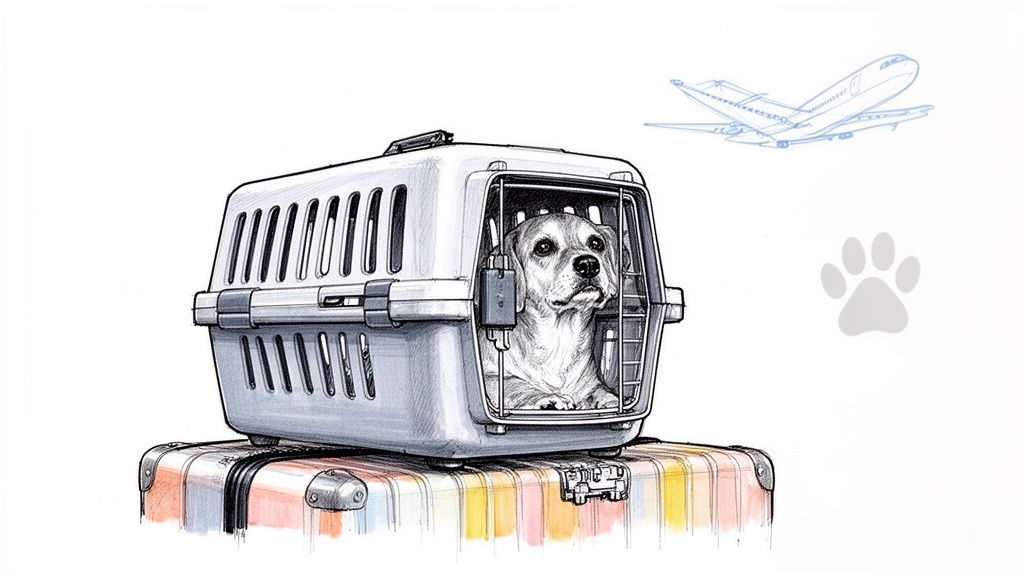
Getting the right dog cage for a flight isn't just a suggestion—it's the most important decision you'll make for your pet's safety and comfort. For your dog to be cleared for travel, especially in the cargo hold, the crate should be a hard-sided, airline-friendly carrier. Think secure locks, great ventilation, and a solid, leak-proof floor. Soft carriers? They're usually only an option for tiny pets who can fly in the cabin with you.
Why The Right Dog Cage Is Your Golden Ticket
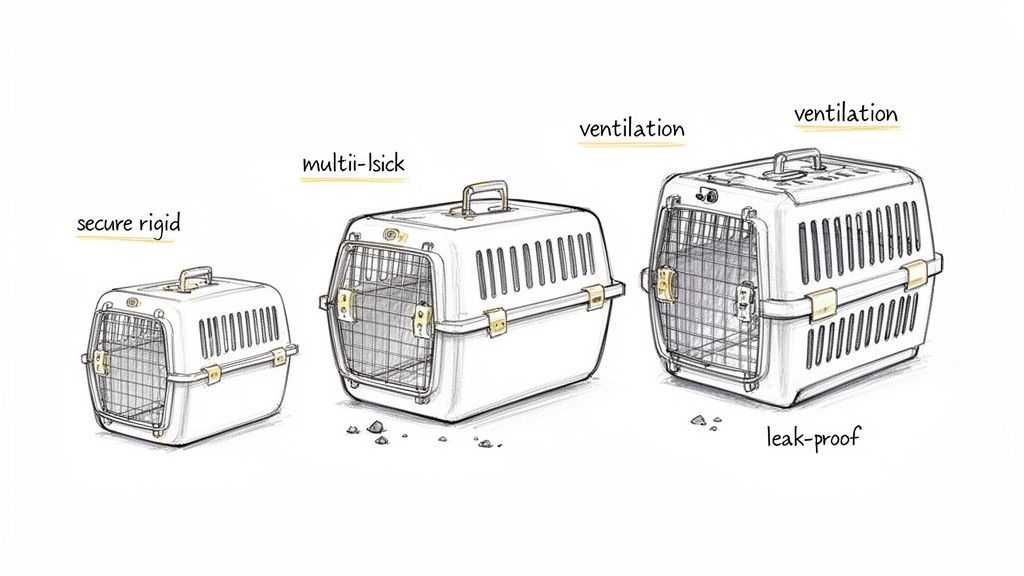
Flying with your four-legged co-pilot should be an exciting adventure, not a stressful experience. Picking the right crate is the first step to a smooth trip, making sure your best friend is safe, secure, and as comfortable as possible from gate to gate. It’s not just about finding a box; it's about providing a familiar, protective den for their journey.
There's a good reason why airlines and organizations like the International Air Transport Association (IATA) have such specific guidelines. These standards are carefully designed to protect your pet, especially when they're traveling in the cargo hold where the environment is very different from the main cabin.
Core Features Of A Flight-Ready Crate
When you're shopping for a crate, some features are a must-have. It’s a safety checklist for your pup's temporary home in the sky.
Here’s what every airline-approved cargo crate typically needs:
Durable, Hard Materials: The shell should be made from hard plastic, metal, or wood. Soft-sided carriers just don't offer enough protection for cargo travel and are usually not allowed.
A Secure Locking Mechanism: The door has to lock firmly and be made of metal, not plastic. Many airlines now ask that the crate's halves are fastened together with metal nuts and bolts, not flimsy plastic clips that can fail under pressure.
Proper Ventilation: Good airflow is key. The crate needs ventilation openings on at least three sides to prevent your dog from overheating. Four sides is even better.
A Solid, Leak-Proof Bottom: The floor of the crate must be solid and should be lined with absorbent material to handle any accidents during the flight.
Your dog’s travel crate is more than just luggage; it’s their personal safety capsule for the journey. Investing in a high-quality, airline-friendly cage is the best way to ensure their well-being and give you peace of mind.
To help you keep track of these must-haves, here's a quick summary.
Quick Checklist for Airline-Approved Dog Cages
Feature | Guideline | Why It Matters |
|---|---|---|
Material | Hard-sided (rigid plastic, metal, or wood). | Provides strength and protection against bumps and shifting cargo. |
Hardware | Metal nuts and bolts (no plastic clips). | Helps ensure the crate won't accidentally come apart during transit. |
Door | Solid metal with a secure, spring-loaded lock. | Prevents accidental escapes and provides strength. |
Ventilation | Openings on at least 3 sides. | Important for maintaining airflow and preventing overheating. |
Floor | Solid and leak-proof. | Contains any messes and keeps your pet dry. |
Size | Must allow pet to stand, sit, and turn around comfortably. | Ensures comfort and reduces stress during a long journey. |
Making sure your crate checks every one of these boxes is the first step toward getting that "approved for travel" stamp from the airline.
In-Cabin vs Cargo Crates
It's important to know the difference between a carrier for in-cabin travel and a crate headed for the cargo hold. A small dog flying under the seat in front of you has very different needs than a large dog traveling below deck. Our guide on choosing an airline travel pet carrier breaks down the details for both situations.
Globally, dogs make up a huge 58% of all pets transported by air. The U.S. Department of Transportation has strict standards for cage design to prevent accidents, as poor ventilation and overheating are among the leading causes of incidents. These rules aren't just red tape—they're in place to keep your best friend safe.
Navigating IATA and Airline Crate Rules
Figuring out the specific rules for flight-ready dog crates can feel complicated, but it's much simpler once you know the basics. Nearly every airline builds its requirements on the foundation laid by the International Air Transport Association (IATA). Think of them as the global standard for moving animals safely.
Getting these details right is the difference between a smooth check-in and a last-minute panic at the airport.
Master the IATA guidelines, and you're already 90% of the way there. These aren't just random rules; every single one is designed with one thing in mind: your dog's safety and well-being during the journey.
The Building Blocks of an Airline-Friendly Crate
Let's get right to the key points. Airlines are very strict when it comes to the crate's construction.
Your dog’s crate should be made of hard plastic, wood, or metal. Soft-sided carriers and collapsible crates are an instant "no" for the cargo hold—they just don't provide the needed protection against bumps and shifts.
The hardware is another big detail. The two halves of a plastic crate are often required to be fastened with metal nuts and bolts. Those easy plastic clips or twist locks you see on some models are a common reason for rejection. They can snap open under pressure, which is a risk no airline is willing to take.
Material: Should be a hard-sided crate made of rigid plastic, wood, or metal.
Hardware: Only metal nuts and bolts are usually allowed to connect the top and bottom. No plastic clips.
Door: The door should be solid welded or cast metal. A flimsy plastic door won't cut it. It also needs a secure, spring-loaded lock that your dog can't paw or nudge open.
Why Ventilation Is So Important
You can't overstate the importance of proper airflow. IATA suggests ventilation openings on at least three sides of the crate. The gold standard, however, is a crate with ventilation on all four sides, which ensures maximum cross-breeze.
This is a serious safety issue. Good ventilation is what prevents heatstroke during transit. Just make sure the holes are small enough that your dog can't stick a paw or nose through and get injured. And never, ever cover the vents with a blanket or pad—it traps heat and defeats the whole purpose.
Key Takeaway: A flight-friendly crate isn't just a box; it's a safety device. The strict guidelines on materials, hardware, and ventilation are all there to protect your dog from check-in to arrival.
The Airline-Specific Wrinkles
While IATA sets the stage, your airline always has the final say. Some carriers have their own quirks and extra requirements that go beyond the IATA basics.
For example, some major U.S. airlines require reinforced or even custom-built wooden crates for certain "strong-jawed" breeds. Another airline might have slightly different rules about the size of the ventilation holes. These small details can derail your entire trip if you're not prepared.
Imagine getting to the check-in counter with a brand-new crate, only to be told that this specific airline needs an extra inch of headroom for your dog's breed. That's a travel-day disaster you can easily avoid.
Your best move is to go directly to your airline’s website, find their pet travel policy, and print it out. Highlight the crate requirements and stick it with your other documents. For a deeper dive into the world of air travel with pets, our guide to flying with pets internationally is packed with more tips for a smooth trip. A few minutes of double-checking now can save you a world of stress later.
Getting The Pawfect Fit For Your Dog's Crate
Choosing the right size for your dog's flight cage is a true Goldilocks situation—it can't be too big or too small, it has to be just right. A crate that’s too small is stressful, but one that’s too large can be just as dangerous during turbulence, letting your dog get tossed around. Getting the sizing perfect is a huge part of their safety.
Your goal is to give them a secure, cozy den for the trip, not a tight squeeze or a huge box. Both airlines and IATA have a clear standard here: your dog should have enough room to comfortably stand up, sit down, and turn around. This isn’t just a friendly suggestion; it's a key requirement for their well-being.
How To Measure Your Dog For Their Crate
To find that perfect fit, you’ll need a soft measuring tape and maybe a few treats to convince your dog to stand still. It’s always best to do this when they're calm and standing naturally on all four paws.
You'll need to capture two key measurements:
Length (A): Measure from the tip of their nose straight back to the base of their tail. The tail itself doesn't count, so don't include it in the measurement.
Height (B): While your dog is standing, measure from the floor to the very top of their head or the tips of their ears—whichever is higher. For floppy-eared dogs, just measure to the top of their skull.
Once you have these two numbers, the math is simple. To figure out the minimum internal crate dimensions, you just need to add a bit of buffer room for comfort.
Required Crate Length: Your Dog’s Length (A) + 3-4 inches.
Required Crate Height: Your Dog's Height (B) + 3-4 inches.
This extra space is important. It helps ensure your dog isn't wedged in and can shift positions easily during the long journey.
The Turn-Around Test
One of the most important rules is that your dog must be able to turn around inside without a struggle. A great rule of thumb is to make sure the crate's width is at least double your dog's width at their widest point, which for most dogs is across the shoulders.
Pro Tip: If your dog falls between two crate sizes, always go with the larger one. A little extra room is far better than not enough. Being denied boarding at the check-in counter because the crate is too small is a nightmare scenario you can easily avoid.
The infographic below shows how these construction rules work together with proper sizing, from the materials down to the hardware.
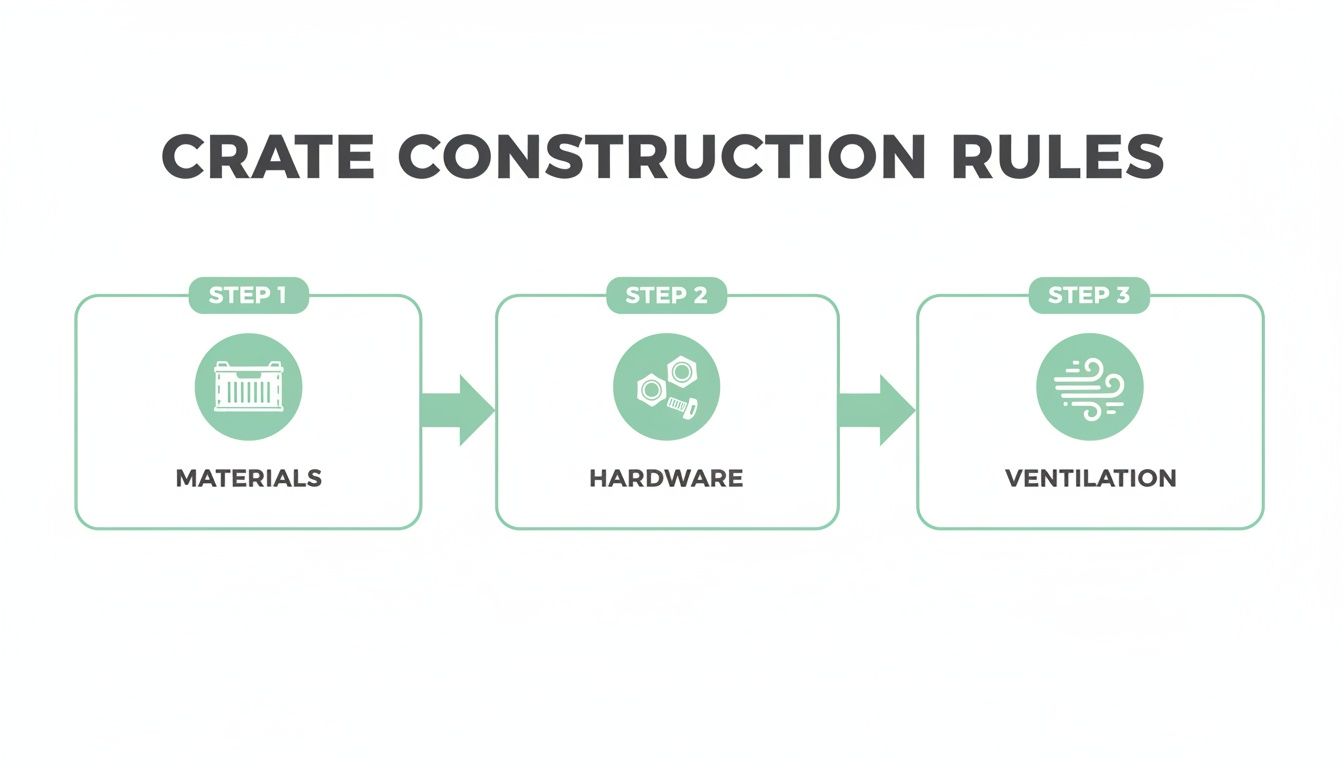
This really drives home the point that a suitable crate isn't just about size. It’s the whole package: the right dimensions, strong materials, secure hardware, and good ventilation all working together.
Real-World Sizing Scenarios
Let's put this into practice with a couple of examples.
Say you have a Beagle named Bagel who measures 20 inches long (nose to tail base) and 15 inches tall (floor to head).
Crate Length Needed: 20" + 4" = 24 inches
Crate Height Needed: 15" + 4" = 19 inches
You'd be looking for a crate with internal dimensions of at least 24 inches long and 19 inches high.
Now, let's think bigger. A Golden Retriever named Sunny is 34 inches long and 26 inches tall.
Crate Length Needed: 34" + 4" = 38 inches
Crate Height Needed: 26" + 4" = 30 inches
Sunny is going to need a much larger crate to fly safely and comfortably. Getting these measurements right is everything. For more tips on getting your whole trip in order, check out our guide to pet travel. It's full of practical info to help make your journey a success.
Prepping The Crate For A Comfortable Journey
You’ve found the perfect, airline-approved crate. Now it's time to turn that empty shell into a safe, comfortable space for your dog's flight.
Properly outfitting the crate is about more than just making it cozy—it’s an important step for your dog's well-being. A well-prepped crate helps reduce stress, contains any accidents, and ensures the journey goes as smoothly as possible for both your pet and the airline staff caring for them.
Setting Up The Crate Interior
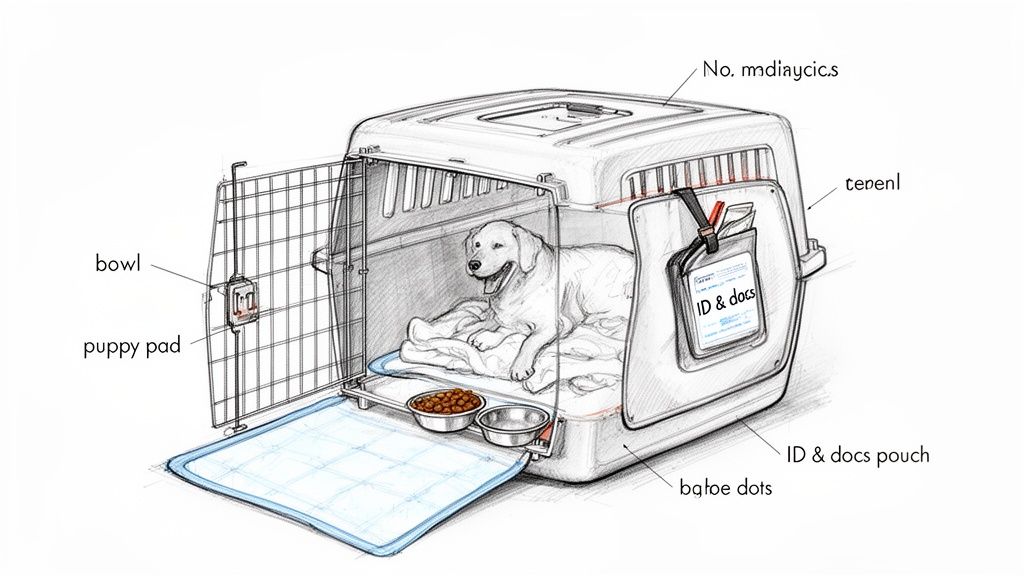
First things first: the floor. Airlines ask you to line the bottom of the crate with an absorbent material. A simple puppy training pad or a layer of shredded newspaper does the trick perfectly.
This lining serves two key purposes. It offers a bit of padding for comfort, but more importantly, it soaks up any spilled water or potty accidents, helping your dog stay clean and dry. Steer clear of thick blankets or plush bedding, as these can create an overheating or even a suffocation risk in an enclosed space.
Next up are food and water. IATA guidelines are very specific here: food and water bowls should be attached to the inside of the crate door. They also need to be reachable from the outside. This is a great safety measure, as it allows airline crew to give your dog refreshments without ever having to open the door.
Food and Water Bowls: Find sturdy, clip-on bowls made for travel crates. A great pro tip is to fill the water bowl and freeze it solid the night before you leave. This gives your dog access to water as it slowly melts, which really cuts down on spills during loading and takeoff.
Emergency Food: Tape a small, clearly-labeled Ziploc bag of your dog's usual dry food to the top of the crate. Make sure to include simple feeding instructions in case of a long delay.
The Dangers of Sedation and What to Do Instead
It’s tempting to think about sedating an anxious pet for a flight, but veterinarians and airlines strongly advise against it. Sedatives can interfere with a dog's ability to regulate their body temperature and maintain balance—both of which are very dangerous when dealing with altitude and air pressure changes.
In fact, oversedation was a contributing factor in nearly 50% of all pet deaths on US airlines between 2015 and 2020. These aren't just numbers; they're a stark warning about the serious risks involved and why a natural approach to keeping your dog calm is always the safer bet.
The best way to reduce travel anxiety isn't medication—it's positive association. A dog who sees their crate as a familiar, safe den will handle the journey with far less stress than one who is sedated and disoriented.
The far better alternative is good old-fashioned crate training. You’ll want to start this process weeks, if not months, before your travel date. The goal is simple: make the crate a happy, familiar space that your dog enters willingly.
To build that positive connection, using the best training treats for crate conditioning can make a huge difference. Reward your dog for spending short, happy moments inside the crate with the door open, then slowly work your way up to longer periods with the door closed.
Crate Preparation Dos and Don'ts
To make things simple, here’s a quick rundown of what should and should not go into your dog's crate on travel day.
Do This | Don't Do This |
|---|---|
Do line the floor with an absorbent puppy pad or newspaper. | Don't use thick blankets, towels, or plush bedding. |
Do attach clip-on food and water bowls to the door. | Don't leave loose bowls on the crate floor. |
Do freeze water in the bowl to prevent spills. | Don't include hard toys, bones, or anything that can break. |
Do tape a small bag of emergency food to the top of the crate. | Don't sedate your dog unless explicitly directed by a vet. |
Do ensure your dog has plenty of space to stand and turn around. | Don't add bulky items that restrict movement. |
Ultimately, simplicity is your best friend when preparing dog cages for flights. Your focus should always be on safety and the essentials: an absorbent lining, reachable water, and a calm, well-adjusted pup ready for their adventure.
Final Checks: Labels and Paperwork
You've got the crate perfectly sized and prepped—now for the finishing touches. This final step is all about making sure your dog's crate communicates everything airline staff need to know at a glance. Think of it this way: proper labels and paperwork are your last, and most important, line of defense against any confusion on travel day.
This isn't just about sticking your name on the crate. You're following specific airline and IATA guidelines designed to keep your pet safe. These rules help ensure that every person who handles the crate knows there's a living, breathing animal inside who needs special care. It’s a small detail that makes a world of difference.
Making the Crate Easy to Identify
Your dog's crate needs to be covered in clear, unmistakable labels. While most airlines provide these stickers at check-in, it's a good idea to have your own set ready to go. You never want to leave something so important to chance.
Here’s what should be visible on the outside of the crate:
"Live Animal" Stickers: These are a must. They should be placed on the top and at least one side of the crate. Their bright colors and universal design immediately tell cargo handlers to be gentle.
"This Way Up" Arrows: You need arrows pointing upward on at least two sides of the crate. This simple instruction prevents the crate from being loaded sideways or upside down—a situation that would be terrifying and dangerous for your dog.
Your Contact Information: Your name, cell phone number, and destination address need to be clearly attached. It's also a smart move to include the name and phone number of someone at your destination, just in case.
Your Dog's Information: Don't forget to include your dog's name! Some owners even tape a friendly photo of their dog to the outside. It’s a small, personal touch that helps humanize the precious cargo inside.
The All-Important Document Pouch
Along with the stickers, you should securely attach a waterproof pouch to the crate. This pouch should hold copies of your dog's essential travel documents, giving airline staff instant access to key info without having to track you down.
Here’s what to put inside:
A copy of the health certificate.
Clear feeding and watering instructions.
A copy of your travel itinerary.
Proof of rabies vaccination.
Think of this pouch as your dog’s passport and instruction manual all in one. If a flight gets delayed, this is the information the ground crew will use to care for your pet, making sure they get food and water exactly when they need it.
Navigating the world of pet travel documents can be a real headache. In fact, a CivicScience survey found that a huge 39% of pet owners have skipped flights because of pet-related complexities, and 23% have canceled trips altogether. You can see how travel rules impact pet owners in their full report. This is exactly why getting the paperwork right is so empowering.
Making International Paperwork Less "Ruff"
For international travel, the single biggest hurdle is often the veterinary international health certificate. This isn't just one form; it’s a whole process involving your vet, strict timelines, and often, government approvals. Every country has its own unique set of rules, and one tiny mistake can mean your pet is denied entry. We break this down in detail in our guide on the veterinary international health certificate.
This is precisely where a service like Passpaw shines. It helps vets and pet owners manage this entire complex process from one organized dashboard. The Passpaw system guides you through every requirement, making sure medical records are in order and all necessary government approvals are handled correctly and on schedule.
By keeping everything organized and accurate, Passpaw helps you avoid those heart-stopping, last-minute panics at the airport. It turns a stressful documentation nightmare into a clear, manageable workflow, letting you focus on the adventure ahead with your best friend.
Common Questions About Flying with a Dog
Getting your dog's travel crate ready for a flight can bring up a ton of questions. It's totally normal to feel a bit swamped by all the little details, especially when you're trying to make sure your best friend is safe and comfortable.
Let's clear up some of the most common worries pet parents have. Getting straight answers will help you feel much more confident about the journey ahead.
Can I Use a Soft-Sided Carrier for My Dog on a Flight?
This is one of the first questions people ask, and the answer comes down to one thing: where your dog will be on the plane.
Soft-sided carriers are really only an option if your dog is small enough to fly in the cabin with you. The carrier has to be compact enough to slide neatly under the seat in front of you and stay there for the entire flight.
For any dog traveling in the cargo hold, a hard-sided, airline-friendly crate is the standard. These crates are built tough—usually from hard plastic—to offer the best protection. A key feature is that they should be held together with metal nuts and bolts, not flimsy plastic clips. They also need a single, secure metal door to prevent any unexpected escapes. Always, always double-check your airline's specific rules on this.
Should I Give My Dog Medication Before a Flight?
It might feel like the kindest option for a nervous traveler, but giving your dog a sedative before they fly is usually a bad idea.
Both the American Veterinary Medical Association (AVMA) and almost every airline strongly advise against it. The reason is simple: medication can mess with a dog's ability to regulate their body temperature and keep their balance, which is a real risk at high altitudes.
The best way to calm your dog's nerves is through positive crate training long before your travel day. A dog who views their crate as a safe den is in a much better position to handle travel than one who is sedated and confused.
If your dog suffers from serious travel anxiety, the best move is to talk to your veterinarian. They can explore safer alternatives or strategies that don't involve risky drugs, ensuring your pet is both calm and safe. Never just "wing it" with medication.
What Kind of Food and Water Bowls Should I Use?
Your dog's everyday bowls from home won't cut it for air travel. You need sturdy food and water bowls that can be securely clipped to the inside of the crate door.
This isn't just a random rule—it's an important safety feature. It lets airline staff give your dog food and water without ever having to open the crate. This simple setup minimizes the chance of an escape and ensures your pet's needs are met, especially if there are delays.
Here are a few tips to get it right:
Find Clip-On Bowls: Most pet stores carry them. Make sure they're tough and won't get knocked off easily.
Freeze the Water: This is a fantastic travel hack. Fill the water bowl the night before you leave and pop it in the freezer. It will melt slowly during the trip, giving your dog a steady water supply and preventing a big sloshy mess during takeoff.
Pack Food Separately: Don't leave loose kibble in the crate. Instead, securely tape a small bag of your dog's food to the top of the crate with clear, simple feeding instructions for the airline staff.
How Do I Ensure the Crate Has Enough Ventilation?
Good airflow isn't just about comfort; it's a key safety requirement. A crate with proper ventilation keeps your dog from overheating and ensures they can breathe easily.
IATA guidelines suggest a travel crate should have ventilation openings on at least three sides. The gold standard, however, is a crate with ventilation on all four sides, as this provides the best possible airflow.
When you're checking your crate, keep a few things in mind:
The openings need to be big enough for air to circulate freely.
But they must also be small enough that your dog can't get a paw, nose, or collar stuck.
Never, ever cover the ventilation holes with blankets or anything else. This can trap heat and create a very dangerous situation for your pet.
Tackling these questions puts you in a great position to make your dog's travel day safe, comfortable, and as stress-free as possible. A little bit of prep work makes all the difference.
Navigating the mountain of paperwork for international pet travel can be the most stressful part of the whole process. With Passpaw, you can make it simple. Our platform helps vets and pet owners manage every document, from health certificates to government endorsements, making sure everything is correct and submitted on time. Ready for a smoother travel experience? Visit https://passpaw.com to see how we can help.
More articles
From regulatory changes to best practices for veterinarians and pet owners, our resources keep you ahead of the curve.