Are you a team member in a veterinary practice?
Are you a pet parent planning a trip with your furry pal?
Dog Carrier with Wheels: A Complete 2026 Buyer's Guide
Airport floors are long. Parking shuttles are crowded. Gate changes happen at the worst time. If you've ever carried a squirmy dog in a shoulder bag while balancing your own luggage, you already know why a dog carrier with wheels gets so much attention.
A good rolling carrier can take real strain off your body and make travel feel calmer for your dog. A bad one can be bulky, awkward on stairs, and frustrating at the check-in desk. That's why the right question isn't “Should I buy one?” It's “Will this specific carrier work for my dog, my route, and the way I travel?”
Your Guide to the Dog Carrier with Wheels
Dog travel gear has moved from niche purchase to everyday planning tool. The broader pet carriers market was estimated at USD 764.5 million in 2023 and is projected to reach USD 1,178.7 million by 2030 according to Grand View Research's pet carriers market report. That tells you something simple. More owners want safer, easier ways to move pets through real life, not just from the car to the vet.
A dog carrier with wheels fits that shift because it solves a very specific problem. Carrying weight on one shoulder gets old fast. Rolling that same load through a terminal, hotel lobby, or clinic hallway is often easier on your back and steadier for your pup.
That doesn't mean every rolling carrier deserves a gold star. Some glide nicely on smooth floors but become a nuisance on curbs, stairs, or uneven sidewalks. Some are sold with “airline-approved” language that sounds reassuring, then turns into a headache when you realize the wheels change the outside dimensions. Some feel roomy in product photos but don't match your dog's body shape at all.
A wheeled carrier is most useful when it reduces effort without creating a new problem at the airport, in the car, or at security.
The smartest way to shop is to think like a traveler, not like a browser. Check fit first. Check how the wheel base works. Check whether the carrier still works when you have to lift it. If flying is part of the plan, keep a practical reference handy, such as this guide to airline travel pet carriers, because dimensions and setup matter more than marketing copy.
A rolling carrier can be a real life-saver. It just has to be the right kind of life-saver for your trip.
Are Wheeled Dog Carriers Right for Your Pup
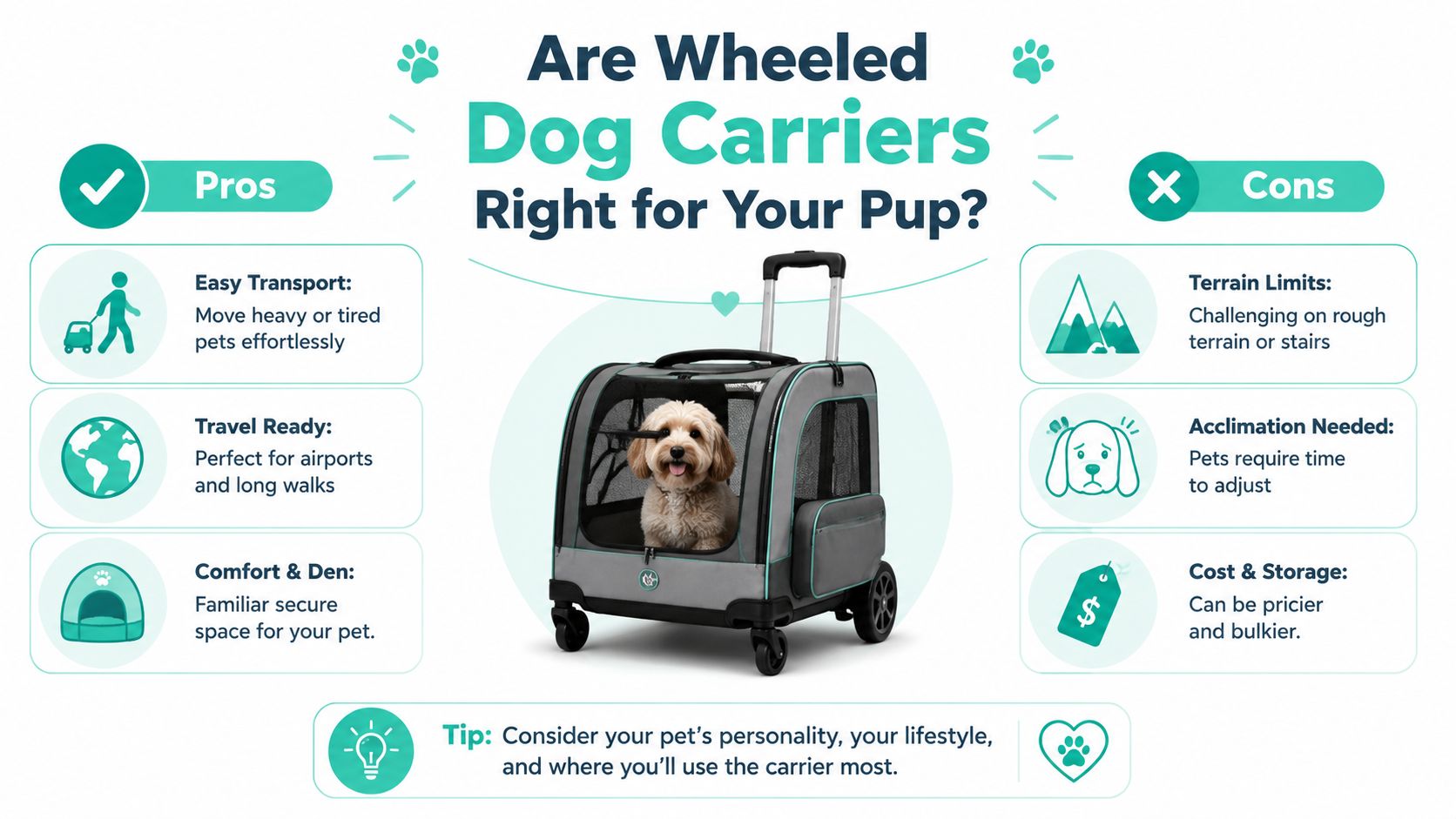
Some dogs settle into a rolling carrier and treat it like a private first-class suite. Others dislike the motion, the sound of the wheels, or the stop-and-go rhythm of busy travel days. That's why this choice starts with your dog's temperament as much as your own back and shoulders.
When rolling makes sense
If you regularly walk long terminal distances, move through large clinics, or carry extra bags, wheels can make daily travel much less tiring. They're also useful for owners who don't want all the weight hanging from one arm. In the right setting, a rolling carrier is less of a gimmick and more of a practical mobility tool.
The tradeoff is built into the design. Detachable or recessed wheels improve portability but add weight and moving parts, so the best option depends on walking distance, pet size, and whether your trip is airport-only or includes sidewalks, transit, or car transfers, as discussed on Sherpa's rolling carrier page.
That last point matters more than many buyers expect. A smooth airport concourse is very different from cracked pavement, escalator detours, or a hotel with no elevator.
When wheels become a hassle
Rolling carriers are weakest when you have to lift them often. Stairs, curbs, train platforms, and tight restaurant entries can turn a clever setup into dead weight. If you live in a walk-up building or your trips involve a lot of transitions, test whether you'd still be comfortable carrying the unit with your dog inside.
A few common friction points show up again and again:
Crowded spaces: Wheels help on open floors, but they can feel clumsy in security lines and packed boarding areas.
Noise-sensitive pups: Some dogs react to wheel rumble or vibration, especially on tile seams or rough concrete.
Storage reality: A rolling carrier often takes up more room in closets, trunks, and overhead storage areas at home.
Practical rule: Buy for your hardest travel moment, not your easiest one.
Match the carrier to the dog
Breed tendencies, body shape, and confidence level all affect whether a rolling setup feels natural. If you want a quick refresher on size, structure, and behavior differences across the canine species details, it can help you judge whether your dog is likely to enjoy a den-like carrier or feel cramped and reactive.
Use this quick self-check before you buy:
Choose wheels if: you mostly travel on flat surfaces, your dog tolerates enclosed spaces well, and you want less shoulder strain.
Skip wheels if: your route includes frequent stairs, rough ground, or lots of lifting in and out of vehicles.
Pick a hybrid style if: you want some rolling help but still need a design you can carry comfortably. Many owners compare these with travel crates for dogs when deciding how much structure and portability they need.
The best answer is rarely universal. It's tail-waggingly specific.
Choosing the Paw-fect Wheeled Carrier
A dog carrier with wheels should fit your dog first and your wish list second. Fancy handles and smooth wheels won't rescue a carrier that's too tight, too flimsy, or too awkward to use in motion.
Start with size and body fit
The most important measurement isn't the product label. It's your dog.
The American Kennel Club says a carrier should be a few inches taller and longer than your pet. Their example is clear: a dog that measures 9 inches tall would likely need a carrier at least 12 inches high to avoid feeling cramped, according to the AKC's dog carrier guidance.
That advice is practical because dogs don't travel as rigid rectangles. They shift, turn, and brace when you stop rolling. A little extra room helps them stay comfortable without sliding around too much.
Measure these before you shop:
Back length: From the base of the neck to the base of the tail.
Shoulder height: From the floor to the top of the shoulders.
Widest point: Usually shoulders or chest, depending on build.
Resting posture: Notice whether your dog curls tightly or likes to lie stretched out.
If your dog is between sizes, don't automatically size up. In a wheeled model, too much extra space can make the ride feel less stable.
Pick the shell for your actual travel style
Soft-sided rolling carriers are usually easier to store and often feel less imposing to a nervous dog. They're a common choice for car trips, clinic visits, and in-cabin planning. They can also flex a bit when space is tight.
Hard-sided models hold shape better and can feel sturdier during transfers. They're often easier to wipe down after accidents. The downside is obvious once you carry one up stairs. They don't forgive awkward spaces.
A simple comparison helps:
Feature | Soft-sided wheeled carrier | Hard-sided wheeled carrier |
|---|---|---|
Comfort feel | More den-like for many dogs | More structured and rigid |
Storage at home | Usually easier to collapse or stash | Usually bulkier |
Cleaning | Fabric needs more detailed cleaning | Plastic is usually easier to wipe |
Weight feel when lifted | Often easier to manage | Can feel heavier and stiffer |
Check the wheel system, not just the fact that it has wheels
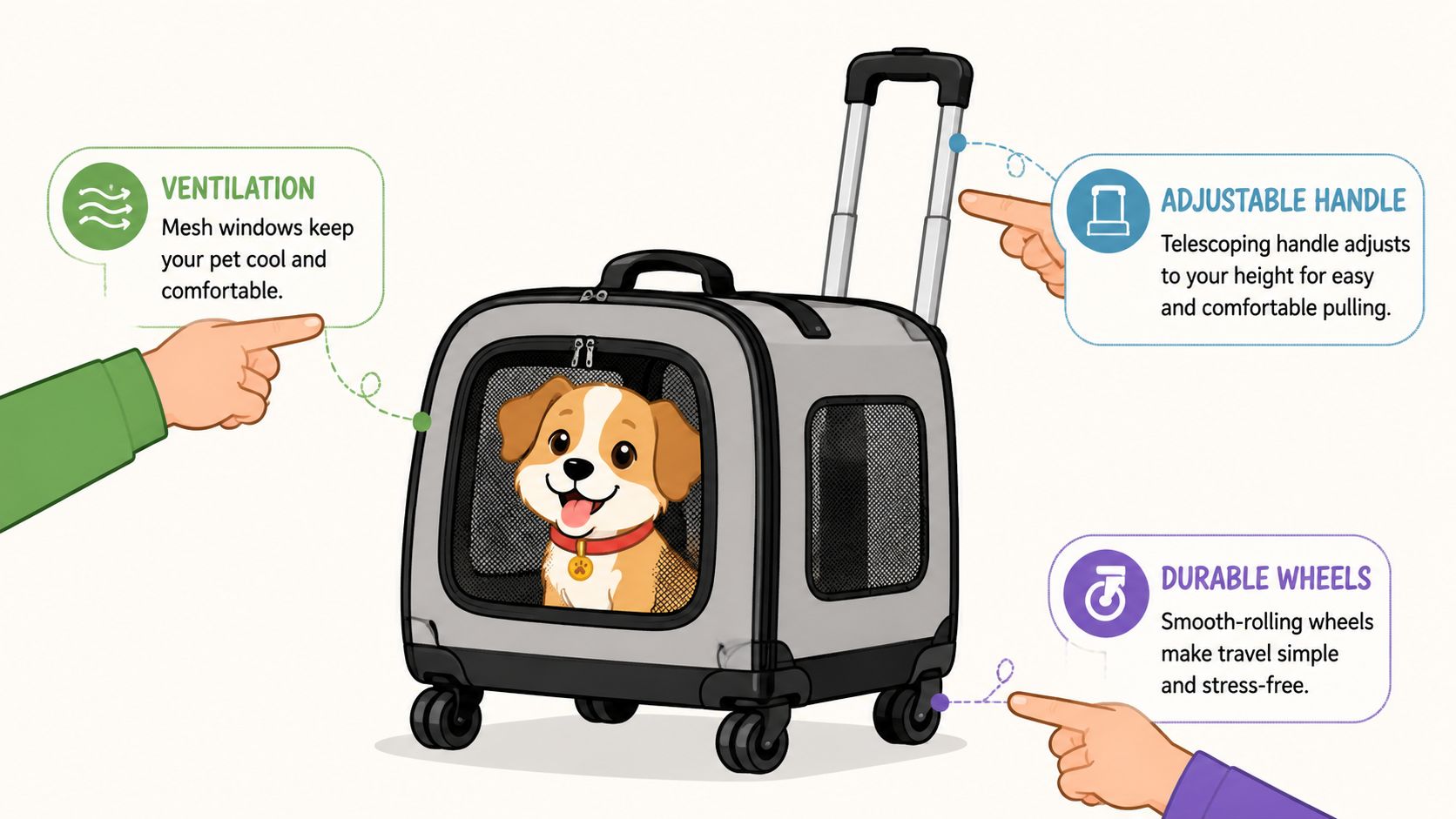
Wheels aren't equal. Some track smoothly. Some wobble after a few trips. Some are fine indoors but irritating outdoors.
Look closely at these details:
Wheel placement: Wider-set wheels can feel more stable when turning corners.
Removability: If the wheel base detaches cleanly, the carrier becomes more flexible for travel and storage.
Rolling noise: Hard plastic wheels can be loud on certain floors.
Brake or lock feature: Helpful when you stop on a slope or while waiting in line.
Don't test a rolling carrier by pulling it empty in a store and calling it good. The real test is how it behaves with your dog's weight shifting inside.
Handles, closures, and small details that matter
The telescoping handle should extend smoothly and lock firmly. If it wiggles badly in your hand, it'll only get more annoying with a live passenger aboard. Side handles matter too, because rolling carriers spend more time being lifted than many buyers expect.
Pay attention to closures and interior safety:
Zippers: Double zippers are easier to secure and less likely to drift open accidentally.
Interior tether: Useful for dogs that try to pop out when the door opens.
Ventilation panels: More airflow usually means a calmer ride.
Base support: The bottom should not sag noticeably when the dog stands up.
Use this shortlist before checkout
If you want a practical filter, ask five blunt questions:
Can my dog stand, turn, and settle comfortably?
Can I carry it up stairs without regretting all my life choices?
Does the wheel system feel stable when turning and stopping?
Are the handles, zippers, and seams built for repeated travel?
Will this still work when plans change and I have to lift, store, or detach parts quickly?
If a carrier passes those tests, you're probably looking at a keeper. If it only looks cute online, let it lie.
Wheeled Carriers and Airline Travel Compliance
You roll into the airport feeling prepared, then the agent asks whether the wheels come off. That is the moment many owners learn that "airline-approved" often applies only to one version of the carrier, not the version rolling beside them.

Why the label alone isn't enough
Rolling carriers create a common travel trade-off. Wheels make the airport easier for you, but they often make cabin fit harder once you reach check-in or boarding. Some product listings say "airline-approved" only if the wheel set is removed, as noted by Katziela's rolling carrier collection guidance.
That means the useful question is not whether a carrier has an airline badge on the listing. The useful question is whether your dog carrier with wheels fits your airline's limits in the exact configuration you will present on travel day.
One publicly listed example shows why this matters. A rolling pet carrier sold for small to medium pets is listed at 19.7 in long × 12.2 in wide × 11.8 in high with wheels on this Walmart product listing for a wheeled pet carrier. Those numbers may or may not work for your flight, but they highlight a very practical issue. A little extra height from the wheel base can be the detail that knocks a carrier out of cabin use.
The air-travel constraint that catches buyers
For flights, the main problem is simple. Rolling hardware adds bulk in the exact spot airlines care about most: height.
Guidance summarized by Travel Ready Pets on airline pet carrier dimensions explains that wheels often need to be removable or locked, and that airlines may also expect a secure, leak-resistant, ventilated carrier. In real use, many wheeled models work best as two-part systems. You roll through the terminal, then remove or secure the wheel assembly before the carrier goes under the seat or into the airline's accepted setup.
That extra step is not a design flaw by itself. It is the trade-off. Better airport mobility usually means more handling at the gate, during screening, and at boarding. If lifting and reconfiguring the carrier sounds annoying now, it will feel even less cute when your pup is squirming and the line behind you is growing.
Treat the wheel base as optional travel gear, not as a guaranteed part of the flight-ready setup.
What to verify before travel day
Airline compliance comes down to exact fit, exact route, and exact setup. Check the carrier the same way you plan to use it at the airport.
Measure the no-wheel setup: If the wheels must come off, measure the carrier after removal, not from the product box.
Check your specific aircraft rules: Under-seat space can vary by airline and plane type. This guide on which airlines allow pets in the cabin is a helpful starting point before you book.
Confirm how the carrier closes and ventilates: Airlines may care about secure zippers, airflow, and whether the structure holds its shape.
Practice wheel removal at home: Do a dry run before travel day so you are not wrestling with clips and axles at the counter.
A quick test helps. Pack the carrier as if you are leaving that morning, put your dog inside for a short session, then remove the wheels and carry it a reasonable distance. That tells you more than any marketing claim ever will.
Don't separate carrier setup from paperwork
Airline problems and document problems usually come from the same assumption. Owners trust broad labels, but air travel runs on specifics.
If you are flying internationally, you may need destination-based health documents coordinated with your veterinarian and timed correctly. Passpaw helps clinics and pet owners manage international health certificate workflows, document requirements, and travel timing in one place. That solves the paperwork side of the puzzle. You still need to confirm the carrier setup with the airline.
For a broader packing and travel perspective, Nandog's 2026 guide for pet travel is a useful companion read because it looks at the full travel routine, not just the carrier.
The smoothest trips happen when the carrier fits the plane, the paperwork fits the destination, and nobody ends up in the doghouse at check-in.
Packing Prep and Maintenance for Your Carrier
A dog carrier with wheels works better when your dog already trusts it. If the first ride happens on travel day, you're asking for too much all at once. New smells, new motion, crowds, and confinement can make even an easygoing pup hit the brakes.
Help your dog accept the carrier
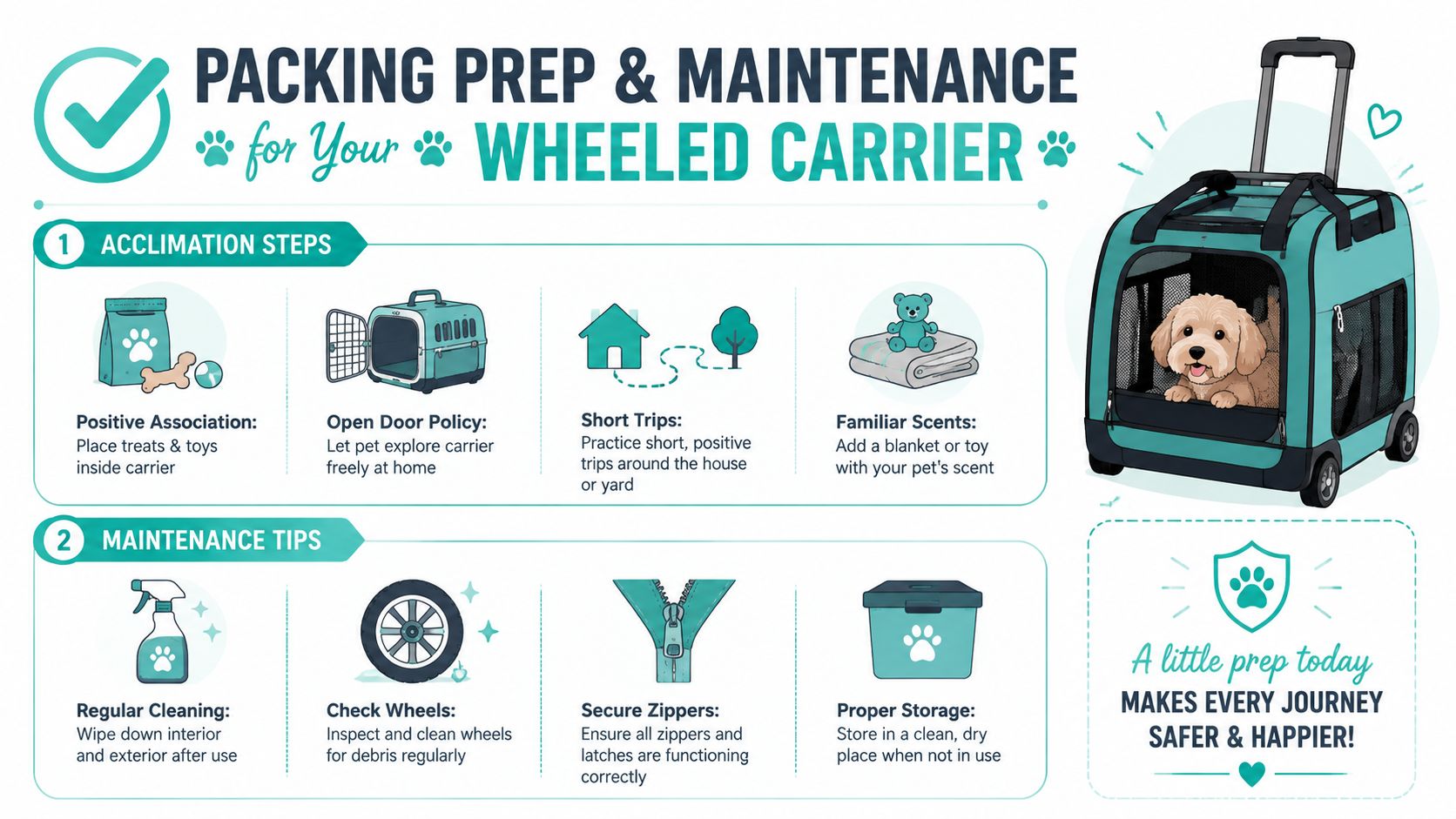
Start at home, with no pressure. Leave the carrier open in a familiar room and let your dog investigate it like a new piece of furniture. Add a blanket, a favorite toy, or a T-shirt that smells like you.
Then build motion gradually:
Open-door exploration: Let your dog enter and exit freely.
Reward calm behavior: Toss treats inside and praise quiet settling.
Short stationary sessions: Zip the carrier briefly while staying nearby.
Gentle rolling practice: Pull it slowly across smooth flooring.
Mini outings: Try a short walk, car transfer, or lobby trip before the main event.
If your dog startles at wheel noise, don't push through it. Slow down. Many dogs need time to learn that the rumble means movement, not danger.
Some pets don't need a “travel carrier.” They need a familiar den that happens to travel.
Pack for comfort, not clutter
Inside the carrier, less is usually more. Overpacking reduces space and can make the ride hotter or messier.
A sensible packing list includes:
Absorbent liner: A pee pad or washable insert helps with surprise accidents.
Familiar comfort item: A small blanket or soft toy can lower stress.
Simple leash access: Keep the leash easy to reach for security checks or hand-carry moments.
Paper towels and wipes: Useful for quick cleanup.
Small essentials pouch: Store medication, waste bags, and any feeding basics separately.
For broader travel-day prep, this guide on how to fly with pets is worth reviewing before you lock in your routine.
Keep the carrier working trip after trip
Maintenance is boring until a wheel jams in the terminal. Then it becomes the star of the show.
After each trip, inspect the carrier before storing it:
Wheels: Remove hair, dirt, and grit that can affect rolling.
Handle tracks: Extend and retract the handle to catch stiffness early.
Zippers and seams: Look for stress points, especially near corners.
Base panel: Check that the bottom still supports weight evenly.
Cleaning depends on material. Fabric interiors usually need spot cleaning, deodorizing, and full drying before storage. Hard plastic sections are easier to wipe down but still need attention at vents, corners, and wheel mounts.
If your car picks up fur during these trips, a practical guide to car interior pet hair cleaning can help you deal with the aftermath without turning your back seat into a permanent fluff exhibit.
Fix small issues before they become big ones
Minor problems tend to show themselves early. Listen to them.
Issue | What to check |
|---|---|
Wobbling roll | Debris in one wheel, loose mount, uneven load distribution |
Sticky zipper | Fabric caught in teeth, bent track, dirt buildup |
Crooked handle | Misaligned rails or damage from lifting by the telescoping grip |
Sagging base | Worn support board or weight distribution problem |
If a part feels unreliable at home, it won't get better under travel stress. Retire weak gear early. Your dog shouldn't have to beta test it.
Your Next Steps for Smoother Travels
You feel the difference in a wheeled carrier on the parts of the trip nobody advertises. Rolling through the terminal is easy. Lifting it onto a scale, carrying it up a short flight of stairs, or sliding it under a seat is where the design either helps or starts a small circus.
Choose based on your actual trip pattern, not the box copy. A rolling carrier suits a small dog and a route with long indoor stretches, level floors, and limited lifting. If your trips include sidewalks, curbs, stairs, or frequent transfers in and out of cars, portability matters just as much as mobility. In those cases, a model with a removable wheel base, sturdy side handles, and balanced weight distribution usually earns its keep.
Three checks make the decision easier:
Fit for the dog: enough room to rest comfortably, turn naturally, and stay stable in motion
Function for you: manageable to lift, simple to steer, and practical to store between trips
Compliance in practice: dimensions that work in the exact setup you will use, including wheels, frame, and handle position
For flights, treat “airline-approved” as a starting point, not a guarantee. Measure the carrier in travel mode. Then verify the airline, the route, and the aircraft if possible. Some carriers roll beautifully in the terminal but become awkward the moment you need to remove wheels or carry them by hand. That trade-off catches plenty of owners off guard.
A good carrier reduces hassle. A good match reduces stress for both of you.
If your dog stays settled and you can switch from rolling to carrying without wrestling the bag, you picked well. That is the kind of setup that makes future trips feel less ruff around the edges.
If you're planning international pet travel and want help keeping documents organized alongside your carrier and airline prep, Passpaw offers a practical way to manage pet travel paperwork with your veterinary team. It can help make destination-specific health certificate workflows clearer, easier to track, and less stressful.

More articles
From regulatory changes to best practices for veterinarians and pet owners, our resources keep you ahead of the curve.