Are you a team member in a veterinary practice?
Are you a pet parent planning a trip with your furry pal?
Documentation Fee for Pet Travel: A Vet Practice Guide
A documentation fee is a practice charge, usually $85 in California to about $950 in Florida, and some national guides place the average around $400. In pet travel, it covers the administrative time and resources needed to prepare, review, and submit international health certificates, not a government fee.
The first time this comes up at the front desk, it usually sounds simple to the client and complicated to the team. One owner sees a line item, assumes it's a mark-up, and wants a fast answer while the clock is ticking on travel dates and paperwork. That's where a clear, calm explanation saves everyone grief.
A good way to think about the charge is that it pays for the unglamorous work around the exam, not the exam itself. The fee helps cover the back-and-forth that happens before a certificate is ready, and it keeps the process from becoming a pile of unpaid admin time sitting on a receptionist's desk. For practices that want to tighten the workflow, a useful outside read is Logivo's hauliers' guide to AI billing, because the same idea applies here, standardize the boring parts so the people part stays smooth.
If your team already uses a pet health certificate workflow, keep the fee definition close to the process itself. Passpaw's overview of the pet health certificate for international travel is a helpful reference point for the client-facing side of that journey.
What a Documentation Fee Actually Is for Pet Travel
At the front desk, this fee often gets mistaken for a government charge because it sits beside official-sounding paperwork. It isn't that. In veterinary pet travel, the documentation fee is a practice-level administrative charge that helps recover staff time spent preparing, checking, and filing the travel packet.
That usually includes the dull but necessary steps clients never see. Someone has to review destination requirements, verify microchip and vaccine records, fill out or validate the health certificate, coordinate endorsement timing, and keep a clean file in case questions come later. None of that happens in the exam room by magic.
What clients should hear
The simplest explanation is the best one. The fee covers the work needed to move a pet travel case from “we have a vaccine record” to “the paperwork is ready to submit.” It's separate from lab charges, USDA or other endorsement charges, and any government costs tied to the destination.
Practical rule: if a task takes staff time, requires checking rules, or creates a paper trail, it belongs in the documentation conversation.
A useful way to frame it is to compare it with other regulated documentation work. Federal fee rules for government records can be tied to the cost of the service and itemize things like copies, discs, and certification, which shows why documentation work is priced around handling and validation rather than a flat notion of “just paperwork” (Cornell's text of 32 CFR 286.13). That same logic makes sense in vet travel, even though the setting is different.
For practices that want a clear service line, the wording matters more than the label. “Documentation fee” lands better than a vague admin surcharge because it tells owners what the team is doing. It also gives staff a stable phrase to use when the same question comes up three times before lunch, which, let's be honest, is a pretty normal Tuesday.
The part that keeps the file moving
A strong process also protects the team after the appointment. That means keeping copies of what was reviewed, noting what the fee covered, and making sure the client sees the charge early instead of at checkout. When those pieces line up, the fee stops feeling like a surprise and starts feeling like part of the service.
Why Veterinary Practices Charge Documentation Fees
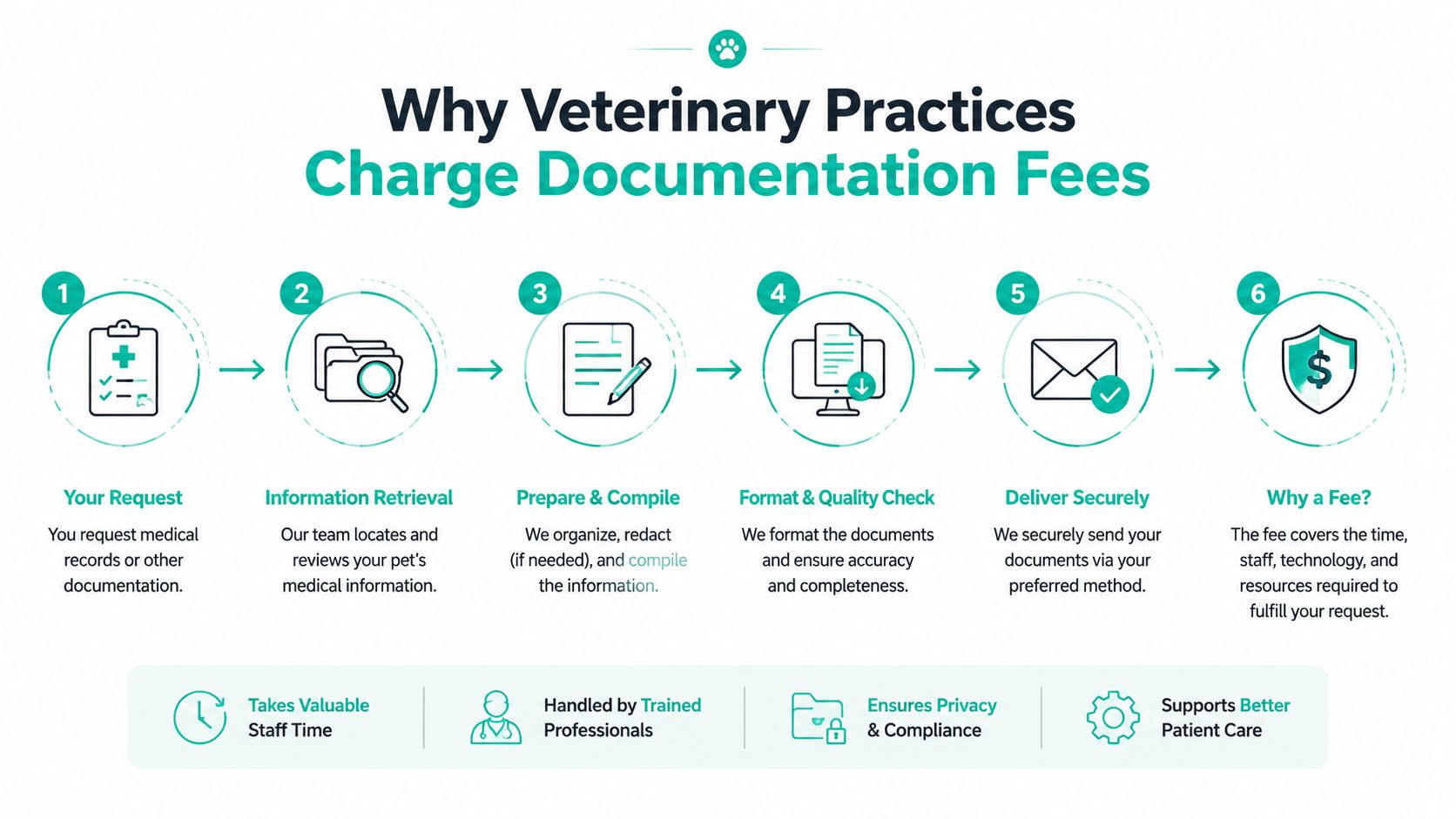
A travel file can look simple at the counter and still turn into a stack of checks behind the scenes. One client may need a quick certificate review, while another needs destination rules checked, records matched, timing confirmed, and a veterinarian's sign-off on wording that does not follow normal clinic paperwork.
The work behind the line item
The fee covers a workflow, not a stamp. Staff are checking destination rules, preparing forms, reviewing the medical record, and making sure the file matches what the receiving country or agency will accept.
That work often stretches beyond the appointment itself. A routine wellness visit is mostly clinical. A travel certificate can become an operations project, with deadlines, document review, owner follow-up, and corrections if the destination changes its requirements or the original record is incomplete.
Where the time actually goes
A documentation fee usually reflects several smaller tasks that add up quickly:
Requirement research: confirming the destination's paperwork rules before anyone gives the client a completion date.
Form preparation: entering pet and owner details into the correct certificate template without avoidable errors.
Veterinary review: checking that the medical record matches the destination language and the pet's history.
Follow-up coordination: setting up endorsements, boosters, or rechecks when timing matters.
Rework handling: correcting forms when a country changes its requirements or a record needs clarification.
That is why the charge works better as a workflow fee than as a vague add-on. It pays for the quiet work that keeps a file from bouncing back. For owners trying to compare what travel paperwork can cost, Passpaw's guide on how much an international health certificate costs for dogs gives a useful consumer-side reference.
The front desk test is simple. If the team cannot complete the travel file without checks, reminders, and revisions, the work has already moved past a standard exam. That is the reason the line item belongs on the invoice.
How Documentation Fee Ranges Vary by Region and Regulation
A documentation fee does not sit at one fixed national number for pet travel. Practices set it from staff time, destination complexity, filing volume, and how much manual review the case demands. One export file may be routine. Another may require repeated checks, correction requests, and careful timing, so the fee has to match the actual workload at the front desk and in the treatment area.
Regional rules shape that workload too. In regulated fee environments outside pet travel, compliance reviews of deal records have found that documentation-fee violations are uncommon, and enforcement teams also adjust thresholds for inflation as administrative costs shift over time. That pattern matters here because it shows fees tend to move with the amount of oversight and paperwork attached to the job, not just with the exam itself (Informed IQ compliance summary).
What drives the range
A fee stays modest when the certificate is straightforward and the destination asks for standard paperwork. It rises when the file needs destination-specific timing, repeated checks, or extra coordination with the owner. The more steps your team has to manage, the more the fee needs to reflect that labor.
Factors That Influence Documentation Fee Pricing | Low Complexity | High Complexity |
|---|---|---|
Destination requirements | Standard paperwork | Multiple country-specific steps |
Record readiness | Complete records | Missing or inconsistent records |
Staff handling | Single review pass | Several follow-ups and corrections |
Timing pressure | Flexible schedule | Tight travel deadline |
Endorsement needs | Simple submission flow | Added coordination and rework risk |
How to build a sane price
Start with the time your team spends getting a case from intake to submission. Then decide whether a flat fee or a small range tied to complexity fits your operation better. A flat price is easier for the front desk to quote, but a range can be fairer when some files are much messier than others.
Internal notes do a lot of work here. If your staff can explain why a basic file and a complicated file do not cost the same, they sound prepared instead of defensive when an owner asks for a breakdown.
For a practical consumer-side comparison of pricing spread, Passpaw's guide to how much an international health certificate is for dogs helps show why owners often hear different numbers from different clinics.
A quick reality check
If the fee is the same for every case, make sure the process is the same for every case.
That one line prevents a lot of awkward conversations. Consistency is good, but pretending every travel file needs the same amount of work usually backfires once the team is already buried in paperwork.
How to Present and Justify the Fee to Pet Owners
The cleanest client conversation starts before anyone is frustrated. If you wait until checkout, the fee feels hidden. If you explain it when the travel process begins, it feels like part of the service package.
The main objections are predictable. Owners confuse the fee with a government charge, assume it's a profit grab, or don't understand why it's separate from the exam. Your answer should hit those three points directly, without sounding rehearsed. A helpful phone framework for tone and pacing is SkipCalls' sample script for vet clinics, which is a decent model for keeping the conversation calm and short.
A simple script that works
Start with the purpose, not the price. Something like this lands better than leading with a number.
Open with the service: “We charge a documentation fee for the travel paperwork review and preparation.”
Separate it from government costs: “That's our clinic's charge for handling the certificate process, and it's separate from any USDA or lab fees.”
Explain the value: “It covers the time it takes to review records, complete the forms, and coordinate the submission steps.”
Close with transparency: “I can break out the full estimate for you before we start.”
Sample invoice language
Keep the bill readable. A pet owner should be able to tell what's clinical and what's administrative.
Exam fee
Documentation fee
Laboratory costs
Endorsement or government processing fees, if applicable
That structure does two things. It makes the invoice easier to understand, and it helps staff explain why the total is what it is without lumping everything into one mystery number. A short written handout can help too, especially for owners comparing travel options or asking relatives to review the quote.
The broader communication habits matter beyond this one line item. Passpaw's article on veterinary client communication pairs well with this approach because the goal is the same, fewer misunderstandings and fewer back-and-forth calls.
Practical rule: if the client hears the fee early, the fee feels like preparation. If they hear it at the end, it feels like a surprise.
Best Practices for Transparency and Compliance
Transparency isn't just a nice client experience, it's a workflow habit. The best practices are the ones your team can repeat on a busy day without improvising. That means the fee is disclosed early, the invoice is itemized, and the file clearly shows what the charge covered.
The hardest part is timing. If the documentation fee appears only after the certificate is already underway, the client may feel trapped. If it's explained before the work starts, there's far less friction later, and the front desk doesn't have to defend the charge from memory while juggling incoming calls.

A lightweight monthly checklist
A simple internal review keeps the process honest.
Check disclosure timing: Confirm the fee is mentioned before the paperwork work starts.
Review itemized invoices: Make sure the documentation fee is separated from exams and outside charges.
Spot-check file notes: Verify that the record shows what the fee covered.
Train the front desk: Keep the same language across phone, email, and in-person conversations.
Watch for drift: If different staff quote different explanations, tighten the script.
A practical scenario
One clinic tells the owner about the fee at the first travel call, sends a short estimate, and itemizes the final invoice. Another clinic mentions it only after the forms are complete. The first clinic spends less time calming people down. The second clinic spends more time justifying something that never had to feel hidden in the first place.
That's the compliance-minded habit here. Consistency lowers complaint risk because clients can see that the fee is part of a predictable service, not a random add-on. It also makes internal audits easier, since everyone is using the same language and billing structure.
A strong transparency system doesn't need to be complicated. It just needs to be repeatable, visible, and documented well enough that any team member can explain it the same way.
Streamlining Documentation Fees with Passpaw
Manual pet travel work tends to fail in the same places, scattered records, missed deadlines, and inconsistent client updates. That's where automation helps the most, not by replacing judgment, but by giving the team one place to track the case from intake to submission. If the workflow is visible, the fee is easier to justify because the work itself is easier to show.
Passpaw's features are built around that kind of organization. Centralized application tracking lets the clinic see where each travel file stands, and task prioritization based on travel dates helps the team focus on the cases that are urgent.
Where automation reduces friction
The biggest win is consistency. When the platform keeps the application data together, staff don't have to hunt through email threads or paper notes to confirm what's missing. That makes it easier to present the documentation fee as a clear service tied to a defined workflow.
A cleaner process usually means:
Fewer incomplete forms before submission
Less retyping of owner and pet information
More consistent client messages about what's needed next
Better deadline visibility for the whole team
The front desk also benefits because they can answer status questions without putting the caller on hold every time. That alone can take a lot of heat out of the conversation around fees, since the owner can see that there's an active process behind the charge.
What to look for in a tool
Good software doesn't just store data. It makes the fee easier to defend by showing the work attached to it. That means real-time document checks, clear task ownership, and client communication that doesn't rely on someone remembering to send a follow-up later.
If your team handles pet travel often, the right system can turn the documentation fee from a vague line item into a visible service path. That's a lot easier to explain, and a lot easier to run, when the clinic is busy.
Turning Documentation Fees into a Trust-Building Service
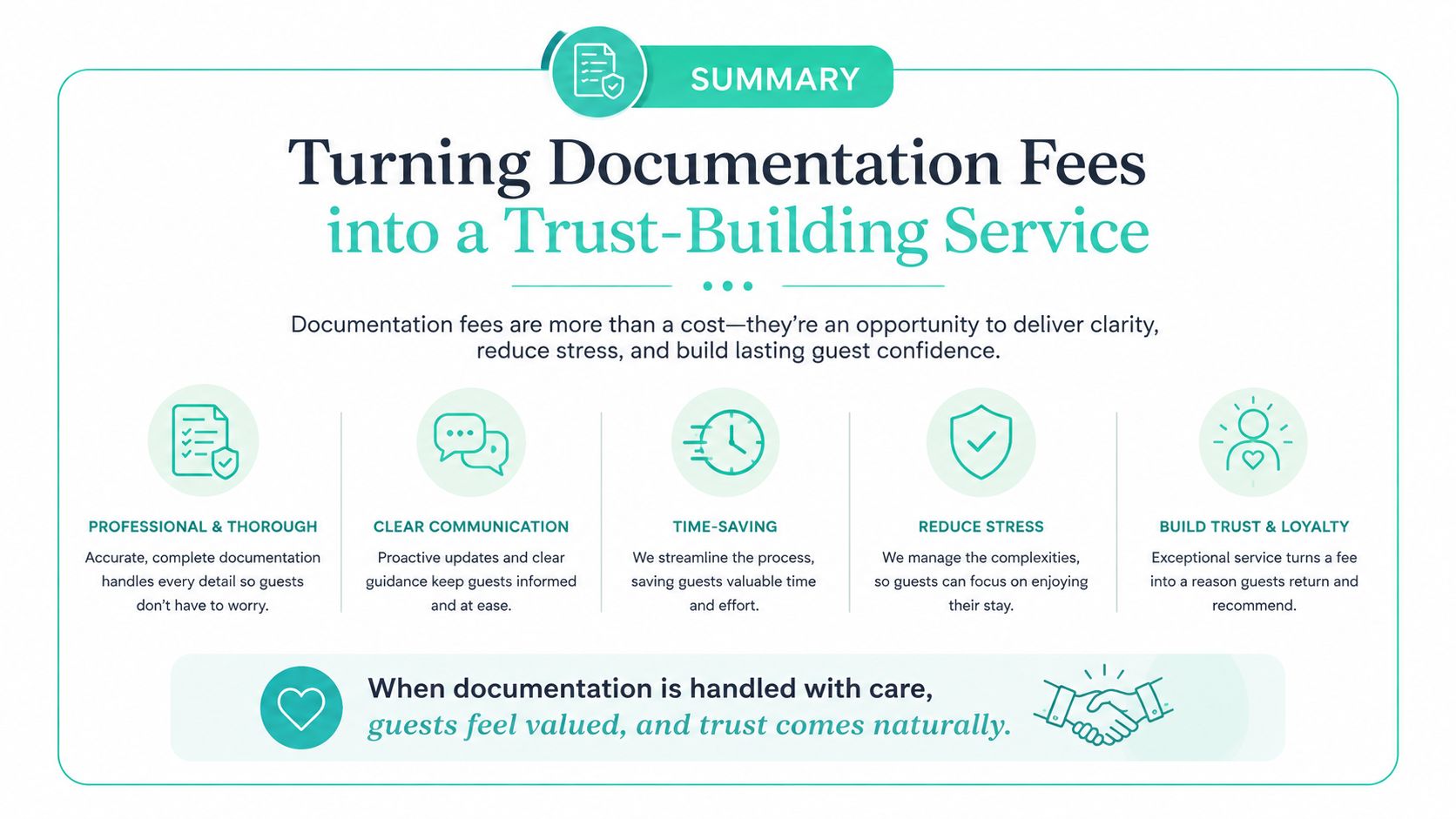
A well-run documentation fee does more than cover admin time. It signals that the practice has a process, understands the rules, and respects the owner's time enough to make the paperwork feel orderly. That's the part clients remember when they recommend the clinic to the next person who's trying to fly with a nervous little suitcase of a cat.
What success looks like
Revenue matters, but it isn't the only signal. Fewer billing questions, fewer rewrites, faster turnaround, and more repeat travel clients usually tell you the process is working. If owners stop asking what the fee is for, your explanation is probably doing its job.
The best practices are simple enough to implement without a full systems overhaul:
Update the front desk script so staff explain the fee before the paperwork starts.
Standardize invoice language so every client sees the same breakdown.
Keep file notes consistent so anyone can trace what the fee covered.
Use a tracking system to reduce missed steps and manual errors.
Clear pricing doesn't make the work smaller. It makes the work easier to trust.
That's the main shift. A documentation fee should not feel like a mystery charge stapled onto a pet travel file. It should feel like a professional, understandable part of a specialized service that helps the trip go right the first time.
If your practice wants to make pet travel easier to manage, Passpaw can help organize the workflow, keep clients informed, and bring more consistency to how documentation fees are presented and tracked. Start there, and make the paperwork feel less like chaos and more like a service your team can stand behind.

More articles
From regulatory changes to best practices for veterinarians and pet owners, our resources keep you ahead of the curve.