Are you a team member in a veterinary practice?
Are you a pet parent planning a trip with your furry pal?
How Much Is An International Health Certificate For Dogs
For most dogs leaving the United States, an international health certificate usually ends up costing about $500 to over $1,100. That range is wide because the final bill isn't one flat fee. It's a stack of moving parts tied to your destination, your timing, and how much paperwork and testing your dog's trip requires.
If you're planning a move, a long trip, or a one-time international flight with your dog, you've probably already noticed that simple answers are hard to find. One clinic lists a base fee. Another mentions USDA endorsement. A third talks about testing, timing windows, and destination rules that sound like alphabet soup.
That confusion is normal. In practice, how much is an international health certificate for dogs depends less on the form itself and more on the process behind it. The certificate is really the final output of veterinary review, regulatory paperwork, possible lab work, and government endorsement.
For standard destinations, typical out-of-pocket costs from 2022 to 2025 rose to roughly $510 to $560, while more demanding destinations such as Australia or Hawaii often land around $800 to $1,100 or more, according to Paws Abroad's cost guide for pet travel certificates.
Your Dog's Passport to the World
Travel planning gets expensive fast. Flights, crates, hotel policies, airline rules, import paperwork. Then the dog's documents come into focus, and many owners assume the health certificate will be a quick office visit and a signature.
Usually, it isn't.
What catches people off guard is that the certificate cost behaves more like an airline fare than a basic form. There's the base service, then the official endorsement, then any destination-specific add-ons. If your route is simple, the bill may stay near the lower end. If your destination has tighter import controls, the cost climbs.
Why one price quote rarely tells the whole story
A clinic may quote the appointment fee, but that doesn't always include every piece of the trip prep. Some countries require more declarations, more checks, or more supporting records. Others are relatively straightforward. That difference changes the amount of staff time, document handling, and government processing involved.
Here's the part I wish more owners heard early: the price itself isn't random. It's usually a reflection of regulatory complexity.
Practical rule: If two dogs are flying from the same U.S. city but heading to different countries, they can have very different certificate costs even when they see the same veterinarian.
Think of the certificate as a compliance package
The health certificate is the document you see. The work behind it is what you pay for.
That package often includes:
Veterinary review: A USDA-accredited veterinarian has to evaluate whether your dog meets the importing country's rules.
Document preparation: Staff have to match your dog's records to the destination's required format.
Possible testing and declarations: Some countries want very little. Others want a lot.
Official endorsement: The USDA endorsement is a separate government step, not just clinic paperwork.
Once owners understand that, the cost starts to make sense. It still may not make anyone wag their tail, but it stops feeling arbitrary.
Deconstructing the Cost of a Dog Health Certificate
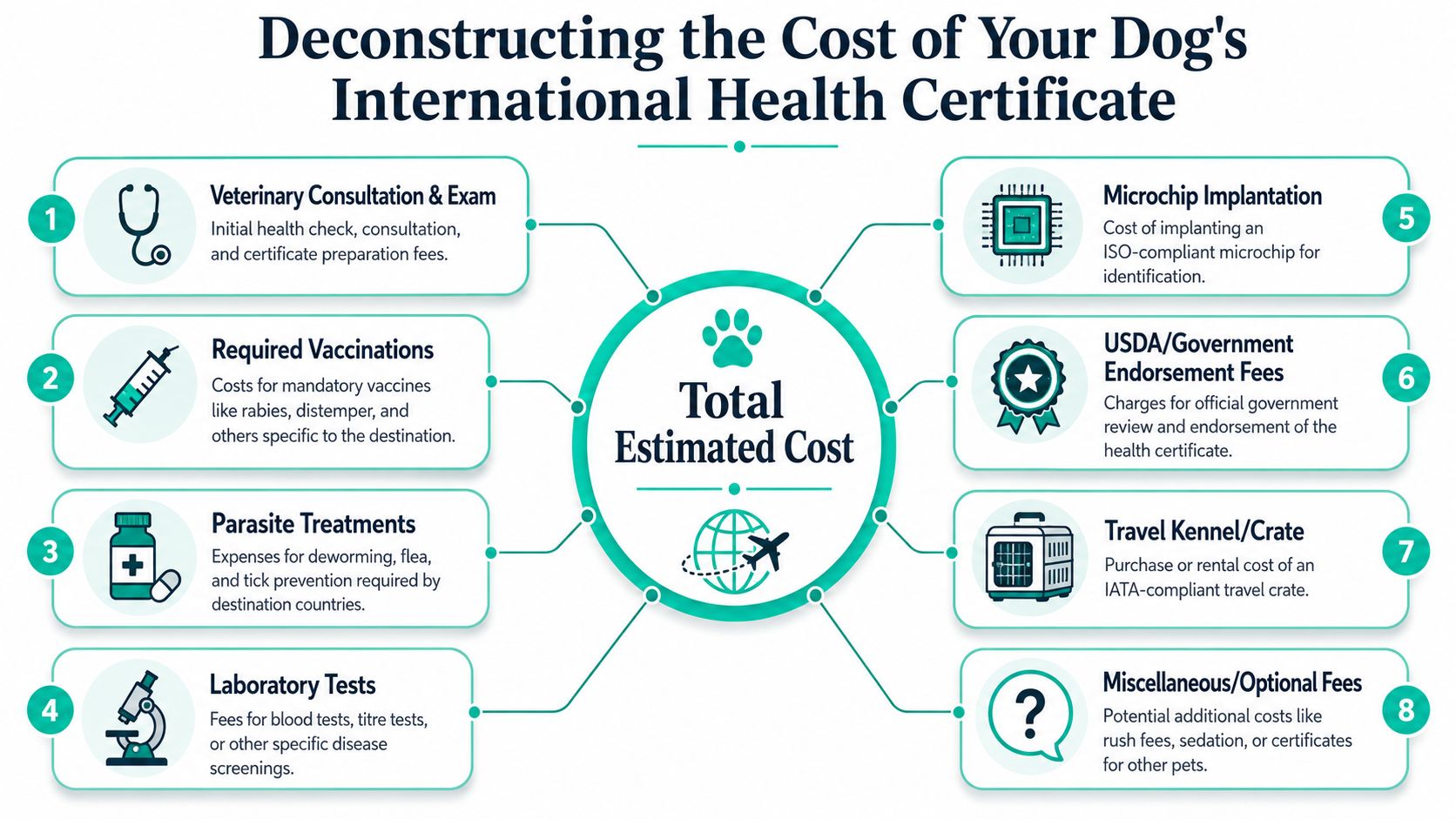
The cleanest way to understand the bill is to itemize it. It's comparable to a vet invoice combined with a government filing. You're not paying for a single stamp. You're paying for a chain of services that has to be accurate and timed correctly.
The veterinary side of the bill
Most clinics charge for the exam, the certificate preparation itself, and the staff time needed to assemble and review documents. The pricing can vary a lot by practice and destination.
One example in the verified data shows average veterinary exam and paperwork starting around $200, while some clinics list international certificate services much higher. Another example notes a metropolitan clinic charging $750 for the international health certificate appointment itself, with endorsement charged separately, as summarized in this pet travel certificate cost breakdown.
You may also see clinics use destination categories or service bundles. That usually reflects how much work the team expects to do based on the country's rules.
The USDA endorsement is its own cost center
The part many owners miss is the USDA endorsement fee. That is not a clinic-invented charge. It's a separate government fee structure published by APHIS, and it changes based on how many laboratory tests are required for the certificate.
According to the USDA APHIS endorsement fee schedule for pet travel documents, the fee is:
No lab tests: $101 per certificate
One to two tests: $160 for the first pet, plus $10 for each additional pet
Three to six tests: $206 for the first pet, plus $18 for each additional pet
Seven or more tests: $275 for the first pet, plus $21 for each additional pet
That scale matters because it creates a predictable baseline inside an otherwise variable bill. If your dog's destination requires no tests, the endorsement piece is much lighter. If the destination triggers several tests, the endorsement jumps accordingly.
The USDA fee doesn't care whether the destination feels "easy" or "hard" to an owner. It cares about the number of required tests tied to that certificate.
What owners often bundle together by mistake
People often say "the certificate costs X," but they may be mixing together several categories:
Cost component | What it covers | Why it varies |
|---|---|---|
Veterinary exam and review | Health check and record review | Clinic pricing and case complexity |
Certificate preparation | Form completion and administrative handling | Destination paperwork requirements |
Lab-related requirements | Tests and supporting documentation when required | Country rules |
USDA endorsement | Official government review and endorsement | Number of tests and pets |
This is why a quote from one clinic isn't always easy to compare to another. One estimate may include more of the process upfront, while another starts with a lower base and adds pieces later.
How Your Destination Determines the Final Price
If there's one factor that shapes the bill more than anything else, it's where the dog is going.
Many veterinary teams sort countries into practical "levels" because the process changes so much from destination to destination. In the verified data, veterinary practices often price Level 1 countries such as Canada from around $400, while Level 3 countries such as Australia start around $600 or more, before numerous lab tests are added, according to this overview of pet health certificate costs by destination level. That same source notes the USDA endorsement fee can jump by 2.7x depending on destination-specific testing requirements.
Why clinics use tiers
Tiering isn't about being fancy. It's about setting expectations.
A lower-complexity destination may involve relatively limited paperwork. A higher-complexity destination can trigger more declarations, tighter timing windows, and more supporting requirements. That means more chances for cost to rise before the dog ever gets near the airport.
For owners going south, this can be especially useful to understand early. If your route includes Mexico, destination rules matter enough that it's worth reviewing a country-specific overview like this guide to a health certificate for dogs traveling to Mexico.
Sample cost variation by destination complexity
Complexity Tier | Example Destination | Key Requirements | Estimated Cost Range |
|---|---|---|---|
Level 1 | Canada | Lower-complexity certificate preparation | Starting around $400 |
Level 2 | Moderate-rule destination | More supporting requirements and possible testing | Higher than Level 1, varies by country |
Level 3 | Australia | High-complexity preparation, often numerous lab tests | Starting at $600 or more before numerous lab tests |
The point isn't that every country fits neatly into a perfect box. It's that cost usually rises with complexity.
What works and what doesn't
What works is asking your clinic a direct question: How does this destination affect the level of certificate work? Good travel prep starts there.
What doesn't work is pricing the trip as if every country uses the same import model. That's how owners end up budgeting for a routine certificate and discovering later that their chosen destination is a paperwork mastiff, not a paperwork Chihuahua.
Watch Out for These Hidden Cost Drivers
You get the flight booked, the crate measured, and the pet fee paid. Then the paperwork review starts, and the budget shifts. In practice, the biggest surprise costs usually come from timing mistakes and country-rule mismatches that were caught too late.
Rush fees can bite hard
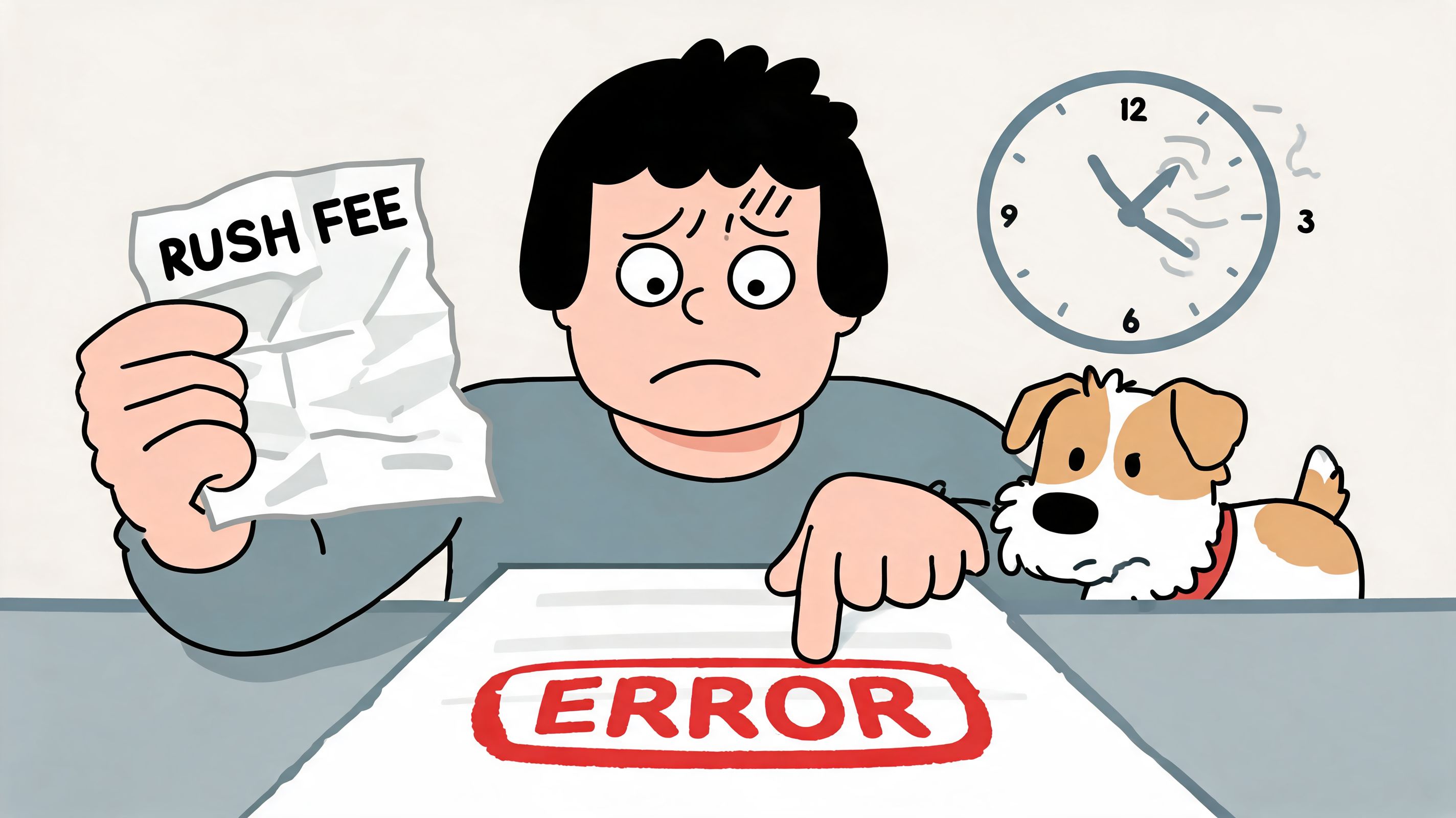
A standard certificate fee only reflects a case that arrives on time, with usable records, inside the clinic's normal workflow. Once the travel window gets tight, clinics often have to review records faster, coordinate endorsements under pressure, and rework schedules to fit the case in.
Clarendon Animal Care's international paperwork policies are a good example. Their published guidance notes that failing to submit prep work at least five business days before the appointment can add a $285 rush fee, which rises to $365 with even shorter notice. They also list a $25 rescheduling fee within one week, based on the policies described by Clarendon Animal Care for international travel paperwork.
The practical point is straightforward. Delay costs money.
As that same guidance notes, a simple lack of preparation can raise the certificate cost substantially. That is why I tell owners to treat the timeline as part of the medical paperwork, not as an admin detail.
Corrections create costs even before a clinic sends a bill
International pet documents have very little tolerance for small inconsistencies. A vaccine date that does not line up with the destination window, a microchip number copied incorrectly, or a missing lab result can force a file back into review.
Sometimes that means a direct fee. Sometimes it means staff time, a missed endorsement slot, or a new appointment because the certificate can no longer be issued inside the valid window. Those are real costs whether they appear as a line item or not.
Here, country-specific rules hit the budget. A correction for one destination may be minor. The same correction for a country with narrow timing rules can trigger overnight shipping, expedited review, or repeated paperwork.
The hidden charges usually start before the exam
The expensive part is often not the appointment itself. It is the chain reaction that starts when the record set is incomplete or the itinerary changes after the plan was built.
Common examples include:
Incomplete vaccine and microchip records: Staff cannot verify compliance quickly if the history is scattered across old invoices, emails, and multiple clinics.
Late intake forms: Problems that could have been caught early show up during the final review, when every revision is more expensive.
Flight or route changes: A new transit country can create different timing, treatment, or endorsement requirements.
Rescheduling: Even a small date change can push the certificate outside the acceptable travel window and require documents to be reissued.
Owners who want a clearer picture of these budget traps should read this breakdown of the hidden costs of pet travel that many owners and vets discover too late-don-t-realize-until-it-s-too-late).
Good planning also protects the dog, not just the budget. If you are reviewing the travel setup from a safety angle as well, this guide explains how to ensure safe dog trips.
The owners who spend less are usually not the ones who found the cheapest starting quote. They are the ones who started early, matched the timeline to the destination's rules, and kept every document organized in one place so problems were caught before they became rush charges.
Smart Ways to Plan and Reduce Travel Costs
The cheapest international health certificate isn't always the one with the lowest starting quote. It's usually the one that avoids rework, rush processing, and destination surprises.
That means planning early, choosing the right veterinary support, and keeping every record in one place before the travel window gets tight.

Start with the process, not the plane ticket
Owners often book flights first and sort out pet compliance second. That's understandable, but it can create expensive friction. A better approach is to confirm the dog's travel requirements early, then build your trip around the timeline those rules demand.
That same mindset helps with the human side of travel too. If you're coordinating a longer trip and want broader budgeting ideas, this guide on how to maximize value on international business travel has practical tips that pair well with pet planning.
Choose experience over the cheapest base fee
A low quote can look attractive until the case turns out to be more complicated than expected. For international travel, what matters most is a clinic or coordinator that handles pet travel paperwork regularly, understands destination-specific requirements, and asks detailed intake questions upfront.
Look for signs of a strong process:
Clear document checklist: You should know what records the clinic needs before the visit.
Destination-specific screening: The team should ask where the dog is going, not just when you're leaving.
Timeline awareness: Good teams work backward from the travel date.
Communication habits: You want updates before a problem becomes urgent.
Use tools that reduce manual error
Once cases get more complex, spreadsheets, email chains, and memory aren't enough. For these scenarios, a purpose-built platform can help.
Passpaw is one option used to simplify international pet travel paperwork. It helps veterinary teams manage destination regulations, validate documents in real time, prioritize tasks by travel date, and keep client communication organized. In practical terms, that means fewer missed steps and better visibility into the pieces that often drive cost. If you're comparing the broader picture of travel expenses, this overview of pet transport costs and what shapes them is also useful context.
Good planning doesn't make the rules disappear. It makes the costs easier to predict.
A simple planning checklist that actually works
You don't need a heroic system. You need a consistent one.
Confirm the destination first. Country rules drive the work.
Book with a travel-savvy veterinary team. Experience matters more than a low teaser price.
Gather records early. Vaccine records, identification details, and prior paperwork should be easy to access.
Leave room for review. Tight timing invites mistakes and rush fees.
Track every step in one place. That's especially important when multiple people are involved.
Owners who do this usually spend less energy on surprises. They also make life much easier for the veterinary team trying to get everything right the first time.
A Smooth Journey Starts with Good Planning
The key to understanding how much is an international health certificate for dogs is that the price reflects a process, not just a form. The certificate sits at the end of a chain that includes veterinary review, destination-specific requirements, government endorsement, and careful timing.
That can feel like a lot when you're already planning an international trip. But once you understand what drives the bill, the process gets far less mysterious. You stop chasing a single magic number and start managing the factors that move the cost up or down.
The value isn't just in the paperwork
A well-managed certificate process protects more than your budget. It protects your timeline, your bookings, and your dog's travel experience.
For the travel day itself, owners often need a separate safety plan beyond the documents. This guide on how to ensure safe dog trips is a helpful companion to the paperwork side of preparation.
What to remember before you book
Keep these points in mind:
Destination rules shape cost: Not all countries ask for the same level of preparation.
Timing matters: Waiting too long can turn an ordinary case into a rush case.
Accuracy matters just as much: Clean, complete paperwork is often the most cost-effective path.
Good systems help: Organized records and clear communication reduce last-minute scrambling.
If you approach the certificate as part of your travel plan rather than a last checkbox, the whole trip goes more smoothly. That's good for your budget, good for your veterinary team, and very good for the dog who has no idea why everyone is discussing paperwork instead of treats.
If your clinic or travel team wants a more organized way to handle international pet paperwork, Passpaw provides tools for managing destination requirements, validating documents, and keeping pet owners informed throughout the certificate process.

More articles
From regulatory changes to best practices for veterinarians and pet owners, our resources keep you ahead of the curve.