Are you a team member in a veterinary practice?
Are you a pet parent planning a trip with your furry pal?
Compliance Automation Software for Pet Travel
A dog is booked for Spain in six weeks, and the team is still matching a microchip number, a rabies date, and a certificate window that can close quickly. The owner is hopeful. The front desk has three PDFs open. The veterinarian hasn't opened the file yet.
Pet travel paperwork looks like one form until a date slips. The chip has to come before the vaccine. The vaccine has to sit through a waiting period. The certificate has its own short window. Treat those as linked clocks, plus a human review, not as a green light on a dashboard and not as a software verdict that the pet may fly.
Compliance automation software can put those clocks on a shared task list. It doesn't sign the certificate, and it doesn't promise a border will accept the file. A named person still checks the odd case.
Why Clinics Outgrow Spreadsheet Checklists
A Spain file may sit in a shared spreadsheet beside a folder of PDFs. The sheet works until the travel date changes, a requirement is updated, or the details on an uploaded document do not match the pet's record.
Compliance automation software can organize destination requirements, travel dates, and pet information into tasks with due dates. Passpaw's rules engine builds requirements, sequencing, and deadlines from those details, while its document checks flag errors and mismatches for review.

A spreadsheet is not careless; it is a practical way to track work until edits and document versions become hard to follow. Good veterinary record keeping preserves the medical history. Travel paperwork adds deadlines and destination-specific steps that need to be coordinated with those records.
One general estimate, not specific to animal-health certificates, comes from Vanta's compliance statistics: organizations may save roughly three to five hours per week by automating compliance tasks. For a clinic, the more useful question is which handoffs and reminders software can manage, and which decisions should stay with the veterinarian.
Agencies coordinating travel for several animals may also find tour management tools for 2026. In a clinic, naming the separate clocks makes it easier to see which tasks software can carry and where veterinary judgment remains necessary.
The Separate Clocks on a Pet Travel File
A dog's rabies vaccine, health certificate, and departure date each run on a different clock. A file can meet one deadline and still be out of sequence on another, so check the dates as a connected timeline.
Checkpoint | Typical timing | What must already be true | Why one expiry date fails |
|---|---|---|---|
EU animal health certificate for entry from a non-EU country | Issued no more than 10 days before arrival | Official state veterinarian issues it | It supports onward EU travel for a limited period under the rules, and ends when the rabies vaccination expires |
EU first rabies vaccination | Wait at least 21 days before travel | Microchip implanted before the rabies vaccination | A tattoo counts only if applied before 3 July 2011 |
Dog entering or returning to the United States | Rules in force since 1 August 2024; CDC Dog Import Form recommended 2 to 10 days before arrival | At least 6 months old and ISO-compatible microchip before any required rabies vaccination | First or lapsed rabies vaccine must be given at least 28 days before arrival, and rules also depend on the prior 6 months of travel |
USDA endorsement and travel window | Destination may allow only a short period, such as 30 days, after the accredited veterinarian signs | Endorsement date is separate from the veterinarian signature date | The full process may take a few weeks to many months, so planning starts from the departure date |
How to read an EU row
For travel from a non-EU country into the European Union, Your Europe's pet travel guidance says an EU animal health certificate must be issued by an official state veterinarian no more than 10 days before arrival. The certificate can also support onward travel within the EU for a limited period set by the rules. That period ends when the rabies vaccination expires.
The next row describes a separate clock. The pet must be microchipped before receiving the rabies vaccination. A readable tattoo may qualify only if applied before 3 July 2011. After a first rabies vaccination, the owner must wait at least 21 days before travel. The order matters: identify the pet, vaccinate, wait, then meet the certificate window.
UK day counts and US dog entry
For travel to the UK, government animal health certificate guidance says the certificate is valid for 10 days after its issue date, with the issue date counted as day 1. If the pet needs a first rabies vaccination, the owner waits at least 21 full days before the certificate can be issued for travel, counting the day after vaccination as day 1. After arrival in the EU, the certificate may support onward travel for a limited period set by the rules, ending when the rabies vaccination expires. “Valid” can refer to different stages of the trip.
Dogs entering or returning to the United States follow another set of requirements. Since 1 August 2024, CDC dog importation rules require the dog to be at least 6 months old, with an ISO-compatible microchip implanted before any required rabies vaccination. Other requirements depend on countries visited in the previous 6 months and where vaccination occurred. Travelers submit a CDC Dog Import Form. CDC recommends completing it online 2 to 10 days before arrival, though it may be completed immediately before travel if internet is available. A first rabies vaccination, or a vaccine after coverage has lapsed, must be given at least 28 days before arrival.
A timeline can flag a sequence that needs attention. A person still needs to review unusual cases, older tattoos, lapsed vaccines, and travel history that does not match the form. A pet travel application deadline checklist can help teams assign each date to a clear next step.
Features That Turn Rules Into Dated Tasks
Features are jobs, not a buzzword list. Each job replaces a habit the clinic already has, and none of them removes the veterinarian from the file.

Workflow job | Usual manual habit | What software adds |
|---|---|---|
Build the requirement list | Staff reread government pages for each trip | A rules engine uses destination, dates, and pet details to build requirements and due dates |
Keep tasks in order | Memory, sticky notes, or a spreadsheet | Sequencing, due dates, and checks that required tasks are complete |
Check uploaded records | Someone eyeballs each PDF | Real-time checks for errors and mismatches with the pet data entered |
Prepare the certificate | The same fields are typed again | The form fills after prerequisite tasks are marked complete |
Keep a history | Email threads and shared folders | A time-stamped trail of corrections and status changes |
Show the client what is left | Phone calls and repeated messages | A shared status both practice and owner can follow |
A light on the file, not a yearly printout
Think of the file as getting a dashboard light, not only a report printed once a year. IBM's explanation of compliance automation describes software that can collect evidence, map a requirement, test whether a control is in place, and keep a timestamped trail. The same design point still holds in a clinic. Destination rules can be structured requirements. Missing items can become tasks. Every correction can be an event with a time on it.
Unclear rules and exceptions stay with a person. Software can show that a chip number doesn't match. It can't decide what an odd government footnote means for this pet.
Our rules engine reads each client's destination, travel dates, and pet details, then builds the requirements, sequencing, and due dates. We keep task order, due dates, and checks that required steps are done. After those prerequisite tasks are marked complete, the health certificate form fills so staff aren't retyping the same fields. Passpaw is one example of that pattern, not a substitute for the veterinarian's read of the form.
Other industries use the same shape of work. Safety teams describe managing WHS obligations with compliance software as turning published duties into tasks people can see. A clinic's version is narrower. It's chip, vaccine, wait, certificate, and a shared view of what's still open.
What a Veterinary Team Actually Gains
The gain isn't a longer feature menu. It's a cleaner split of work on a busy day.
Support staff can run the dated checklist. The veterinarian's time stays on the exam and the certificate review. A technician can chase a missing rabies scan while the doctor is in the room with the next patient. The file moves without waiting for a gap in the appointment book.
Early mismatches cost less than late ones. A chip number that doesn't match, or a waiting period that's a few days short, is easier to fix before an endorsement window gets tight. The rework is a phone call and a new upload, not a restarted government packet.
An international health certificate visit often bundles an exam, diagnostics, vaccines, and documents. That's a natural moment for parasite treatment and follow-up the pet may already need. The visit can serve health as well as paperwork, and it can be a team-led service rather than a doctor-only burden. Practices weighing that service can read why pet travel can fit a practice's business without treating paperwork volume as the goal.
Owners stay in the loop. They can see which document or date is still open instead of waiting for a surprise call the week of travel. Fewer "did you get my email?" messages, because the open item is visible.
One hospital told us health certificates that used to take a large part of the day now feel more organized and less stressful. "Passpaw has completely transformed the way our hospital handles health certificates. What used to be one of the most time-consuming parts of our day now feels streamlined, organized, and stress-free." That's one hospital's experience, not proof that every clinic will feel the same.
None of this says the software makes a trip compliant. The gain depends on complete source records and a named person for exceptions. If the vaccine date was never entered, the checklist can't warn you that the wait is short.
One EU Trip From Intake to Review
Say a fictional dog, Miso, needs to fly from the United States to Spain in eight weeks. The file moves in order, and each beat has an owner.

Intake captures the facts. Destination, travel dates, microchip, vaccine history, and owner contacts go in one place. Empty fields are visible on day one, not the week of the flight.
The workflow sets the order. Identity first, rabies record second, the 21-day wait third, and the certificate window last, aiming for an official certificate no more than 10 days before arrival.
Staff upload the rabies certificate. The scan sits against the pet record already entered, not in a side folder nobody opens.
A mismatch becomes a task. If the chip number on the certificate doesn't match the entered record, the workflow assigns an owner and a due date. It doesn't sit unnoticed inside a PDF.
The veterinarian reviews before any signature. Once prerequisite tasks are complete, certificate fields fill. The veterinarian reads them before a signature or a government submission.
Why the calendar runs backward
USDA's pet travel process overview warns that paperwork can have a short endorsement and travel window after an accredited veterinarian signs the health certificate. Depending on the destination, there may be only a limited period, such as 30 days, for USDA endorsement and travel before the destination country stops accepting that certificate. USDA also says the full process may take from a few weeks to many months. That's why planning starts from the departure date, and why the signature date and the endorsement date are not the same stamp.
Software can line the file up. The veterinarian still decides what to sign. If Miso's flight moves, the certificate window and the appointment dates need another look before anyone treats the old due dates as safe.
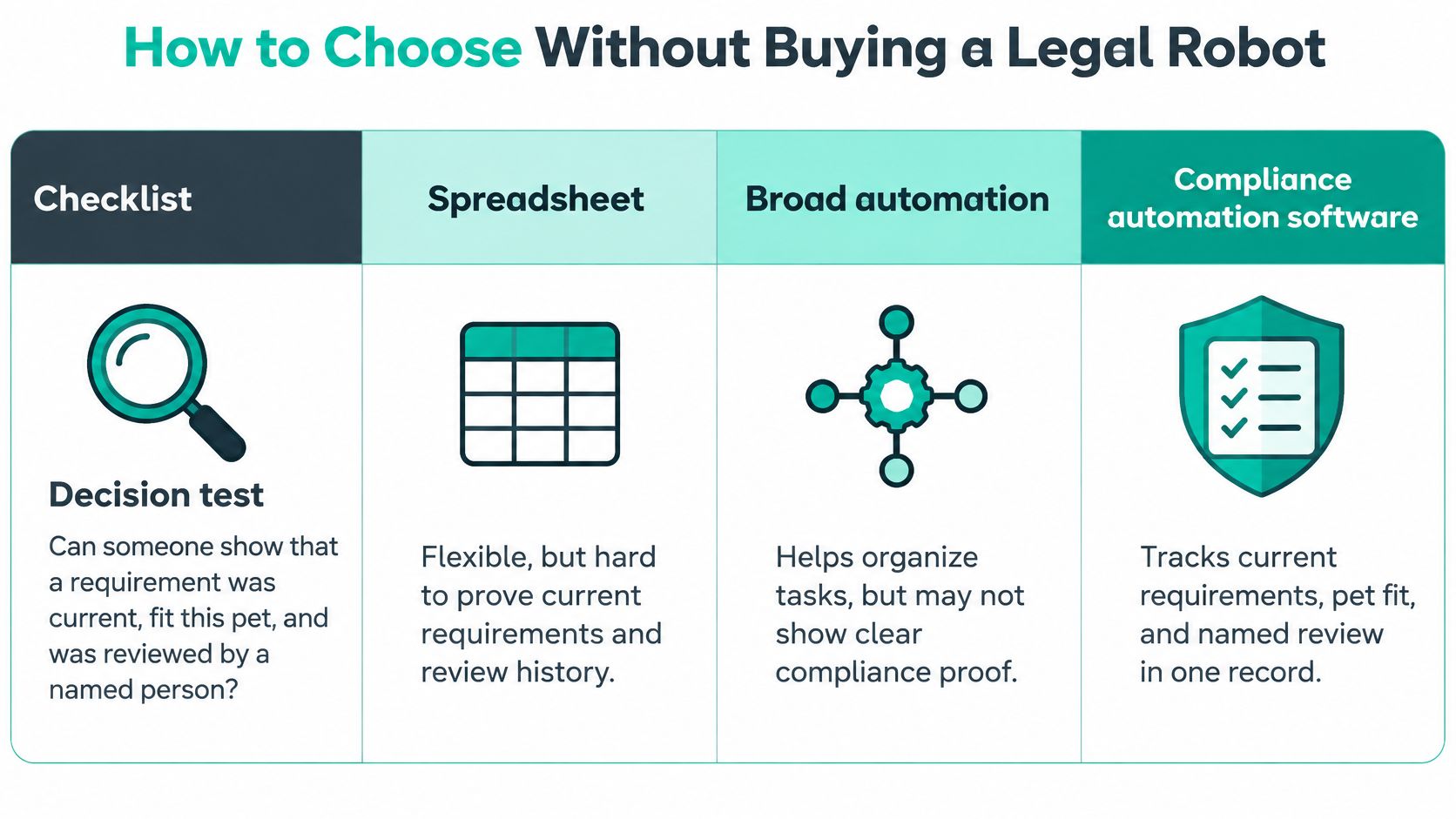
How to Choose Without Buying a Legal Robot
The decision test is simple. Can someone show that a requirement was current, fit this pet, and was reviewed by a named person? If the answer is a shrug, the tool is a faster spreadsheet.
Question to ask | Spreadsheet or shared folder | Broad compliance suite | Pet-travel workflow tool |
|---|---|---|---|
Who updates destination rules | Staff, whenever someone notices a change | Often an internal compliance team | A rules engine and country guidance maintained for the workflow |
What happens when a document fails | A person must notice it | A control may be flagged for later review | A task, owner, and travel-based due date can be created |
Who makes the final call | The veterinarian, if the file reaches them | Not built around a health certificate signature | The veterinarian reviews and signs; software does not replace that judgment |
Who enters pet and travel data | Whoever has the spreadsheet | Set up differs by configuration | Self-service entry by practice or client, or a concierge data-entry option |
How cost shows up | Staff time, mostly hidden | Enterprise license and setup | Flat service fees, with platform access for client and practice on listed plans |
US export handoff | Manual login and retyping | Usually not specific to VEHCS | A browser extension may be used with VEHCS and Login.gov |
When a fixed rule beats a chatty tool
AI can summarize a long page or sort a task list. It shouldn't decide that a pet is eligible. In the PwC 2025 Global Compliance Survey, two-thirds of respondents believe compliance requirements limit AI adoption, 56% cite data reliability and quality as a challenge, 32% are not piloting or using AI for compliance activities, and, separately, 38.8% of organizations reportedly still lack a formal AI-risk review process. For vaccine timing, pet identity, government forms, and destination deadlines, a fixed rules workflow is the safer path.
Clinics comparing products can start with a veterinary software comparison, then ask how a failed check gets an owner. Teams buying general approval tools can also compare approval workflow software and notice what those tools don't know about a health certificate.
On our self-service tier, the practice or client enters pet, owner, and travel details and uploads records such as rabies certificates. The veterinarian completes and submits the health certificate to USDA through VEHCS, the USDA's online system for export health certificates, using our browser extension. Login.gov is the government sign-in step staff may need to pass through. On Concierge, records are sent to us and entered into the forms for the practice. We charge flat fees. No tier guarantees that a country will accept the certificate.
Ask where pet and owner records are stored, who can see them, and how they're protected. These files include personal contact details. Ask every vendor, in writing, who updates destination rules and how quickly a change reaches the workflow.
Pilot One Real Case Before Buying
A practice with no compliance-IT team doesn't need a full rollout to learn if a workflow helps. Start small enough that a missed field is obvious.
Pick one destination you already see. EU entry or a dog returning to the United States is enough. Don't boil the ocean of every country page on week one.
List the records you already collect. Vaccination history, microchip details, owner information, and travel dates. If a field is usually missing, write that down before any software demo.
Name one person who owns exceptions. When a date or document doesn't match, that person gets the task. A shared inbox isn't an owner.
Run five past cases. Note which missed waits or mismatched numbers the workflow would have flagged. Old files are kinder teachers than a live departure.
Keep veterinarian review on every certificate. Automatic field fill doesn't change who reads the form before a signature.
Book a demo only after those five cases. Use that destination and those files, not a generic tour. Practices can schedule a demo once the sample is ready.
A tidy dashboard built on missing records creates false comfort. Connector coverage matters less than whether the chip date, vaccine date, and travel date are present. Customization, training, and rule updates are real work, so keep the pilot to one route.
We collect inputs such as vaccination records and check them against the destination country's requirements. Real-time document checks are meant to complement the practice's own validation, not replace it.
The pass mark
Pick one trip already on the calendar this month. Confirm the destination, travel dates, microchip record, and vaccine documents sit in one place. Mark the next dated task and its owner. Software organizes requirements and documents. The veterinarian and the government process still decide what is accepted.
You've passed the pilot when the team can point to the current task, its due date, and the person responsible.
Passpaw helps veterinary teams turn destination rules, travel dates, and pet records into dated tasks, document checks, and a certificate the veterinarian still reviews. If your clinic is matching chip numbers and certificate windows by hand, see how the workflow fits a real file at Passpaw. Bring one upcoming trip and the records you already have.

More articles
From regulatory changes to best practices for veterinarians and pet owners, our resources keep you ahead of the curve.