Are you a team member in a veterinary practice?
Are you a pet parent planning a trip with your furry pal?
Australian Wolf Dog: The Dingo Story Explained
What exactly is an Australian wolf dog? The name sounds as if it describes a wolf living in Australia, or perhaps a modern wolfdog breed. In most cases, it points to something quite different: the dingo, Australia's distinctive wild canid.
That small change in terminology matters. A dingo, a gray wolf, and a deliberate wolfdog cross may share ancestry and a few dramatic traits, but they aren't the same animal. Their histories, behaviour, care needs, and legal treatment can differ sharply, so the first step is working out which animal the phrase describes.
What People Mean by Australian Wolf Dog
The phrase Australian wolf dog is best understood as a historical and biological description of the dingo, not as the official name of a modern pet breed. People have used wolf-like language for dingoes because these animals have pointed features, strong hunting instincts, group behaviour, and vocalisations that can sound more wild than those of a familiar domestic dog.
The word can hide three separate ideas:
The dingo, an ancient Australian wild canid.
A wolfdog, meaning an animal produced by crossing a gray wolf with a domestic dog.
An imagined Australian wolf, even though the dingo's story doesn't make it a population of gray wolves.
The safest plain-language answer is simple: when someone asks about an Australian wolf dog, they usually mean a dingo. The dingo is sometimes described as an Australian wolf or wolf-like dog, but those labels describe appearance and history rather than proving that the animal is part wolf.
Genetic research places dingoes within the wider dog lineage that ultimately shares ancestry with gray wolves. At the same time, researchers identify dingoes as an early, geographically distinct lineage rather than a recent designer cross. The genomic research on dingo ancestry helps explain why the animal can look familiar while still behaving unlike a typical household dog.
The useful translation: “Australian wolf dog” usually means “dingo,” while “wolfdog” usually means a deliberate wolf and domestic-dog cross.
There's one more complication. Dingoes and domestic dogs can interbreed, and many dingo populations now contain domestic-dog ancestry. That means a photograph, a nickname, or even a casual description may not tell you exactly what animal you're looking at. Biology doesn't always fit neatly into a kennel-club label.
How Dingoes Arrived in Australia
The dingo's story begins long before European colonisation. Ancestral canids reached Australia from Asia at least roughly 3,500 years ago, according to archaeological and genetic interpretations. Some historical readings place the arrival window more broadly, at 5,000 to 8,000 years ago, depending on which evidence researchers use. The archaeological review of the dingo explains why the timeline is often presented as a range rather than one perfectly settled date.
The leading biological picture is not of modern gray wolves stepping directly into Australia. Instead, dingoes are associated with an old dog lineage from East Asia. Their ancestors likely travelled through the island world north of Australia, using human-linked movement routes through Indonesia and the region of Papua New Guinea before reaching the Australian mainland.

The geography of Tasmania adds an important clue. Tasmania separated from mainland Australia around 11,000 years ago, before dingoes arrived in the region. As a result, dingoes never reached Tasmania under natural conditions. That fact helps explain why the dingo is a mainland Australian story, not a native Tasmanian wolf-dog story.
European colonisation began in 1788, with the arrival of the First Fleet. Dingoes were already established in Australia long before that event. Domestic dogs arrived with the First Fleet and later populations, creating opportunities for hybridisation after European contact.
This sequence gives the dingo a distinctive place in Australian history. It isn't a modern breed developed by crossing a wolf with a dog, and it isn't just a recently escaped household pet. It is an ancient, free-living dog-line canid whose Australian history spans millennia, followed by later contact and admixture with domestic dogs.
What Dingoes Look and Act Like
A dingo has a lean, athletic outline rather than the heavy build many people associate with large domestic dogs. Reported measurements include a head-to-body length of 860 to 1,220 millimetres, a shoulder height of 440 to 630 millimetres, and a body mass of 9 to 25 kilograms. Size varies with region, sex, and living conditions, so a single photograph can't establish whether an animal is a dingo.
The animal's pointed ears, bushy tail, and alert posture contribute to the “Australian wolf dog” nickname. Its appearance can overlap with domestic dogs, especially where dingo and dog ancestry have mixed. Behaviour and reliable records are therefore more useful than looks alone.
Dingoes retain several wild-canid traits. They can live in social groups with dominant breeding pairs, cooperate while hunting, and switch prey according to body size and local circumstances. They may hunt larger prey such as kangaroos and wallabies, which requires coordination and persistence rather than the routine behaviour of a companion dog chasing a toy.
Life stages and daily rhythm
Dingo pups can become independent at about four months, while females mature at around two years. Gestation lasts roughly 63 days. These milestones reflect a wild animal adapting to seasonal food, territory, and social pressures rather than a pet breed shaped for close human dependence. The dingo husbandry fact sheet provides these biological benchmarks.
Dingoes are often more cautious around unfamiliar people than ordinary domestic dogs. They can be territorial, highly motivated by prey, and difficult to predict in settings that don't meet their environmental needs. They also use a varied vocal repertoire, including yips and howls, rather than behaving like a dog that mainly barks for human attention.
Trait | Dingo | Typical wolfdog, such as Saarloos or Czechoslovakian |
|---|---|---|
Ancestry | Ancient Australian dog-line canid | Deliberate wolf and domestic-dog ancestry |
Build | Lean, agile, and adapted to free-living conditions | Varies with breed line and wolf ancestry |
Social needs | Social groups, territorial behaviour, and strong pair bonds | Social needs vary, often with intense attachment and sensitivity |
Vocal behaviour | Yips, howls, and other wild-canid sounds | Howling and other vocalisations may be prominent |
Human interaction | Often cautious or aloof with unfamiliar people | Can be demanding, wary, or highly alert |
Identification | Appearance alone is unreliable | Breed records and lineage are important |
At a glance, a dingo may resemble a wolfdog. That resemblance is not proof of wolf ancestry. A secure identification needs context, location, records, and sometimes genetic analysis.
Dingo, Wolf, and Wolfdog Compared
These three animals belong to related branches of the dog family, but related doesn't mean interchangeable. The dingo is an ancient Australian lineage. The gray wolf is a wild wolf lineage. A wolfdog is defined by ancestry that combines a gray wolf with a domestic dog, whether through deliberate breeding or later lineage development.
Recent genomic work treats the dingo as an old dog lineage rather than a true wolf hybrid. It also connects dogs and wolves through a much older shared history, with one study placing their divergence at about 11,000 to 16,000 years ago. That broad ancestry explains the family resemblance, but it doesn't turn every wolf-like canid into a wolfdog.
Trait | Dingo | Gray wolf | Wolfdog, such as Czechoslovakian |
|---|---|---|---|
Basic identity | Ancient Australian wild canid | Wild wolf lineage | Wolf and domestic-dog cross or descendant line |
Main setting | Australian habitats from tropical regions to cool forests | Wild landscapes across its native range | Domestic or managed setting, depending on law and care |
Social pattern | Groups with dominant breeding pairs | Pack-based social structure | Varies with wolf ancestry and domestic-dog line |
Prey drive | Strong, including cooperative hunting | Strong, adapted to wild prey | Often strong, but individual behaviour varies |
Vocalisation | Yips and howls | Characteristic long-range howls | Howling and dog vocalisations may both occur |
Human dependence | Limited compared with domestic dogs | Very limited | Depends on individual lineage and socialisation |
Pet suitability | Requires specialist knowledge and secure space | Not a household companion | Context-dependent and often demanding |
Dingoes can interbreed with domestic dogs, producing dingo-dog hybrids. Wolfdogs, by contrast, are defined by wolf-dog ancestry from the outset. The two labels describe different histories, even if a mixed animal makes the boundary difficult to see.
A wolf needs an environment capable of supporting wild behaviour. A dingo needs secure outdoor space and experienced handling. A wolfdog may fall somewhere between those descriptions, but its needs depend heavily on its lineage and wolf ancestry.
For broader planning around dogs suited to warm environments, compare the best hot-weather dog breeds, while remembering that climate tolerance doesn't make a wild canid domesticated.
Living With a Dingo in Everyday Care
A dingo is not just a domestic dog with an exotic coat. It's a wild canid that may live alongside people under controlled conditions, but that arrangement demands more planning than ordinary pet ownership.
Start with containment. A dingo needs secure, tall fencing, including a dig-proof base, because escape behaviour can be persistent. An enclosure around 1.8 metres high is a practical benchmark often discussed for secure management, but local standards may differ. Gates, latches, roof lines, and nearby objects all deserve attention because a clever animal can exploit a small weakness.
What the routine involves
Exercise needs go beyond a short walk. Long daily runs, safe movement, scent work, food puzzles, and other forms of mental enrichment help provide outlets for natural behaviour. Free roaming in an unfenced area creates risks for the animal, wildlife, livestock, and nearby people.
Food also requires care. Dingo diets may include whole prey, raw meat, and appropriately supplemented commercial food, but an improvised raw diet can create nutritional problems. A veterinarian or qualified wildlife nutrition professional should help design a complete plan for the individual animal.
Grooming is usually less demanding than grooming a long-coated breed. Seasonal shedding can be substantial, while frequent bathing is generally unnecessary. Training works best through positive reinforcement, patient routines, and early socialisation. Punishment can increase fear and make handling less safe.
Practical rule: secure the environment first, then train the animal within it. A reliable recall can't replace fencing.
Dingoes may howl more than they bark. They can form a strong bond with one person while remaining reserved with strangers, and their escape risk means visitors, children, contractors, and open doors all need clear household routines. Anyone considering a dingo should also review broader companion animal health planning.
Ownership rules vary by location. In many Australian jurisdictions, keeping a dingo as a pet may require authorisation, and other countries may restrict or prohibit ownership. Treat a dingo as a semi-wild animal with a long-term care commitment, not as an unusual substitute for a conventional family dog.
Myths Worth Clearing Up
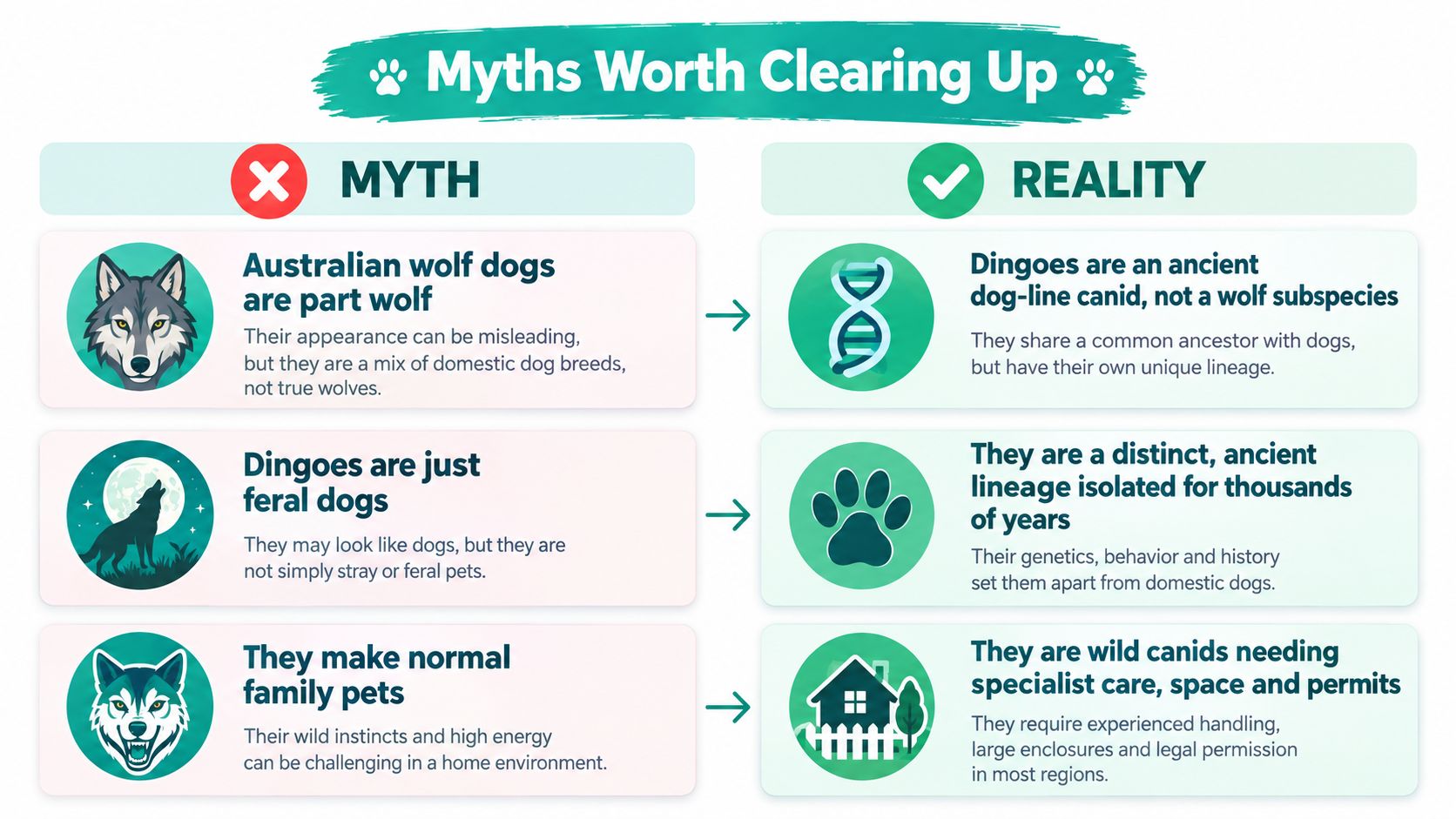
Myth one, Australian wolf dogs are part wolf.
The dingo belongs to an ancient dog-line canid lineage. Genetic studies connect dingoes with the broader dog family that shares ancestry with gray wolves, but a dingo isn't automatically a wolf subspecies or a wolfdog hybrid.
Myth two, dingoes are just feral domestic dogs.
Dingoes have a much older Australian history than modern domestic dogs. They can hybridise with domestic dogs, but that later mixing doesn't erase the distinct lineage that arrived in Australia thousands of years ago.
Myth three, gray wolves roam Australia.
The phrase “Australian wolf dog” doesn't establish that gray wolves live wild in Australia. It is usually a loose name for the dingo, whose own evolutionary and geographic story is different.
Myth four, dingoes make easy family pets.
Dingoes retain wild instincts, can be wary around unfamiliar people, and need specialist management. A friendly individual still isn't equivalent to a Labrador bred for life in a household.
Myth five, a wolfdog is the same as a dingo.
A wolfdog descends from a gray wolf and a domestic dog. A dingo is an ancient Australian canid lineage. Some animals may carry mixed ancestry, but the terms aren't synonyms.
The legal distinction matters too. Australia's biosecurity rules prohibit the import of wolves and dog-wolf crosses, including Czechoslovakian wolfdogs and Saarloos wolfdogs, while a dingo is a separate wild canid category. That difference is one reason a person should identify the animal accurately before asking about ownership, transport, or importation.

Ownership, Travel, and the Legal Picture
Legal questions about dingoes rarely have one Australia-wide answer. Rules can differ between states and territories, and authorities may treat a dingo as wildlife, a restricted animal, or a managed animal under particular conditions. A permit, enclosure approval, registration requirement, or other authorisation may apply, so prospective owners should contact the relevant authority before acquiring an animal.
Interstate movement deserves separate attention. A dingo that can be kept in one place may not be freely movable to another. Authorities can require documentation or permission for animal movement, and those requirements may change according to the animal's classification, origin, destination, and purpose of travel.
International travel adds another layer. Canid transport can involve veterinary certificates, identification records, quarantine procedures, and destination-specific conditions. Australia also has strict biosecurity controls, so assumptions based on ordinary dog travel can lead to missed requirements.
A sensible pre-travel check
Before making plans, confirm:
Animal identity: Establish whether the animal is a dingo, dingo-dog hybrid, domestic dog, or wolfdog.
Local permission: Ask the relevant state or territory authority about ownership, containment, and registration.
Movement rules: Check whether an interstate permit or transport approval is needed.
Destination rules: Contact the destination authority and an experienced veterinarian about entry conditions.
Document timing: Match examinations, certificates, treatments, and approvals to the travel schedule.

The same caution applies outside Australia. Some countries prohibit wolves or wolfdog crosses, while others regulate them through permits or local restrictions. The fact that an animal is called an Australian wolf dog online doesn't establish that it can enter a country, cross a border, or live legally in a private home.
For anyone planning an international move with an animal, the guidance on moving to Australia with a pet is a useful starting point for understanding why destination-specific preparation matters. Always confirm current requirements directly with the appropriate authority and a veterinarian, because rules and procedures can change.
Quick Questions Readers Ask First
Are dingoes domesticated enough for a family with children?
There isn't enough verified information here to turn dingo ownership into a simple child-safety statistic. The important distinction is between a wild-trapped animal and one born under managed conditions, but captive birth doesn't automatically create the predictable temperament of a domestic dog.
Families should consider the dingo's caution around unfamiliar people, territorial behaviour, escape risk, prey drive, and need for specialist care. Children shouldn't be expected to manage those traits, and adults need secure separation, supervision, and a realistic plan for visitors.
Can a dingo and a domestic dog breed?
Yes, dingoes can interbreed with domestic dogs, creating dingo-dog hybrids. That mixed ancestry is one reason appearance alone may not identify an animal accurately.
Hybrid animals can be difficult to place because their behaviour, containment needs, and legal status may not match those of an ordinary dog. Anyone dealing with a suspected hybrid should seek advice from qualified authorities and experienced animal professionals rather than relying on an internet label.
How long do dingoes live?
Verified husbandry information supports a wild dingo lifespan of roughly five to seven years. Managed-care animals may live longer, but a dependable single captivity range isn't established in the provided evidence, so claims of a fixed managed-care lifespan should be treated cautiously.
Lifespan also depends on injury, disease, nutrition, environment, and the quality of veterinary care. Those variables matter more than a neat number on a profile page.
Why do Australians often call them wild dogs?
“Wild dog” can function as a management term rather than a precise statement about ancestry. In agricultural and wildlife contexts, authorities and landholders may use the category to discuss free-living dingoes, domestic dogs, and hybrids together.
That terminology can make public discussions confusing. A management label may group animals for practical control work, while a biological label asks what the animal is and where its lineage came from. Keep those questions separate, and consult pet passport guidance when travel documentation is part of the decision.
Passpaw helps veterinary practices and pet owners organise international health certificates, destination requirements, treatment tasks, and travel documents in one workflow. If your Australian wolf dog question is connected to cross-border travel, visit Passpaw to plan the paperwork before the journey begins.

More articles
From regulatory changes to best practices for veterinarians and pet owners, our resources keep you ahead of the curve.