Are you a team member in a veterinary practice?
Are you a pet parent planning a trip with your furry pal?
Animal Transport Jobs: Start Your Career in 2026
You might be staring at job boards right now, seeing titles like pet transporter, relocation coordinator, animal handler, or cargo specialist, and wondering what any of them mean. You love animals, you want work that feels useful, and the idea of helping pets travel sounds meaningful. But the path into this field can look a little ruff around the edges.
That confusion is normal. Animal transport jobs sit at the crossroads of animal care, travel planning, customer service, and logistics. Some roles are hands-on and road-based. Others are desk jobs built around paperwork, timing, and country rules. The good news is that this field is real, growing, and far more varied than commonly assumed.
Your Career in Animal Transport Jobs Starts Here
A lot of people find this career path the same way. They start with a simple thought: “I want to work with animals, but I don't want the same clinic or kennel role everyone talks about.” Then they discover that families move overseas, military households relocate, breeders ship animals, rescue groups coordinate transfers, and pets need safe, calm travel support from door to door.
That's where animal transport jobs come in. At their best, these jobs combine care and coordination. One day you may be checking crates, calming a nervous dog, and confirming feeding instructions. Another day you may be tracking paperwork, calling an airport cargo desk, or helping a family avoid a travel delay that could throw the whole trip off leash.
The scale of the work surprises many newcomers. More than 4 million domestic and other live animals are transported by air each year globally, with over 2 million of these movements occurring within the United States alone, according to IPATA figures cited here.
Why this work matters
Transport isn't just about moving an animal from one place to another. It often means:
Reuniting families: A pet arrives safely after a household move.
Supporting life changes: Owners relocating for work, study, or service need help.
Protecting welfare: Good transporters reduce stress by planning carefully.
Keeping trust intact: Clients hand over a living companion, not a suitcase.
Practical rule: If you like animals but also enjoy schedules, checklists, route planning, and problem-solving, this field may fit you better than you think.
Who tends to do well here
You don't need to be the loudest person in the room. You do need to be dependable. The people who last in this field usually share a few traits:
Strength | Why it matters in transport |
|---|---|
Calm under pressure | Flights change, paperwork gets tight, animals pick up on stress |
Good observation | Small signs of discomfort matter |
Clear communication | Owners need updates they can understand |
Respect for routines | Feeding, crate timing, and document timing all count |
If that sounds like you, you're not chasing a fantasy job. You're looking at a field with real demand and real responsibility.
The Wide World of Animal Transport Roles
One reason people get confused about animal transport jobs is that the title sounds singular. It isn't. This field includes road roles, airport roles, office roles, and specialized jobs for livestock or exotic species. The work can be local, national, or international.
This visual gives the broad picture.

Ground transport roles
A domestic pet transporter usually works by road. That may mean picking up a dog from a home, driving to a boarding stop, coordinating rest breaks, and delivering the pet to a new address or airport facility. This role suits people who like travel, direct animal contact, and practical routines.
Daily tasks often include:
Checking crate setup: Bedding, labels, water setup, and fit
Monitoring behavior: Watching for stress, motion discomfort, or overheating
Updating clients: Sending clear arrival and status notes
Managing the route: Traffic, stop timing, and handoff windows
A transporter on the road has to think ahead. If a dog is reactive, if a cat startles easily, or if a weather delay changes timing, that driver needs a backup plan. This is less “pet taxi” and more controlled care on wheels.
Airport and air cargo roles
An air cargo handler works in a more structured environment, usually around airport cargo operations. This role can involve live animal intake, crate inspection, staging, transfer coordination, and communication with airline or shipping staff.
The key skill here isn't just comfort with animals. It's precision.
A crate can look fine to an untrained eye and still be rejected if it doesn't meet airline rules.
People in these jobs work with timing windows, handling standards, and paperwork checks. You may not spend all day cuddling puppies. You may spend a lot of time making sure a carrier, label, and handoff process meet airline expectations.
Office and planning roles
A pet relocation coordinator is the person many clients remember most. This role is usually office-based and involves guiding owners through requirements, collecting records, booking services, and keeping travel plans on track.
Typical responsibilities include:
Reviewing destination rules
Requesting veterinary documents
Coordinating with airlines or agents
Explaining deadlines to the owner
Catching errors before travel day
This role is great for people who prefer detail work over driving or cargo-floor handling. It's also one of the clearest entry points into international transport because you learn how the whole system fits together.
If you want a broader look at how these services operate in practice, this guide on animal transportation services is a useful companion.
Specialized paths
Some animal transport jobs go beyond standard pet moves.
Livestock hauler: Focuses on farm animals and welfare standards for commercial movement.
Exotic animal handler: May work with birds, reptiles, or zoo-related moves.
Rescue transport coordinator: Supports shelter and rescue networks.
Veterinary support role: Helps prepare health records and fitness checks for travel.
These paths often expect stronger species-specific handling knowledge. They can be rewarding, but they're not usually the easiest place to start. For most beginners, domestic pet movement or relocation support is the better first paw-step.
Getting Qualified for Animal Transport
Loving animals helps. It doesn't replace qualifications, habits, or practical judgment. In this field, employers often look for a mix of soft skills and transport-specific know-how.
The soft skills that carry weight
The best candidates usually bring more than affection for pets.
Patience: Nervous animals may need slower handling.
Attention to detail: A missed date or mislabeled crate can create major problems.
Physical stamina: Loading, driving, lifting, and long days are common.
Professional communication: Owners need calm, accurate updates.
These skills don't sound glamorous, but they matter. A reliable transporter who shows up prepared is worth far more than someone with a fancy resume and no field sense.
The hard requirements to understand
For commercial pet transporters in the United States, the mandatory regulatory requirement is a Class T Registration with the USDA/APHIS, as explained in this USDA transporter overview. That same source also notes that industry best practice strongly recommends IATA endorsement, because failing to meet IATA Live Animal Regulations, often called IATA LAR, can lead to airline rejection.
That's a key distinction many beginners miss.
Qualification | What it does |
|---|---|
USDA/APHIS Class T Registration | Allows commercial pet transport work in the US under the stated framework |
IATA LAR knowledge or endorsement | Helps you meet airline expectations for live animal air transport |
IATA LAR matters because air transport has strict expectations around crate construction and handling. If the crate isn't right, the pet may not fly. That affects the animal, the client, and your reputation.
Where people often get stuck
New applicants often ask, “Do I need a degree?” Sometimes it helps, especially in animal science or veterinary-related work. But it usually isn't the first thing that gets you hired. Employers care a lot about whether you can safely handle animals, follow instructions, and stay steady when plans change.
If you're choosing between another general course and hands-on shelter work, the hands-on experience often gives you the stronger story in an interview.
For road-based jobs, it also helps to understand transport rules from adjacent industries. If you're exploring larger vehicle pathways or commercial driving, this breakdown of 2026 HGV licence rules gives helpful context on how regulated driving careers are structured.
Good early additions to your resume
A beginner-friendly qualification plan might include:
Pet first aid and CPR: Shows you take welfare seriously
Document handling experience: Useful if you want coordination roles
Customer service history: Important because clients are often stressed
Clean driving record: Valuable for ground transport work
You don't need to collect every possible credential at once. Start with the requirements that match the role you want, then add skills that make employers trust you with living cargo.
Understanding Pet Travel Rules and Compliance
This is the part of animal transport jobs that catches many people off guard. The job isn't only about the animal. It's also about the paperwork timeline, the country rules, and the exact order in which things must happen.
A transporter can do everything right on handling and still face trouble if one certificate is late, expired, or missing an endorsement.
Why timing matters so much
Professional pet transport services must follow IATA Live Animals Regulations, and the health certificate often must be endorsed by an official government veterinarian within 10 days of travel to remain valid for the entire journey, according to this international pet travel guide.
That short window creates real pressure. Owners may assume they can “get paperwork done early,” but in pet travel, too early can be as risky as too late.
Common compliance trouble spots
Here's where jobs in this field become more than animal handling:
Certificate timing: Documents may expire before departure
Crate compliance: Airlines may reject a non-compliant setup
Route changes: A delay can affect document validity
Country-specific rules: Some destinations require more than core vaccination records
A strong transporter learns to think like a planner. You're not just asking, “Is the pet ready?” You're asking, “Are the pet, crate, route, dates, and documents all aligned?”
Why operations knowledge helps
Ground transport professionals can also benefit from understanding broader transport safety thinking. Even though pet work has its own rules, learning from commercial transport resources sharpens your instincts around secure movement and equipment standards. This explainer on Understanding 49 CFR Part 393 is a good example of the kind of operational reading that helps transporters think more carefully.
The best compliance habit is simple. Track every critical date in one place, then check it again before booking anything final.
If you want to better understand one major part of the paperwork process, this article on USDA pet travel requirements is a practical reference.
Job Market Outlook for Animal Transporters
If you're wondering whether this field is too niche to build a career around, the market outlook is encouraging. Animal transport is no longer a side service tucked inside a few specialty agencies. It's part of a broader pet travel and logistics ecosystem that keeps getting more organized.
The strongest demand tends to cluster around major airports, relocation corridors, military-heavy regions, and businesses that support international moves. But smaller local markets can also support ground transport and regional pet travel work.
What the market projection tells us
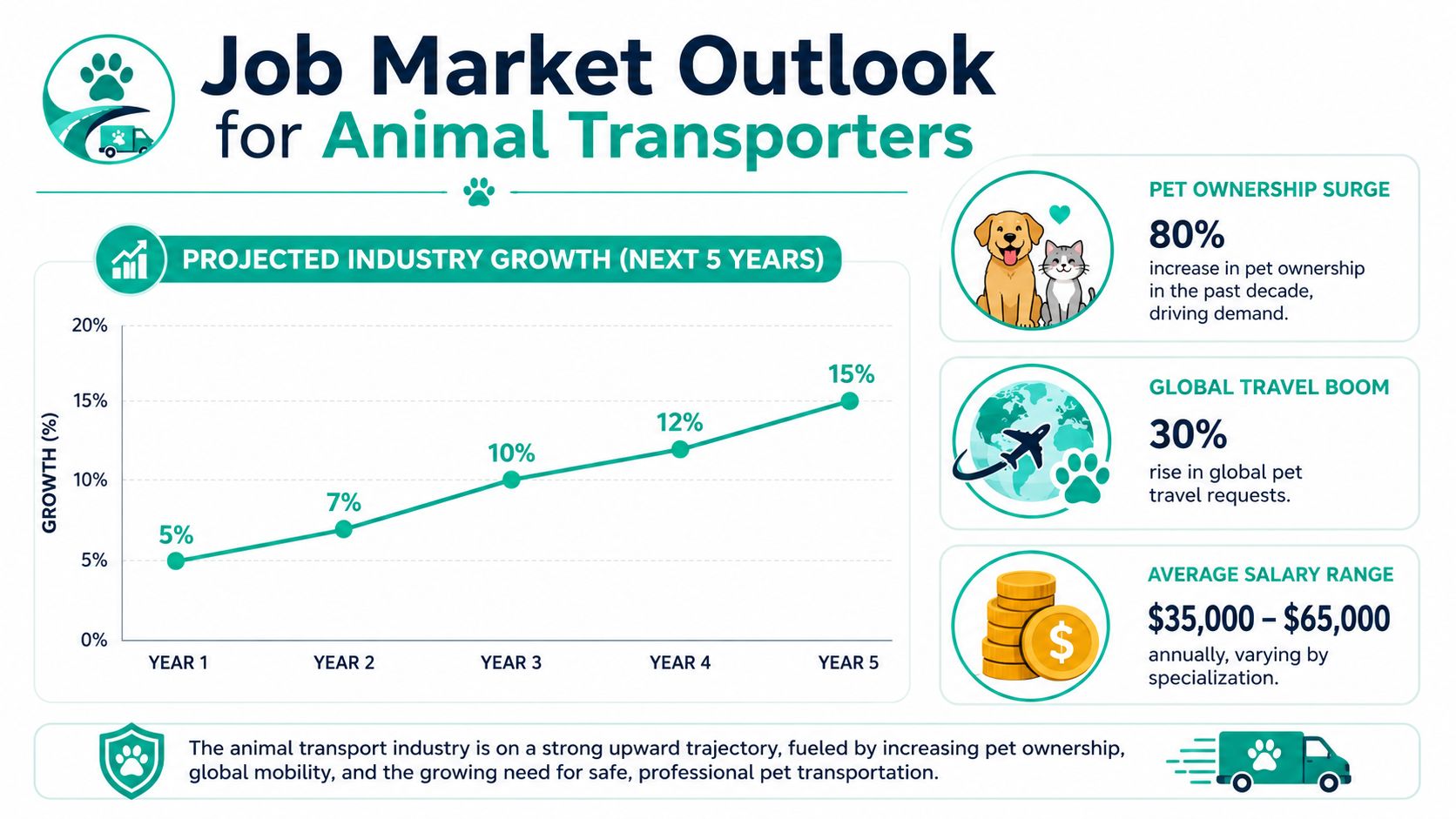
The clearest big-picture signal is this. The global animal transportation market is projected to reach USD 1.16 billion by 2030, growing at a CAGR of 9.24% from an estimated USD 0.67 billion in 2024, according to Mordor Intelligence.
That projection doesn't mean every job will be easy to get. It does suggest that skilled workers who understand handling, paperwork, and transport standards should remain valuable.
Where opportunity tends to be strongest
Different areas support different roles.
Setting | Typical opportunity |
|---|---|
Major international airport regions | Air cargo and relocation coordination |
Large metro areas | Domestic pet transport and premium concierge services |
Agricultural regions | Livestock and farm-related transport roles |
Military relocation corridors | Pet move support for frequent household transfers |
Specialization matters too. A person who can handle standard pet moves may find steady work. A person who can manage international documentation, airline requirements, and owner communication often becomes harder to replace.
A realistic read on career growth
This isn't a field where everyone starts in a dream role. Many individuals build their way in. They begin with kennel work, shelter transport, dispatch support, or local driving. Then they gain trust, add certifications, and move toward more specialized work.
A useful way to think about it is this: the higher-value roles usually involve one or both of these areas:
Greater compliance complexity
Higher responsibility for timing and client communication
That's also why understanding client expectations matters. This overview of pet transport costs can help you see the service from the owner's side, which is smart career homework if you want to work directly with clients.
Your Action Plan to Land an Animal Transport Job
The biggest hiring hurdle in animal transport jobs isn't usually education. It's proof that you can do the work. Many employers want someone who can walk in and handle a nervous dog, follow a route plan, speak professionally to an owner, and notice when something is off.
That's why practical experience matters so much. Most job listings emphasize basic education but employers prioritize practical, boots-on-the-ground experience, such as volunteering at shelters or farms, over formal credentials, as discussed in this career-focused video source.
Step one to build hands-on proof
Start where animals are handled every day.
Volunteer at shelters: You'll learn restraint basics, stress signals, and routine care.
Help rescues with transport days: You'll see timing, crate loading, and handoffs up close.
Work in boarding or daycare: You'll build confidence with different temperaments.
Support farm or barn operations: Useful if livestock or equine transport interests you.
Don't worry if the work seems basic at first. Employers know that cleaning kennels, walking dogs, and assisting intake can teach calm, practical habits.
Step two to shape a stronger resume
A good resume for this field shouldn't read like a generic animal lover profile. It should show dependability, care, and logistics awareness.
Include things like:
Animal handling experience
Driving or route-based work
Customer communication
Scheduling or record-keeping
Any first aid or CPR training
Your resume should answer one quiet employer question: “Can I trust this person with an animal, a client, and a schedule?”
Step three to target the right first role
Not every first job needs to be “animal transporter.” Useful entry points include kennel assistant, veterinary receptionist, dispatch assistant, pet boarding staff, shelter operations helper, or relocation support assistant.
These jobs help you build the habits transport employers value:
showing up on time
documenting correctly
communicating clearly
keeping animals safe in busy environments
If you want a clearer sense of how professional agencies operate across borders, this guide to a global pet travel agency can help you understand the service models behind many transport careers.
Step four to present yourself like a professional
When you interview, don't only say you love animals. Everyone says that. Talk about situations where you stayed calm, followed protocols, solved a timing problem, or handled a worried client professionally.
A simple interview formula works well:
What to mention | Why it helps |
|---|---|
A real animal handling situation | Shows practical confidence |
A logistics or scheduling example | Shows operational thinking |
A customer service example | Shows client readiness |
A safety-focused habit | Shows maturity |
That combination tells employers you're not just warm-hearted. You're useful.
A Rewarding Career Path for Animal Lovers
Animal transport jobs ask for more than affection. They ask for steadiness, planning, attention to detail, and respect for the animal in your care. That's exactly why this work can feel so meaningful.
You don't need to begin as an expert. You need to begin sincerely. Learn the role types, get hands-on experience, understand the key qualifications, and treat compliance as part of animal care, not as boring paperwork off to the side. In this field, the checklist protects the pet.
There's also something deeply satisfying about this work. You help a family stay together during a move. You reduce stress on a travel day that feels huge to the owner. You become the person who makes a complicated process feel safe and manageable.
If you're ready to keep researching, good next stops include the IPATA network, USDA APHIS information for commercial transporters, and airline guidance related to live animal travel. Start small if you need to. One volunteer shift, one certification, one entry-level role. That's how many strong careers begin.
You don't have to chase this path blindly. With the right mix of field experience and transport knowledge, you can build a career that's both practical and full of heart.
If your work touches pet travel paperwork, Passpaw is worth a look. It helps veterinary teams and pet travel professionals manage international health certificate workflows, keep track of destination requirements, organize deadlines, and reduce the document chaos that can slow down a trip. For teams handling complex pet moves, it can make the compliance side feel much less hairy.

More articles
From regulatory changes to best practices for veterinarians and pet owners, our resources keep you ahead of the curve.