Are you a team member in a veterinary practice?
Are you a pet parent planning a trip with your furry pal?
What is a Pet Health Certificate? A Complete Guide (2026)
You’ve booked the flight. You’ve picked the carrier. You may even have your own packing list ready. Then someone says, “Don’t forget the pet health certificate,” and suddenly the whole trip feels less like a vacation and more like a paperwork obstacle course.
That reaction is normal.
Most pet owners don’t struggle because the process is impossible. They struggle because the rules come in pieces. The airline says one thing, the destination country says another, and the veterinary paperwork has its own timing. By the time people call the clinic, they’re often asking the same question in plain English: what is a pet health certificate, and when do I need it?
The simplest answer is this. A pet health certificate is the official veterinary document that helps show your pet is healthy enough to travel and meets the destination’s import requirements. Think of it as the key document that ties your pet’s exam, identification, vaccine history, and travel readiness into one place.
If you’re still sorting out the full set of forms beyond the certificate itself, this guide to pet travel documents helps put the rest of the paperwork in context.
Your Guide to Pet Travel Paperwork
A pet owner usually reaches this stage in one of two moods. They’re either calmly planning ahead, or they’re calling in a mild panic because the airline asked for documents they’ve never heard of. Both situations are fixable.
In practice, the certificate isn’t mysterious. It’s a formal veterinary record prepared for travel. It confirms that a veterinarian has examined the pet, reviewed the required medical details, and documented the information needed for the trip.
Why this document matters
A pet health certificate exists for two practical reasons.
It supports safe travel: It helps confirm your pet is free from contagious disease and fit for the journey.
It supports border compliance: It gives airlines and destination authorities a standardized document to review.
It keeps records aligned: It pulls together details that are often scattered across vaccine receipts, microchip records, and treatment notes.
That last point matters more than people expect. The certificate itself is rarely the hard part. The hard part is making sure every record behind it matches.
Practical rule: Start with the destination country’s requirements, not with the airline’s generic checklist. The certificate has to fit the country’s rules first.
What pet owners usually get wrong
The most common misunderstanding is thinking the certificate is just a quick exam form you can grab a day or two before travel. Sometimes domestic travel is that simple. International travel usually isn’t.
Another frequent issue is timing. A pet may be healthy, vaccinated, and microchipped, but still not ready for a certificate if a required vaccine window, treatment timing, or approval step hasn’t been met.
That’s why I tell clients to think of the process as a travel timeline, not a single appointment. Once you see it that way, the path gets much easier to follow. Less maze, more map. Or if we’re being honest, less chasing your tail.
Decoding Your Pet Health Certificate
A lot of stress disappears once you know what’s on the document and why each part is there. The certificate isn’t just bureaucratic fluff. It’s a structured health and identification record.
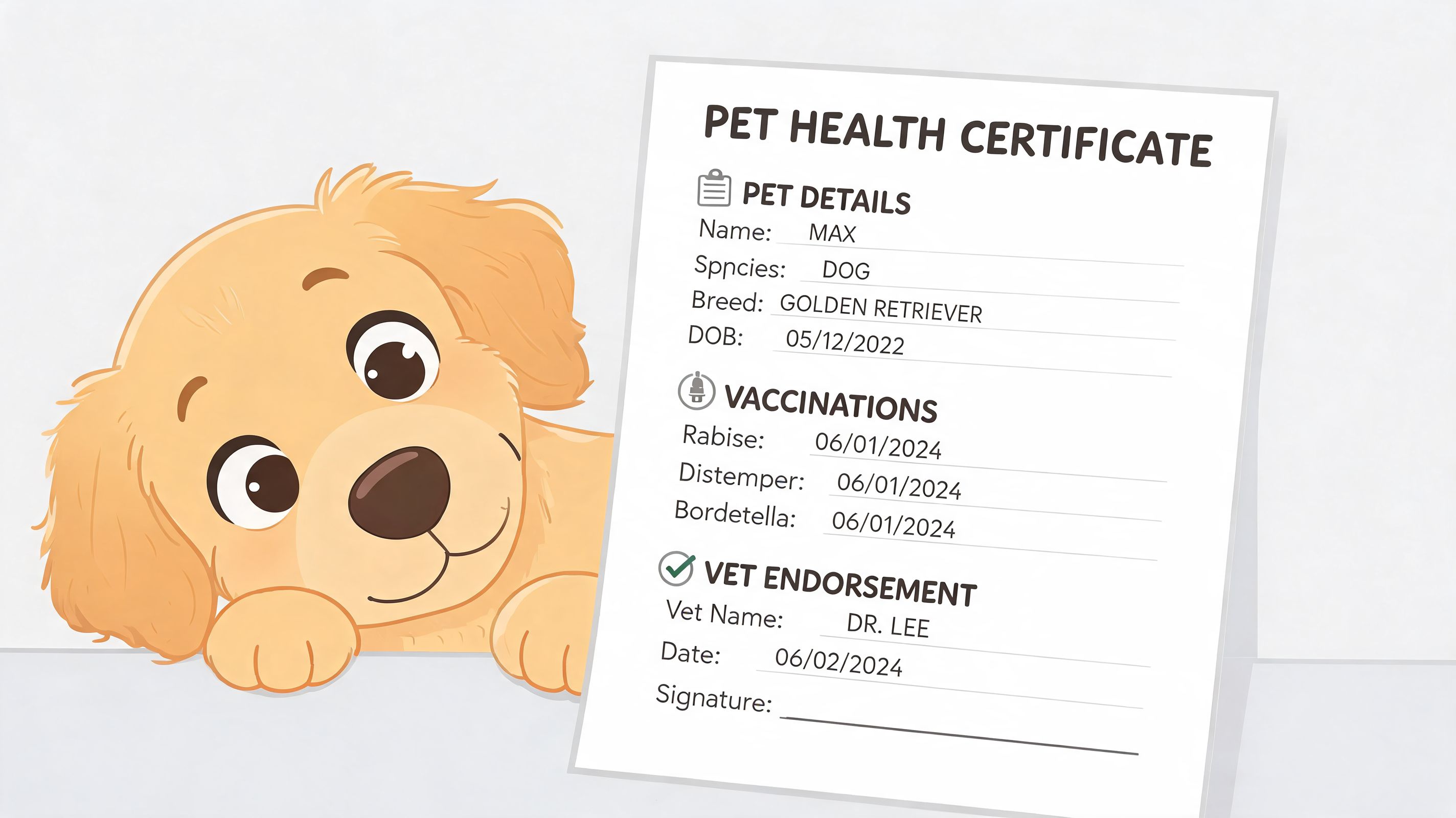
A pet health certificate is an official veterinary document confirming a pet is free from contagious diseases and meets travel requirements. It includes the pet's microchip number, a detailed vaccination history with batch numbers and validity periods, recent parasite treatments, and a vet's declaration of fitness for travel according to the CDC’s pet travel guidance.
If you’ve ever wondered whether a CVI and a health certificate are exactly the same thing, this quick explainer on CVI vs health certificate terms clears up the language.
The exam
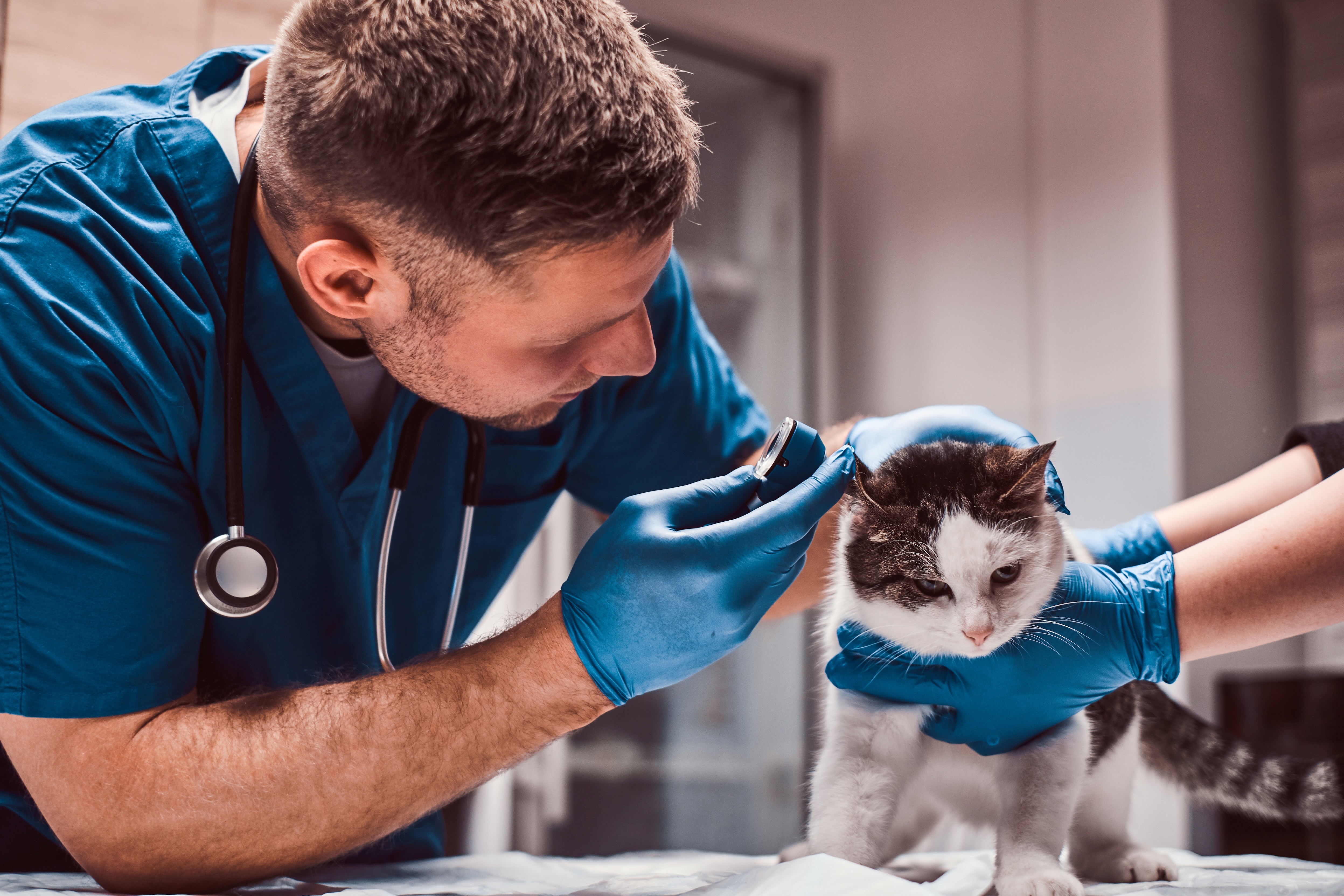
The physical exam is the anchor of the whole document. A USDA-accredited veterinarian examines the pet and records whether there are any signs of illness that would affect travel or entry.
This isn’t a casual look-over. For travel paperwork, the exam has to line up with the destination’s timing rules. If the exam is done too early, the certificate may no longer be valid by departure day.
The microchip
For international travel, the microchip often acts as the pet’s permanent identity marker. It connects the animal in front of the veterinarian with the vaccines, lab work, and supporting documents in the file.
A correct chip number matters because officials don’t just want “a vaccinated dog” or “a healthy cat.” They want proof that this specific pet received those services.
The vaccinations
Rabies is the big one in many travel cases, but not the only one that may matter. The certificate often needs vaccine details with enough specificity to satisfy importing authorities, including dates and validity periods.
Here’s the practical issue. A vaccine can be medically current and still not satisfy travel timing if it was given too recently for the destination’s rule set. That’s why travel medicine and routine wellness medicine overlap, but they aren’t always identical.
The treatments and supporting notes
Some destinations want parasite treatment records. Others want test results, import permit references, or very specific declarations tied to country rules.
What works best is treating the certificate as the final summary of a complete file, not as a stand-alone piece of paper. When clinics try to “fill the form first and fix the details later,” that’s when mistakes creep in.
The smoothest certificates come from records that were organized before the appointment, not reconstructed during it.
Domestic Trips vs International Adventures
Many owners often misunderstand this point. They hear “health certificate” and assume the same form works everywhere. It doesn’t.
A domestic Certificate of Veterinary Inspection, or CVI, is usually simpler. An international health certificate is more exacting, more country-specific, and often needs USDA APHIS endorsement. That distinction isn’t always obvious to travelers, and a 2024 AVMA survey reported that 62% of veterinarians received client questions about the difference between domestic CVIs and international health certificate formats.
The practical difference
For a domestic trip, the question is often, “Is this pet healthy for travel, and does this state or airline require documentation?”
For an international trip, the question becomes, “Does this exact document format, with this exact supporting record set, satisfy this exact country’s import rules?”
Those are very different jobs.
Domestic vs. International Pet Health Certificates
Feature | Domestic Travel (CVI) | International Travel (IHC) |
|---|---|---|
Primary purpose | Shows the pet is healthy for travel within the country | Shows the pet meets destination-country import rules |
Complexity | Usually more straightforward | Often highly country-specific |
Veterinary role | Exam and document completion | Exam, document completion, and alignment with country rules |
Government involvement | May involve state-level requirements | Commonly requires USDA APHIS endorsement |
Format sensitivity | Often less rigid | Format and wording can be critical |
Planning window | Often shorter | Usually needs earlier preparation |
Why international paperwork takes longer
International certificates don’t fail because pets are unhealthy. They fail because details don’t match, the timing is off, or the destination required something the owner didn’t know to ask about.
Three examples come up often:
Country-specific wording: Some countries require exact declarations.
Supporting records: A vaccine certificate, test result, or permit may need to accompany the form.
Endorsement steps: The veterinarian may prepare the certificate, but USDA APHIS may still need to review and endorse it.
A domestic trip is often a health check with paperwork. An international trip is a coordinated document process with a health check built into it.
If you’re dealing with an overseas move or flight, this overview of an international pet health certificate gives a useful bigger-picture view before you start booking appointments.
Your Pet Travel Timeline and Checklist
Most pet travel problems aren’t medical problems. They’re calendar problems.
Owners often assume the final exam is the start of the process. For international travel, it’s usually one of the last steps. The main work begins months earlier with rule-checking, record review, and scheduling.
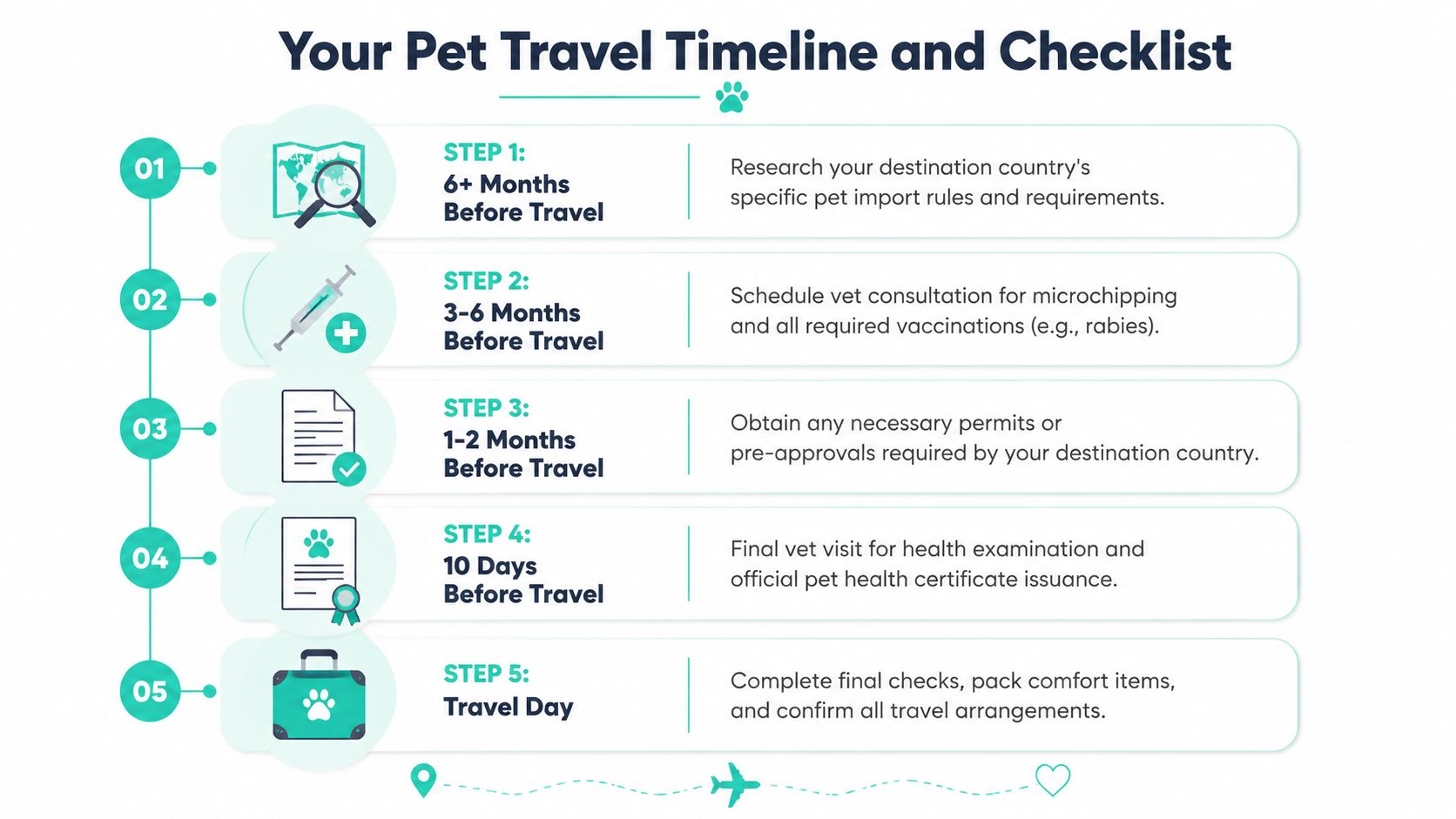
Six months or more before travel
This is the ideal moment to research the destination country and identify the long-lead requirements. Some countries require more than a current rabies vaccine. They may require a rabies titer, permit approval, or waiting period that cannot be rushed.
If a trip involves a stricter destination, early planning gives you room to correct records, place a microchip before vaccines if needed, and avoid expensive last-minute scrambling.
Start here:
Check the destination rules: Use the official country requirements your veterinarian will rely on.
Review the microchip record: Make sure the chip can be scanned and the number matches prior records.
Audit vaccine history: Confirm dates, product details, and whether the timing fits travel rules.
Ask about long-lead tests: Some trips need lab work or additional approvals that take time.
Three to six months before travel
This is when the veterinary planning visit becomes valuable. The pet may not need the final certificate yet, but this is the right time to build the travel file.
At this stage, the veterinarian can identify what’s missing while there’s still time to fix it. That might mean updating a vaccine, ordering a test, or correcting a mismatch between records.
One to two months before travel
This is the window for document review and confirmation. Ideally, you’re no longer asking, “What do we need?” You’re asking, “Do we have every supporting item in place?”
A short checklist helps here:
Confirm destination-specific extras such as permits, treatment timing, or special declarations.
Verify record consistency across microchip paperwork, vaccine certificates, and any lab reports.
Book the final certificate appointment so it lands inside the required validity window.
Ask how endorsement will be handled if the destination requires USDA review.
The final ten-day window
For many international trips, this is the critical stretch. The certificate must be issued close enough to departure to remain valid on travel day. According to Deerfield Animal Care Center’s summary of APHIS timing and endorsement data, failure to have the health certificate issued within the 10-day window required by 80% of countries can result in 15-90 day quarantines costing $2,000-$10,000, and accredited veterinarians using VEHCS see a 90% first-pass endorsement rate compared with 60% for paper submissions.
That tells you two things. Timing matters. Clean digital workflows matter too.
Checklist mindset: In the final week, don’t “assume” anything. Confirm exam date, certificate date, endorsement status, and travel date as a matched set.
Travel day
Travel day should be the calm part. By then, the documents should already be complete and reviewed.
Keep your packet organized and easy to access. Bring the paperwork your airline, destination, and veterinarian told you to carry. Also bring the practical pet stuff that makes the trip easier, like a familiar blanket, medication if prescribed, and feeding instructions.
A simple travel-day list usually includes:
Your document set: Certificate, supporting records, permits if required
Carrier check: Labels, absorbent bedding, and any airline requirements
Pet comfort items: Leash, food plan, and familiar scent items
Contact details: Veterinarian, destination contact, and transport provider if one is involved
The process is a lot less stressful when each step happens in the right order. That's the key. Not speed. Sequence.
Navigating Common Hurdles and Country Rules
Even well-prepared trips can hit snags. Most of them come down to tiny details that carry a lot of weight.
Some countries are stricter because they’re trying to protect against diseases that are rare or absent within their borders. Others require extra treatments or test timing that doesn’t feel intuitive unless you work with travel documents often.

The microchip mismatch problem
One of the most common rejection issues is also one of the least dramatic. The pet has a microchip, but the number is entered incorrectly, scanned poorly, or listed differently across records.
According to USDA information shared through the VEHCS system, incomplete or incorrect microchip verification causes 40% of health certificate endorsement rejections. The same USDA-linked guidance notes that a mismatch between the microchip number on the health certificate and the rabies certificate can trigger a 30-day quarantine in countries like Japan.
That’s why experienced clinics scan the chip, read the number back, and compare it line by line against every related record. It sounds fussy. It saves trips.
Country rules that catch owners off guard
The UK is a good example of how specific travel medicine can be. A pet may be healthy and vaccinated, yet still need a particular parasite treatment documented in the required time frame.
Australia and Japan often prompt early planning because owners assume the process will look like a standard certificate workflow. It usually doesn’t. Rabies-sensitive destinations may require more documentation, more lead time, or both.
When outside logistics matter
Some trips involve more than veterinary paperwork. They may include cargo handling, supply coordination, or a specialized shipper. In those cases, it helps to understand the broader transport side too. This essential guide for pet freight forwarders is a useful companion resource if your move includes commercial or international shipping logistics.
The trips that go smoothly aren’t always the simplest ones. They’re the ones where the medical records, document timing, and transport details all line up.
What works and what doesn’t
What works
Early record review: Find errors before the final appointment.
One source of truth: Use the same microchip and vaccine details everywhere.
Country-specific planning: Build the file around the destination’s rules.
What doesn’t
Copying an old certificate: Each trip may have different requirements.
Relying on memory: Dates and chip numbers need direct verification.
Waiting for the final week to ask questions: By then, some fixes are no longer possible.
How Passpaw Simplifies Pet Travel Compliance
Manual pet travel prep is doable. It’s also where clinics and owners lose time.
The challenge isn’t only the certificate itself. It’s managing changing destination rules, keeping timelines straight, validating records, and making sure nothing slips between the first consult and the travel date. That problem has become more visible as requirements shift. A PetRelocation study summarized by Trophy Club Animal Hospital found that 41% of international pet moves were delayed by outdated documents, while veterinarians spent 12+ hours weekly on manual checks. The same source notes that Australia’s 2025 Brucella canis testing requirement initially led to a 22% rejection rate for U.S. certificates.
That’s the kind of work software is built to reduce.
Where software helps most
A good workflow tool acts less like a filing cabinet and more like a route planner. It helps the clinic and the owner see what’s due, what’s missing, and what depends on what.
Useful functions include:
Country-based task lists: The right checklist appears based on destination and travel date.
Record validation: The system flags incomplete or inconsistent fields before submission.
Timeline prioritization: Teams can see which cases need action now and which ones are waiting on dates or results.
Client communication: Owners get updates without long email chains and repeated back-and-forth.
A practical example
For clinics that handle travel certificates regularly, tools such as Passpaw’s pet travel planner can organize country-specific requirements, validate document fields in real time, and keep the case moving in the right order. That’s useful when staff are balancing routine appointments with travel cases that each have their own timing rules.
For owners, the value is simpler. Fewer surprises. Clearer next steps. Less chance of finding out at the end that one small detail has gone walkies.
Good pet travel prep feels organized, not frantic. The best systems make the timeline visible before problems show up.
A pet health certificate isn’t just a form your veterinarian prints at the end. It’s the final product of good planning, accurate records, careful timing, and destination-specific review. Once you understand that, the process gets much less intimidating.
If you’re planning international travel with a pet, Passpaw can help you map the paperwork from first checklist to final certificate so the process stays clear, organized, and easier on both your team and your travelers.

More articles
From regulatory changes to best practices for veterinarians and pet owners, our resources keep you ahead of the curve.