Are you a team member in a veterinary practice?
Are you a pet parent planning a trip with your furry pal?
Veterinary Practice Manager Certification: Your 2026 Guide
Monday starts with a callback about a no-show doctor. By lunch, the schedule is backed up, two invoices need approval, a client is upset about a refill delay, and someone asks whether the practice can start offering pet travel certificates because demand keeps coming up. You are supposed to lead the hospital, but most days feel like triage.
Many veterinary managers face this reality. Many were strong technicians, reception leads, or office coordinators before they were handed the keys. They know the floor. They know the people. What many have not had is structured management training.
That gap matters more as a practice grows. The bigger the hospital gets, the less you can run it by memory, hustle, and goodwill alone. Veterinary practice manager certification gives managers a formal framework for finance, operations, people leadership, and compliance-heavy services that can go sideways without process discipline.
Taming the Chaos in Your Veterinary Practice
One of the clearest warning signs in a growing clinic is when the manager becomes the backup for everyone. You answer phones when the front desk gets slammed. You cover treatment when staffing gets tight. You chase inventory issues, mediate team friction, and try to squeeze payroll review into the last half hour of the day.
That setup can work for a while. Then it starts biting the practice.
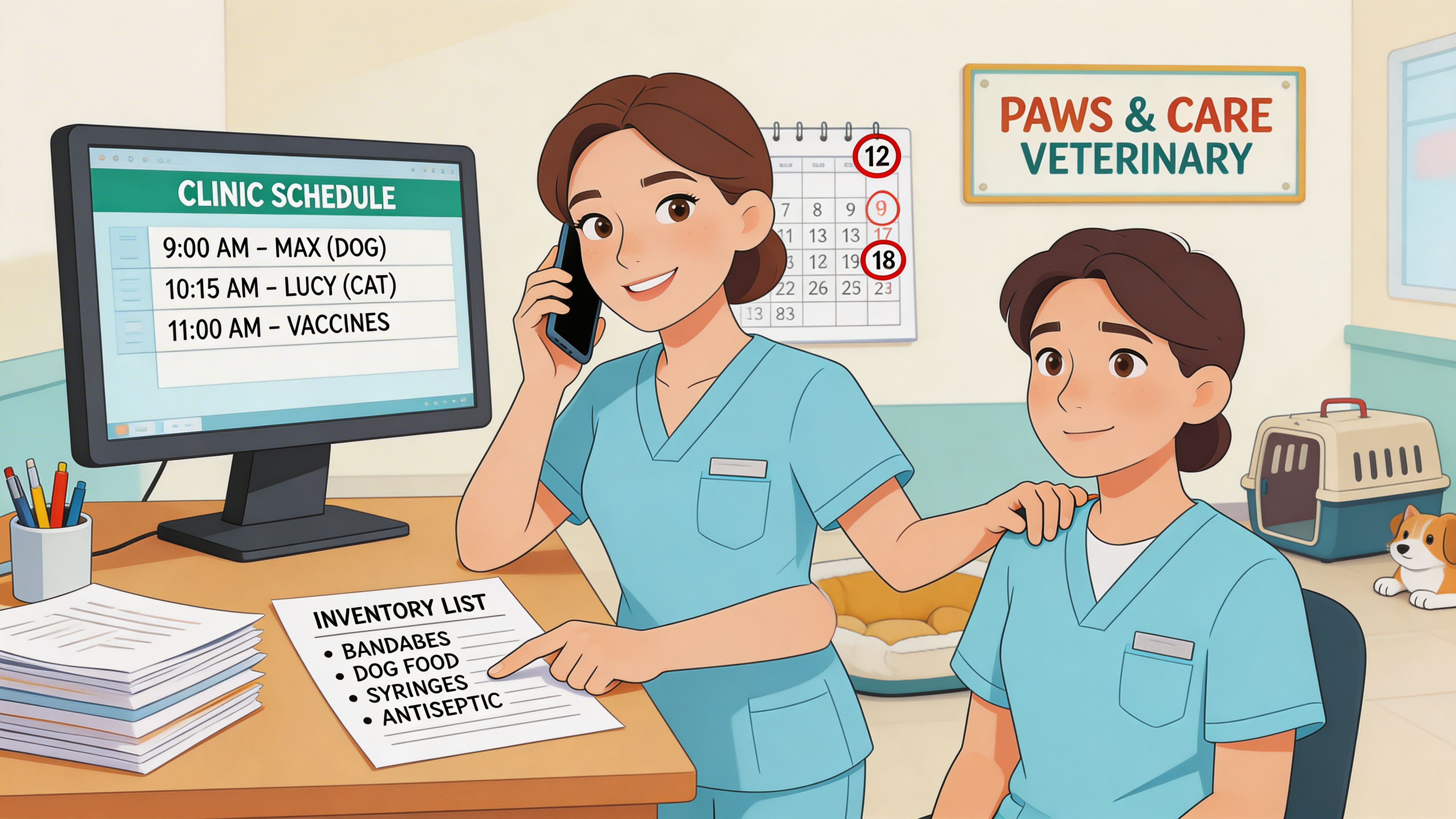
What daily chaos usually looks like
In veterinary hospitals, the mess is not dramatic. It is small breakdowns that stack up.
Scheduling slips: A doctor’s day gets overloaded because no one built enough buffer for urgent work-ins.
Inventory drift: High-use items run low because ordering depends on one person remembering.
HR bottlenecks: Reviews get delayed, documentation gets inconsistent, and hiring becomes reactive.
Client confusion: New services get offered before the team has a script, workflow, or handoff plan.
If that sounds familiar, the problem is not effort. It is structure.
A manager with formal training tends to spot process gaps. They also know when to stop doing everything. In some practices, part of that fix includes outsourcing repeat admin work or adding support roles. For ideas on that side of the equation, this guide on a healthcare virtual assistant to streamline administrative tasks is useful because it shows where delegation can relieve pressure instead of creating more of it.
Why certification changes the game
Certification is not magic. It does not make staffing shortages disappear or turn a weak owner-manager relationship into a strong one.
It does give a manager a better operating system.
Instead of solving the same problem five times, certified managers tend to document the process once, train the team, and track whether it works. That habit matters in everything from onboarding to inventory control to document-heavy services. Good records help when the practice is juggling forms, approvals, and client updates. This overview of document management best practices is a practical place to tighten that side of operations: https://passpaw.com/blog/document-management-best-practices
Tip: If you keep saying “we need a better system,” pause and list the three tasks that break down every week. That list usually tells you what management skill needs work first.
Understanding Veterinary Practice Manager Certification
A growing practice usually hits this point sooner or later. The medicine is strong, demand is rising, and the manager is no longer just handling payroll, inventory, and the schedule. Now the hospital also wants to add higher-value services that depend on tight coordination, such as breeding paperwork, referral workflows, or pet travel compliance. At that stage, the difference between a course certificate and a true professional certification starts to matter.
A certificate program shows that someone completed training.
A professional certification shows that an independent organization has assessed whether that person meets defined standards for experience, education, and applied management competence. For an owner deciding who should build systems, lead staff accountability, and scale complex services, that distinction is practical, not academic.
What certification is
The leading credential in this area is the Certified Veterinary Practice Manager, or CVPM. As reported in dvm360's coverage of the April 2024 CVPM class, the credential is widely recognized in veterinary management and awarded through the VHMA.
A credible certification needs to reflect the full scope of the job. Veterinary practice managers handle finance, HR, operations, compliance, service delivery, communication, and team performance. A serious credential should test more than whether someone sat through training.
That is the practical value of the CVPM. It represents external validation that a manager has both experience and management education, then passed an exam built around real hospital administration. If you want the clinical side of credentials explained alongside the management side, this guide to certification for veterinarians and veterinary professionals is a useful companion.
What certification is not
Certification is not a shortcut for someone who has never owned outcomes inside a hospital.
It also is not the same thing as finishing a few webinars or attending a short course. Those programs can still be useful. I often recommend them for newer managers, lead technicians stepping into supervision, or practice teams that need help in one weak area such as budgeting, hiring, or workflow design.
The difference is application. Certification signals that a manager can connect those skills across the whole practice and hold the system together when priorities compete.
Why practices care
Owners rarely hire or promote based on initials alone. They care whether the manager can make the hospital run better, protect margin, and keep the team aligned while the practice grows.
A certified manager often brings three things that are hard to fake:
Operational judgment: They understand how staffing, scheduling, pricing, client communication, and doctor efficiency affect each other.
Management discipline: They build policies, document procedures, and train to a standard instead of relying on memory.
Execution capacity: They are better prepared to roll out services that involve multiple handoffs, deadlines, and compliance requirements.
That third point deserves attention. Complex service lines break weak systems fast.
Pet travel work is a good example. It can add revenue and strengthen client loyalty, but it also requires document control, country-specific requirements, timing, client updates, and clean coordination between veterinarians, support staff, and administrative workflows. A manager with formal training is more likely to map that process, assign ownership, track turnaround times, and use software well instead of letting the service live in one employee's inbox.
Certification pays off in business terms. It supports better service delivery, fewer preventable errors, stronger delegation, and a practice that can grow without turning every new offering into chaos.
Comparing the Top Certification and Certificate Programs
If you are sorting through options, the biggest mistake is comparing everything as if it serves the same purpose. It does not.
Some programs are designed to prepare a manager. One is designed to credential a manager.
Attribute | CVPM (Certification) | Veterinary Management Certificate (Example) |
|---|---|---|
Purpose | Validates professional competence against formal standards | Documents completion of a training program |
Issuing body | Veterinary Hospital Managers Association | School or education provider |
Experience requirement | Yes | Often less strict or more accessible |
Education requirement | Formal prerequisites required | Usually based on coursework enrollment and completion |
Exam | Rigorous certification exam | Course quizzes, assignments, or completion criteria |
Recognition | Broad professional recognition in veterinary management | Useful for learning and resume building |
Best fit | Experienced managers seeking top-tier credential | Newer managers or those building foundational skills |
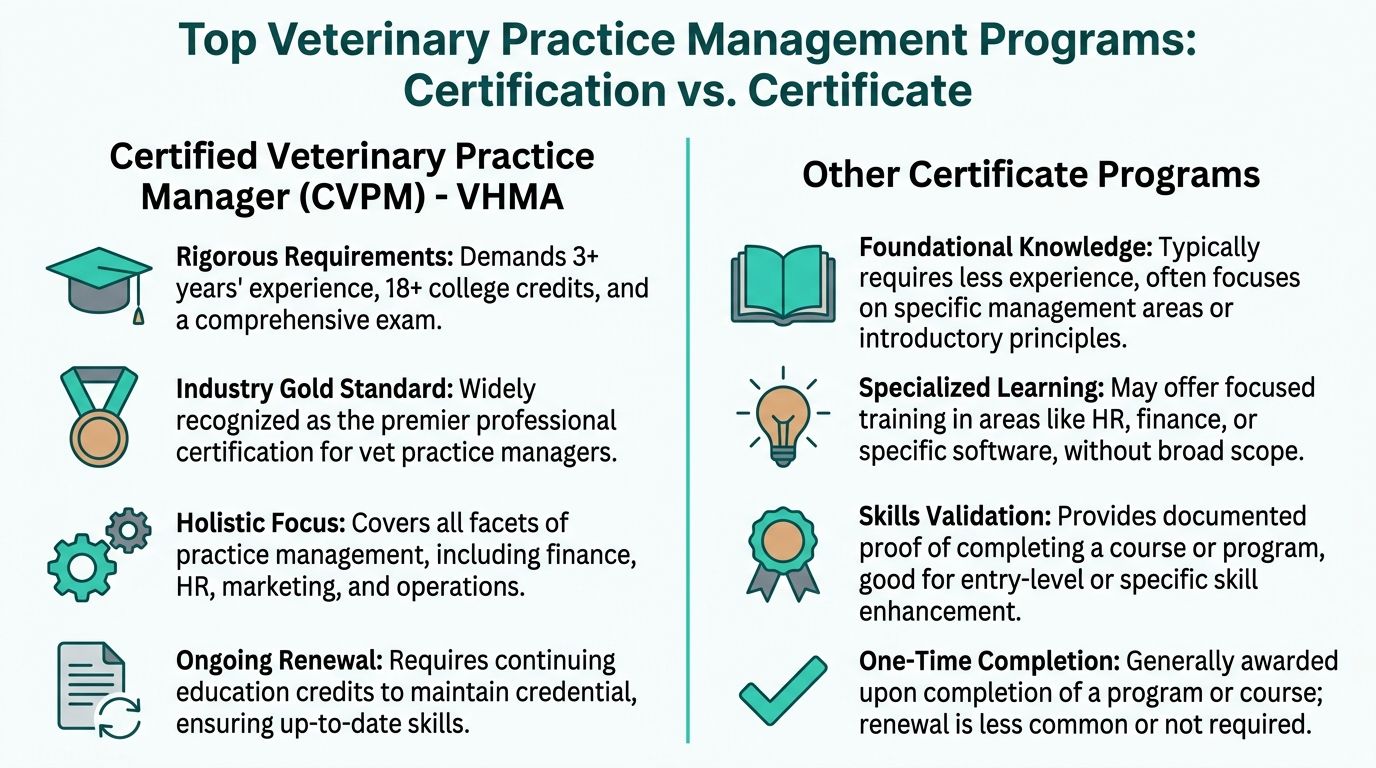
Why the CVPM stands apart
The CVPM has a very different weight in the field because it sits at the intersection of experience, education, and assessment.
Its exam framework covers management areas that shape the health of a hospital, including human resources, law and ethics, marketing, organization of the practice, and finance, as described in VHMA-related reporting and credential materials. That breadth is why owners tend to see it as more than a training badge.
It also remains selective. The April 2024 class included 28 newly credentialed professionals, with similar numbers in prior classes, which reinforces that this is not a mass-market completion certificate. It is a professional benchmark tied to demonstrated readiness, not just attendance.
Where certificate programs fit
Certificate programs are still useful. They just solve a different problem.
Penn Foster, for example, offers a 19-credit curriculum that can be completed in 12 to 14 months, and those credits contribute toward the formal education requirement for the CVPM, as noted in dvm360 reporting on the credential. VETgirl’s management-focused certificate work can also support continuing education needs for managers building toward certification or renewal.
Those options make sense when a manager needs to strengthen fundamentals before going after the larger credential.
Consider these practical points:
Choose a certificate program first if you are newer to management, missing required coursework, or need more confidence in core business topics.
Choose the CVPM path if you already manage at a high level and want formal validation that carries stronger industry recognition.
Use both strategically if your long-term goal is leadership in a larger or more complex hospital.
A related read that helps put the broader credential context in perspective is this guide to https://passpaw.com/blog/certification-for-veterinarians. It is useful when owners are thinking about how different credentials support different service lines.
Key takeaway: A certificate can help you learn. A certification proves you met a professional standard.
What works and what does not
What works is matching the program to the manager’s current stage.
What does not work is enrolling a burned-out manager in random CE and hoping that scattered information somehow becomes leadership skill. That approach creates notebook clutter, not operational change.
The gap. Is the manager missing finance fluency? HR structure? Confidence with policy writing? A formal educational program can close those gaps. Certification then validates that the full set of skills is in place.
Your Step-by-Step Roadmap to Getting Certified
A manager usually decides to pursue certification in the middle of real operational pressure. The phones are still ringing. Payroll still needs approval. A doctor wants help rolling out a new service line, and the front desk is already stretched. That is exactly why a clear plan matters. Certification works best when you treat it like an operational project with milestones, owners, and deadlines.
As noted earlier, the eligibility requirements are specific. Before you buy study materials or book time off for the exam, confirm that your work history, coursework, continuing education, and references are all in order.
Step one, audit your eligibility with documents in hand
Start with paperwork.
Pull your job descriptions, resume, transcripts, CE certificates, and any records that show management responsibility. Candidates often lose momentum at this stage. They remember they completed the work, but they cannot quickly prove it.
Review four areas:
Management experience: Your record should show active responsibility for staffing, operations, budgeting, compliance, or leadership.
College coursework: Confirm which credits count toward management-related education.
Management CE: Separate leadership and business education from clinical CE.
References: Identify people who can speak to how you lead, solve problems, and make decisions.
If anything is thin, fix that gap first. It is faster to build a clean application now than to scramble later.
Step two, choose references who can describe results
A strong recommendation explains what changed because you were in the role.
Practice owners, medical directors, regional operators, and experienced peers can all be good choices if they have seen your work up close. Ask early. Give them a short summary of your responsibilities, the improvements you led, and the areas you want them to address.
Generic praise does not help much. Specific examples do. A letter that mentions scheduling redesign, inventory control, team accountability, or policy implementation carries more weight than one that says you are hardworking.
Step three, study the domains you avoid at work
The exam covers the full management job, not just the part you like doing. For many candidates, that is a significant challenge.
Focus your plan around the core domains:
Human resources
Law and ethics
Marketing
Organization of the practice
Finance
Start with your weakest area, not your favorite one. A manager who is comfortable with staff coaching may still struggle with budgeting. Someone strong in finance may have blind spots in legal risk, documentation, or marketing accountability.
Step four, tie study time to live hospital decisions
Do not just read and highlight. Build policies, revise workflows, and test ideas against your current hospital. If your practice is expanding into higher-value services, this approach becomes even more useful. I see this clearly with hospitals adding pet travel support. The manager who studies compliance, documentation control, staff training, and client communication through the certification lens is usually the same manager who can scale pet travel work without creating bottlenecks or preventable errors.
Certification starts paying off before you even sit for the exam.
A good place to pressure-test your systems is this guide to practice compliance solutions for veterinary teams. It helps managers examine how technology, workflow design, and accountability fit together when the service is complex and detail-sensitive.
Use a study routine that matches the way you already manage projects:
Weekly topic blocks: Assign one content area to each week.
Applied notes: Turn concepts into SOPs, checklists, or decision trees for your own clinic.
Verbal recall: Explain the concept out loud without your notes.
Peer discussion: Review difficult topics with another manager who will challenge your assumptions.
That method builds judgment, not just memory.
Step five, run the application like a launch plan
Set a target submission date. Work backward from it. Put every requirement into one tracker with status, date requested, follow-up date, and completion date.
This matters even more for managers in busy, growing hospitals. A loose application process tends to stall when the clinic gets busy, and busy is the default setting in veterinary medicine. A structured process keeps the credential moving while you keep the hospital running.
There is a business upside here too. The same discipline that gets an application completed also improves service rollout, team follow-through, and client communication. Those habits help improve client retention, especially when your hospital offers services that involve multiple steps, strict deadlines, or high client anxiety.
Step six, use the credential to solve a bigger operational problem
Certification should not end with letters after your name. Put it to work.
For a small animal general practice, that may mean tighter budgeting, better onboarding, and fewer policy gaps. For a hospital adding advanced services, the return is larger. A certified manager is often better prepared to build repeatable systems around travel certificates, interstate and international documentation, follow-up communication, and team handoffs between doctors, technicians, and client service staff.
That is the trade-off to keep in mind. Certification takes time, money, and focus. But if the result is a manager who can standardize complex services, protect compliance, and free doctors from operational cleanup, the investment usually earns its keep fast.
Unleashing a Pawsitive Impact on Your Practice
Monday starts with a full surgery board. By 9:15, the front desk is fielding questions about an international health certificate, a doctor is trying to confirm timing requirements between appointments, and a technician is hunting for the latest form version. Practices do not feel the cost of weak management during a quiet week. They feel it when a high-stakes service collides with an already packed schedule.
A credential earns its value when it changes that outcome. Veterinary practice manager certification gives a growing hospital more than better terminology or a stronger resume. It gives the manager a framework for building repeatable systems, holding teams to a process, and protecting the schedule from avoidable disruption.
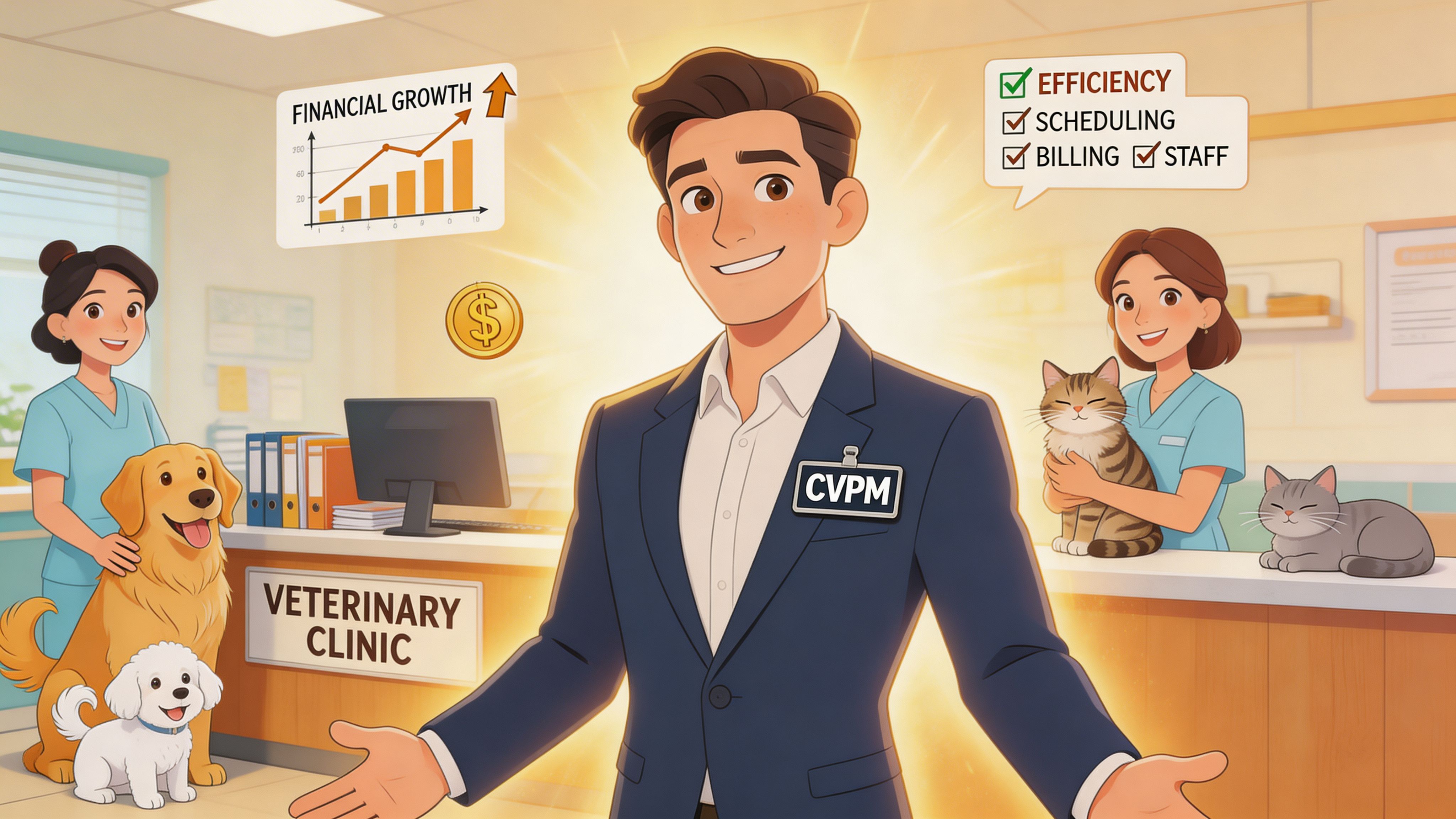
What improves when management gets sharper
The fundamental shift is operational. A stronger manager creates fewer loose ends, fewer handoff errors, and fewer decisions that depend on one person remembering what to do.
That shows up across the hospital:
Staffing gets more consistent. Hiring criteria, onboarding steps, and performance follow-up stop changing from one supervisor to the next.
Financial control improves. Purchasing, budget review, and reporting happen on a schedule instead of after a problem appears.
Team handoffs get cleaner. Client service staff, technicians, and doctors work from the same process instead of filling gaps on the fly.
Client communication gets steadier. The team can give clear answers because the workflow behind those answers is documented.
Certification does not make a manager excellent overnight. It does raise the odds that the person running the hospital has training in finance, HR, workflow, compliance, and accountability, which are the areas that usually break first in a growing clinic.
Why certification matters more with complex services
Routine appointments can limp along on informal habits for a while. Pet travel work usually cannot.
Travel compliance requires timing, document control, doctor availability, country-specific rules, client education, and follow-up. If any part of that chain is vague, the service becomes expensive in the worst way. Staff lose time, doctors get pulled into preventable cleanup, and clients remember the stress. Practices that want to improve client retention should pay attention here, because clients judge the hospital on how it handles complicated, high-anxiety cases, not just routine vaccines.
Certification presents a clear business case here. A trained manager is more likely to map the process, assign ownership, build checklists, set deadlines, and audit whether the system works under pressure.
What scaling looks like
Offering a service once is not the same as scaling it.
A scalable pet travel program still works when the lead manager is off that day, when two doctors are fully booked, or when three travel cases hit the same week with different destination requirements. That takes process discipline. It also takes the judgment to decide what should be standardized, what needs doctor review, and where software should replace manual tracking.
For teams building this service line, a useful operational reference is this guide to USDA pet travel requirements: https://passpaw.com/blog/usda-pet-travel
The practical payoff for a growing clinic
In real hospitals, the benefit is straightforward. Certified managers are usually better prepared to add revenue-producing services without letting those services overload the core schedule.
That matters if your clinic wants to grow beyond basic general practice work. Pet travel support can be profitable and sticky, but only if the workflow is controlled. Otherwise, the service eats phone time, creates bottlenecks at the doctor level, and turns every urgent client request into a same-day fire.
I have seen the trade-off up close. Practices that treat complex services as side tasks stay dependent on heroic staff effort. Practices that assign a trained manager to build the system can document the workflow, train backups, set client expectations early, and use tools that track forms, deadlines, and communication in one place.
If your practice wants to offer pet travel services without burying the team in paperwork and follow-up, Passpaw gives managers a more organized way to handle international health certificate workflows, client communication, and document tracking. It is a practical fit for clinics that want a smoother process and a service line they can scale with confidence.
More articles
From regulatory changes to best practices for veterinarians and pet owners, our resources keep you ahead of the curve.