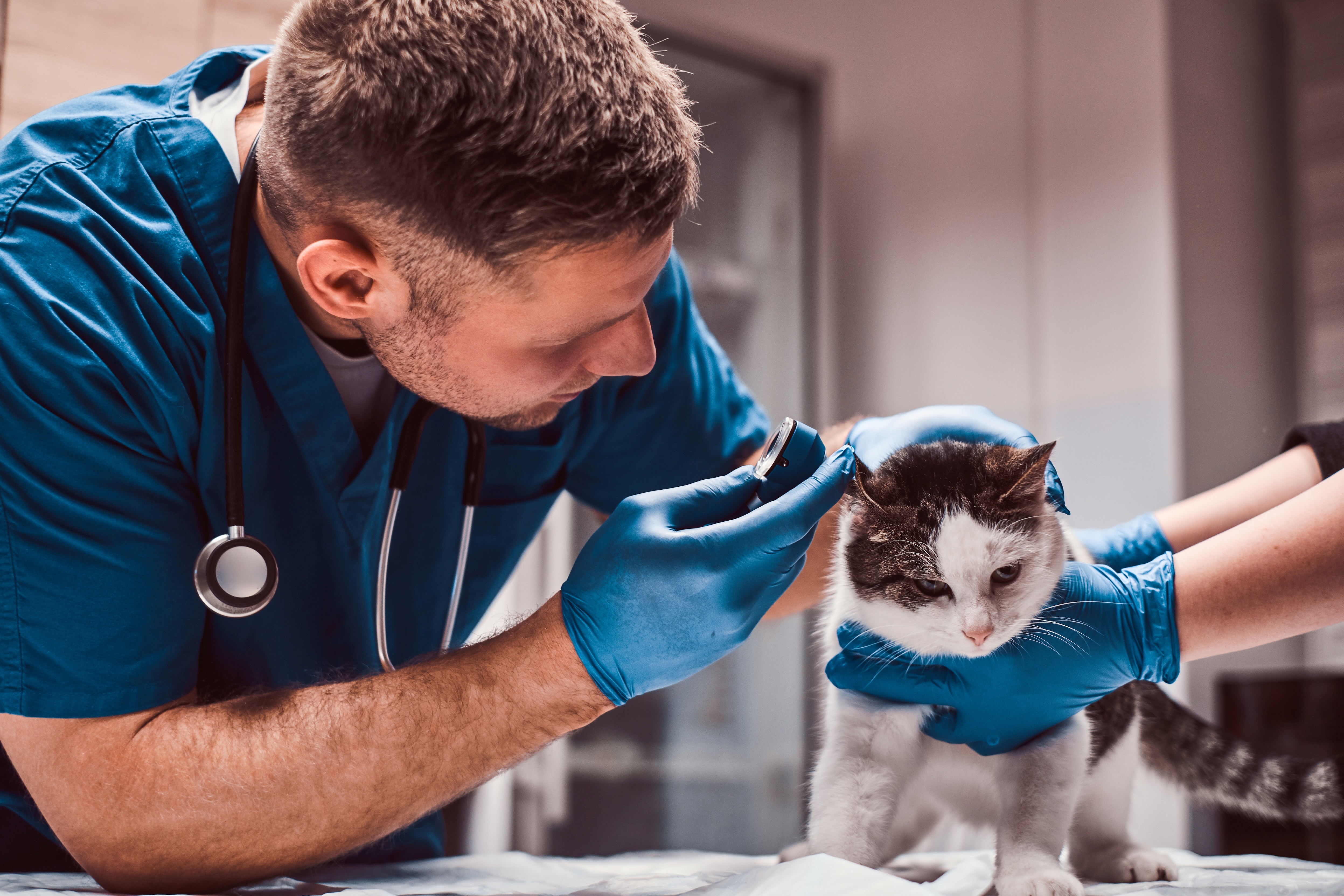
Are you a team member in a veterinary practice?
Are you a pet parent planning a trip with your furry pal?
Vet Entry Requirements Explained for Smooth Pet Travel
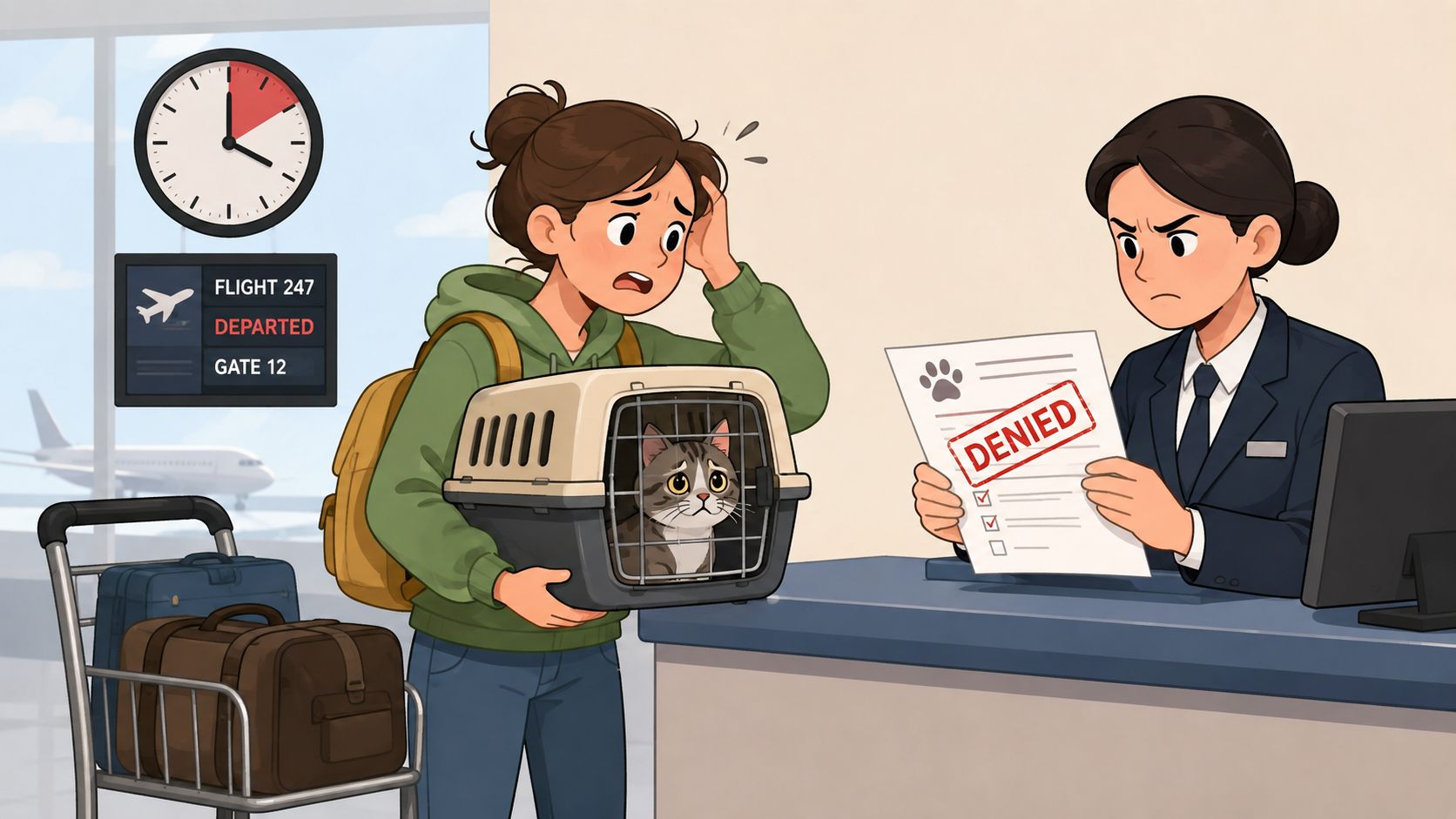
You've checked the microchip, booked the vaccination, and placed the health certificate safely in a folder. Then, at the airport desk, someone notices that the rabies vaccine was recorded before the microchip, or that the certificate was issued outside the destination's travel window. The file looks complete, but the dates don't line up. Your pet is ready to go, yet the journey may be delayed while you try to fix a calendar problem under pressure.
That's why vet entry requirements need more than a document checklist. They're a sequence of identity checks, vaccinations, examinations, endorsements, and destination-specific treatments. Each step has a purpose, and some steps only count when they happen in the right order. A little planning now can keep your pet's travel plan from going off the leash.
Why Vet Entry Requirements Matter More Than You Think
A pet owner may arrive at an airport with a carrier, passport, vaccination record, and health certificate. From a distance, everything appears organized. The problem often sits in a small detail, such as a missing endorsement, an expired certificate, or a vaccination that was administered before the animal's identification was recorded.
Those details can affect boarding, border inspection, and the next available travel arrangement. They can also create extra stress for the animal. A nervous cat or dog doesn't understand why a departure has changed, and the owner may need to rearrange flights, accommodation, transport, or care plans.
The paperwork protects more than the journey
Entry rules exist to confirm that the traveling animal can be identified and that important health risks have been addressed. The foundational EU framework established by Regulation (EC) No 998/2003, which applied from 3 July 2004, helped standardize the movement of dogs, cats, and ferrets for non-commercial travel across the European Union. The framework connected pet identity, rabies vaccination, and veterinarian-issued documentation in one system. The original regulation also tied vaccine requirements to a measurable veterinary standard.
That model influenced the way many travelers now think about pet movement. The animal needs a verifiable identity, proof of vaccination, and documents that match the route. Those elements aren't interchangeable. A health certificate can't replace identification, and a vaccination record can't always replace a destination-specific certificate.
Practical rule: Treat every date on the file as part of the travel plan, not as background information.
A complete file can still fail
The most frustrating errors are often sequencing errors. An owner may have completed every task but completed one task too early. A certificate may be signed correctly but become unusable because the appointment or endorsement falls outside the permitted window.
The safest approach is to work backward from the arrival date. Confirm the destination's current rules, identify every deadline, and ask the veterinarian or relevant government authority which dates must be linked. This turns a confusing collection of forms into a manageable schedule, with your pet's passport earning its travel stamps one step at a time.
The Core Components of Pet Travel Documentation
Think of pet travel paperwork as a passport system. The microchip identifies the traveler, the rabies record documents a key vaccination, the health certificate confirms the animal's condition and eligibility for the route, and any extra test or treatment addresses a destination-specific concern.
The four components may appear familiar, but each answers a different question:
Identity comes first
A microchip connects the pet to its records. For EU entry, dogs, cats, and ferrets must have an approved microchip, and the animal's identity must be established before the rabies vaccination is given. The European Commission's pet entry guidance makes that order important because a vaccine given before identification won't meet the EU travel sequence.
The chip isn't a tracking device. It's an identification reference that allows officials and veterinarians to match the animal to its documents. The number should appear consistently across the certificate, vaccination record, and other travel paperwork.
Rabies vaccination proves timing as well as treatment
A rabies entry requirement isn't satisfied by a vaccine label alone. Officials may need to see when the vaccine was administered, whether it followed identification, and whether the waiting period has passed.
For an EU primary vaccination, the animal must be at least 12 weeks old, and at least 21 days must pass after completion of the primary course before entry. EU guidance also states that the vaccination must begin before the animal travels.
The health certificate describes the specific trip
A health certificate isn't a universal permission slip. It's tied to the destination, origin, travel purpose, and sometimes the way the animal is transported. The issuing veterinarian may need to use a prescribed form, record the correct microchip number, and complete the examination within a defined period.
For practical background on how these documents are prepared, see this guide to veterinary international health certificates.
Extra requirements depend on the route
Some journeys may involve additional tests, treatments, or endorsements. These can depend on the origin country's rabies status, the destination's disease controls, whether the pet travels with the owner, and whether the animal travels as cargo.
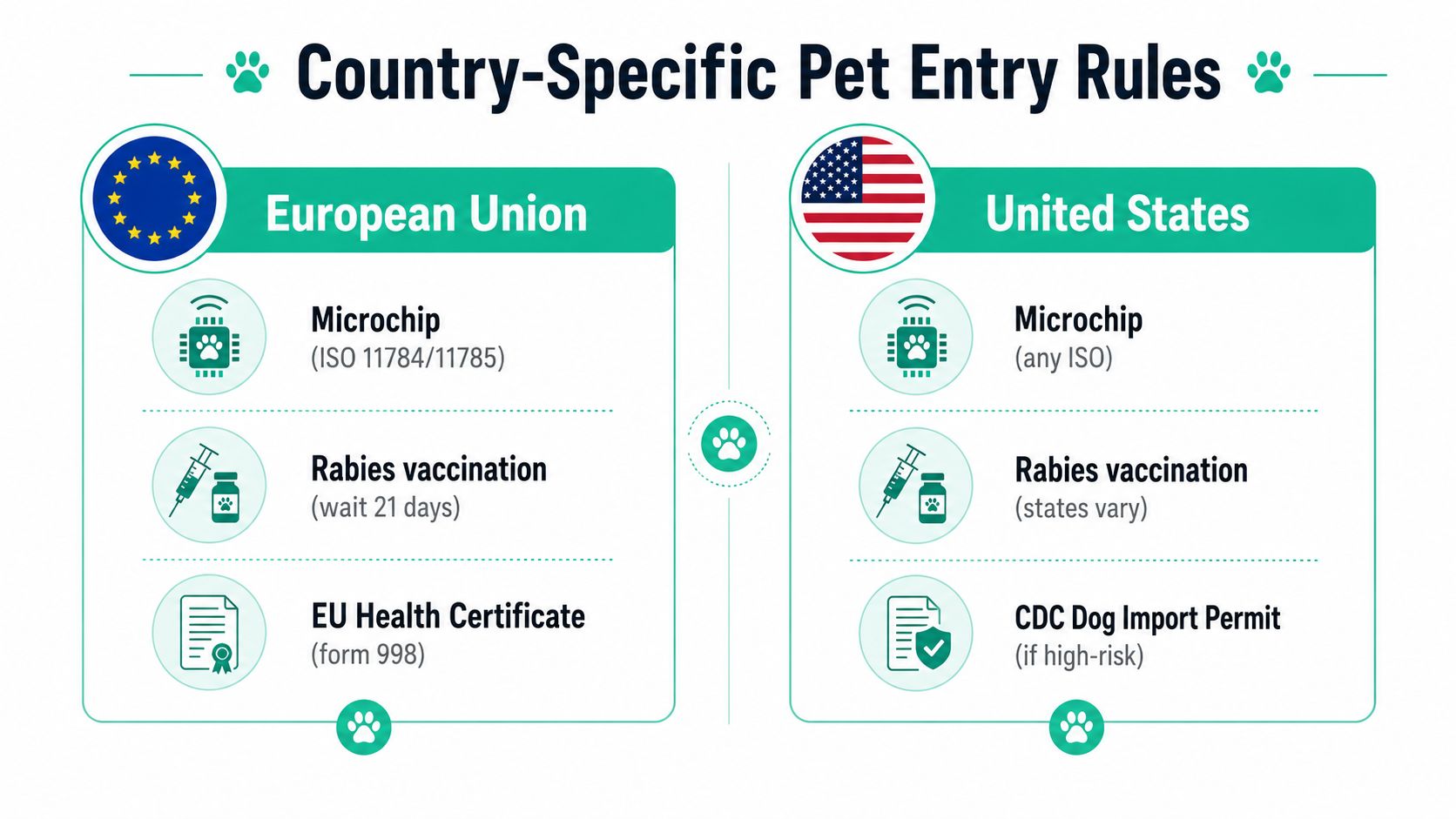
The image's comparison is useful as a reminder, but travelers should verify the current rules for their exact route. A checklist built for one country can leave a critical gap in another.
How Different Countries Set Their Own Rules
There's no single global pet travel checklist. Countries build rules around their own public health priorities, animal disease risks, border systems, and agreements with other jurisdictions. That's why two pets with the same microchip and rabies history may face different document requirements when they travel on different routes.
The EU provides a useful example of a coordinated regional approach. Its rules focus on individual identification, rabies vaccination, and supporting documentation, but the process still changes depending on whether the pet is entering from an EU or non-EU country and whether the movement is non-commercial or commercial.
Great Britain adds a route-sensitive treatment requirement for dogs. A dog arriving from many countries must receive tapeworm treatment from a veterinarian no less than 24 hours and no more than 120 hours before entry. Dogs arriving directly from Finland, Ireland, Malta, Norway, or Northern Ireland are exempt from that step under the Great Britain government rules.
The route changes the checklist
A treatment can be required on one route and unnecessary on another. A pet traveling with its owner may follow a different process from a pet shipped separately. The destination may also distinguish between personal travel and commercial movement.
Carrier checks add another practical layer. Official guidance for pet transport carriers explains that if the tapeworm treatment time is missing, the dog may still travel only when the carrier can establish that the treatment falls within the permitted arrival window. That makes the treatment clock part of the boarding process, not merely a veterinary record. The carrier checking guidance is worth reviewing alongside the destination rules.
Country research must happen before the appointment
A practice shouldn't assume that a standard certificate will fit every journey. Before scheduling, record the pet's species, origin, destination, travel date, travel mode, owner travel details, and whether the movement is non-commercial.
Then check the official government guidance for the destination and departure country. The international pet travel requirements guide can help organize the research, but the final decision should follow the current rules for the exact route.
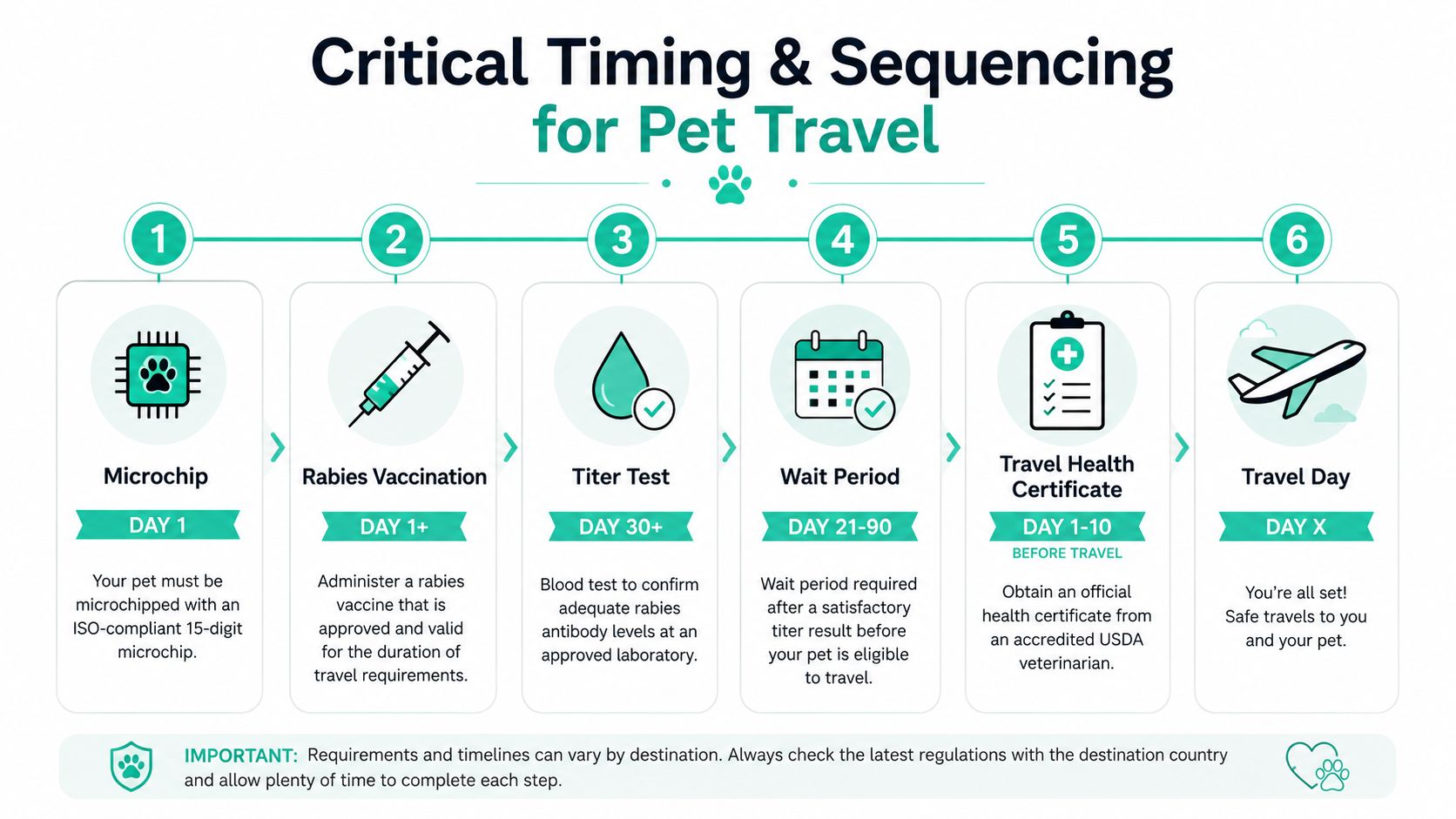
The important lesson is simple: destination, route, species, and travel mode determine the process. A generic online checklist may start the conversation, but it shouldn't end it.
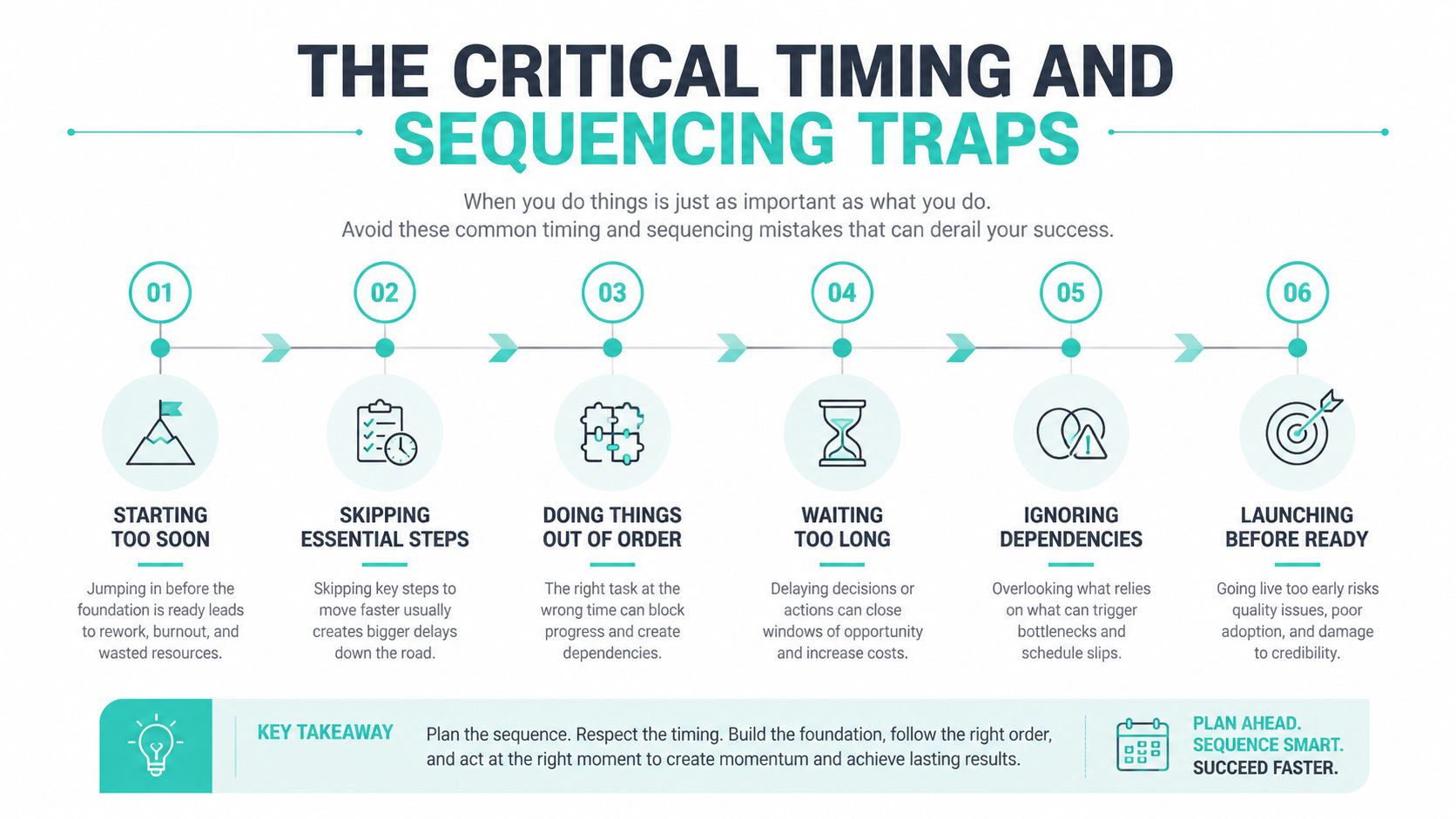
The Critical Timing and Sequencing Traps
A pet can have every required document and still miss entry because one step happened too early, too late, or in the wrong order. Treat the file like a relay race. Each requirement must pass the baton to the next one, or the whole journey can stumble at the border.
Trap one, identifying the pet after vaccination
For EU entry, the microchip must be recorded before the rabies vaccination. The vaccination counts for this purpose only when it follows identification. For a primary vaccination, the animal must be at least 12 weeks old, followed by a minimum 21-day wait after completion before entry. The EU's detailed requirements explain why the order matters.
If the vaccine came first, the owner may need revaccination after the microchip is recorded. That resets the relevant waiting period and can move departure, even though the pet already has a vaccination record.
Trap two, counting from the wrong event
Travelers may count from the appointment, certificate printing, or airline booking. The applicable clock may begin with the vaccination date, completion of a primary course, certificate issue, endorsement, or arrival.
Write the starting event beside every deadline. A clinic appointment does not automatically satisfy a government time limit, and memory is a poor travel clerk.
Trap three, letting the certificate expire
For non-commercial travel from Great Britain to the EU, the animal health certificate must be issued by a veterinarian and is valid for travel within 10 days of issuance. The pet must already have a valid rabies vaccination, and a first rabies course requires a 21-day wait before travel. The UK government's certificate guidance shows why issuance and departure need close coordination.
Issue the certificate too early and it may expire before departure. Issue it too late and there may be no workable time for endorsement, correction, or a replacement document.
Trap four, missing an endorsement window
Some routes require more than a private veterinarian's signature. The U.S. State Department explains that a pet shipped as cargo more than five days after the traveler arrives in the EU requires a commercial EU Pet Animal Health Certificate. A private veterinarian must sign the form, and a USDA-APHIS veterinarian must endorse it within 48 hours before the pet's arrival in the EU. The State Department's guidance shows how a certificate can be properly completed at the clinic yet fail when its endorsement does not match arrival.
See this guide on how to get a USDA-endorsed pet health certificate for the endorsement process.
Build a dependency map
Use a calendar with a separate entry for each dependency:
Identification: Record the microchip before any vaccination that relies on it.
Vaccination: Confirm the date, product details, and whether it is a primary course.
Waiting period: Count from the event specified by the destination authority.
Tests and treatments: Schedule route-specific tasks within their permitted windows.
Certificate: Book examination and issuance close enough to travel, while leaving time for corrections.
Endorsement: Confirm who endorses the document and the permitted timing before arrival.
The calendar should drive the paperwork. That simple change keeps the pet's file on the right track.
How Veterinary Practices Can Streamline Compliance
Pet travel cases deserve a defined workflow, not an informal favor handled between routine consultations. A practice that assigns ownership, records deadlines, and checks dependencies can give clients clearer answers while reducing avoidable rework.
Start with an intake form that captures the complete route. The team should collect the pet's species, microchip details, vaccination history, origin, destination, travel date, airline or transport method, owner travel timing, and whether the movement is commercial or non-commercial. Without those details, staff may prepare the wrong certificate or miss a route-specific task.
Give every case a visible owner
A designated travel coordinator can review the file, contact the client, confirm government requirements, and keep the veterinarian's clinical role separate from administrative follow-up. That doesn't mean one person must do every task. It means the practice knows who checks each stage and who contacts the owner when a date changes.
Use a checklist with dependencies rather than a list of unrelated boxes. “Rabies vaccination complete” isn't enough. The record should also show whether identification preceded vaccination, whether a waiting period applies, and whether the certificate and endorsement fit the planned arrival.
A good workflow asks not only whether a document exists, but whether it's valid for this animal, this route, and this date.
Digital document management can help the team store the current certificate, vaccination record, client messages, and task status in one place. Passpaw is one option that provides a documentation hub for pet travel files, allowing practices to organize documents and client communication within a structured workflow.
Manage changes before they become emergencies
Travel dates move. Airlines change cargo arrangements. Owners alter their arrival plans. Each change can affect certificate timing or endorsement requirements. The team should review the calendar whenever the route, transport mode, or arrival date changes, rather than only editing the flight information.
The U.S. State Department example shows why this matters. Cargo shipment timing relative to the traveler's arrival can change the certificate category and endorsement process. A practice that treats the case as a living file is better positioned to spot that change before the client reaches the airport.
Your Action Plan for Successful Pet Travel
Begin with the destination, not the vaccination appointment. Check the current government rules for the origin, destination, species, travel purpose, and transport method, then work backward from the arrival date.
For pet owners
Create a route record: Note every country involved, including transit points and the way your pet will travel.
Confirm identification first: Ask the veterinarian to verify the microchip and ensure its number matches the records.
Review rabies timing: Check whether the vaccination is primary, whether a waiting period applies, and whether the destination recognizes the record.
List extra treatments or tests: Look for route-specific requirements, such as Great Britain's tapeworm treatment window for eligible dog routes.
Schedule the certificate carefully: Confirm the issue window, endorsement process, and arrival deadline before booking the appointment.
Keep one current file: Store the certificate, vaccination record, treatment details, and correspondence together, with calendar reminders for every deadline.
For veterinary teams
Assign a case owner, use a route-specific checklist, and review the file whenever the client changes the itinerary. Encourage clients to contact the practice early, because sequencing problems can require a new vaccination or a revised certificate.
Rules can change, so use official government resources for the final verification. Careful timing won't make every journey effortless, but it can keep a small paperwork error from becoming a very large travel problem.
Passpaw helps veterinary practices organize destination-specific tasks, documents, deadlines, and client communication for international pet travel. Visit Passpaw to see how a structured workflow can make vet entry requirements easier to manage for your team and your clients.

More articles
From regulatory changes to best practices for veterinarians and pet owners, our resources keep you ahead of the curve.