Are you a team member in a veterinary practice?
Are you a pet parent planning a trip with your furry pal?
Your Guide to USDA Accreditation Renewal for Vets
Renewing your USDA accreditation is a key task that keeps your federal authorization active, letting you sign off on pet travel papers and other official health documents. The process involves completing a set number of training modules and filing a renewal application—VS Form 1-36A—every three years. Staying on top of this ensures your clinic can keep offering these crucial services without a hitch.
Keeping Your Accreditation Current Without the Headaches
We know your schedule is overflowing. Between appointments, surgeries, and the daily grind of running a clinic, administrative chores like renewing your USDA accreditation can feel like just one more thing on a never-ending list.
But this isn't just paperwork. It's about your ability to help clients navigate the world with their pets, especially as global travel becomes more common. A lapse in accreditation means turning clients away and losing revenue. More importantly, it creates massive stress for pet owners caught in the web of complex international travel rules.
Think of this as your friendly roadmap to staying compliant and ready for any travel-bound pet that walks through your doors.
The Renewal Basics: Category I vs. Category II
The key to a stress-free renewal is knowing exactly what’s required of you. The National Veterinary Accreditation Program (NVAP) runs on a structured 3-year renewal cycle for all accredited veterinarians.
The requirements differ based on your accreditation category. Here’s a quick look at how they stack up.
USDA Accreditation Renewal at a Glance
This table breaks down the core requirements for each category, helping you quickly identify what you need to do.
Requirement | Category I Veterinarian | Category II Veterinarian |
|---|---|---|
Typical Practice | Companion animals (dogs, cats, etc.) for domestic travel and simple international health certificates. | All animal species, including livestock, poultry, and complex export certifications. |
Training Units | Three units of APHIS-Approved Supplemental Training (AAST). | Six units of APHIS-Approved Supplemental Training (AAST). |
Renewal Cycle | Every 3 years. | Every 3 years. |
Whether you're a Category I vet who mainly sees companion animals or a Category II vet handling all species and more complex exports, the cycle is the same—only the training volume changes.
Key Takeaway: Renewal is an essential requirement to perform accredited duties. A little bit of planning now prevents a last-minute scramble and keeps your services running smoothly.
Weaving Renewal Into Your Daily Workflow
The real challenge isn't the training itself, but finding the time to do it. A bit of planning can make all the difference.
Instead of seeing renewal as a big event every three years, treat it as a continuous, low-effort task. Simple calendar reminders or alerts in your practice management system can be a lifesaver. For a truly seamless process, automating data entry is a game-changer, helping ensure accuracy and freeing up valuable time.
Similarly, having a solid system for your paperwork is helpful. Our guide on document management best practices for vet clinics is a great place to start.
By turning this task into a manageable one, you’ll avoid that "oh no" moment when a client needs an urgent health certificate and you realize your accreditation is about to expire. It's not fur-tunate when that happens.
Navigating Your Training Requirements and Key Deadlines
Let's get into the details of your APHIS-Approved Supplemental Training (AAST). This is the core of your USDA accreditation renewal, and knowing the ropes can turn a dreaded task into a simple checklist. Don't let this be a last-minute fire drill.
Everything you need is housed in the NVAP online portal. That’s your one-stop shop to find, complete, and track all the required training modules. How many you need to tackle depends entirely on which accreditation category you fall under.
Understanding Your Training Load
The requirements are refreshingly simple, based on the accreditation you chose when you first signed up. It’s a straightforward system designed to keep you current without overwhelming your schedule.
Category I Veterinarians: You’ll need to complete three units of AAST modules within your three-year accreditation window.
Category II Veterinarians: Your requirement is a bit higher, at six units of AAST modules over the same three-year period.
These modules aren't just busywork. They cover useful topics in animal health, disease control, and the ever-changing world of import/export rules. Think of them as a great refresher that keeps your knowledge aligned with federal standards. The training has become a fantastic resource—not just for accredited vets, but for any licensed veterinarian or technician looking to sharpen their skills.
You can even retake modules you've completed in previous cycles for credit, which is a huge help. If you get stuck, APHIS coordinators are there to guide the thousands of vets who go through this annually. Feel free to browse the full list of training modules and their CE eligibility on the APHIS website.
This flow chart breaks down the renewal process into a simple, continuous loop. It’s all about reviewing what’s needed, getting the training done, and submitting the renewal.
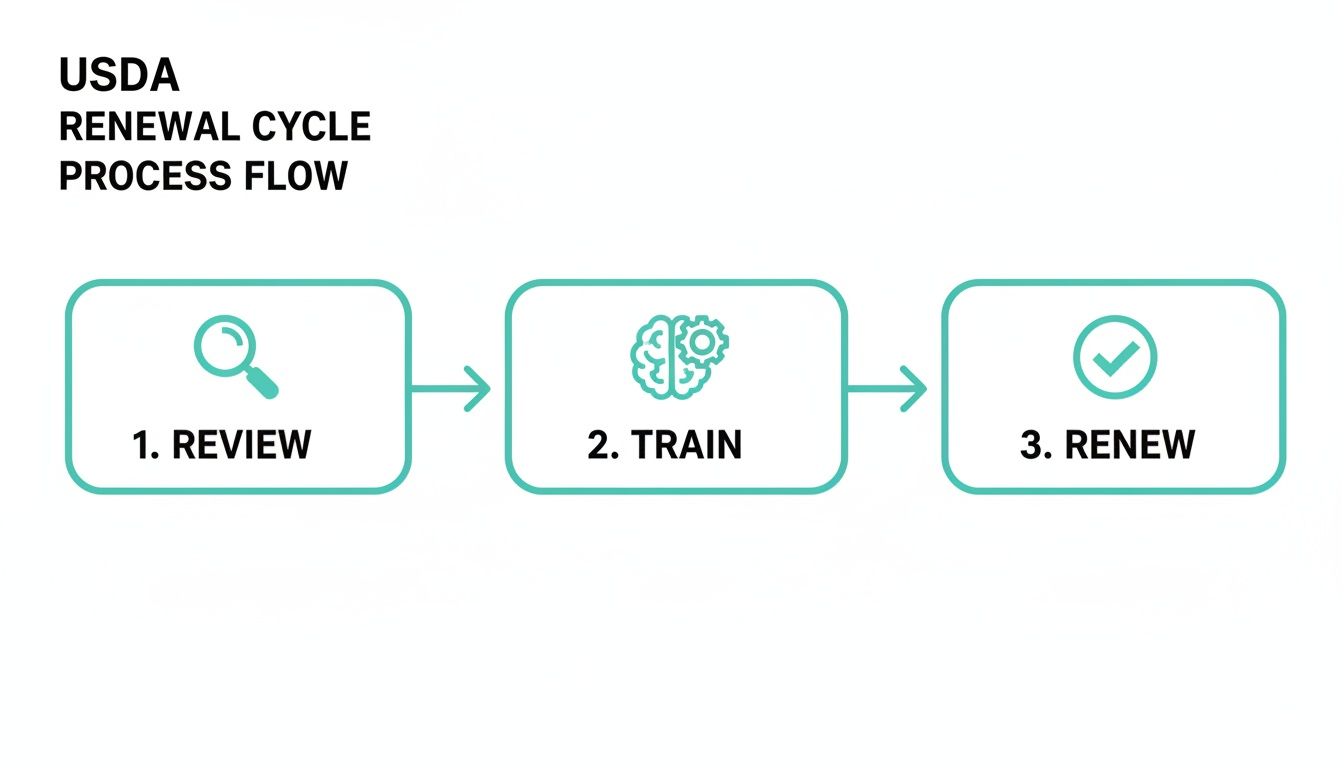
It’s a good reminder that renewal isn't a one-time event, but a cycle of small, proactive steps that keep your practice ready for anything.
Crafting a Realistic Timeline
When it comes to renewal, timing is everything. APHIS gives you a generous window, letting you submit your renewal application up to six months before your accreditation expires. But from our experience, waiting until the last few weeks is a recipe for stress. The APHIS portal can get bogged down during peak renewal season, and you don’t want to get stuck in a digital traffic jam.
The best strategy is to be proactive. Spacing out your training modules is much more manageable than a marathon cram session over a weekend. A little planning now saves a lot of headaches later.
Pro Tip: You don't have to wait until your renewal year to start chipping away at your training. You can complete your AAST modules anytime during your three-year cycle. Plus, many of these modules offer free Continuing Education (CE) credits, so you can double-dip and knock out two requirements at once.
Here’s a sample schedule that shows how a Category II vet can stay ahead of the game:
Sample Training Timeline (Category II Vet)
Year of Cycle | Modules to Complete | Action Item |
|---|---|---|
Year 1 | Two Modules | Get your first two modules done. Save the completion certificates in a dedicated folder right away. |
Year 2 | Two Modules | Complete two more. This keeps the workload light and the information fresh in your mind. |
Year 3 | Two Modules & Renew | Finish your last two modules and submit your renewal as soon as that six-month window opens. |
This staggered approach makes the training feel less like a chore and more like a routine part of your professional development. It ensures you're never caught scrambling.
For a bird's-eye view of the entire accreditation journey, from your first application to renewal, you might want to check out our complete guide on what veterinary accreditation with the USDA entails. A simple, forward-thinking plan ensures you're always prepared, compliant, and ready to serve your clients without a single hiccup.
A Clear Walkthrough of the Submission Process
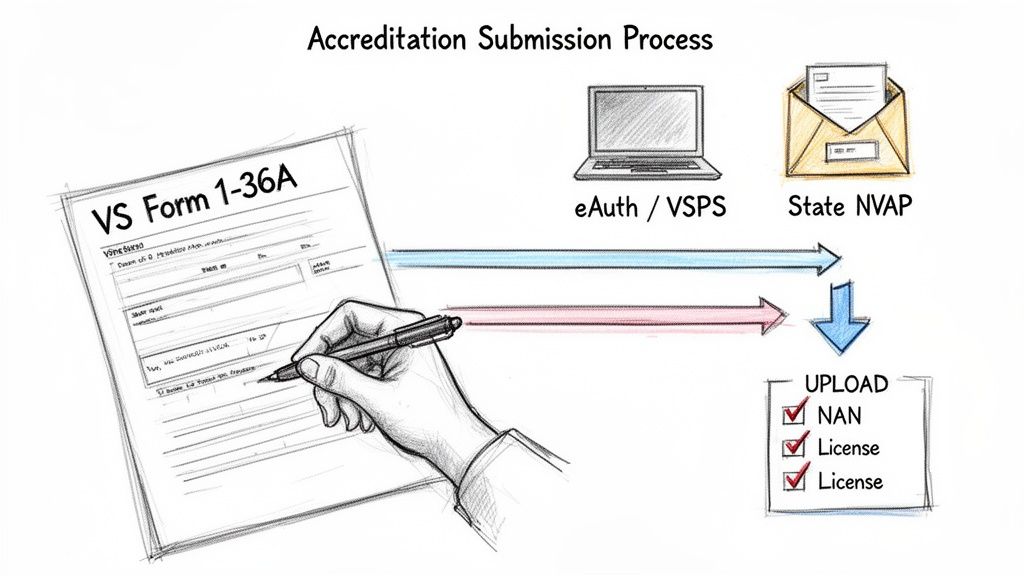
You’ve finished the training modules and have the certificates saved. Now for the final step: submitting your USDA accreditation renewal application. This is where you pull everything together to keep your accreditation active without any issues.
The whole process revolves around one key document: VS Form 1-36A, Application for Veterinary Accreditation Renewal. This is the official form where you’ll confirm your details and attest that you've completed all the required training.
Luckily, you have two ways to get this form to APHIS. You can go the modern online route or stick with the traditional paper method. Both work, but one is definitely faster.
Choosing Your Path: Online vs. Paper
How you submit your renewal often boils down to personal preference, but the feedback from most vets is pretty clear—the online system is the easiest path.
The Online Route (Recommended): This involves using your USDA eAuthentication (eAuth) account to access the Veterinary Services Process Streamlining (VSPS) system. It's faster, you get an instant confirmation, and there's no risk of paperwork getting lost in the mail.
The Paper/PDF Route: The old-school method. You download, print, and fill out VS Form 1-36A, then mail, email, or fax it to your state's NVAP Coordinator. It’s reliable, but it's also slower.
Let's be honest, in a busy clinic, anything that saves time and cuts down on admin headaches is a huge win. The online submission process is designed to do just that.
Pre-Submission Checklist: Get Your Ducks in a Row
Before you log in or print a single page, take a few minutes to gather all your information. Having these details ready prevents you from having to stop and dig through files mid-application. It's the best way to make your USDA accreditation renewal a one-and-done task.
Here’s what you should have on hand:
Your National Accreditation Number (NAN) — that unique six-digit identifier.
Your Veterinary License Number(s), including the expiration date for every state where you're licensed.
Your eAuthentication User ID and password.
Your training completion certificates, saved as clearly named digital files (e.g., "AAST_Module1_YourName.pdf").
Taking 10 minutes to organize these items beforehand can easily save you 30 minutes of frustrating searching later. It’s a simple step that helps ensure a clean, error-free submission.
Submitting Online Through VSPS
The Veterinary Services Process Streamlining (VSPS) system is your digital portal for renewal. The name is a mouthful, but the process is straightforward once you know the clicks.
First, log into the system with your eAuth credentials. Once you're in, find the section for accreditation management and select the "Accreditation Renewal" option.
The system will guide you through a digital version of VS Form 1-36A. You’ll verify your personal info, enter your license details, and then get to the most important part: uploading your training certificates. You just need to attach the PDF files as proof of your completed AAST units.
The VSPS system gives you immediate confirmation once your application is received, which offers fantastic peace of mind. No wondering if your paperwork made it.
This digital workflow is especially helpful if you're regularly completing complex documents like the APHIS 7001. If that's part of your daily routine, you might appreciate our deep dive on everything you need to know about the APHIS 7001 health certificate. The accuracy you get from digital systems is a massive benefit.
Once you’ve submitted your renewal, you can sit back and relax. You’ve successfully navigated the process and are all set for another three years. It wasn't so ruff, was it?
Common Pitfalls and How to Avoid Them
Even the most organized veterinarian can hit a snag with their USDA accreditation renewal. It just happens. Let's walk through some of the most common hiccups we see and, more importantly, how you can sidestep them for a smooth, panic-free process.
Learning from the missteps of others is the goal here. A seamless renewal means no interruption in your ability to help clients with their pet travel needs, and that’s what matters.
Mismanaging Training Certificates and Deadlines
One of the most frequent—and frustrating—mistakes is assuming APHIS automatically tracks your continuing education. Many vets complete an AAST module and figure the system logs it for them. Unfortunately, that's not how it works.
You are responsible for saving a PDF copy of each completion certificate the second you finish a module. If you close that window without saving, you’ll have no proof to upload when it's time to renew. We've seen it happen, and it often means having to retake the training. It's a classic "oops" moment that is entirely avoidable.
Another common pitfall is cutting the deadline too close. Your accreditation is valid for three years. While you can submit your renewal application up to six months before it expires, many vets wait until the final weeks. This is a gamble.
We’ve seen this exact scenario play out: A vet planned to renew in the last week of their cycle, only to discover the APHIS portal was down for maintenance. It created a stressful scramble and a temporary lapse in their accreditation. Don't be that person—aim to renew as soon as your six-month window opens.
Confusion for Vets Licensed in Multiple States
If you hold veterinary licenses in more than one state, you might be wondering if you need to renew your accreditation for each one. This is a huge point of confusion, but the answer should bring a sigh of relief.
Your USDA accreditation is federal, not state-specific. It's tied to you as an individual veterinarian through a designated "State of Record" with APHIS. This means you only go through the renewal process once every three years.
You will submit just one VS Form 1-36A.
You will upload your training certificates just once.
Your entire renewal is handled through your single State of Record's NVAP Coordinator.
The key here is making sure your contact information and State of Record are always current with APHIS. If you move your primary practice to a new state, you have to update this information. It helps ensure your renewal reminders and paperwork go to the right place for a pain-free process.
Overlooking System Glitches and Outdated Contact Info
Last-minute technical difficulties are the silent saboteurs of so many renewal applications. Simply hoping the APHIS portal will work perfectly on the day you need it is a risky strategy. Like any website, it can experience slowdowns or be down for maintenance, especially at the end of the month when traffic spikes.
The fix is simple: plan ahead. Download all the necessary forms and get your documents in order well in advance. If you’re submitting online, try doing it during off-peak hours, not on the last day of your renewal month.
Finally, a surprisingly common error is having outdated contact information on file. If APHIS doesn't have your current email or mailing address, you won't get those official renewal reminders. While you should never rely solely on them, they're a great safety net. A quick check to confirm your details are correct can prevent a major cat-astrophe down the line.
Tying Your Renewal Into Your Practice’s Workflow
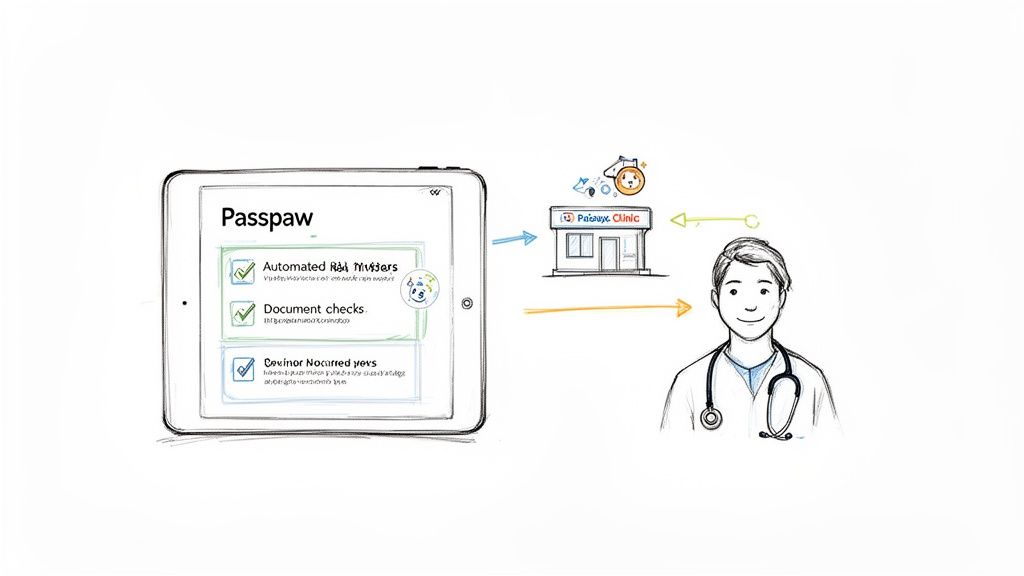
Keeping your USDA accreditation current is essential for offering pet travel services. But we all know the real headache isn't the renewal itself—it's managing the relentless stream of international health certificates, each with its own strict deadlines and dizzying rules.
This is where the lightbulb goes on. A painless renewal process is just the starting line. The real win is building a system that turns the entire pet travel compliance process from a potential administrative nightmare into a well-oiled machine. It’s not just about dodging paperwork; it’s about making this service line more efficient and profitable.
From Simple Reminders to Full Automation
Think about a system that does more than just ping you about a client’s upcoming travel deadline. Imagine it also sends an alert the moment your own USDA accreditation renewal window opens. That’s the difference between a simple calendar and a true compliance workflow.
A dedicated platform like Passpaw is built for exactly this. It goes beyond basic alerts by actively tracking all the moving parts. This helps ensure your clinic never has to hit pause on services because of a missed deadline—whether it’s for a patient’s flight or your own accreditation. Exploring workflow automation software can open your eyes to how much manual effort can be taken off your team's plate.
A lapse in your accreditation is more than an inconvenience. It’s a direct hit to your revenue and reputation. Integrating your renewal into a bigger efficiency system helps ensure continuity, keeping your pet travel services running without a single hiccup.
Sidestepping Costly Errors
In the world of pet travel documents, human error is the biggest risk. A simple slip-up, like using the wrong National Accreditation Number (NAN) or having an inactive DVM sign a certificate, can create a travel-stopping crisis for your client and a major headache for your practice.
This is where automated guardrails become your best friend. A system like Passpaw helps reduce these exact risks by:
Verifying Accreditation Status: Before any document is finalized, the platform can cross-reference the signing DVM’s info to help confirm their USDA accreditation is active.
Confirming NAN Accuracy: It helps ensure the correct NAN is used on every single health certificate, cutting the risk of rejection by APHIS or foreign officials.
Integrating Renewal Reminders: By tracking your renewal date, the system prompts you to stay ahead, preventing any chance of signing documents with an expired accreditation.
These checks are like having a second, expert set of eyes on every detail, making your practice’s compliance solutions are robust and reliable.
The Financial and Professional Upside
A timely USDA accreditation renewal pays dividends that go far beyond signing health certificates. It’s directly tied to other professional opportunities.
Take the USDA's Veterinary Medicine Loan Repayment Program (VMLRP). With $18 million in funding available for FY2026, it’s a huge opportunity. But to even apply, you must provide proof of your active USDA APHIS accreditation. A lapse could make you ineligible for significant debt relief. You can read the full details about the VMLRP application requirements from the USDA to see just how critical this is.
When you connect your accreditation management to a practice efficiency platform, you’re not just simplifying a task—you’re investing in your practice’s future. You free up your team, slash the risk of costly mistakes, and deliver a seamless, stress-free experience for your clients. It’s all about working smarter to keep your practice and your clients on the move.
Your USDA Renewal Questions Answered
We’ve covered the core steps of the USDA accreditation renewal process, from the training modules to the final submission. But as any experienced vet knows, the real devils are often in the details.
Here, we’ll tackle some of the most common questions and tricky scenarios we see in our practice community. Think of this as your go-to FAQ for navigating renewal with confidence.
What Happens If I Miss My Renewal Deadline?
Let's get the tough one out of the way first. If you miss your renewal deadline, your USDA accreditation becomes inactive. Immediately.
This means you are no longer authorized to perform accredited duties, which includes signing international health certificates or any other official travel documents. It’s a serious situation that can bring a critical service at your clinic to a sudden halt.
To get reactivated, you’ll have to complete all the required AAST training units and submit a fresh application using VS Form 1-36A. Depending on how long your accreditation has been inactive, APHIS may require additional steps.
It's far less stressful to renew on time than to go through the reactivation process. Think of it as avoiding a totally preventable headache for you, your practice, and your clients. An ounce of prevention is worth a pound of cure—and a lot less paperwork!
Can I Complete All My Training Modules at Once?
Yes, you can. The USDA allows you to complete your required AAST units—three for Category I, six for Category II—at any point during your three-year accreditation window. There’s no rule against knocking them all out in one sitting.
However, we don't usually recommend it. Spacing your modules out over the three-year cycle makes the workload much more manageable. More importantly, it helps you stay current on regulations as they evolve, rather than trying to absorb three years of changes all at once.
Spreading them out also offers a practical advantage: you avoid the last-minute rush. The APHIS site can slow down when too many people try to log on near common deadlines. Planning ahead sidesteps that technical frustration entirely.
How Do I Handle Renewal If I Am Licensed in Multiple States?
This is a fantastic question and a common point of confusion. The good news is that your USDA accreditation is federal, tied to you as an individual veterinarian, not to any single state license.
You will have one designated "State of Record" with APHIS, which is typically the state where you do most of your work. You only need to complete one USDA accreditation renewal, and it’s all managed through that one State of Record.
You do not need to renew separately for each state where you hold a license.
You will submit just one renewal application (VS Form 1-36A).
Your single renewal covers your accreditation nationwide.
The most important thing is to keep your State of Record and contact details current with APHIS, especially if you move your primary practice. This ensures you get all official correspondence, including those crucial renewal reminders.
Where Can I Find My National Accreditation Number (NAN)?
Your National Accreditation Number (NAN) is your unique six-digit identifier in the NVAP system. It's essential for filling out your renewal forms and is required on all official documents you sign.
You can find your NAN in a few places:
Your Accreditation Certificate: It is printed right on the official certificate you received when you were first accredited or last renewed.
AAST Completion Certificates: Your NAN is also listed on the completion certificates for each training module you finish.
Your State's NVAP Coordinator: If you’re still stuck, you can always contact your state's NVAP Coordinator. They can look up your information and provide your NAN.
It’s a smart move to save your NAN somewhere you can easily find it, like a digital note or a file with your other professional credentials. You’ll need it more often than you think.
Ready to take the stress out of pet travel compliance for good? Passpaw integrates these critical deadlines and document checks into a simple, automated workflow. Discover how our platform can save your practice time, reduce errors, and keep you and your clients on track. Learn more at Passpaw.
More articles
From regulatory changes to best practices for veterinarians and pet owners, our resources keep you ahead of the curve.