Are you a team member in a veterinary practice?
Are you a pet parent planning a trip with your furry pal?
Travel Insurance for Pets: A Complete 2026 Guide
You've booked the flight. You've checked the airline carrier rules twice. Your pet's carrier is sitting by the door, your vet appointment is on the calendar, and then one small problem shows up. A vaccine date is off, a health certificate timing window gets tight, or your pet wakes up with an upset stomach two days before departure.
At that point, it becomes clear that pet travel planning has two separate, interconnected stress points. Insurance helps with some unexpected travel problems. Paperwork helps prevent the problems that insurance often won't touch.
I've seen this catch people off guard again and again. They assume travel insurance for pets works like a big safety blanket. In practice, it works more like a backup layer for very specific events. If the travel disruption starts with missing documents, wrong timing, or a failed entry requirement, that backup layer may not help at all.
That's why this topic matters now. Pet owners are treating travel planning more seriously, and the broader insurance market shows it. In the U.S., the number of insured pets grew 12.7% in 2023, with nearly 5.7 million insured pets by year-end, according to NAPHIA's insured pet market data. More owners are already comfortable paying to reduce risk, which makes pet travel protection a natural next step.
If you're in the middle of planning a move, vacation, or long stay abroad, it helps to treat insurance as one part of the travel system, not the whole leash. A good starting point is understanding the full journey itself, from documents to transit day, as outlined in this pet travel guide.
Your Pet Travel Adventure Needs a Safety Net
A common travel day problem looks small at first. A flight delay turns into a missed connection. A pet has to stay in boarding longer than expected. Or your dog seems fine at home, then develops a sudden issue during the trip and needs urgent veterinary care in a city you don't know.
Those are the moments when travel insurance for pets can earn its keep.
Where the stress usually starts
Travelers typically don't worry about insurance first. They worry about whether their pet will be safe, accepted by the airline, and allowed into the destination country. That makes sense. The emotional part comes first.
Then the practical side kicks in. If something goes wrong, who pays for emergency care? What happens if the return trip is delayed and boarding runs longer? If your pet becomes the reason the trip changes, do you absorb every cost yourself?
Practical rule: Buy coverage for the risks you can't comfortably self-fund, not for the risks you can prevent with better prep.
That distinction matters. Insurance can help with some unexpected costs. It won't fix paperwork errors, timing mistakes, or skipped requirements. For pet owners, that's the key trade-off.
Why more travelers are looking at coverage
The bigger pet insurance market gives useful context here. According to the Insurance Information Institute, pet insurance has existed outside the U.S. since the early 1900s, and the first U.S. pet insurance policy was issued to Lassie in 1982. The same source says more than 6.4 million U.S. dogs and cats were covered in 2024, up nearly 13% from the prior year, which shows how normal insurance has become for pet owners who want a financial buffer during stressful moments, as noted in the III pet insurance facts and statistics page.
That doesn't mean every traveler needs a policy. It does mean fewer owners see insurance as strange or unnecessary. For international travel especially, the appeal is simple. You're already spending time and money to move your pet safely. Adding a contingency layer feels reasonable.
What Is Travel Insurance for Pets
Travel insurance for pets is usually a short-term add-on tied to travel. It is not the same thing as regular pet health insurance, and treating them as interchangeable is where many people get tripped up.
Think of it this way. Your normal pet insurance is for your pet's ongoing medical life. Travel insurance is for the trip itself.
The clearest way to separate the two
A simple comparison helps:
Type | Main purpose | Typical trigger |
|---|---|---|
Regular pet insurance | Ongoing accident and illness coverage | Your pet needs covered care, whether traveling or not |
Pet travel insurance | Trip-related protection | A travel event creates a covered expense or disruption |
That trigger matters more than people expect. With travel insurance for pets, the claim often depends on the event happening during the trip or directly affecting the trip.
What it commonly looks like in real life
Most pet travel coverage is bundled into a broader travel policy or added as a pet rider. It typically focuses on two buckets, based on Experian's overview of pet travel insurance:
Emergency veterinary care during travel
Trip disruption costs tied to your pet's illness, injury, or transport delay
That means it's less like a full health plan and more like a targeted travel tool. If your cat needs urgent treatment while abroad, that may fall within scope. If your return is delayed and you have extra boarding costs, that may also fit. But if the issue started long before the trip, or if the loss came from failing entry rules, that usually falls outside what these policies are built to cover.
Why that distinction matters before you buy
The pet insurance market has trained many owners to think in annual coverage terms. The III reports average U.S. accident-and-illness premiums of $676 per year for dogs and $383 per year for cats, or about $56 and $32 per month, in its pet ownership and insurance facts. That familiarity is useful, but it can create the wrong expectation if you assume travel coverage behaves the same way.
It doesn't.
A better way to think about it is this: regular pet insurance protects the pet's health costs over time. Travel insurance protects your itinerary from certain pet-related disruptions for a limited window.
If you're trying to budget realistically for the full move or trip, it helps to look at the wider expense picture too, not just insurance. These pet transport cost considerations are often where owners see how quickly “small” add-ons stack up.
Unpacking Your Pawsome Policy Coverage
The good parts of a pet travel policy are usually straightforward. The challenge is knowing which benefits matter for your route, your destination, and your pet's health history.
A lot of policies sound generous until you match the wording to real travel scenarios.
The three coverage areas that matter most
Most useful policies revolve around three practical needs.
First, there's emergency veterinary care during the trip. This is often the core reason owners buy travel insurance for pets. If your dog gets sick after arrival or your cat is injured in transit, this is the benefit you'll look for first.
Second, there's trip interruption or cancellation linked to the pet. This is one of the most important but least understood parts of the category. Some plans help if a covered pet illness or death forces the owner to cancel or cut short the trip. Others don't.
Third, there are delay-related costs, such as extra boarding or kennel fees when travel doesn't go to plan.
Quick reference table
Coverage Type | What It Typically Covers | Example Scenario |
|---|---|---|
Emergency veterinary care | Urgent treatment for illness or injury during covered travel | Your dog develops a sudden medical issue after landing |
Trip cancellation or interruption | Covered trip changes tied to a pet emergency under policy terms | Your pet becomes acutely ill close to departure and the plan allows cancellation benefits |
Delay-related boarding | Added boarding or kennel expenses after a travel delay | Your return flight is pushed back and your boarding booking has to be extended |
Pet assistance services | Help locating a vet or navigating a pet emergency while away | You need urgent local guidance in an unfamiliar city |
Return or transport support | Limited help if a pet's travel arrangements must change after a covered event | A medical event changes who can accompany the pet home |
What the benefit limits tell you
The numbers matter here, but only if you read them the right way. One provider lists benefits of up to $250 for extra boarding and up to $2,500 for emergency veterinary expenses under eligible conditions, according to Travelex's pet travel protection page. Industry-facing guidance also describes single-trip pet travel policies as often priced around $100 to $500.
That tells you something important. These plans are usually designed to soften the blow from a bad event, not to erase every cost.
A policy with a modest cap can still be useful. It just needs to match the kind of expense you're actually likely to face.
If you're comparing plans, ask one question before anything else: Would this limit cover the problem I'm worried about most?
What tends to work well
Coverage works best when it's matched to a clear exposure:
Complex flight itineraries: More chances for delays and missed handoffs
High-cost destinations: Emergency vet treatment may be expensive enough that partial reimbursement still helps
Trips with prepaid reservations: Interruption coverage matters more when the owner has meaningful nonrefundable spend
Older pets or stress-prone pets: Not because insurers guarantee broad coverage, but because owners may value a financial backstop more
For owners trying to estimate real-world treatment costs, local service pricing can offer a reality check. This look at Personalised Mobile Vet pricing is useful because it shows how quickly veterinary expenses can climb once convenience, urgency, and location enter the picture.
The Fine Print What Pet Travel Insurance Excludes
Often, the tail starts wagging the dog. People buy a policy for peace of mind, then assume the hard part is done. In reality, the exclusions section often decides whether the coverage is useful.

The biggest exclusions are not surprising
Most policies are built for sudden events, not known issues. That's why pre-existing conditions are commonly excluded. A pet that already had a condition, symptoms, or an ongoing problem before the policy started may not qualify for related claims later.
Waiting periods can also matter. A traveler who buys a plan right before departure may assume coverage starts instantly. That isn't always how it works.
Behavioral issues and elective treatments are also common weak spots. If the problem isn't framed as an emergency travel event, there may be little or no coverage.
The paperwork exclusion is the one owners miss
The more painful exclusion is this one: losses tied to your failure to follow airline or country entry rules may be excluded.
That point appears clearly in Experian's explanation of pet travel insurance. Pet travel insurance is typically a short-term add-on, not a full health plan, and many policies exclude both pre-existing conditions and losses tied to noncompliance with travel requirements.
This changes how you should think about risk. If your pet can't board because the health certificate is incomplete, the microchip record doesn't match, the vaccine timing is wrong, or an import requirement was missed, the disruption may be pet-related without being covered.
Hard truth: Insurance often responds to bad luck. It usually doesn't respond well to preventable paperwork mistakes.
That's why insurance and compliance can't be planned in separate silos.
What owners should assume unless proven otherwise
If the policy wording is unclear, assume these situations may be denied unless the insurer says otherwise:
Missing or incomplete travel documents
Vaccination timing problems
Wrong carrier setup or airline rule failures
Border entry issues caused by owner error
Known health problems that existed before coverage started
This is also where many comparison articles fall short. They explain emergency vet benefits but skip the practical denial triggers. For international pet travel, that gap matters more than the glossy list of inclusions.
What actually lowers your risk
You can't insure your way out of weak prep. The better move is to reduce what the policy excludes.
Use a simple order of operations:
Confirm destination rules first
Map document timing backward from departure
Check vaccine, microchip, and certificate details against the destination
Then buy the policy that fits the remaining risk
Owners often do that in reverse. They buy a policy early, then assume the insurance has their back. Sometimes it does. But if the issue is administrative, the claim can go cold fast.
Choosing and Buying the Right Policy
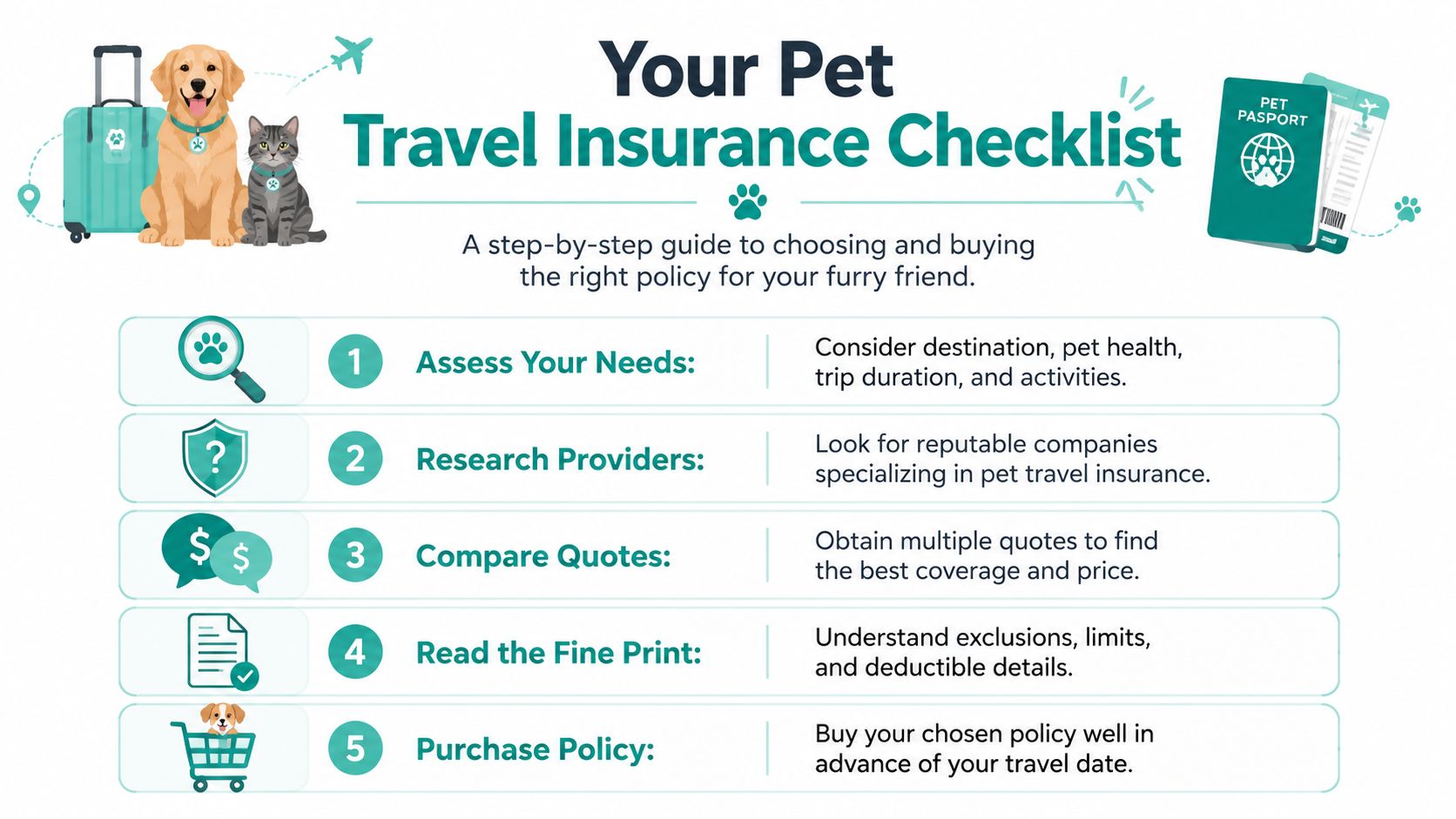
Buying travel insurance for pets gets easier when you stop asking, “What's the best plan?” and start asking, “What problem am I trying to protect against?”
That shift keeps you from paying for coverage that sounds comforting but doesn't fit your trip.
Start with the trip, not the policy
A short nonstop trip with a healthy young pet creates a different risk profile from a multi-leg international move with tight entry windows.
Before you compare quotes, write down:
Destination rules: Some trips are documentation-heavy even when the flight itself is simple
Trip structure: Direct flight, connections, overnight layovers, relocation, or vacation
Your pet's health picture: Not for over-disclosure here, but to judge whether exclusions may limit usefulness
Your financial pressure points: Emergency care, cancellation loss, extra boarding, or all three
That list tells you whether a policy is worth buying at all.
Compare the parts that actually matter
Many owners focus on the premium first. That's understandable, but the cap often matters more than the purchase price.
Travelex's example benefits show why. Some pet add-ons offer up to $2,500 for vet expenses and $250 for extra boarding. Those limits can be useful, but they're not huge. In some destinations, they may function as partial reimbursement rather than complete protection.
When comparing policies, look at these in order:
Trigger language
Does the policy cover the event you're worried about, or something narrower?Benefit caps
Are the limits meaningful relative to likely costs where you're going?Exclusions
Especially anything tied to paperwork, pre-existing conditions, or travel rule failuresClaims process
Do you know what records you'd need if something goes wrong abroad?Timing
Is there any waiting period or purchase window that affects eligibility?
A working pre-travel checklist
Use this before you click “buy”:
Check microchip records: Make sure the chip information matches the records your vet and destination paperwork will use
Gather medical records: Keep vaccine history, treatment records, and travel documents easy to access
Verify certificate timing: Some trips fail because the certificate is correct but issued at the wrong time
Review the cancellation trigger: If your pet gets sick before departure, don't assume the plan pays
Save emergency contacts: Vet contacts, insurer contact details, airline pet desk, and boarding backup
Confirm service support if needed: If you're using a transporter or courier, make sure responsibilities are clear from the start, especially if you're coordinating a pet courier service
Buy the policy only after you can explain, in one sentence, what event would make you file a claim.
If you can't answer that cleanly, keep reading the policy.
Guidance for Veterinarians and Pet Travel Providers
For clinics, shippers, and pet travel coordinators, insurance questions usually show up late. A client asks whether a missed flight, rejected document, or sick pet will be covered. By then, the issue is often workflow, not insurance literacy.
The professional opportunity
Clients don't need providers to sell insurance. They need providers to explain where insurance stops helping.
That usually means telling them three things clearly:
A policy may help with emergency events during travel
It may help with some disruption costs
It may not help if the root cause is bad or incomplete compliance paperwork
That guidance is valuable because it changes client behavior early. They book the health certificate appointment sooner. They verify timelines. They ask better questions about destination requirements.
Why documentation quality affects financial risk
A clean certificate workflow doesn't just improve operations. It lowers the chance of uninsured loss.
If a pet is delayed, denied boarding, or refused entry because records don't line up, the owner may face new transport costs, boarding costs, or trip losses that insurance won't reimburse. That makes compliance work one of the most important risk controls in the entire trip.
For providers, process matters more than heroics. Standardized checklists, destination-specific review, and task tracking prevent the kind of small mistakes that become expensive on departure week.
A platform such as Passpaw's veterinarian certification workflow guide is relevant here because it focuses on the mechanics clinics struggle with: managing international health certificates, checking destination requirements, and reducing document errors through a structured workflow.
How to advise clients without overpromising
Keep the message practical:
The health certificate is not just an admin task. It's part of the client's financial protection strategy because insurance may depend on compliant travel.
That also applies to wellness prep. Some owners ask about supporting gut comfort or travel stress before departure. Products like dog probiotics may come up in those conversations, but they don't replace destination compliance, emergency planning, or policy review.
The clinics and travel providers that handle this well don't just move pets. They reduce preventable claims, client panic, and last-minute scrambles.
Frequently Asked Questions About Pet Travel Insurance
Does travel insurance for pets cover cancellation if my pet gets sick before the trip
Sometimes, but don't assume it does. This is one of the most important questions to check in the policy wording.
Independent guidance from Tailwind Global Pet's pet travel insurance overview notes that some premium policies may cover trip cancellation or interruption tied to a pet illness or death, while many standard plans do not. It also notes that documentation problems are generally not covered. That means the trigger matters more than the marketing summary.
Is pet travel insurance the same as pet health insurance
No. Pet health insurance is usually ongoing coverage for accidents and illness. Pet travel insurance is generally short-term and tied to travel-related events.
If you already have pet insurance, check whether it applies outside your home area and whether it responds to travel disruptions. Many owners need to review both policies side by side.
Can I put multiple pets on one policy
Sometimes, but it depends on the insurer. Some providers may require separate coverage per pet, while others may allow multiple pets under the same trip structure.
The practical move is to check whether limits apply per pet or per booking. That detail changes the value of the plan quickly.
What should I do if my pet has an emergency abroad
Start with care, then documentation.
Use this order:
Get veterinary help immediately
Contact the insurer as soon as practical
Keep all invoices, records, and travel documents
Document the timeline of the incident
Check whether the event fits the policy trigger before assuming reimbursement
If the emergency also affects onward travel, contact the airline or transport provider early so you can create a clear record of what changed and why.
Will insurance cover losses caused by missing paperwork
Usually, that's where coverage becomes weak or disappears. If the disruption happened because the owner or transporter failed to meet airline or country entry requirements, many policies won't respond.
That's why the safest approach is to treat document compliance as the first line of protection and insurance as the backup.
Is it worth buying for a short trip
It can be, but only when the likely downside is meaningful to you. A short trip with a simple route may not justify the premium. A short trip with strict entry rules, expensive bookings, or a pet with a history of travel stress might.
The question isn't whether insurance feels nice to have. The question is whether the policy covers the specific mess you're most likely to face.
What's the single biggest mistake owners make
They separate insurance from compliance.
They buy a policy, feel covered, and then discover that the uncovered part was the part most likely to go wrong. For international trips, the paperwork chain often decides whether the trip proceeds smoothly in the first place.
If you're planning international pet travel and want fewer document surprises, Passpaw helps veterinary teams and pet owners manage health certificate workflows, destination requirements, and compliance tasks in one place. That won't replace insurance, but it can help reduce the kinds of preventable paperwork problems that insurance often won't cover.

More articles
From regulatory changes to best practices for veterinarians and pet owners, our resources keep you ahead of the curve.