Are you a team member in a veterinary practice?
Are you a pet parent planning a trip with your furry pal?
Proof of Rabies Shot: How to Get and Use It for Your Pet
You’re usually looking for proof of rabies shot at one of the worst possible moments. The boarding stay is tomorrow. The groomer just asked for records. Your airline says the rabies document doesn’t match the microchip. Or your vet emailed “certificate attached,” but you can’t find the attachment anywhere.
The good news is that this document is manageable if you treat it like a working travel and health record, not a one-time receipt. A rabies certificate starts at the exam room, but its real value shows up later, when you need to prove identity, timing, vaccine details, and compliance without any last-minute scrambling.
That matters because rabies rules exist for a reason. The elimination of the canine rabies virus variant in the United States helped drive a tenfold decrease in human rabies cases between 1938 and 2018, and 28% of reported U.S. human rabies cases since 1960 were linked to dog bites during international travel, according to the CDC’s report on U.S. rabies trends and imported risk. A small piece of paper can carry a lot of public health weight.
What Makes a Rabies Certificate Valid
A valid rabies certificate does more than say your pet got a shot. It ties together the right pet, the right vaccine, the right date, and the right veterinarian. If one of those pieces is missing, the document may still look official but fail when a kennel, airline, border official, or destination veterinarian checks it closely.
For routine use, I tell clients to think about the certificate in two layers. First, it must identify the pet clearly. Second, it must prove the vaccination event itself. If either layer is fuzzy, trouble follows.
The details that should always be there
Here’s a quick screening tool you can use the same day you receive the certificate.
Required Detail | Why It Matters |
|---|---|
Pet name and description | Confirms the document belongs to your pet, not another patient in the same household |
Species and breed | Helps match the certificate to the animal being presented |
Sex and age or date of birth | Adds another identity checkpoint |
Microchip number, if applicable | Critical for travel and for matching the pet to the vaccine record |
Rabies vaccine product information | Shows what was administered |
Manufacturer and lot number | Supports traceability if the record is reviewed later |
Date of vaccination | Establishes when protection and eligibility start |
Vaccine expiration or valid-until date | Shows whether the certificate is current |
Veterinarian signature | Confirms a licensed professional administered or supervised the vaccination |
Veterinarian license information and clinic details | Lets others verify the issuing practice if needed |
A missing lot number may not matter to a groomer. It can matter very much in travel paperwork. A nickname instead of the legal owner name may be harmless locally. It can create avoidable questions when documents are cross-checked.
Practical rule: If the rabies certificate doesn’t match the pet’s microchip record, travel booking, and health certificate exactly, fix it before anyone stamps or submits anything.
What works and what doesn’t
What works is asking the clinic to issue a complete rabies certificate, not just an invoice line showing “rabies vaccine given.” An invoice is useful for your file. It usually isn’t the same as formal proof of rabies shot.
What doesn’t work is assuming someone else will “probably accept it.” That’s how people end up re-requesting records the day before departure.
If your clinic or destination asks for documents to be notarized as part of a larger paperwork package, it helps to understand notarization with Supatool before you start collecting signatures. And if you want to compare your document against a standard example, this guide to a certificate of rabies vaccination is a useful reference point.
How to Get and Secure Your Pet’s Rabies Proof
The easiest time to get good rabies paperwork is before you leave the vet’s office. That’s when the staff can still correct a typo, add a missing microchip number, or reissue the document while the vaccination details are fresh and the chart is open.
Rabies paperwork isn’t just clerical fussiness. Rabies is 100% fatal once clinical symptoms appear, while post-exposure prophylaxis is nearly 100% effective if given promptly, and around 100,000 people receive PEP annually in the U.S., according to the WHO’s rabies fact sheet. That’s why facilities and authorities tend to be firm about documentation.
What to ask for at the appointment
Ask for three things before checkout:
A printed certificate: Keep one paper original in your home file.
A digital PDF: Ask staff to email it to you before you leave.
Confirmation of matching details: Have them verify the pet name, owner name, microchip number, and dates while you’re standing there.
If your pet may travel internationally, ask one extra question: “Does this certificate match the microchip record exactly?” That one sentence can save a real tailspin later.
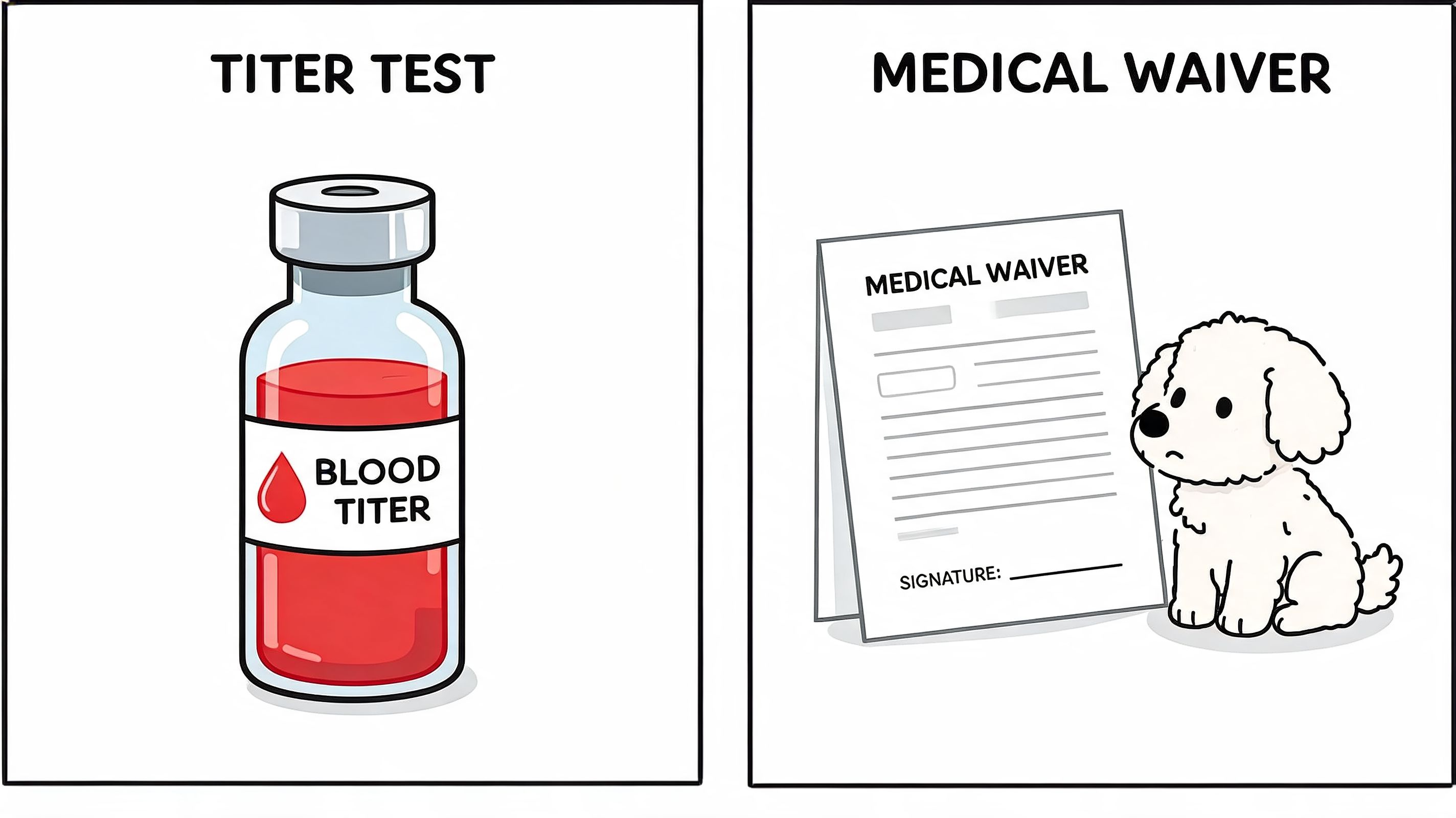
Here’s the visual many owners find helpful when they start organizing documents around vaccination, testing, and exception letters.
A storage system that actually holds up
I’ve found that “I’ll remember where I put it” is not a storage plan. Use a simple two-track system: physical and digital.
Paper file at home: Put the certificate in a labeled pet folder with vaccine history, microchip info, and any travel documents.
Pet go-bag copy: Keep a duplicate in the carrier or travel folder you use for emergencies, boarding, or road trips.
Cloud backup: Save the PDF in a folder you can access from your phone.
Calendar reminders: Set reminders well ahead of expiration and any travel date.
Named files: Use clear filenames, such as PetName_RabiesCertificate_Date.pdf
A rabies certificate should be as easy to find as your passport. If it takes more than a minute, your system needs work.
If you’re still relying on photos of papers in your camera roll, it may be time to switch to a cleaner system. This guide to the best document scanning software is a practical place to start. If you’d like to see the usual document format owners receive from clinics, review this rabies vaccine certificate template.
Help I Lost My Pet’s Rabies Certificate
Losing the certificate feels awful, but most of the time it’s fixable. Start with the source that’s most likely to have the exact document on file: the veterinary practice that gave the vaccine.
When you call, keep the conversation short and specific. Tell them you need a replacement copy of your pet’s rabies certificate. Have these details ready:
Pet name and species
Owner name used at the clinic
Approximate vaccination date
Microchip number, if your pet has one
Phone number or email that may be in the clinic record
Your first call should be to the clinic
Many clinics can email a replacement copy quickly if the vaccination was given there and the record is complete. Ask for the formal certificate, not just the visit summary.
If the clinic finds multiple rabies entries, ask them to confirm which one is the current valid record. That matters when a pet has moved, changed owners, or had vaccines at different practices.
If the clinic is closed or you can’t remember where the vaccine was given
A calm paper trail helps in this situation. Try these in order:
Search your email for vaccine reminders, invoices, or appointment confirmations.
Call your current veterinarian and ask whether prior records were transferred in.
Contact previous boarding or daycare facilities that may have kept a copy on file.
Check county or local animal services if your area ties rabies records to licensing.
Review old moving folders or adoption paperwork if your pet came from a rescue, breeder, or another owner.
If you can’t find the certificate, don’t guess. A guessed date or wrong vaccine product can create a bigger problem than a missing document.
What doesn’t work well is presenting a tag number, an old invoice, or a vaccine reminder card as if it were a full certificate. Those items can help you track down the record, but they usually don’t replace it.
If the record is unrecoverable, your veterinarian can advise you on the safest next step based on your pet’s history, timing, and travel plans.
Using Your Proof for Travel and Services
A proof of rabies shot is not used the same way in every setting. Local pet services often want to know only one thing: is this pet currently vaccinated? International travel asks a much harder question: can every document, date, and identifier be verified across multiple systems?
That difference catches people by surprise.
Local use is usually straightforward
For grooming, daycare, training, or boarding, a standard rabies certificate is often enough if it’s current and legible. These businesses want a clear expiration date and enough identifying detail to match the record to your pet.
In practice, the common issues are simple ones. The pet is listed under a different household member. The certificate was photographed poorly. The clinic note is sent instead of the certificate. Those are annoying, but usually fixable.
Travel use is much stricter
Travel turns one certificate into part of a packet. Your rabies proof may need to line up with a microchip record, a destination form, a health certificate, and sometimes lab results.
One especially important point is microchip timing. The CDC guidance for import paperwork says the pet must be microchipped before the rabies vaccine is administered for the vaccination proof to be valid in the affected import scenario. If the vaccine was given before the chip was placed, that earlier vaccine can be treated as invalid for that purpose, as outlined in the CDC instructions for the U.S.-issued rabies vaccination form.
That’s the sort of issue owners rarely spot on their own because the individual documents each look fine. The mismatch only appears when the full timeline is reviewed.
This process view helps show where proof is checked and rechecked.

What tends to work best
For domestic services, a clear PDF and an easy-to-read paper copy usually cover you.
For international movement, success usually comes from treating the rabies certificate as the base record and then checking every downstream document against it:
Match names exactly: Owner and pet names should stay consistent across records.
Match identifiers: The microchip number must be identical everywhere it appears.
Match chronology: Microchip date, vaccine date, and any waiting periods must line up.
Use the formal record: Don’t substitute invoices, tags, or handwritten notes.
If you’re sorting out travel-specific requirements, this overview of proof of rabies vaccination is a helpful companion to the paperwork you already have.
Advanced Rabies Proof Scenarios Titer Tests and Waivers
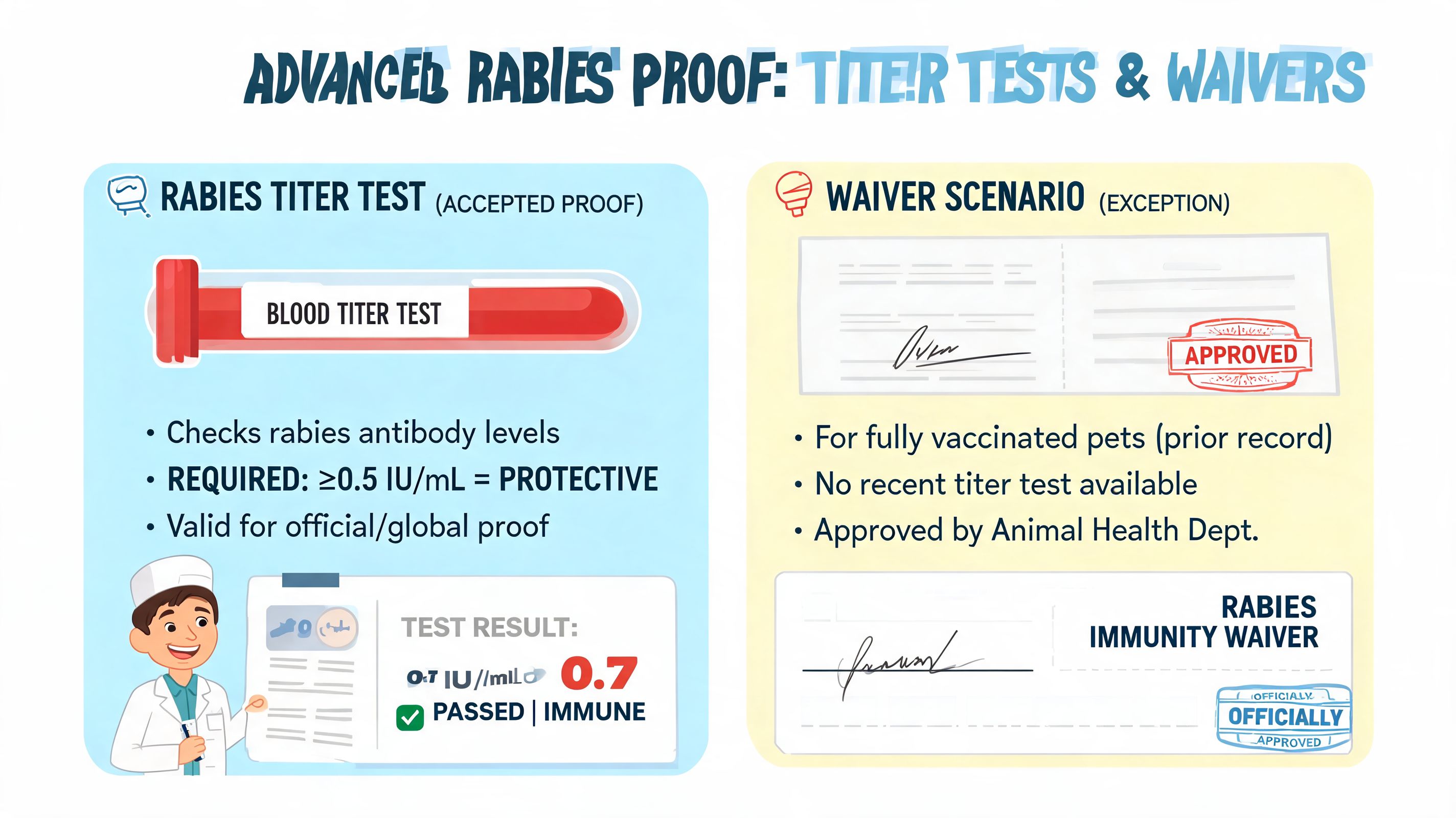
Some pets need more than a certificate. The two scenarios that cause the most confusion are titer testing and medical waivers. They are not interchangeable, and they solve very different problems.
When a titer test enters the picture
A rabies virus neutralizing antibody titer is blood-based proof that the pet mounted an immune response after vaccination. The common lab method is RFFIT, and the WHO benchmark is at least 0.5 IU/mL, as described in the CDC’s evidence review on rabies antibody measurement and protection benchmark.
That’s important because some destinations don’t stop at “show me the vaccine certificate.” They also want serologic proof that the vaccination produced an acceptable antibody level.
Here’s the key distinction: a titer usually adds to the rabies certificate. It doesn’t replace it.
When a waiver helps and when it doesn’t
A medical waiver may help in narrow domestic situations if a veterinarian believes vaccination would pose a serious health risk. That can be relevant for local licensing in some places.
It usually does not help for international entry. A waiver letter that satisfies a local authority often fails completely at the border or during airline document review.
A waiver is not a travel shortcut. For most international planning, it’s closer to a stop sign.
That’s why waiver cases need early review, careful expectation-setting, and a backup plan. If a pet can’t be vaccinated and the destination requires hard proof, the kind answer may be that travel isn’t realistic on the current timeline.
If you’re dealing with the testing side of this issue, this guide to a dog rabies titer test can help you understand the lab piece and how it fits with the certificate.
Frequently Asked Questions About Rabies Proof
How long is a rabies certificate valid
It depends on the vaccine used, the pet’s prior vaccine history, and the rules that apply where the document will be used. Some certificates reflect a shorter validity period, while others reflect a longer licensed interval. Don’t assume. Read the valid-until date on the certificate itself, and if travel is involved, make sure that date also fits the destination’s timing rules.
Is a digital copy enough
Sometimes yes, sometimes no. Groomers, boarding facilities, and apartment offices often accept a PDF or clear phone copy. Travel authorities, airlines, and destination officials may still ask for original signed paperwork or formally issued health documents. My advice is simple: keep both. A digital copy gets you through everyday requests. A paper copy saves the day when Wi-Fi, batteries, or check-in staff don’t cooperate.
What if my pet was vaccinated in another country
Foreign records may be usable, but only if the destination accepts them and the document details are complete and consistent with your pet’s identity records. If anything is missing or formatted differently, have the paperwork reviewed early by your veterinarian or travel coordinator.
Can a waiver replace proof of rabies shot
Usually not for international travel. As noted in guidance discussing rabies vaccination exemptions and their limits, waivers that may work for local licensing are typically not accepted as a substitute for strict vaccination proof when crossing borders.
What’s the safest habit to build
Treat your pet’s rabies proof like a living record. Update it every time something changes, keep it in paper and digital form, and check it long before any boarding stay or travel date. That’s the best way to avoid getting bitten by paperwork.
Passpaw helps veterinary teams and pet owners keep international pet travel documents organized, validated, and on schedule. If you’re dealing with rabies records, health certificates, microchip matching, or destination-specific requirements, Passpaw gives you a cleaner way to manage the process before small paperwork issues become big travel problems.

More articles
From regulatory changes to best practices for veterinarians and pet owners, our resources keep you ahead of the curve.