Are you a team member in a veterinary practice?
Are you a pet parent planning a trip with your furry pal?
Certificate of Rabies Vaccination: Pet Travel 2026 Ready
The trip is booked. The carrier is picked out. Your pet’s photo is already in the family group chat with captions about “vacation mode.” Then the paperwork lands on the kitchen table, and one form suddenly matters more than all the others.
For most pet travel plans, the certificate of rabies vaccination is the document that decides whether things move smoothly or grind to a halt. It’s not just for international flights, either. It often comes up for boarding, re-entry, and routine proof that a pet’s vaccination status is current and properly documented.
People usually assume the hard part is the vaccine itself. Often, it isn’t. The hard part is getting the certificate complete, readable, timed correctly, and matched to the destination’s rules. A healthy dog or cat can still hit a paperwork snag if the lot number is missing, the wrong signature is used, or the microchip trail doesn’t line up.
Your Pet’s Ticket to Ride
A typical version of this story starts a week or two before departure. The owner calls the clinic and says, “My dog is vaccinated, so we’re good, right?” Sometimes yes. Sometimes absolutely not.
That difference usually comes down to the certificate, not the vaccine. A pet may be current on rabies and still not have a travel-ready document. The boarding facility may want one format. A border official may want another. A re-entry review may focus on details the owner has never heard of, like the vaccine product name, lot information, or whether the certificate was completed from original records.

The reason this document carries so much weight is simple. The Certificate of Rabies Vaccination is a legally mandated document in the United States and Canada, required for pet travel, boarding, and re-entry, and its public health role goes back decades. U.S. standardization in the 1970s through AVMA and CDC efforts followed earlier rabies control work and helped reduce human rabies cases from 100+ annually pre-1950 to <5 today, as summarized by Anchorage Pet Travel Certificates.
If a client wants the plain-language science behind why rabies documentation matters in the first place, the science behind inactivated vaccines is a useful primer.
For owners trying to avoid last-minute scrambling, a simple starting point is a pet travel planning workflow that puts document collection earlier in the process. That alone prevents a lot of tail-chasing later.
Keep this mindset: the vaccine protects the pet, but the certificate is what gets reviewed.
Anatomy of a Rabies Certificate
A good rabies certificate is boring in the best possible way. Every field is present. Every name matches. Nothing is abbreviated beyond recognition. An official can read it quickly and trust what they see.
What has to be on the form
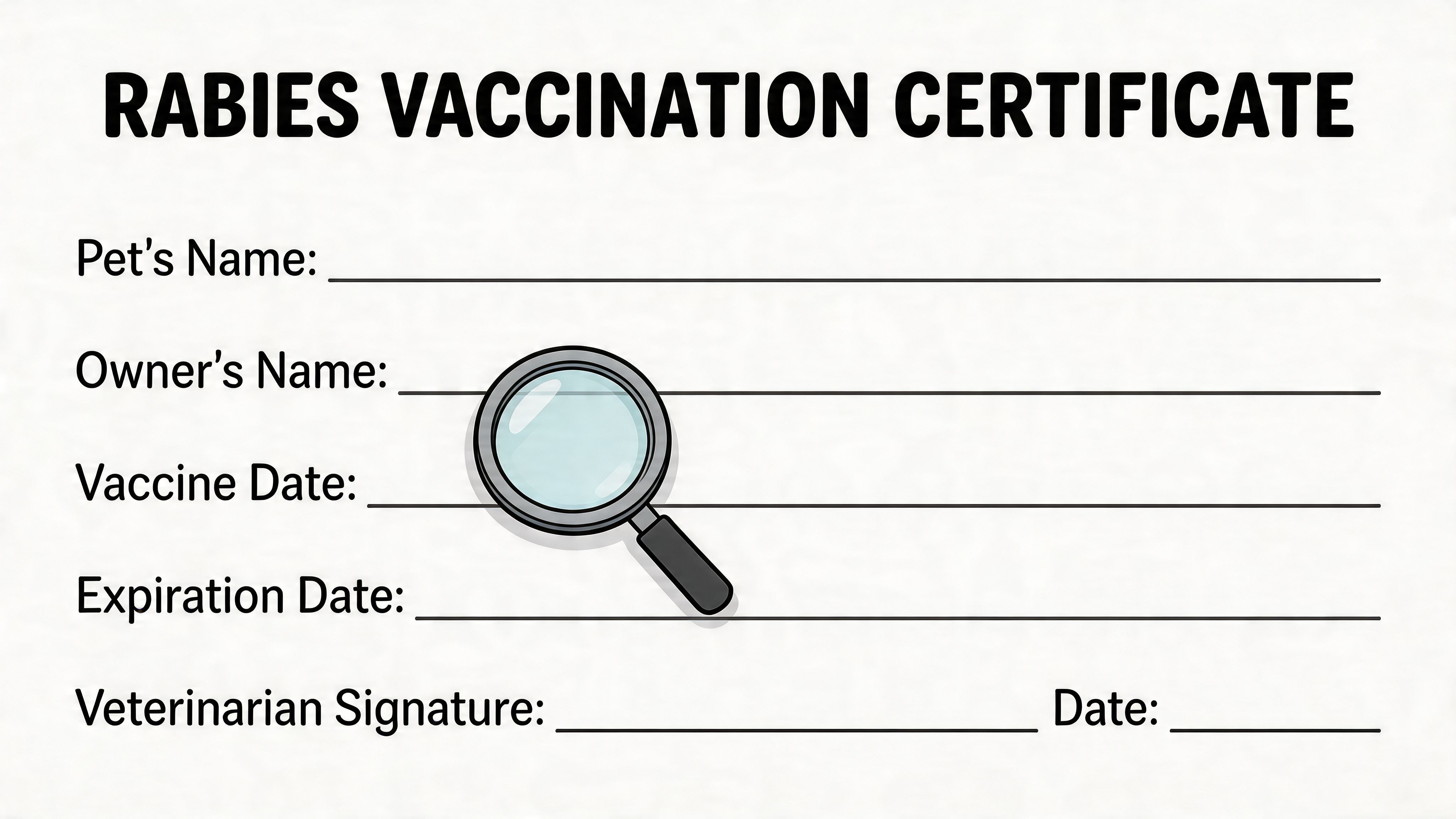
At a minimum, most travel-ready certificates need the pet’s identifying details, the owner’s details, and the vaccine record itself. For cross-border travel, that detail level gets stricter.
Look for these fields before anyone assumes the certificate is complete:
Owner information. Name and address should match the traveler’s other records.
Pet identification. Species, breed, color, sex, age or date of birth, and often weight.
Microchip number when required. For many international routes, this is central to the record.
Vaccine manufacturer and product name. Full names are safer than shorthand. Examples in the verified guidance include manufacturers such as Merial or Zoetis, and product naming like Zoetis Vanguard.
Serial or lot number. The verified data notes this is typically a short numeric identifier and is a common point of failure when omitted.
Administration date. This anchors timing and validity.
Protection duration or expiration details. Certificates may reflect 1-year or 3-year validity depending on the product and record history.
Veterinarian details and signature. Some destinations expect the issuing veterinarian’s signature, and some require the original signed document to travel with the pet.
Why officials care about tiny details
From a clinic perspective, the lot number or product expiration date can feel like back-office detail. From a travel compliance perspective, it’s traceability.
Officials reviewing a certificate are asking practical questions. Can they tie this vaccine to a known product? Can they tell when protection began? Can they verify the document belongs to the animal being presented? If the answer is unclear, the record may not be accepted.
That’s why incomplete certificates can trigger re-vaccination requirements. The issue often isn’t that anyone thinks the pet is unsafe. The issue is that the paper trail isn’t strong enough.
Practical rule: If a field would help you reconstruct the vaccine event from the medical record, it probably matters on the certificate too.
Think like the person checking the document
The easiest way to audit a certificate is to read it as if you’re the one at the counter deciding whether the pet can proceed.
Ask these questions:
Do all names match exactly? Owner name mismatches create avoidable friction.
Is the vaccine clearly identified? “Rabies vax” isn’t enough for stricter reviews.
Can I see when it was given and how long it’s valid?
Is the veterinarian’s certification complete?
If this pet needs microchip linkage, is that connection obvious on the document?
When a certificate answers all five cleanly, it tends to travel well.
Domestic Trips vs International Journeys
Domestic travel and international travel are related, but they are not twins. They’re distant cousins with very different standards for paperwork.
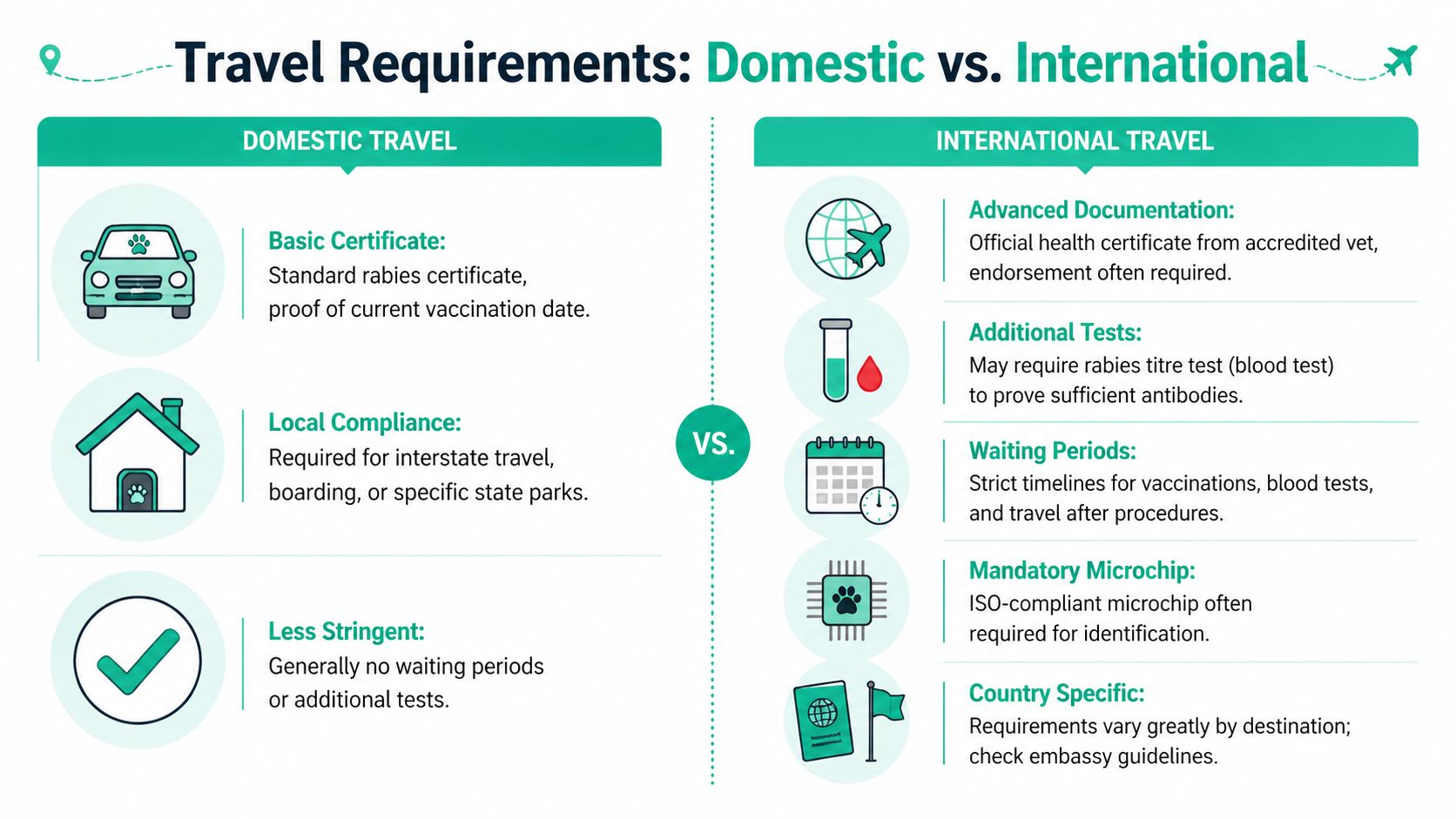
A local boarding kennel may just want proof that the rabies vaccine is current. A country entry desk may want original signatures, full vaccine product details, owner address, and a microchip sequence that proves the animal’s identity. That’s where many owners get caught off guard. They have a certificate, just not the right one for the trip.
The biggest dividing line
For international travel to major markets like the EU, UK, and Japan, the microchip must be implanted before rabies vaccination, and the certificate must include the owner’s name and address, the vaccine lot number and lot expiration date, and the issuing veterinarian’s original ink signature. Digital scans alone are not enough, according to the detailed summary at Starwood Pet.
That one rule changes the entire workflow. If the pet was vaccinated before microchipping, a perfectly fine domestic record may become unusable for certain international purposes.
Rabies Certificate Requirements At-a-Glance
Requirement | Domestic Travel / Boarding | International Travel |
|---|---|---|
Basic proof of vaccination | Often sufficient if current and readable | Usually not sufficient on its own |
Owner details | Commonly requested | Usually expected to match travel records |
Microchip linkage | Sometimes not required | Often required, and sequencing matters |
Vaccine product detail | Helpful | Usually expected in full |
Lot number and lot expiration | Can be overlooked by owners until a problem arises | Often essential for acceptance |
Veterinarian signature | Standard | Original signed documentation may be required |
Format sensitivity | More flexible | Country-specific and less forgiving |
Supporting documents | Limited in many routine cases | May involve health certificates, endorsements, or titers depending on route |
Where people underestimate the difference
The most common mistake isn’t neglect. It’s assuming “my vet gave me the rabies paper” means the file is travel-ready for any destination.
It rarely works that way. International travel stacks requirements. Identity proof, vaccine proof, timing proof, and sometimes language issues all sit on top of each other. If a destination requires translated supporting records, a service for certified document translation can help avoid informal, owner-made translations that create more questions than answers.
There’s also a gray area that deserves more attention. Some routes or review pathways may involve serology rather than relying only on the vaccination certificate. For teams trying to sort that out early, this overview of a rabies titer test for dogs is a helpful companion to the vaccine record itself.
A domestic certificate proves a pet was vaccinated. An international file has to prove when, with what product, to which identified animal, and under which document standard.
Perfect Timing for Your Pet's Paperwork
Timing causes as many problems as missing fields. A certificate can be complete, signed, and still useless for travel if the dates don’t line up.
The most important timing rule to keep in view is for a primary rabies vaccination. For a first-time rabies vaccine, CDC guidance for dog importation notes that the pet is considered fully immunized only at least 28 days after administration, allowing time for seroconversion. That standard is summarized by the CDC guidance on dog importation and rabies vaccination timing.
How to count backward from the trip
If the pet is receiving a first rabies vaccine, don’t schedule the appointment right before departure and hope the paperwork will smooth it over. It won’t.
Use this planning sequence instead:
Start with the travel date. Put the departure date on the calendar first.
Work backward for vaccine timing. If this is a primary rabies vaccine, the date must leave enough room for the waiting period.
Check whether the destination also expects other steps. Some routes need more than the rabies certificate.
Plan the certificate issue date around the valid vaccination record. The form should reflect the vaccine event accurately and completely.
Boosters are a different situation
Clients often get confused because not every rabies event is treated the same way. A booster with no lapse in coverage is different from a first vaccine or a record with a gap.
That distinction matters when owners ask, “Can’t we just update the paperwork now?” Sometimes yes. Sometimes the answer is that the vaccination history has changed the timing, and the travel date needs a hard look.
If there’s any doubt about whether the pet’s current rabies record counts as continuous coverage, review the prior certificate before promising a travel timeline.
For owners who are also trying to stay current on routine rabies scheduling outside of travel, this guide on how often dogs need rabies vaccinations helps frame the conversation before deadlines start barking at everyone.
Common Certificate Mistakes to Avoid
The failures that derail travel usually aren’t dramatic. They’re small, ordinary documentation slips that no one catches until the trip is close.
One clinic prints a certificate without the lot expiration. One owner brings only a scan when the original is expected. One record uses shorthand for the vaccine product. None of these feel major in the exam room. They can become major fast.
Mistake one, missing vaccine detail
This is the paperwork version of stepping on a rake. It happens often because the certificate looks complete at a glance.
But incomplete lot or expiration details create real risk. The CDC can reject certificates with unknown expiration dates, and after July 31, 2025, specific U.S. re-entry forms will require full vaccine data per row to be valid, as discussed in the practice-oriented summary from Bellalaga Veterinary Hospital.
How to avoid it:
Audit from the vial record. Don’t rely on memory or shorthand in the chart.
Write the full product details. Product name, lot information, and relevant dates should all be visible.
Check legibility before the owner leaves. A blurry copy is still a bad copy.
Mistake two, microchip sequence errors
This one is especially painful because the pet may be vaccinated and healthy, yet the identity chain is wrong for international use.
If a destination expects microchip-first sequencing, a rabies vaccine given before chip placement may not support the travel file the way the owner expects. This is one of the most expensive assumptions in pet travel paperwork because it often isn’t fixable with a quick note.
Mistake three, relying on abbreviations and casual edits
Clinic shorthand makes sense inside the hospital. It often fails outside it.
“Rab vac,” “3 yr,” or an unreadable scribble over a corrected date may be fine for internal understanding, but border and import reviews tend to prefer clean, formal entries. A stamped correction may help in some settings, but it won’t rescue a record that lacks core data.
Mistake four, confusing vaccine duration with travel acceptance
Owners hear “three-year rabies vaccine” and assume they’re done for every destination until the end of that interval. Travel review doesn’t always work that neatly.
The certificate has to be accepted as written, and the broader travel file has to meet destination standards. A vaccine’s labeled duration and a destination’s document expectations are related, but they aren’t the same thing.
The safest certificate is the one that answers questions before anyone asks them.
A simple clinic habit helps a lot here. Before handing over the certificate, pause for a thirty-second read-through with the owner. Confirm the pet’s identifiers, the owner’s details, the vaccine details, and whether an original signed copy needs to stay in a travel folder. That small pause saves a surprising amount of kennel cough-level chaos.
How Passpaw Prevents Paperwork Problems
Manual pet travel workflows break down in familiar places. A document lives in someone’s inbox. A due date sits on a sticky note. A missing field isn’t discovered until the owner is already asking for same-day corrections.
That’s why digital workflow tools matter. The best ones don’t replace veterinary judgment. They reduce preventable document mistakes before those mistakes affect the trip.
What a good platform should catch
A useful system should flag the exact issues that commonly invalidate a certificate of rabies vaccination:
Missing record fields such as product details or expiration data
Timing conflicts between vaccination date and travel date
Task order problems when travel steps need to happen in sequence
Scattered documents that make final review harder than it needs to be
A lot of clinics are already seeing the value of automation in nearby parts of pet care operations. For example, teams dealing with heavy call volume may appreciate how an AI phone receptionist for pet grooming businesses can reduce missed calls and intake friction. The same operational logic applies to travel paperwork. Fewer manual handoffs usually means fewer avoidable mistakes.
Why workflow beats last-minute heroics
The strongest compliance process isn’t “a very organized person remembers everything.” It’s a workflow that makes missing steps visible early.
That matters even more when the rabies certificate is only one piece of the file. If a clinic is also working through broader travel forms, the APHIS 7001 health certificate guide gives useful context on how rabies documentation fits into the larger export picture.
Good systems don’t make pet travel effortless. They make it trackable, reviewable, and much less likely to go off-leash at the worst moment.
Frequently Asked Questions
Can a rabies titer test replace a certificate of rabies vaccination
Sometimes a titer may play a role in proving immunization status, particularly in certain international or high-risk situations, but it should not be treated as a universal substitute for the certificate of rabies vaccination.
The practical takeaway is to avoid guessing. Some programs may accept titers in specific circumstances, while others still expect a complete vaccination certificate and related forms. If an owner wants to avoid unnecessary revaccination, that question should be raised early with the destination requirements in hand.
What if the original rabies certificate is lost
Start with the issuing veterinary clinic. Ask for a replacement based on the original medical record, not a casual summary recreated from memory.
If travel is close, also confirm whether the destination or carrier expects an original signed document in hand. A scanned copy may help for review, but it may not be enough for travel presentation.
What if an old certificate is missing a lot number or expiration detail
Don’t assume a handwritten add-on will fix it. First, go back to the medical record and vaccine inventory record to see whether the missing detail can be verified properly.
If the missing information cannot be documented clearly, the path forward may involve reissuing from complete records if allowed, or discussing whether revaccination is the cleaner option for travel. The right answer depends on the route and the quality of the underlying record.
Does every pet traveler need the same rabies form
No. A boarding kennel, an airline, a destination country, and U.S. re-entry authorities may all focus on different pieces of the file.
That’s why “my pet has a rabies certificate” is only the starting point. The better question is whether the pet has the right certificate, with the right details, for that exact trip.
What should owners bring to the clinic to make this easier
Bring prior rabies certificates, any microchip paperwork, the travel itinerary, and the destination requirements if available. If the owner has changed address or the pet’s identifying records differ across documents, fix that before the final certificate is issued.
That prep makes the appointment much more productive. It also gives the clinic a fair chance to spot gaps while there’s still time to correct them.
Is the rabies certificate enough for re-entry into the United States
Not always. U.S. re-entry requirements can depend on where the dog has traveled and what supporting forms are needed.
That’s where owners benefit from route-specific review rather than general advice from social media, breeders, or airline call centers. Those sources may be well-meaning, but they often mix domestic, export, and import rules into one fuzzy answer.
If you want a simpler way to keep pet travel documents organized, reviewed, and aligned with destination requirements, Passpaw gives veterinary teams and pet owners a more reliable path than juggling forms by email and memory alone.
More articles
From regulatory changes to best practices for veterinarians and pet owners, our resources keep you ahead of the curve.