Are you a team member in a veterinary practice?
Are you a pet parent planning a trip with your furry pal?
A Guide to Moving Pets to Australia: A Paws-itively Smooth Relocation
Bringing your pet to Australia is a big deal, but with some planning, it’s totally doable. The whole process, from the first vet visit to the day you pick them up, usually takes about six to seven months. Australia's biosecurity rules are some of the strictest in the world, so starting early is the best way to make the move as smooth as possible.
Your Guide to a Smooth Move Down Under
Moving your furry family member to Australia can feel a bit much at first. Think of it less like a simple flight and more like getting them a special passport for an exclusive trip. The process is very detailed for one important reason: to protect Australia's unique wildlife and keep it free from pests and diseases.
This guide will break down the entire journey into clear, easy-to-follow steps. Our goal is to take a complex process and make it feel simple. Let's get your best friend ready for their new life Down Under.
Why Are the Rules So Strict?
Australia's tight rules are all about protecting its delicate ecosystem. The country has successfully kept out many serious animal diseases found elsewhere, like rabies, and keeping it that way is a top priority.
Australia's rules for importing dogs and cats are among the world's toughest, with rabies being a major concern. This is why following every step, from vet checks to quarantine, is so important.
What to Expect on This Journey
The journey to Australia involves several key parts, each with its own timeline and checklist. Here’s a quick look at what you’ll be handling:
Veterinary Preparations: This is the foundation of the whole process. It includes getting a microchip, a series of shots, and specific blood tests that must be done in a precise order and timeframe.
Permits and Paperwork: You'll need to apply for an import permit from the Australian government. This means sending in all your pet’s correct health documents for approval.
Booking Quarantine: All pets coming to Australia must spend some time at a government-run quarantine facility. These spots fill up fast, so booking well in advance is key.
Travel Arrangements: This means working with an approved airline and making sure your pet has an IATA-compliant travel crate for a safe and comfortable flight.
Beyond the paperwork, your pet's well-being during the long flight is a top priority. For some great tips on getting them ready for the trip, check out this ultimate guide to traveling safely with your dog. It's full of practical advice to prepare your companion for their journey.
To give you a clearer picture of the timeline, here’s a quick overview of what the entire process looks like from start to finish.
Australia Pet Import Journey at a Glance
This table breaks down the major phases of bringing your pet to Australia, from the initial planning stages right up to the exciting day you're reunited.
Phase | Key Actions | Typical Timeline |
|---|---|---|
1. Initial Planning & Vet Prep | Confirm pet eligibility, implant microchip, administer rabies vaccination, perform rabies titer test. | 6-7 months before travel |
2. Permit Application | Wait for titer test results, apply for the Australian Import Permit online with all required documents. | 3-4 months before travel |
3. Quarantine & Flight Booking | Once the permit is approved, book a spot at the Post Entry Quarantine (PEQ) facility in Melbourne. Book flights. | 2-3 months before travel |
4. Final Vet Checks & Treatments | Complete final health checks, parasite treatments, and obtain the official government health certificate. | Within 30 days of travel |
5. The Big Move | Pet travels to Australia and is transferred directly to the quarantine facility upon arrival. | Travel Day |
6. Quarantine & Collection | Pet completes the mandatory quarantine period (minimum 10 days). You collect your pet from the facility. | Post-Arrival |
As you can see, the journey is a marathon, not a sprint. Each step builds on the last, which is why following the sequence and timelines is so important for a successful and stress-free move.
The Step-by-Step Pet Relocation Timeline
Moving your pet to Australia is a lot like planning a months-long trip for a very important passenger. It follows a strict timeline that starts at least six to seven months before you even think about boarding a plane. It’s a marathon, not a sprint, where every single step is a critical checkpoint.
If you miss just one deadline, it can cause a domino effect, leading to serious delays, unexpected costs, and a mountain of stress you just don't need. This guide breaks the whole thing down into manageable stages, so you know exactly what to do and when. Let’s get started.
Stage 1: The Foundation (7+ Months Before Travel)
This is the starting line for your entire relocation plan. Getting this stage right is everything, because all future steps depend on what you do here. Don’t worry, it’s more straightforward than it sounds if you just follow the order.
Your first stop is a government-approved veterinarian. Here’s what needs to happen:
Microchip Implantation: Before anything else, your pet needs an ISO-compliant microchip. If they already have one, the vet will scan it to make sure it’s working perfectly. This chip is your pet’s official ID for the whole journey.
Rabies Vaccination: Immediately after the microchip is scanned and confirmed, your pet gets their rabies shot. The timing here is key—the vaccination must happen after the microchip is checked. Any shot given before the microchip is considered invalid for Australian import.
This initial vet visit officially starts the clock for the rest of your timeline.
Stage 2: The Waiting Game and Blood Test (6-7 Months Before Travel)
Once the rabies vaccine is done, a waiting period begins. This isn't just red tape; it gives the vaccine enough time to build up immunity in your pet's system. You can't rush this part, so patience is your best friend.
After the wait is over (your vet will tell you exactly when), you’ll head back to the vet for a very important blood test.
This is called the Rabies Neutralising Antibody Titre Test, or RNATT. Its job is to show the vaccine worked and produced enough antibodies to protect your pet. The blood sample has to be sent to a specific government-approved lab for analysis.
As soon as that blood sample is drawn, another clock starts ticking. Your pet cannot set paw in Australia until at least 180 days have passed from the date the lab receives the sample. This is one of the most important deadlines in the entire process.
Stage 3: Permits and Quarantine (3-4 Months Before Travel)
With the RNATT test behind you and the long 180-day wait underway, it's time to tackle the official paperwork. This is where you formally ask for permission to bring your pet into the country.
You'll need to apply for an Import Permit from Australia’s Department of Agriculture, Fisheries and Forestry. It's an online application where you'll submit all the documents you've gathered so far, including:
Microchip information
The rabies vaccination certificate
The official RNATT laboratory report
Once your import permit is approved, you’ll finally get the green light to book a spot at a Post Entry Quarantine (PEQ) facility. It’s very important to book this the moment you get your permit. Spaces are limited and fill up months in advance, and the only facility for cats and dogs is in Melbourne.
To get a feel for how these pieces fit together, this timeline gives you a great visual overview of the key milestones.
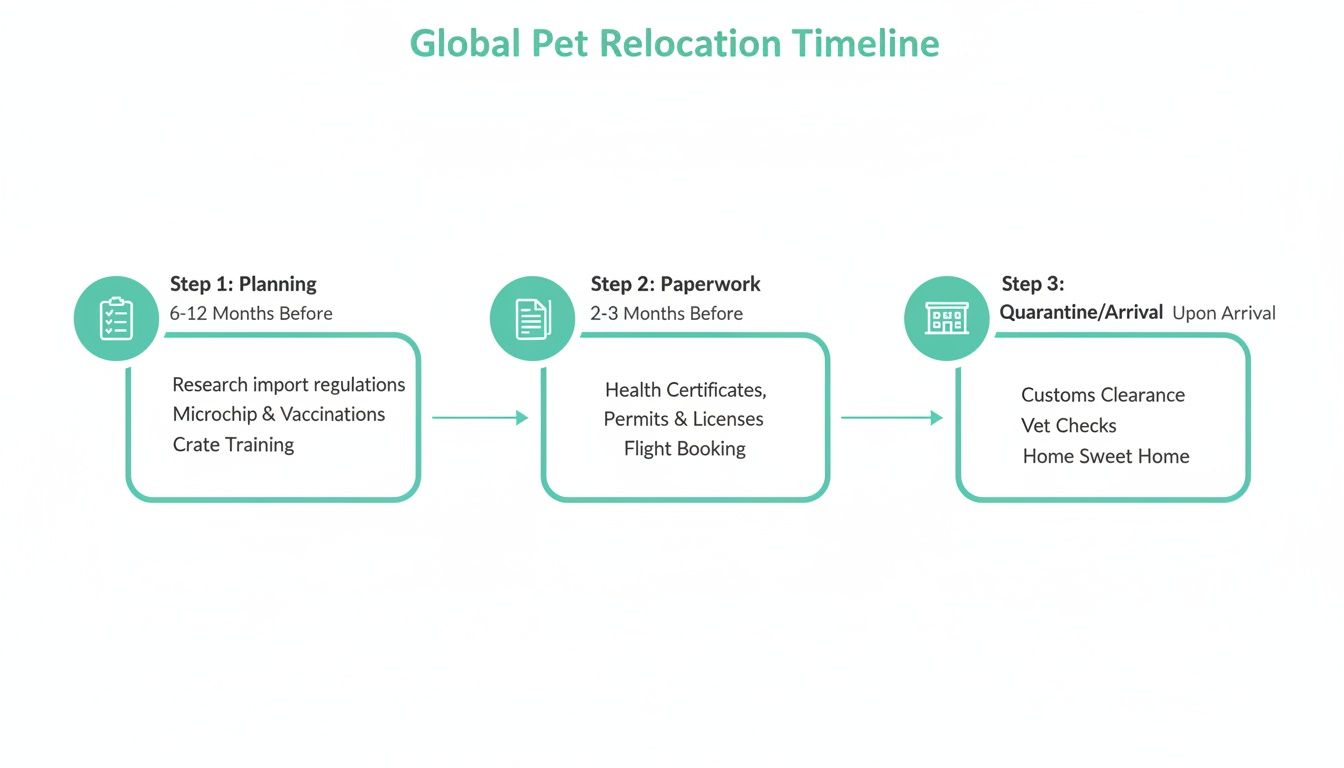
As you can see, it’s a long-term project where each phase builds on the last, from early planning all the way through to quarantine.
Stage 4: Final Preparations (1-2 Months Before Travel)
You're on the home stretch! With the permit in hand and quarantine booked, the focus shifts to final health checks and travel plans. This means more vet visits to make sure your pet meets every last health requirement before they fly.
During this window, your pet will need:
Additional Vaccinations: They’ll need to be up-to-date on all their routine shots, depending on whether you have a cat or dog.
Parasite Treatments: Your pet must get specific treatments for ticks, fleas, and internal worms. Your vet has to give these within a very strict timeframe before departure.
This is also when you lock in the travel details. You’ll book a flight with an approved airline and buy an IATA-compliant travel crate. Make sure the crate is the right size—your pet must be able to stand, turn around, and lie down comfortably inside. Sorting out these logistics is a huge part of any successful pet relocation overseas.
Stage 5: The Final Vet Visit and Departure (Within 5 Days of Travel)
The last few days before the flight are a flurry of final, super-important tasks. You’ll have one last appointment with your government-approved vet to complete the official health certificate.
The vet will do a final check to confirm your pet is healthy and fit to fly. They will then fill out and endorse all the final paperwork, which has to travel with your pet to Australia.
Every single detail on these forms has to be perfect. One small error could mean your pet faces a longer quarantine or is even denied entry. After this last check-up, your furry friend is finally ready for their big adventure Down Under.
Navigating the Essential Paperwork
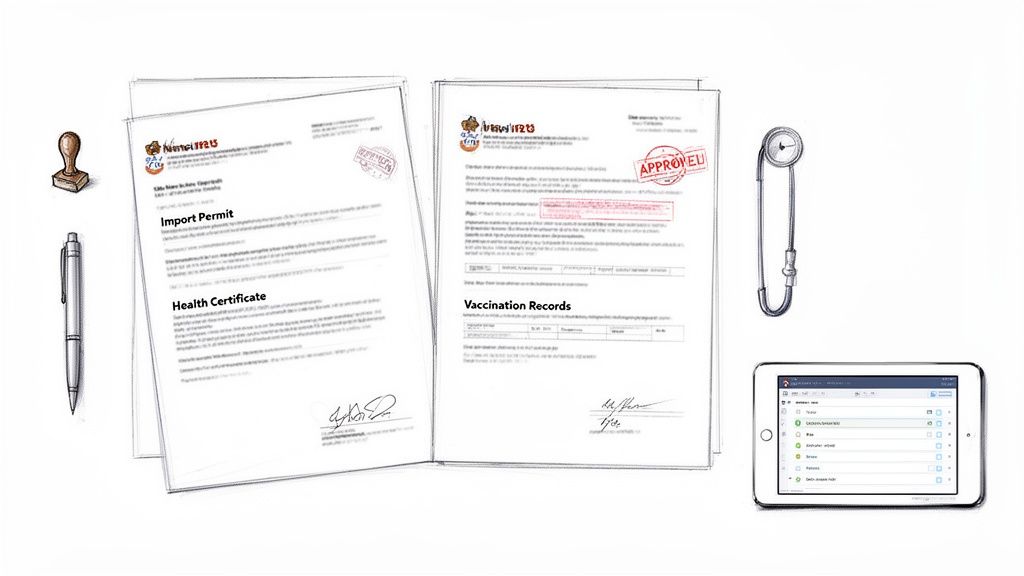
If the timeline is your roadmap, then the paperwork is your pet’s passport, visa, and boarding pass all rolled into one. It’s the official proof that your pet meets every one of Australia's famously strict biosecurity standards.
At first glance, it can feel like a mountain of forms. But it’s better to think of it as a detailed checklist where every single box needs a perfect tick. The Australian government is very careful for a reason—one missing signature or an incorrect date can derail everything, possibly delaying your pet’s entry or extending their quarantine time.
Getting the documents right isn't just a step in the process. It's everything. Let's break down the key pieces of paper you'll be handling.
The Big Three Your Pet Can't Leave Home Without
While you'll handle quite a few forms, three main documents make up the backbone of your application to bring pets to Australia. Nail these, and the rest of the process becomes much more manageable. Don't worry, it's not as ruff as it sounds!
Here’s what you need to focus on:
The Australian Import Permit: This is your green light from the Australian government. You apply for it online after the initial vet work is done, and it's only granted once officials have reviewed your pet's health records and confirmed they meet all the early rules.
Official Health Certificate (Veterinary Health Certificate): Think of this as your pet's official health story for the trip. It’s a multi-page document that your government-accredited veterinarian completes, detailing every treatment, vaccination, and test your pet has received.
Vaccination and Treatment Records: These are the supporting documents that prove everything on the health certificate is true. This includes the original rabies vaccination certificate, the RNATT test lab report, and detailed records of all parasite treatments.
Together, these documents tell your pet’s complete health story to Australian officials. Each one must be accurate, complete, and signed by the right people at the right time.
Getting the Details Right
When it comes to this paperwork, being precise is your best friend. A simple mistake—a typo in a microchip number or a date written in the wrong format—can quickly turn into a major headache. The Australian government requires complete accuracy.
Think of it like this: your pet’s paperwork is their official identity for the entire import process. If the details don't match perfectly across every single form, it raises a red flag for officials.
For example, the veterinarian's name, the clinic address, and treatment dates must be identical everywhere they appear. This is where having a system really helps. Many veterinary practices now use special platforms to manage this process, which helps catch errors before they become problems. These tools can automatically check information, ensuring consistency and saving vets from the tough task of checking every detail by hand.
This kind of organization is a crucial part of getting an international health certificate for your pet approved on the first try.
Understanding Australian Pet Quarantine
The word "quarantine" can sound a little scary, we get it. But when you’re bringing pets to Australia, it’s a standard and absolutely required part of the journey.
Think of it less like a lockdown and more like a temporary stay at a secure wellness center. It's the final, important biosecurity checkpoint designed to protect Australia's unique wildlife from diseases like rabies before your pet can join you. While it’s tough being separated, the facilities are run by professionals who specialize in caring for newly arrived animals.
Where Will My Pet Stay?
Every single cat and dog flying into Australia goes to one place: the Post Entry Quarantine (PEQ) facility in Mickleham, just outside of Melbourne. This is the only facility of its kind in the country. So, whether you're moving to Perth, Sydney, or Brisbane, your pet's first stop will be in Victoria.
It’s a modern, well-designed center, not some afterthought. The whole place is built to keep pets safe, comfortable, and secure while their health is carefully watched by trained staff and veterinarians.
A question we hear all the time is, "Can I visit my pet?" Unfortunately, due to the strict biosecurity rules needed to keep all the animals safe, visits from owners aren't allowed. It’s tough, but it’s necessary for maintaining a clean and safe environment.
What Happens During Quarantine?
Your pet's stay is much more than just sitting in a kennel. Their time is structured around high-quality care and observation.
Here’s a glimpse into what their routine will look like:
Daily Health Checks: First thing every morning, trained staff check on each animal, looking for any changes in behavior or signs of illness. Any potential issue is noted immediately.
Feeding and Hydration: Pets get good quality commercial food, and there’s always fresh water. If your pet is on a specific diet for health reasons, you can arrange for it, but it must be sourced from within Australia.
Clean and Secure Housing: Every animal gets their own climate-controlled space that’s cleaned daily. Dogs also have access to an attached outdoor run to get some fresh air and stretch their legs.
Professional Oversight: Vets are on-site to provide medical care if anything comes up. The staff are all trained to handle animals with kindness, making the whole experience as stress-free as possible.
Booking Your Pet’s Spot
This is one of the most time-sensitive steps in the whole process, so this is important. You can only book a spot at the PEQ facility after the Australian government has officially approved your import permit.
Spaces are very limited and fill up fast—often months in advance. It is really important to book your pet's spot the moment you get that permit. If you wait, you could easily find yourself having to delay your entire move.
For a clearer picture of which countries require this quarantine step, you can check out the different country categories for pet import. Seriously, planning ahead here is the key to a smooth arrival.
What's This Going to Cost? Budgeting for Your Pet's Move
Moving your pet to Australia is one of the most exciting parts of your journey, but it's also a big financial commitment. It's smart to get your head around the costs early to build a realistic budget and avoid any surprises later on.
This isn't a single, one-off payment. The total cost is made up of different fees and services that you'll pay over the six-to-seven-month timeline.
A Look at the Main Expenses
Let's be honest: every single step in bringing your pet to Australia comes with a price tag. From that first vet visit right through to the day you pick them up from quarantine, you'll be spending money. Thinking about this as a series of smaller, expected costs makes it feel a lot less scary.
When you're mapping out your budget, don't forget to account for the hidden costs often associated with a move that can sneak up on anyone.
Here’s where your money will go:
Government Fees: These are the fixed costs paid directly to the Australian government. Think of the import permit application fee and the daily board for your pet's stay at the quarantine facility. No getting around these.
Veterinary Bills: This is where the numbers can really change. It covers a whole lot—the initial microchip, rabies shots, the important RNATT blood test, a series of parasite treatments, and the final health certificate endorsement.
Travel and Crate Costs: This is your pet’s airfare, plain and simple. You'll also need to buy an IATA-approved travel crate. It has to be the right size, giving them enough room to stand up and turn around comfortably during the flight.
Pet Transport Services (Optional): Many people decide it's worth it to hire a professional pet transport company. These experts handle all the planning, paperwork, and bookings. It definitely cuts down on your stress levels but adds to the final bill.
You're in Good Company
As you start this process, know that you're joining a massive community of animal lovers. In 2022, Australia was home to an estimated 28.7 million pets living in 6.9 million households. That pushes the pet ownership rate to a whopping 69%. Thanks to a recent "pet boom," you and your furry mate will fit right in.
Getting a handle on these costs upfront is a huge part of successful planning. For a deeper dive, check out our guide on the cost of shipping pets.
The table below gives you a general idea of what to expect, but remember, the final total can change quite a bit depending on where you're coming from, your pet's size, and your choice of airline.
Estimated Cost Breakdown for Pet Relocation to Australia
A look at the potential costs involved in the pet import process, from vet bills to government fees.
Expense Category | Description of Costs | Estimated Cost Range (USD) |
|---|---|---|
Government & Quarantine Fees | Import permit application, quarantine facility booking, and daily care fees for the mandatory 10-day stay. | $1,500 - $2,500 |
Veterinary Services | Microchipping, rabies vaccinations, RNATT blood test, parasite treatments (internal/external), and final health certificate with official government endorsement. | $800 - $1,500 |
Air Travel & Crate | One-way international airfare for your pet and the purchase of an IATA-compliant travel crate. Costs are highly dependent on your pet's size and weight. | $1,000 - $4,000+ |
Optional Pet Relocation Agent | Professional services to manage logistics, paperwork, flight bookings, and coordination. This is an added service for convenience and peace of mind. | $1,500 - $4,000+ |
Total Estimated Cost | A comprehensive estimate covering all primary expenses, excluding optional services. | $3,300 - $8,000 |
All told, you’re looking at a significant but manageable investment. By breaking it down and planning ahead, you can make sure your pet's journey to their new home in Australia is as smooth as it can be.
Common Mistakes and How to Avoid Them
Moving a pet to Australia is a complex process with a lot of moving parts. A tiny slip-up can lead to some pretty big—and stressful—delays. It’s like baking a delicate cake from scratch; get one measurement wrong or miss a single ingredient, and the whole thing can fall flat.
The best way to get it right is to learn from the mistakes others have made. Let’s walk through some of the most common errors people make when bringing pets to Australia and, more importantly, how you can sidestep them completely.
The Microchip Mix-Up
This one happens more often than you’d think, and it happens right at the start. The problem usually isn’t that the pet doesn't have a microchip, but that the timing of the scan is off.
The Mistake: A vet gives the rabies vaccine before scanning the microchip to confirm it’s there and working. Australian biosecurity is very strict on this: any procedure done before the microchip is officially checked is invalid.
The Solution: Make sure your vet scans and documents the microchip first. This isn't just a suggestion; it's a firm rule. Getting this simple "scan-then-vaccinate" order right lays the correct foundation for everything that follows.
Think of it this way: the microchip is your pet's official passport for this entire journey. If that passport isn't checked first, none of the other steps count in the eyes of Australian authorities.
The Last-Minute Paperwork Panic
Another classic mistake is simply underestimating the time and care needed for the mountain of paperwork. Submitting forms that are incomplete or have even tiny errors can bring the entire process to a dead stop.
The Mistake: Waiting until the last minute to get all the documents together, only to find a missing signature, a typo in your pet’s birthday, or a treatment date that’s off by a single day.
The Solution: Treat the paperwork like a long-term project, not a last-minute assignment. Create a special folder—digital or physical—from day one. Use a checklist to track every single form, and double-check every entry with your vet. Better yet, have a fresh pair of eyes review everything before you hit "submit."
Other Common Pitfalls to Watch For
Beyond those two big ones, a few other preventable errors can easily trip you up. Keep these on your radar to stay organized and on track.
Missing Critical Deadlines: That 180-day waiting period after the RNATT blood test isn't flexible. Miscalculating this date could get your pet’s flight and quarantine booking canceled. Put this and all other key dates into a digital calendar with multiple reminders.
Choosing the Wrong Crate: Not all travel crates are built the same. If you buy one that isn't IATA-compliant or is the wrong size for your pet, the airline has the right to refuse boarding. Measure your pet carefully and only buy a crate that is specifically approved for international air travel.
A Few Common Questions
Thinking about bringing a pet to Australia? It’s a big move, and it's totally normal to have a few questions swirling around. Let's tackle some of the most common ones we hear from pet owners.
How Long Does This Whole Thing Really Take?
Let's be upfront: this is a marathon, not a sprint. You'll need to plan for a minimum of 6 to 7 months from start to finish.
That timeline kicks off with the very first rabies vaccination. Key milestones, like the Rabies Neutralising Antibody Titre (RNATT) test, come with required waiting periods that you can't skip. There are no shortcuts here, so getting a head start is the best approach.
Can I Visit My Pet During Quarantine?
We know how tough this part is, but unfortunately, you can't visit your pet while they're in quarantine. The facilities maintain very strict biosecurity rules to keep all the animals safe and healthy.
The good news is that the quarantine centers are run by dedicated professionals. They handle everything from feeding and exercise to daily wellness checks, making sure your pet is comfortable and cared for until it's time for that happy reunion.
You can feel good knowing your pet is in good hands. The staff's entire focus is on animal welfare, and they'll make sure your furry friend is safe and sound until you can finally pick them up.
What If There’s a Mistake on My Paperwork?
Even a tiny error—a wrong date, a misspelled name—can bring the entire process to a screeching halt. A simple mistake could lead to major delays or, in a worst-case scenario, your pet being denied entry into Australia.
This is where being careful really pays off. Go over every single document with your veterinarian. Then, check it again. Making sure every detail is perfect before you submit anything is the single best way to avoid stress and keep things moving smoothly.
Navigating the maze of international pet travel documents can feel overwhelming for anyone. Passpaw is designed to take the guesswork out of it for veterinary practices, cutting down on errors and ensuring a smoother journey for your clients and their pets. You can learn more about how Passpaw works on our site.

More articles
From regulatory changes to best practices for veterinarians and pet owners, our resources keep you ahead of the curve.