Are you a team member in a veterinary practice?
Are you a pet parent planning a trip with your furry pal?
Cost of Shipping Pets: A Clear Guide to Fees, Rules, and Savings
Figuring out the cost to ship your pet can feel like untangling a ball of yarn, but it's more straightforward than you might think. For a trip within the U.S., you're generally looking at a range of $200 to $1,200. Heading overseas? That's when the price tag often starts around $1,500 and can climb from there.
Of course, these numbers are just a ballpark. The final cost really depends on your pet’s specific needs and where you're headed.
A Paws-on Guide to Pet Shipping Costs
Planning a move with a furry family member is about more than just buying a ticket. The total cost is a blend of several key factors, from how big your companion is to how far they're traveling. It’s not just about getting from point A to point B; it’s about making sure their journey is safe, comfortable, and checks every regulatory box along the way.
Getting a handle on the costs upfront is the best way to prepare. For most pet owners, the idea of shipping a pet brings up a flood of questions. Is it going to break the bank? What am I even paying for? Let's clear the air and break it all down.
Estimated Pet Shipping Costs at a Glance
Before diving into the details, this table gives you a quick snapshot of what you might expect to budget for different types of pet travel. Think of it as a starting point to frame your expectations.
Travel Type | Average Cost Range (Small Pet) | Average Cost Range (Large Pet) | Key Influencing Factors |
|---|---|---|---|
Domestic Ground | $200 – $800 | $500 – $1,500 | Distance, route, shared vs. private transport, time of year. |
Domestic Air | $400 – $1,200 | $800 – $2,500+ | Airline fees, crate size/weight, direct vs. layover flights. |
International Air | $1,500 – $4,000+ | $3,000 – $8,000+ | Destination rules, health certs, import permits, quarantine. |
Keep in mind these are just estimates. The final cost will always depend on your unique situation, but this should help you see how different factors come into play.
Domestic vs. International Travel Costs
The single biggest factor driving the cost is your destination. A trip across state lines is a whole different ballgame than a journey across an ocean.
Domestic Travel: This is your most straightforward and budget-friendly option. Whether you choose ground or air, moving a pet within the same country means less complex paperwork and fewer required services.
International Travel: This is where the costs can really add up. International trips often demand specific health checks, import permits, and sometimes even quarantine periods upon arrival. Each requirement adds another layer to the total expense.
The cost of shipping a pet domestically within the United States usually lands between $200 and $1,200. The final price depends on your pet's size, the travel distance, and whether you choose ground or air (ground is often cheaper). For pet owners and vet practices planning a move, this baseline is key. Add-ons like health certificates, IATA-compliant crates, and insurance can easily push the total higher—sometimes by 20-50% during peak seasons like summer holidays when surcharges kick in. You can explore more about these pet shipping cost factors on Petworks.com.
Preparing for your pet’s travel is a lot like packing for your own trip. You have the main ticket price, but then you add in costs for special luggage (the crate), health checks (like a travel visa), and other essentials to make the trip go smoothly.
Ultimately, your pet's journey is an investment in their safety and well-being. By understanding what goes into the cost, you can build a realistic budget and avoid any ruff surprises along the way.
Decoding the Core Costs of Pet Travel
Ever look at a pet shipping quote and wonder how they got to that number? Why can one trip cost a few hundred dollars while another easily breaks into the thousands? It’s not random—the final price is built from a few core factors, and knowing what they are is the first step to understanding exactly where your money is going.
The two biggest drivers of your base cost are the size of your pet and the distance of the journey. It's a lot like shipping a package; a larger, heavier pet needs a bigger crate, which takes up more space and uses more fuel. Whether they're on the road or in the air, every pound and every mile adds up.
This isn’t a niche need, either. The global pet transport market was valued at a whopping $721.64 million in 2022 and is expected to hit over $1.3 billion by 2032. As more of us treat our pets like family, we’re taking them with us when we move. You can dive deeper into these pet transport market trends to see just how much the industry is growing.
Air Travel vs. Ground Transport
Choosing between flying and driving is a major fork in the road for your budget. Each has its own way of calculating costs, so it’s rarely a simple apples-to-apples comparison.
Ground Transport: This is often the more wallet-friendly choice, especially for bigger dogs or for trips under a few hundred miles. You also get the convenience of door-to-door service, which can be a huge stress-reducer for you and your pet. Costs here are usually calculated by the mile.
Air Travel: For any long-distance domestic trip or international move, flying is pretty much your only option. It’s much faster, but that speed often comes with a higher price tag. Airlines base their fees on the combined weight and dimensions of your pet and their crate, often called "volumetric weight."
Think of it this way: Ground shipping is like a long-haul road trip where you pay for the distance. Air travel is more like booking a flight, where the size of your "luggage"—your pet in their crate—has a massive impact on the ticket price.
This infographic gives a great visual breakdown of how the costs typically build up.
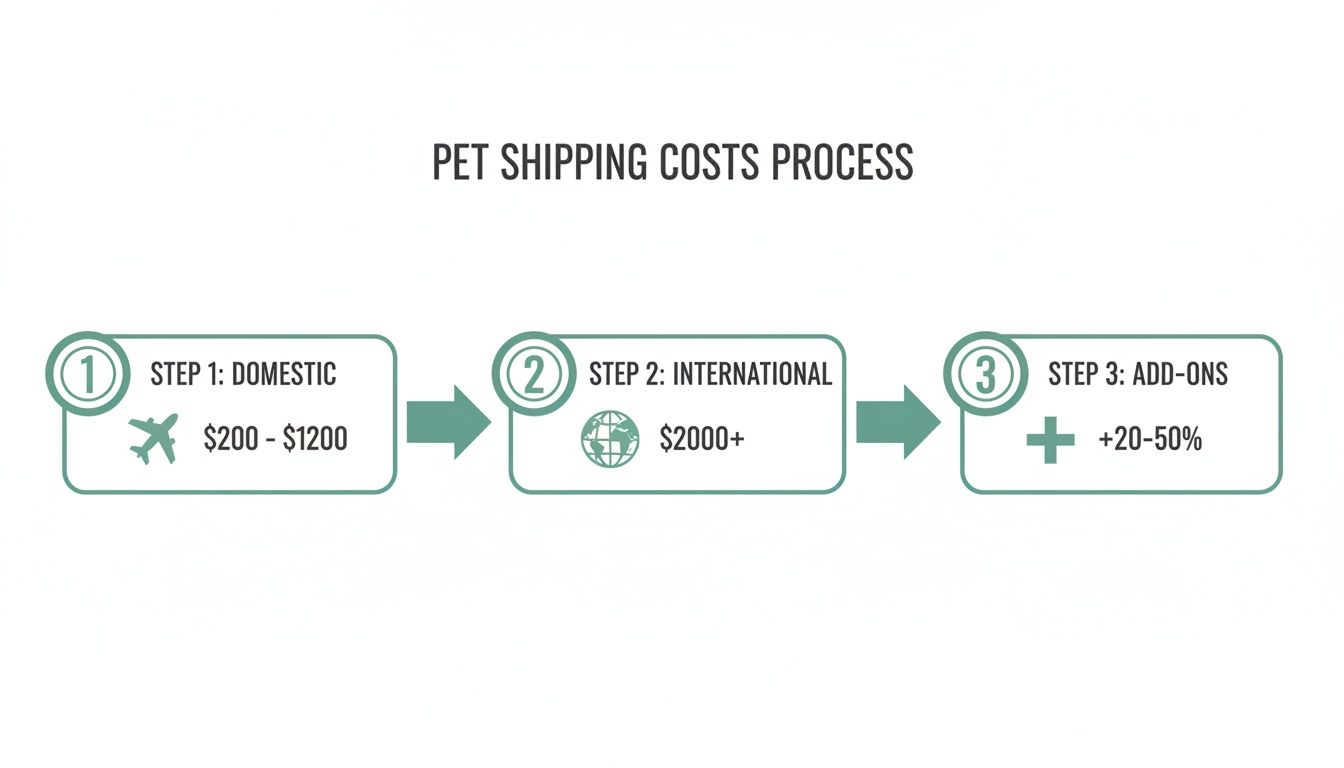
As you can see, the jump from a domestic trip to an international one is where you'll see the biggest price increase, with other services layering on top of that.
How Core Factors Impact Your Final Bill
To really see how this plays out, let's look at a few scenarios. The table below breaks down how different variables can swing your final quote from one end of the spectrum to the other.
Cost Factor | Low-Cost Scenario Example | High-Cost Scenario Example | Impact on Total Price |
|---|---|---|---|
Pet Size & Crate | A 10 lb cat in a small carrier | An 85 lb Golden Retriever in a large, custom crate | Major: The crate's dimensions directly influence volumetric weight for air cargo, making this a primary cost driver. |
Travel Mode | Ground transport for a 300-mile move | International air cargo flight with a layover | Major: Air travel is almost always more expensive due to fuel, cargo handling, and airline-specific fees. |
Distance | Domestic trip from Los Angeles to San Francisco | Cross-country move from New York to California | Significant: Longer distances mean more fuel and time, increasing costs for both ground and air transport. |
Destination | Domestic U.S. travel with simple vet checks | A country like Australia with mandatory quarantine and extensive lab work | Significant: International compliance, import permits, and quarantine fees can add thousands to the bill. |
It's clear that small changes, like the size of your pet or the final destination, can have a huge ripple effect on the total cost.
How Pet Size and Weight Impact the Bill
Let’s dig into this a bit more, because it’s not just about what your pet weighs on a scale—it’s about the physical space they take up.
Every airline and ground shipper has rules to make sure your pet can comfortably stand up, turn around, and lie down in their crate. A bigger pet means a bigger crate, and a bigger crate means a higher price. Period.
For airlines, cargo space is prime real estate. A Great Dane's travel crate is going to cost a whole lot more to ship than a Chihuahua’s tiny carrier. It’s simple logistics.
The travel crate is the foundation of your pet's shipping cost. An IATA-compliant crate that is the correct size is non-negotiable for air travel, and its dimensions will directly influence the price you pay.
For instance, flying a small dog like a Pug might cost around $400, but a Golden Retriever on the very same flight could run you $1,000 or more. The only difference? The crate size and total weight. It's one of the most direct and predictable parts of the entire bill.
The Hidden Costs of Health and Paperwork
The price of the plane ticket or ground transport is just the beginning of the story. While that's the number most people focus on, a huge chunk of the cost of shipping pets actually comes from all the required health checks and official paperwork.
These aren't just friendly suggestions. They're strict rules put in place to protect your pet, other animals, and the local ecosystem at your destination. Think of it like getting a passport and visa for your pet—you simply can't travel without them, and they come with their own set of fees. Trying to skip this part can lead to some truly cat-astrophic problems, like being turned away at the airport right before your flight.
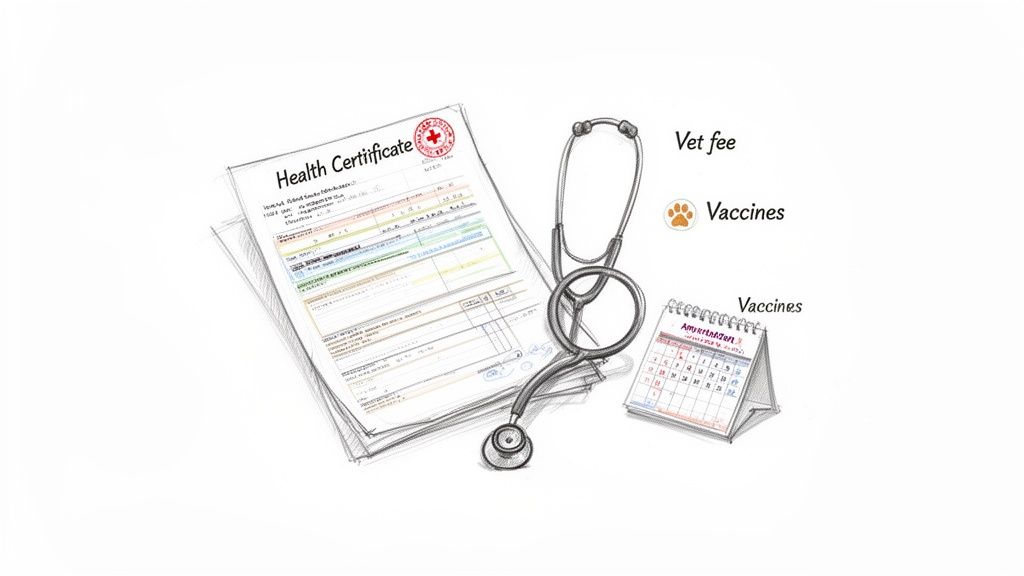
The All-Important Health Certificate
The cornerstone of your pet’s travel file is the health certificate, often called a Certificate of Veterinary Inspection (CVI). This is a document from an accredited veterinarian confirming your pet is healthy enough to travel and has all the necessary vaccinations. It’s the proof authorities need to see that your pet isn't a health risk.
For a simple domestic trip within the U.S., a standard health certificate will usually do the trick, costing somewhere between $75 and $200.
But for international moves, things get a lot more complicated—and expensive. An international health certificate has to be filled out by a special USDA-accredited veterinarian and then sent off for a final government endorsement from the USDA's Animal and Plant Health Inspection Service (APHIS). This back-and-forth process can easily run between $200 and $500, sometimes even more, depending on what the destination country demands. You can get a better sense of what's involved by learning more about the USDA pet travel certificate.
Your pet's health certificate is their official travel document. It proves they are fit for the journey and meet all the health standards of their destination, acting as their passport to a safe and approved arrival.
Vaccinations and Other Medical Needs
On top of the exam for the certificate, your pet will likely need other medical treatments to be allowed into your destination. These costs are completely separate from the certificate fee and can add up fast. It’s so important to get these done on the right schedule, as many treatments have strict timing rules.
Here are some common medical expenses you can expect:
Rabies Vaccination: This one is non-negotiable almost everywhere. If your pet is due for a new shot, it often needs to be given at least 30 days before you travel.
Other Vaccinations: Many places will want to see proof of other standard shots, like DHPP for dogs or FVRCP for cats.
Microchip: Most countries now ask for an ISO-compliant microchip for identification. If your pet has an older, non-compliant chip (or none at all), you'll need to get a new one implanted.
Parasite Treatments: It's common for countries to require flea, tick, and deworming treatments, which must be given within a very specific window before your pet travels.
Blood Tests (Titer Tests): Some rabies-free countries, like Japan or Australia, are extra cautious. They require a rabies titer test, which is a blood test that proves the vaccine is working. This test alone can cost $300 to $600, and the whole process has to be started months before your trip.
Putting It All Together
The administrative side of moving a pet can feel like a mountain of work, but it's much more manageable when you break it down. Every form, vet visit, and test is a crucial step toward making sure your pet’s journey is safe and by the book. Missing even one tiny step can lead to being denied entry or landing your pet in a long, expensive quarantine.
For instance, if you're moving a dog from the U.S. to the European Union, you'll need a specific EU health certificate, proof of a current rabies vaccine, and an ISO microchip. Forget one of those, and your plans could come to a screeching halt at the check-in counter. This is exactly why planning far in advance is the absolute key to managing the cost of shipping your pet and avoiding those last-minute, budget-breaking surprises.
Navigating International Quarantine and Customs Fees
When you're figuring out the international cost of shipping pets, it's easy to focus on the flight itself. But the journey—and the expenses—don't stop when the plane touches down. Some of the biggest fees actually pop up after you land. This is where you run into customs clearance and, for some countries, mandatory quarantine.
These aren't optional upgrades. They are government requirements put in place to protect local ecosystems and public health. Knowing what to expect here is key to a smooth, surprise-free reunion with your best friend.
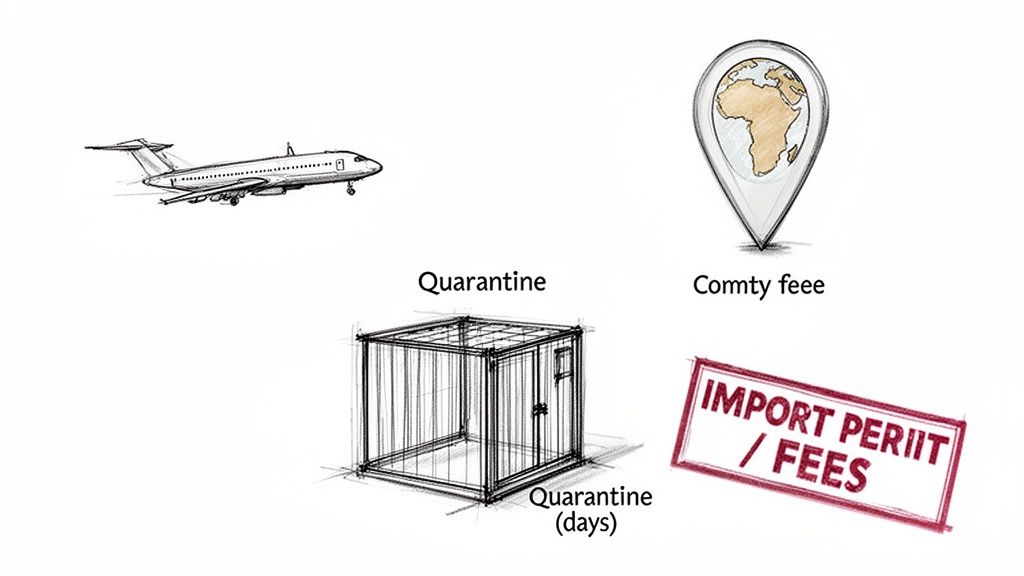
Why Quarantine Is a Major Cost Factor
Some countries are incredibly serious about keeping out foreign diseases, especially rabies. Nations that are either rabies-free or have it under strict control often require incoming pets to stay in a government-operated quarantine facility for a period of time. It's their way of making sure your pet is healthy before being released. A bit of a downer, for sure, but totally unavoidable for certain destinations.
And this isn't a quick, cheap overnight stay. Quarantine can last anywhere from 10 days to several months, and you're paying for every single day.
Who Requires It? Places like Australia, New Zealand, Japan, and Singapore are well-known for their tough quarantine rules. Even Hawaii, while part of the US, has its own requirements to protect its unique environment. You can get the full scoop in our guide on the State of Hawaii animal quarantine.
What's the Cost? The fees can be eye-watering. A 10-day stay in Australia, for instance, can run over $2,000 AUD (around $1,300 USD) just for the facility fees. That doesn't even include other import charges. This can easily become one of the single biggest expenses of the entire move.
Think of quarantine as a mandatory, government-run pet hotel. Your pet is well cared for, but the nightly rate is fixed by the government and can quickly inflate your total pet shipping bill.
Demystifying Customs and Import Fees
Even if your destination has no quarantine, you'll still have to deal with customs and import fees. Every animal entering a new country has to be officially cleared, and that process involves layers of costs that can be confusing if you're not ready. It's far more than a simple passport stamp; it's a formal import procedure.
These fees essentially cover the paperwork and administrative work needed to process your pet's entry. For international travel, it's also important that your documents have the right certifications. For instance, understanding the distinction between an apostille and a notary public can be important, as some countries have specific rules about how health certificates are legalized.
Here’s a look at what you might find on your final invoice:
Customs Broker Fees: Most pet shippers hire a licensed customs broker to manage the paperwork and make sure everything is perfect. Their expertise is invaluable but comes at a cost, typically between $150 and $500.
Import Permits: Some countries demand you apply for an import permit before your pet even leaves home. The application fee alone can be anywhere from $50 to over $300.
Port Fees and Taxes: When your pet arrives at the airport (the port of entry), the government charges fees for using their facilities. You might also have to pay a value-added tax (VAT) or other import taxes, often calculated based on the "value" of your pet plus their airfare.
For example, bringing a dog into the United Kingdom involves a customs clearance fee, an airline handling fee, and potentially VAT. Together, these can easily tack on another $300 to $600 to your total budget, completely separate from the flight itself. Forgetting to account for these arrival fees is a common pitfall that leaves pet owners scrambling at the last minute.
Smart Ways to Reduce Your Pet Shipping Bill
Seeing the potential price tag for shipping a pet can definitely be a bit of a shock. But before you hit the paws button on your plans, know that you have options. With some smart planning, you can make the whole process much more affordable without ever cutting corners on your pet's safety or comfort.
A little forethought really does go a long way. Let's walk through some practical, real-world ways to lower that final bill.
Plan Like a Pro
When it comes to shipping costs, timing is everything. Just like with our own travel, there are peak and off-peak seasons for pets, too. Booking your pet’s flight during the spring or fall can often be much cheaper. Why? Because airlines have temperature restrictions for animal safety in the dead of summer and the deep cold of winter, which can limit your flight options and push prices up.
Along the same lines, try to avoid major holidays to dodge those demand-based surcharges. Planning three to six months in advance gives you the most flexibility to hunt for the best travel dates. This extra buffer also helps you avoid last-minute rush fees for vet appointments and paperwork endorsements.
Choose the Right Size Crate
One of the single biggest factors in your shipping cost, especially by air, is the size of the travel crate. Airlines charge based on dimensional weight, which is a fancy way of saying the space the crate occupies is just as important as your pet's actual weight. Paying for a crate that’s too big is literally like paying for empty space on the plane.
Of course, a crate that’s too small is an absolute no-go—it's unsafe and the airline will reject it on the spot. The trick is to find that perfect fit. Your pet needs to be able to comfortably stand up, turn around, and lie down.
Measure Accurately: Grab a tape measure. For length, go from the tip of their nose to the base of their tail (not the tip). For height, measure from the floor to the top of their head while they're standing.
Add a Buffer: Add 2-4 inches to those measurements to get the ideal internal crate dimensions.
Buy Smart: You don't need the fanciest brand out there. As long as the crate is IATA-compliant, sturdy, and has good ventilation, you're good to go.
Finding the right-sized crate is the Goldilocks principle of pet travel—not too big, not too small, but just right. This single step can save you hundreds of dollars on airfare.
Compare Your Options Thoroughly
Don't just jump on the first quote you get. The price for shipping your pet can swing wildly between different companies and travel methods. Take the time to gather at least three different quotes to get a solid feel for the market rate for your specific trip. When you're comparing, make sure you're looking at what's included in each price to avoid any nasty surprises later.
For a deeper dive into what to expect and how costs break down, check out our complete guide on pet transportation costs.
DIY vs. Hiring a Professional
Finally, you'll need to decide whether you want to manage all the logistics yourself or bring in a professional pet shipper.
DIY Approach: If you're looking at a simple, domestic trip with straightforward paperwork, handling the arrangements yourself can be the cheapest way to go. You'll be the one booking the flight and managing the vet visits.
Hiring a Pro: For complex international moves, a pet relocation service can be a lifesaver. Yes, their fee adds to the overall cost, but they navigate the maze of confusing paperwork, handle customs clearance, and prevent expensive mistakes. In many cases, they can actually save you money in the long run by helping you avoid costly errors and delays.
How Passpaw Helps Cut Costs and Reduce Stress
The mountain of paperwork for pet travel isn't just a headache—a single mistake can get surprisingly expensive. When you're managing the cost of shipping pets, these small administrative errors can pack a real financial punch. An incorrect health certificate could mean paying steep flight rebooking fees, surprise boarding costs, or for extra vet visits to fix the problem.
This is where things can get a bit hairy, but it doesn't have to be that way. These compliance-related costs are so frustrating because they feel completely avoidable. Forgetting a signature, missing a key vaccination date, or using an outdated form can throw your entire travel plan and budget into chaos.
Dodging Costly Paperwork Errors
The real key to avoiding these extra expenses is simple: get the documents right the first time. A tiny oversight, like a missed field on an international health certificate, can be flagged by an airline or border official, causing serious delays. In the worst-case scenario, your pet could be denied travel at the last minute, leaving you to pay for a new flight and find temporary care on the spot.
To see how a tool like Passpaw helps, it’s useful to think about how a no-code automation platform works in other industries. These systems are built to simplify complex jobs, slash human error, and make sure every single step is followed correctly. Passpaw brings that same logic to the world of pet travel.
Our platform helps veterinarians sidestep these very problems by automating document workflows and checking information against official destination rules in real time.
A small mistake on a form can have a big impact on your wallet. The most effective way to control compliance costs is to prevent errors from ever happening, ensuring a smooth journey from the clinic to check-in.
How Better Workflow Translates to Real Savings
By making the whole process more accurate and efficient, Passpaw directly reduces your stress and protects your budget. This means fewer last-minute emergencies and a much clearer financial picture from the start.
This screenshot shows how the platform organizes every task and requirement based on your destination.
When you have a clear, step-by-step checklist, the chance of missing a crucial requirement drops to nearly zero. This structured approach helps ensure every 'i' is dotted and every 't' is crossed.
Here’s how this helps you save money:
Fewer Vet Re-checks: Getting the paperwork right on the first try means you avoid paying for extra appointments just to fix errors.
No Rebooking Fees: A fully compliant health certificate means no last-minute travel cancellations, saving you from expensive airline rebooking charges.
Reduced Administrative Time: For vets, the platform cuts down the manual hours spent researching rules and filling out forms, a saving that makes the entire process smoother for everyone involved.
Ultimately, this level of organization offers priceless peace of mind during what can be a very stressful time. To get even more organized for your move, you can use a dedicated pet travel planner to keep all your details in one spot. This preparation is the key to a successful, cost-effective journey for your furry family member.
Your Top Questions Answered
Thinking about your pet's travel budget can feel a bit overwhelming. Let's clear up some of the most common questions people have about the cost of shipping pets.
Is It Cheaper to Fly with My Pet in the Cabin?
Yes, if your pet is small enough to meet the airline's rules, flying with them in the cabin is almost always the most affordable way to go. This is a fantastic option for small dogs, cats, and other little companions.
Most domestic airlines charge a fee of around $95 to $125 each way for in-cabin pets. That's a huge difference compared to shipping a pet as cargo, which can quickly run from several hundred to over a thousand dollars. The catch? This option is strictly for pets who can fit comfortably in a carrier that slides under the seat in front of you.
Do I Really Need to Hire a Professional Pet Shipper?
Whether you need a pro really depends on the trip. For a straightforward domestic move without a lot of red tape, many pet owners handle the logistics just fine on their own.
Think of a professional pet shipper as a combination of a travel agent and an international logistics expert. For complex international moves, they are worth their weight in gold, helping you navigate the maze of rules and avoid costly mistakes.
But when you're moving internationally—especially to countries with strict biosecurity rules like Australia, New Zealand, or Japan—a professional is a very smart investment. They manage everything from booking the right flights to making sure every last piece of paperwork is perfect for customs. While their fee is an added expense, they can save you from disastrous and expensive errors that could derail your pet's entire trip.
How Does the Time of Year Affect Pet Shipping Costs?
The season can have a surprisingly big impact on both the price and the availability of flights for your pet. To keep animals safe, airlines have temperature embargoes that restrict pet travel in cargo during extreme summer heat or winter cold.
This reduces the number of flights your pet can take, and that limited supply can drive up the cost. On top of that, trying to fly during peak holiday seasons often comes with airline surcharges, which can inflate the base cost by 20% to 50%. For the most options and the best prices, your best bet is usually to book your pet’s travel during the milder spring or fall months.
Ready to take the guesswork out of your pet's travel paperwork? Passpaw makes it easy for veterinarians and pet owners to manage health certificates and meet destination requirements without the stress. Ensure every document is pitch-perfect and avoid costly compliance errors. Discover how Passpaw can simplify your pet's journey today!
More articles
From regulatory changes to best practices for veterinarians and pet owners, our resources keep you ahead of the curve.