Are you a team member in a veterinary practice?
Are you a pet parent planning a trip with your furry pal?
Lufthansa Pet Travel Documents: Your 2026 Guide
You've booked your seat. Your pet has the right carrier, at least in theory. Then the paperwork starts multiplying. A country form here, a vaccine record there, and suddenly you're wondering whether Lufthansa wants the same documents every airline wants, or a completely different stack.
That confusion is where trips usually go sideways.
Most generic pet travel articles stop at “get a health certificate and vaccine records.” That's not enough for Lufthansa. Key trouble spots are airline-specific. The Lufthansa form, the physical printouts, the cabin registration timing, and the small details at check-in are where otherwise prepared travelers get stuck. If you want your Lufthansa pet travel documents in order, you need the veterinary side and the airline side lined up at the same time.
Preparing for Your Pet's Flight with Lufthansa
For most travelers, the stress doesn't start with the vet visit. It starts when they realize that airline paperwork isn't the same thing as entry paperwork.
Lufthansa has its own process, and it rewards people who prepare in sequence. First, confirm whether your pet is even suitable for cabin travel or whether another travel method makes more sense. Then gather the health and vaccination records. After that, match those records to Lufthansa's own acceptance steps, not just to the destination country's rules.
A good working mindset is this: your pet's file needs to satisfy two gatekeepers. One is the destination authority. The other is the airline desk at departure. If either side sees something missing, your travel day can unravel quickly.
If you're still sorting out the broader identity and movement paperwork side, this guide on how to get a pet passport is a useful companion before you lock in your final document set.
Practical rule: Don't treat Lufthansa as a simple “show up with vet papers” airline. Treat it as an airline with its own acceptance workflow.
That one shift in thinking saves a lot of last-minute scrambling and a lot of anxious paws at the airport.
The Core Pet Travel Document Essentials
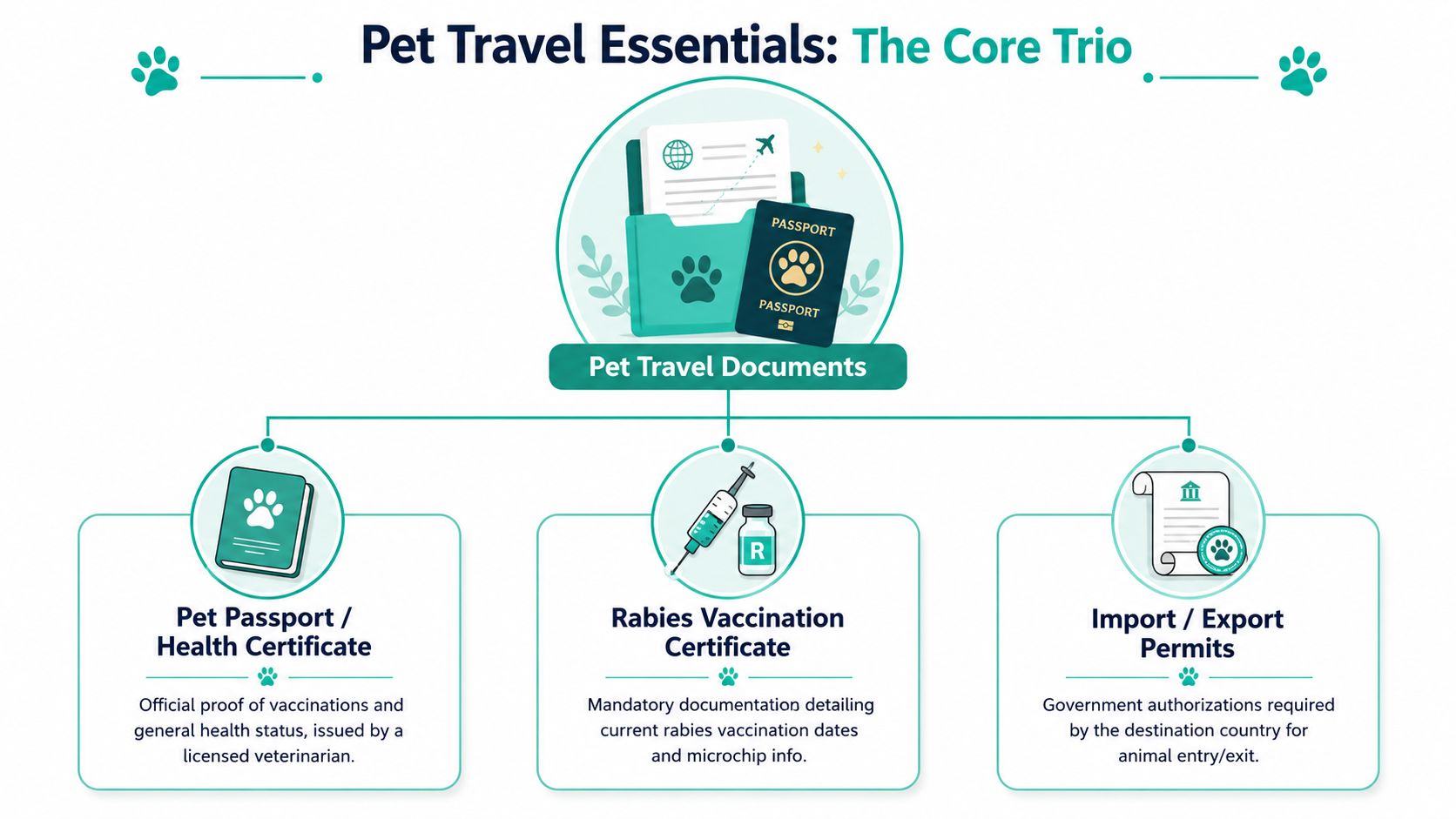
Start with the records that prove your pet's identity, vaccination status, and fitness to travel. If those papers do not line up cleanly, the Lufthansa paperwork later in the process will not save the booking.
The three documents that anchor the file
The first is the microchip record. This is the document that connects the animal in front of the check-in agent to every other page in your folder. I always check the chip number character by character against the rabies certificate and the health paperwork, because one digit off can trigger a manual review at the desk.
The second is the rabies vaccination record. It needs to be current, legible, and clearly tied to the same pet through matching identifiers. A clinic saying the vaccine is “in the system” does not help at the airport. Travelers need the actual record in hand.
The third is the health certificate or pet passport file, depending on the route. For some trips, that means an EU pet passport. For others, it means a government-endorsed health certificate issued within the required timeframe. The trade-off is simple. A passport can make repeat travel easier inside the right system, while a health certificate is often route-specific and date-sensitive.
What airline staff look for first
At the counter, staff usually do not start by reading every page. They scan for consistency.
They check whether the pet name is presented the same way across records, whether the owner name matches the booking, and whether the microchip number appears exactly the same on the core documents. Clean paperwork speeds up acceptance. Mixed formats, missing pages, and blurred phone screenshots slow it down fast.
This is the part many generic guides gloss over. Country entry approval and airline acceptance are related, but they are not the same review. A pet can meet import rules and still face problems at departure if the supporting documents are messy, incomplete, or hard to verify.
For a broader reference point, Pet Magasin has an actionable guide for traveling with pets that helps when you are comparing destination requirements with airline handling rules. If you want a cleaner overview of the usual paperwork categories before you sort your Lufthansa file, this guide to travel documents for pets is a useful baseline.
A filing system that works at the airport
Use one physical folder and one digital backup. Keep the papers in the order an agent is likely to request them.
Identity section: Microchip registration record and any official identification pages
Vaccination section: Rabies certificate and any supporting vaccine history required for the route
Travel clearance section: Health certificate, pet passport pages, and any import permit or endorsement pages
A tidy file is not cosmetic. It reduces the chance of a check-in delay, and it gives staff fewer reasons to pause your case.
The best pet travel folder is easy to scan in under a minute. Every name matches. Every date is visible. Every required page is ready without digging through a phone or a clinic portal.
Lufthansa-Specific Forms You Must Have
You arrive at check-in with a valid health certificate, rabies record, and a carrier that meets the size rule. Then the agent asks for the Lufthansa cabin animal form in duplicate, signed on paper. That is a common failure point, and generic pet travel guides rarely spell it out clearly.
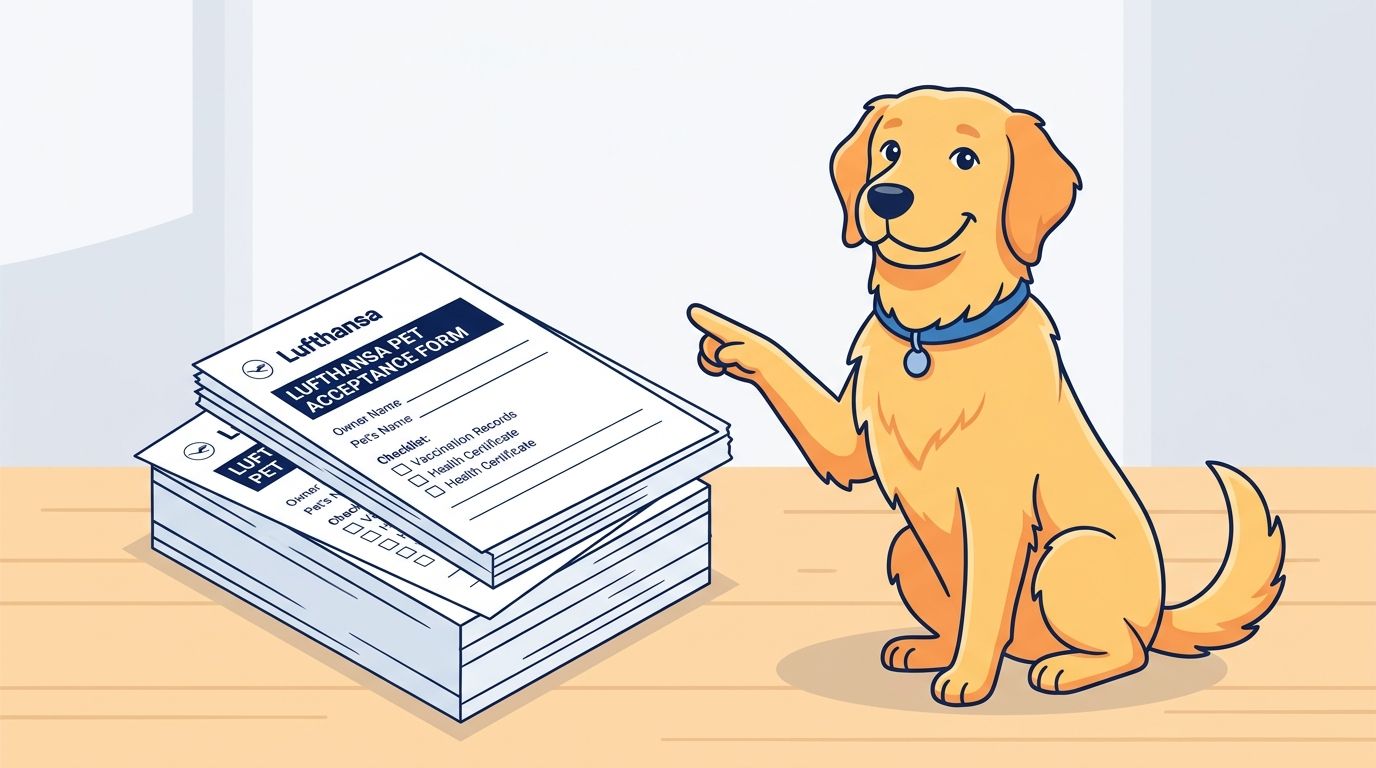
For an in-cabin pet, Lufthansa's own paperwork is part of the acceptance process, not an optional extra. The form to watch closely is “Transporting an animal in the passenger cabin.” Bring two completed, signed paper copies. In practice, one copy, a phone screenshot, or an unsigned printout can stop the check-in process while other passengers move ahead.
The form requirement people overlook
This requirement sounds minor until the travel day gets tight. Airport staff are checking whether the form is the correct Lufthansa cabin document, whether all fields are filled in, and whether both copies are signed before you reach the counter.
Here is what I check in a client file before I clear them to leave for the airport:
Correct Lufthansa form: Use the passenger-cabin animal form, not a general declaration or a cargo document.
Two physical copies: Paper copies matter. Digital access does not replace them.
All fields completed: Do not plan to finish details at check-in.
Both signatures present: A partly signed packet creates the same delay as a missing packet.
Registration is tied to the paperwork
Cabin travel also depends on timing inside Lufthansa's booking system. The pet must be registered with the airline within its required pre-departure window, and for many travelers the practical deadline to remember is 72 hours before departure. Leave this too late and complete veterinary paperwork will not fix the problem.
That is the airline-specific gap many owners miss. Government documents show the pet is medically and legally cleared to travel. Lufthansa's form and registration steps show the airline has space, has recorded the pet correctly, and is ready to accept that animal on that booking.
A quick file check before you leave home
Use this last review before you head to the airport:
Checkpoint | What to verify |
|---|---|
Cabin form | You have the Lufthansa passenger-cabin animal form |
Print status | Two copies are printed on paper |
Signature status | Both copies are signed |
Vet packet | Health and vaccination documents are packed with the form |
Booking record | The pet was added to the reservation within Lufthansa's required timing |
If you are sorting out where government veterinary paperwork fits into this file, this guide to the APHIS 7001 health certificate explains how that document differs from an airline acceptance form.
The practical rule is simple. Vet paperwork gets your pet medically cleared. Lufthansa's own form and registration steps get your pet through the airline's front door.
Cabin Hold and Cargo Document Differences
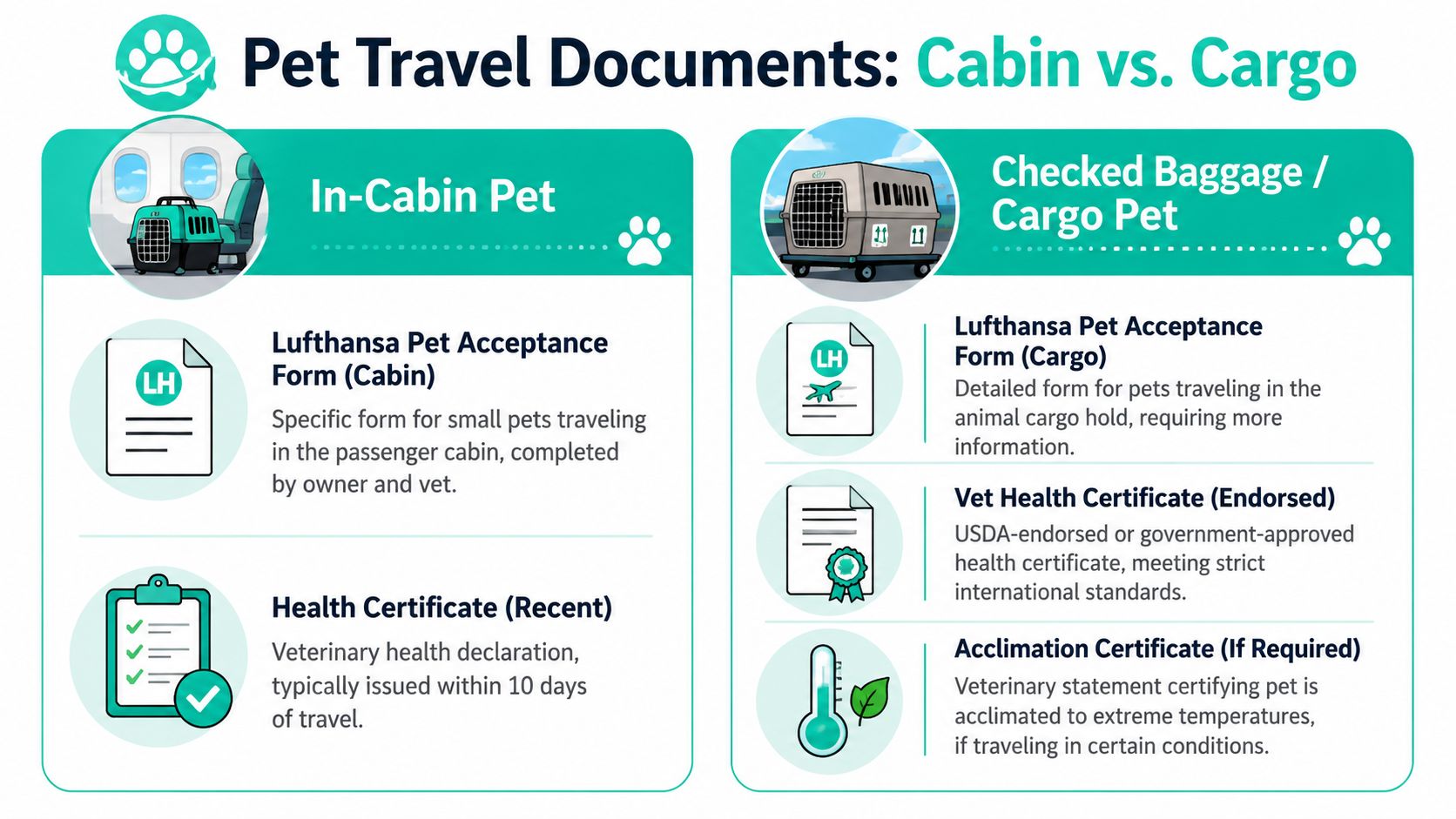
A common airport failure looks like this. The owner brings a valid health certificate and vaccine record, but the pet was prepared for the wrong transport channel. Lufthansa accepts pets differently in the cabin, in the hold, and through cargo, and the paperwork logic changes with that choice.
That usually shows up in three situations. A pet is close to the cabin size limit. A route will not allow the pet in the cabin. A breed restriction pushes the booking out of one lane and into another.
Cabin travel compared with hold and cargo
For in-cabin travel, the document file usually centers on Lufthansa's passenger-cabin paperwork plus the pet's veterinary records. The practical question at check-in is whether the pet and carrier meet cabin rules and whether the airline already has the pet correctly registered in the booking.
For hold travel, staff focus less on under-seat fit and more on crate compliance, handling conditions, and route acceptance. The veterinary documents still matter, but the operational review is different.
For cargo transport, the process is more specialized again. The booking path, handoff, and shipment documents are handled differently from a standard passenger reservation. That is where generic pet travel articles often cause trouble, because they blur hold and cargo into one category when they are not handled the same way.
Travel method | Main document focus | Main operational focus |
|---|---|---|
Cabin | Lufthansa cabin paperwork plus veterinary records | Carrier fit and booking acceptance |
Hold | Veterinary file plus transport acceptance requirements | Crate standards and handling conditions |
Cargo | Shipment and agent paperwork | Cargo booking process and transfer procedures |
Snub-nosed breeds need special attention
Brachycephalic, or snub-nosed, breeds are one of the easiest places to make the wrong paperwork choice. I see owners prepare for hold travel because the pet is too large for the cabin, then learn late in the process that breed restrictions change what Lufthansa will accept.
The practical point is simple. A pet may be ruled out for hold transport but still be eligible for cabin travel if the cabin requirements are met. If that switch happens, the owner has to change the paperwork plan too. The cabin process depends on Lufthansa's own form workflow, and missed airline steps can stop travel even when the veterinary file is otherwise fine.
PetRelocation explains that distinction clearly in its guide to booking a Lufthansa flight for your pet.
How to choose the right path
Choose cabin travel if your pet safely fits the carrier and the route allows cabin transport. This route often feels simpler, but Lufthansa is strict about airline-specific acceptance steps.
Choose hold planning if the pet cannot travel under the seat and the route supports checked animal transport. In that case, crate setup and route review carry more weight than the cabin form process.
Choose cargo planning if the route, size, or handling requirements place the pet outside the passenger booking path. If you need to compare broader options, this guide to the best airlines that take dogs in cargo is a useful starting point.
The trade-off is paperwork type versus handling complexity. Cabin travel usually has the tighter airline form and booking controls. Hold and cargo planning shift more of the risk to crate approval, routing, and transport acceptance.
Your Pet Travel Document Timeline
Three days before departure is a bad time to learn your pet still is not registered in Lufthansa's cabin system, or that you printed one unsigned copy of the airline form when check-in staff expect two signed paper copies. I see that exact problem far more often than missing vaccines. The veterinary file may be perfectly fine, but Lufthansa has its own process, and that process runs on deadlines.
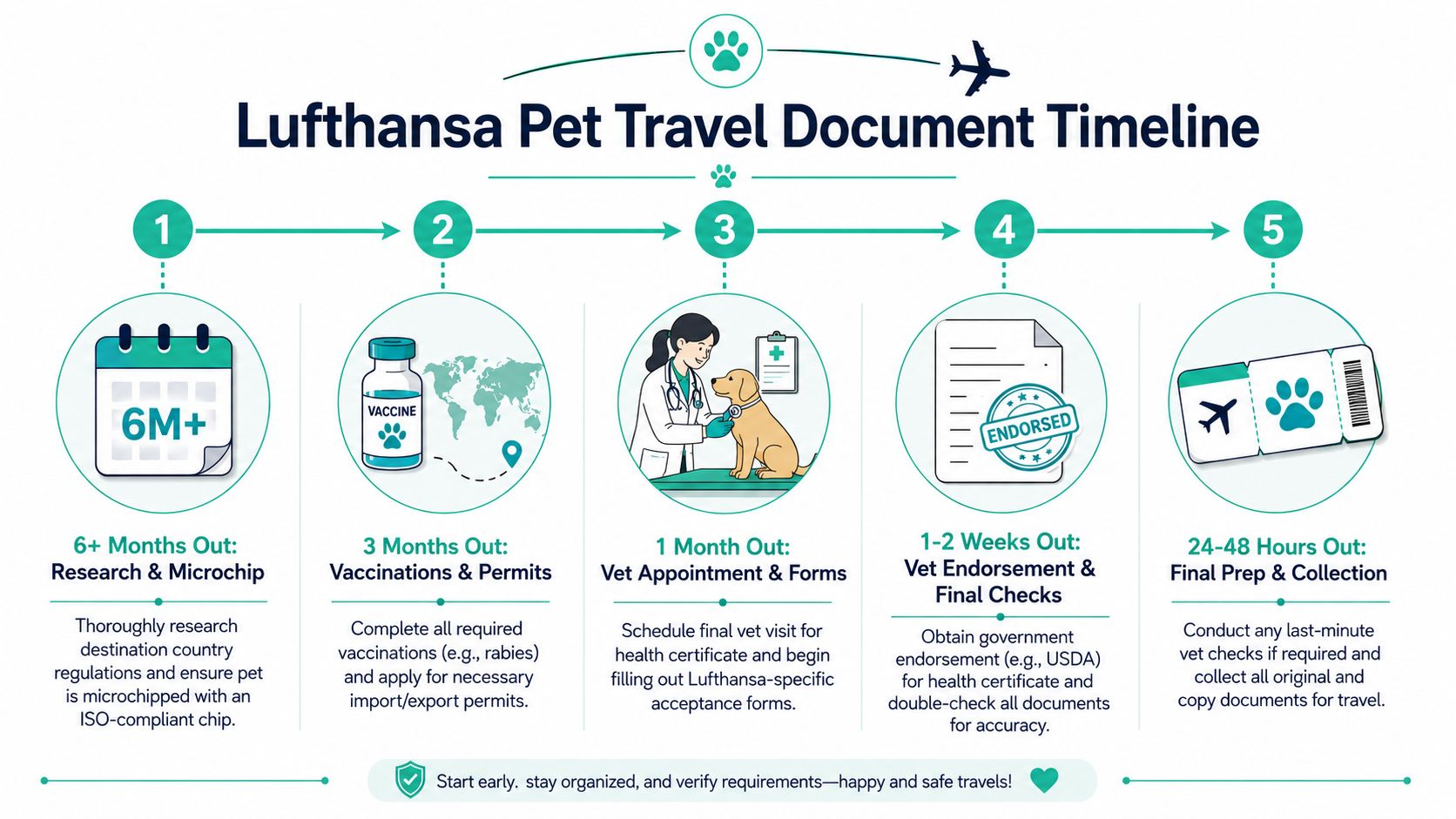
Build your timeline backward from departure day. That method exposes the steps that cannot slip, especially the airline-specific ones generic pet travel guides often skip.
Start with the route, then the pet
First confirm that your pet is old enough and eligible for the exact itinerary, as noted earlier in this guide. Then check the foundation documents. The microchip details, rabies record, name on the booking, and owner information need to match across the file.
This first review saves time. If the route changes from one country pairing to another, the veterinary timeline can change with it.
A practical sequence that works
Use this order:
Several weeks before travel Confirm the route, pet age eligibility, and whether your pet is suited for cabin travel. A pet that technically fits the weight rule but struggles in confinement may be better planned another way.
Once your flights are fixed
Book the veterinary visit based on the destination's entry rules and any timing window for the health certificate. Ask the clinic which documents will be issued as originals, because Lufthansa check-in is much easier when your paperwork packet is complete and clearly organized.As soon as cabin travel is confirmed
Complete the Lufthansa-specific cabin paperwork carefully. Print two signed hard copies of the required airline form and store them with the veterinary documents. Do not leave this to the final evening. Printers fail, signatures get missed, and that is a preventable airport problem.No later than 72 hours before departure
Make sure the pet is registered with Lufthansa for in-cabin travel within the airline's required cutoff. If that step is missed, complete documents from your veterinarian will not rescue the trip.The day before departure
Run a page-by-page check. Look for mismatched dates, unsigned fields, faded print, and records for the wrong pet. I also recommend placing the documents in the order an agent is likely to ask for them: booking confirmation, airline form, vaccination record, microchip record, then health paperwork.
What belongs in your departure folder
Keep one hand-carry folder that stays with you from home to check-in. It should contain:
Original veterinary paperwork required for the route
Rabies vaccination proof that clearly matches the pet and microchip
Microchip details if they are listed separately
Two signed printouts of the Lufthansa cabin form, if your pet is traveling in the cabin
A backup photocopy set in case an agent needs to review something away from the desk
Paper still matters here. A phone full of PDFs is useful backup, but it should not be your only plan.
Done properly, the final week becomes a review window, not a scramble. That is the difference between arriving at the airport ready to check in and trying to solve paperwork problems with a stressed pet at your feet.
Common Pitfalls That Can Ground Your Pet
You can do almost everything right and still get turned away at check-in. I see it most often with travelers who have valid veterinary paperwork but miss one airline step that cannot be fixed at the airport.
The pattern is predictable. A pet is healthy, the rabies record is in the folder, the carrier looks fine at home, and someone assumes the rest can be sorted out at the desk. Lufthansa staff do not have much room to make exceptions once a requirement is missing or a deadline has passed.
Missing the cabin registration cutoff
The biggest failure point is simple. The pet was never properly added for in-cabin travel within Lufthansa's required 72-hour window.
That problem is easy to underestimate because it is separate from the veterinary side. A health certificate can still be valid. The microchip can still match. None of that fixes a missed airline registration cutoff. If the cabin pet was not registered in time, the trip can stop there.
I tell clients to treat this as a booking task, not a document task. It belongs on the calendar early, with confirmation saved.
Bringing paperwork that is technically correct but operationally wrong
This catches careful people off guard. They have the right records, but not in the format check-in needs.
For cabin pets, one of the most common misses is failing to bring two signed printouts of Lufthansa's own cabin transport form. Another is relying on a phone full of PDFs and assuming that will be enough. Sometimes it is accepted. Sometimes it slows the process down at exactly the moment you need a quick yes from the agent. Paper remains the safer choice.
A messy folder also creates avoidable doubt. If an agent has to hunt through mixed records, unsigned pages, or faint copies, the review gets harder. Harder reviews usually do not go in the traveler's favor.
Assuming the carrier will pass because the pet fits inside it
Airline staff are not judging whether the pet looks comfortable for a photo. They are checking whether the carrier meets the cabin rules they have to enforce.
Two problems come up repeatedly. The first is weight. The second is fit under the seat. Soft-sided carriers usually give travelers more margin, but only if the dimensions and structure still meet the airline's requirements. A carrier that seems close enough at home can become a problem at the airport.
This is one of those trade-offs worth making early. Buy the compliant carrier first, then get the pet used to it. Do not choose the roomiest bag and hope it passes.
Letting small mismatches slide
Name differences, missing signatures, old versions of a form, and dates that do not line up are the details that trigger long check-in conversations.
The records should point to the same animal every time. That means the pet name, microchip number, vaccination details, and owner information should read consistently across every page. If your veterinarian corrected something by hand, make sure the correction is clear and properly initialed if needed. A scribbled fix can create more questions than it solves.
The day-before check that prevents airport drama
Do one final review with the actual folder you plan to carry.
Check | What goes wrong if you skip it |
|---|---|
Cabin pet was registered on time | The pet may not be accepted for travel |
Two signed Lufthansa form printouts are packed | Check-in can stall over missing airline paperwork |
Carrier meets the cabin rules | Valid health records will not fix a carrier refusal |
Every document matches the same pet | Mismatched details can lead to delays or denial |
Small mistakes become big problems fast once you are standing at the counter with a nervous pet. The good news is that almost all of these issues are preventable with one careful review at home. A few quiet minutes the day before can save a very loud travel day.
Lufthansa Pet Travel FAQ
Do I need separate documents if one flight segment is on another airline
Yes, sometimes you do.
I tell clients to check the operating airline on every leg, even if the booking was made through Lufthansa. Pet acceptance is handled by the airline flying that segment. A Lufthansa-approved setup does not automatically satisfy another carrier's form, carrier size limit, or check-in process.
Mixed-airline itineraries are where careful travelers still get caught. One segment may allow an in-cabin pet, while the partner segment requires a different approval step or refuses that route altogether.
Can my veterinarian email the paperwork to Lufthansa instead of giving me paper copies
Do not count on emailed paperwork to get you through check-in.
For cabin travel, Lufthansa expects the traveler to arrive with the documents ready to present. That usually means your veterinary records in hand, plus two completed and signed printouts of the Lufthansa cabin transport form. I have seen trips delayed over paperwork that existed electronically but was not physically available at the counter.
Ask your clinic for printed originals or signed hard copies whenever possible. Keep digital backups on your phone, but treat them as backup only.
What if the online registration form isn't working
Handle it the same day.
Cabin pet registration has a firm cutoff before departure, and technical problems do not buy you extra time. If the form fails, take screenshots, note the time, and contact Lufthansa while the deadline is still safely ahead of you. Waiting until the final day turns a minor admin problem into a real risk of refusal.
This is one of the airline-specific gaps generic pet travel guides often miss. The paperwork can be perfect and the pet can still be denied if the cabin registration was not completed in time.
Can I use digital copies at check-in if I have everything on my phone
Bring paper.
Phone copies are useful if a page gets misplaced, but they should not be your primary set. Lufthansa staff may need to review forms quickly at the desk, and printed documents make that process faster and cleaner, especially if they need to keep or compare a copy.
My standard advice is simple. Carry a paper folder with your veterinary records and Lufthansa forms, then keep the same file on your phone as insurance. That small bit of preparation saves a lot of airport stress.
Fly with Confidence and Complete Paperwork
Lufthansa pet travel documents are manageable once you stop treating them like generic airline paperwork. The process works best when you separate the job into three parts. Build the core veterinary file, match it to the correct travel method, and then complete the Lufthansa-specific acceptance steps without cutting timing too close.
The travelers who have the smoothest check-in are rarely the luckiest ones. They're the ones who prepared the exact papers the airline expects, in the format the airline expects, and on the timeline the airline expects.
If you remember only a few things, remember these. Confirm the pet is eligible for the way you want it to travel. Keep the veterinary paperwork tidy and consistent. And never leave the airline-specific steps for the final scramble.
A little paperwork discipline goes a long way. That's not glamorous, but it is what gets tails and suitcases moving together.
If you want a simpler way to manage the veterinary side of international pet travel paperwork, Passpaw helps practices and pet owners keep documents organized, track deadlines, and reduce avoidable errors before travel day.

More articles
From regulatory changes to best practices for veterinarians and pet owners, our resources keep you ahead of the curve.