Are you a team member in a veterinary practice?
Are you a pet parent planning a trip with your furry pal?
Health Certificate for Dogs to Mexico: 2026 Guide
You’ve booked the trip. Your hotel allows dogs. Your airline says pets are welcome. Then you search “health certificate for dogs to mexico” and the answers start fighting with each other.
One page says Mexico doesn’t require a health certificate. Another says you need one. A third talks about rabies records, parasite treatment, and forms on the way back to the United States. By the time you close your laptop, the whole thing feels more confusing than it should.
That confusion is normal. The paperwork for taking a dog to Mexico looks simple at first, but a significant challenge arises because entry into Mexico and return to the US are not the same process. Most travel problems happen when owners prepare for the flight down and forget to plan for the trip home.
Your South-of-the-Border Adventure Awaits
A lot of owners start in the same place. They’ve got a beach trip, family visit, seasonal stay, or winter escape on the calendar, and they can’t imagine leaving the dog behind. Fair enough. If your dog is part of the family, the suitcase isn’t the only thing that needs packing.
The first snag usually comes from mixed advice. Someone crossing by car says they didn’t need much paperwork. Someone flying says the airline asked for a certificate. Then your veterinary clinic tells you one thing, the airline says another, and border guidance sounds simpler than either. That’s when people start second-guessing every step.
The good news is that the process is manageable once you separate the rules into two buckets:
What Mexico requires when your dog arrives
What your airline requires before your dog boards
What the US requires when your dog comes back
That round-trip mindset is what keeps a smooth travel plan from turning into a ruff airport morning.
If you want a broader overview before dialing in the details, this guide on traveling with dogs to Mexico is a helpful starting point. Then use the steps below to get specific about certificates, timing, and the return-home documents that many travelers miss.
The outbound trip feels easier than the return. Plan both at the same time, and the whole process gets much calmer.
Mexico's Rules vs Airline Rules Explained
The biggest mistake I see is simple. Owners assume that because Mexico no longer requires a formal health certificate for entry, they can skip the veterinary paperwork entirely.
That’s not always true.
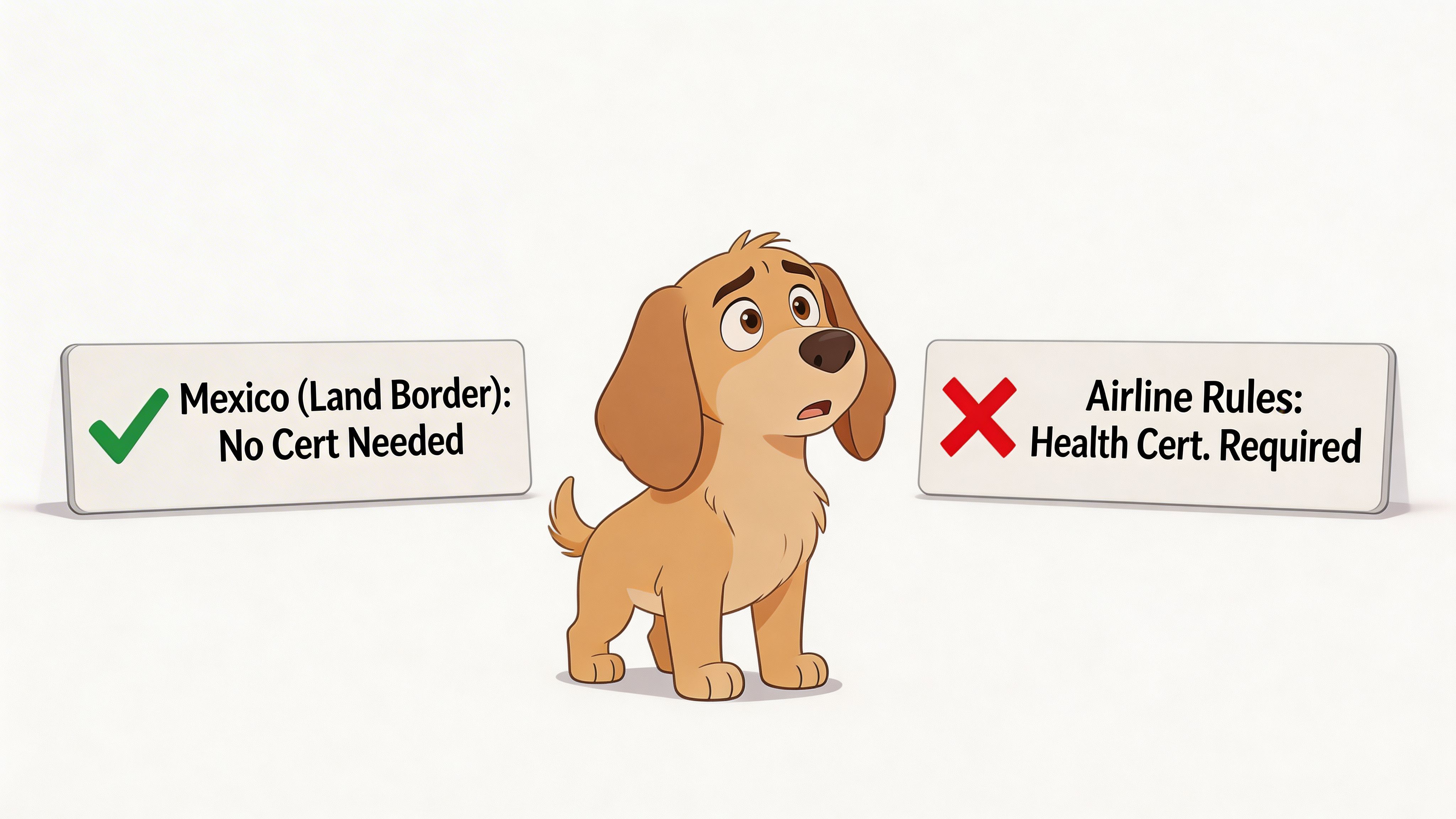
Since December 16, 2019, Mexico has eliminated the requirement for a formal health certificate for dogs entering the country and uses a physical inspection by SENASICA instead. At the same time, return travel to the US became stricter because, since November 22, 2024, Mexico’s screwworm-affected status requires APHIS screwworm freedom certification for all dogs returning to the US, as described by Universal Weather’s update on SENASICA requirements.
What Mexico checks
On arrival, SENASICA performs a physical inspection. The focus is practical. Officers are looking for signs that the dog appears healthy and free of obvious problems that could create animal health concerns.
Expect attention to things like:
Visible parasites such as fleas or ticks
Open wounds or healing skin lesions
General condition and whether the dog appears fit for travel
Carrier cleanliness, since pets should arrive in a clean crate or carrier
Mexico’s side of the process is usually straightforward when the dog arrives clean, healthy-looking, and properly handled.
Why airlines still ask for a certificate
Airlines operate under their own live-animal transport rules. They often want a recent veterinary exam and written proof that the dog is fit to fly. That’s separate from Mexico’s border policy.
This situation often trips up owners. Government entry rules might be simple, but airline boarding rules can still require a health certificate. If you’re flying, the airline’s checklist matters just as much as the destination’s.
A clean way to think about it is this:
Travel situation | What matters most |
|---|---|
Driving into Mexico | SENASICA inspection on arrival |
Flying into Mexico | Airline document requirements plus SENASICA inspection |
Returning to the US | US import requirements, not Mexico entry rules |
Practical rule: If you're flying, never assume “Mexico doesn’t require it” means “I don’t need it.” Ask the airline what they require in writing.
Your Vet Visit Playbook for the Outbound Trip
When clients ask for the simplest way to prepare, I tell them to treat the outbound visit as a document-building appointment, not just a quick exam. You’re not only checking that the dog is healthy. You’re making sure the paperwork matches the trip.
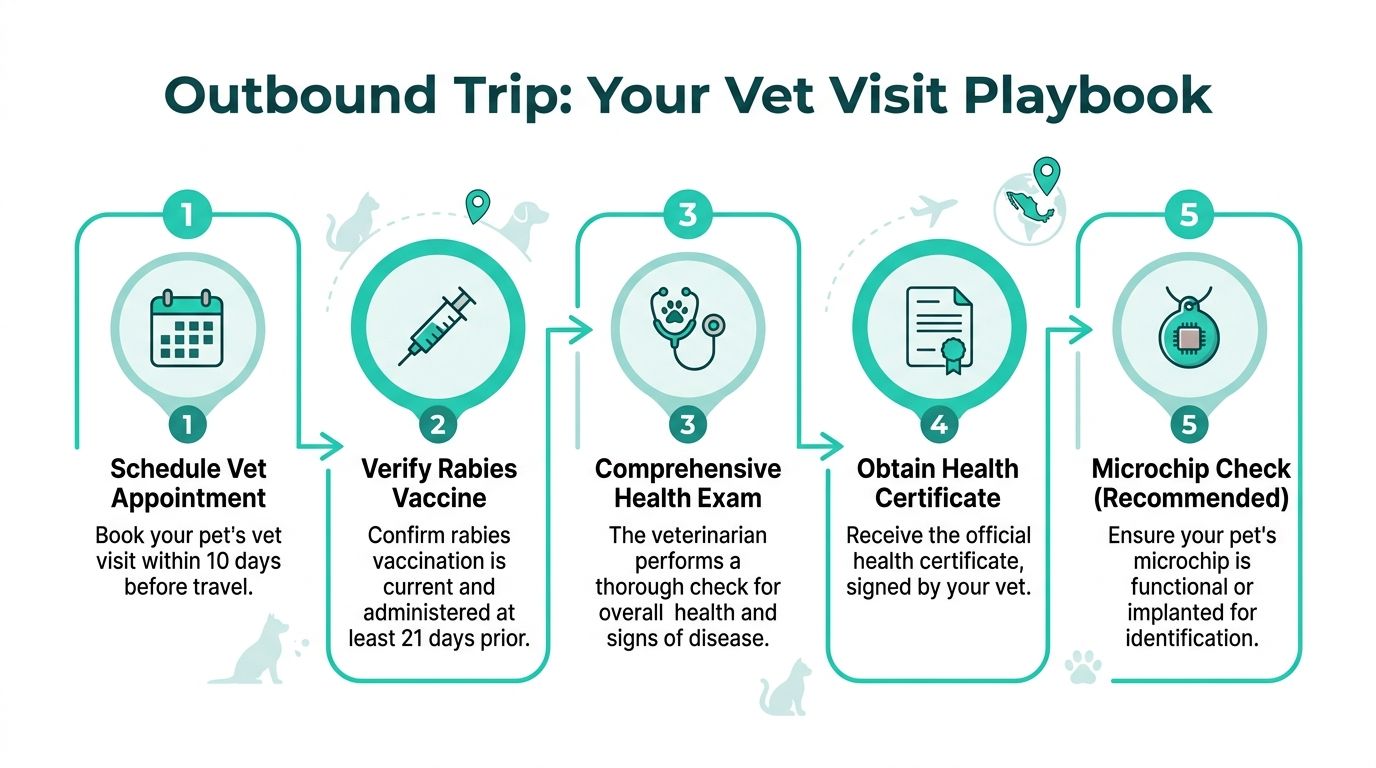
A late vet visit is a common pitfall and accounts for 40% of document rejections, because certificates often expire in 15 days. Another 25% of detentions are due to missing parasite treatment proof, according to this guide on taking your dog to Mexico.
What to bring to the appointment
Don’t walk in empty-handed and hope the clinic can fill in every blank from memory. Bring your records and your travel details.
Have these ready:
Flight information so the clinic knows your actual departure date
Rabies certificate with administration date and validity period
Microchip information if your dog has one
A copy of the airline’s pet policy if the airline has special wording or timing requirements
Any prior travel records if your dog has traveled internationally before
That last point helps more than people expect. Small ID mismatches create big headaches.
What the veterinarian should review
For the outbound trip, the exam is usually about confirming that your dog is healthy enough to travel and that the supporting documents are complete.
The visit typically includes review of:
Overall health status
Your veterinarian checks for signs of illness, skin disease, respiratory issues, wounds, and anything else that could create a problem at boarding or arrival.Rabies vaccination status
Mexico expects rabies documentation to be in order, except for puppies under 3 months. Airlines may also look closely at vaccine dates.Internal and external parasite treatment
Owners often forget this part. If the treatment isn’t documented clearly, it can slow things down later.Identification details
The certificate should match the dog in front of you. Name, breed, sex, age, color, and microchip or tag number should be consistent across records.
What to ask for on the health certificate
For air travel, ask the clinic for a certificate that is clear, legible, and specific enough to satisfy airline review. The exact form can vary, but the content should be easy to verify.
Ask for a document that includes:
Owner name and contact details
Pet description and identifying information
Veterinarian name, license details, and signature
Statement that the dog was examined and is fit for travel
Rabies vaccination details
Recent parasite treatment details
If your airline has its own form, bring it. If not, a clinic letterhead certificate is often what gets used.
Bring the airline policy to the vet appointment. It saves back-and-forth and helps the clinic match the wording to what the carrier expects.
What works and what doesn’t
What works is a planned visit with records in hand, travel date confirmed, and one person responsible for checking every detail before leaving the clinic.
What doesn’t work is the last-minute scramble. Owners book the exam too close to departure, forget proof of parasite treatment, or realize at the airport that the airline wanted a certificate format they never asked for.
If you want the smoothest path, leave the appointment with three things: the health certificate, the rabies document, and proof of parasite treatment. That paperwork trio solves most outbound problems.
Mastering Travel Timelines and Endorsements
The timing is where even organized travelers stumble. The certificate itself might be fine, but if the dates don’t line up with your departure, it won’t matter.
For many trips, the safest approach is to work backward from the flight date and build a small calendar. A lot of health certificates used for travel have a short useful window, and that’s why delay is such a common issue.
A practical calendar that keeps you out of trouble
Think in reverse order:
Travel day
Have your certificate, rabies proof, and parasite records packed in both printed and digital form.Several days before departure
Reconfirm the airline’s pet rules. Airlines sometimes enforce details differently than owners expect.Roughly within the pre-travel exam window
Schedule the veterinary visit so the certificate is still valid when you fly.
This sounds basic, but it saves a lot of stress. Owners tend to book too early because they want to be “ahead.” Then the certificate ages out before the plane ever leaves the runway.
When APHIS endorsement may help
APHIS endorsement isn’t always required for a dog going to Mexico, but some owners choose it when an airline, routing, or extra layer of document review makes it worthwhile. It can also add peace of mind if you’re dealing with a tight itinerary or a carrier that reviews paperwork closely.
The key is not to assume endorsement is automatic or necessary in every case. Ask two separate questions:
Does my airline require it?
Does my route or handling process make it wise to get it anyway?
If you need help understanding that process, this page on how to get a USDA endorsed pet health certificate gives a useful breakdown.
Don’t just ask, “Do I need a certificate?” Ask, “Who is going to review this certificate, and what do they require?”
The Critical Guide to Your Return Trip to the US
This is the part many owners miss. They prepare carefully for getting into Mexico, enjoy the trip, and only later realize that the return to the United States is the harder leg.
That is the main round-trip trap.
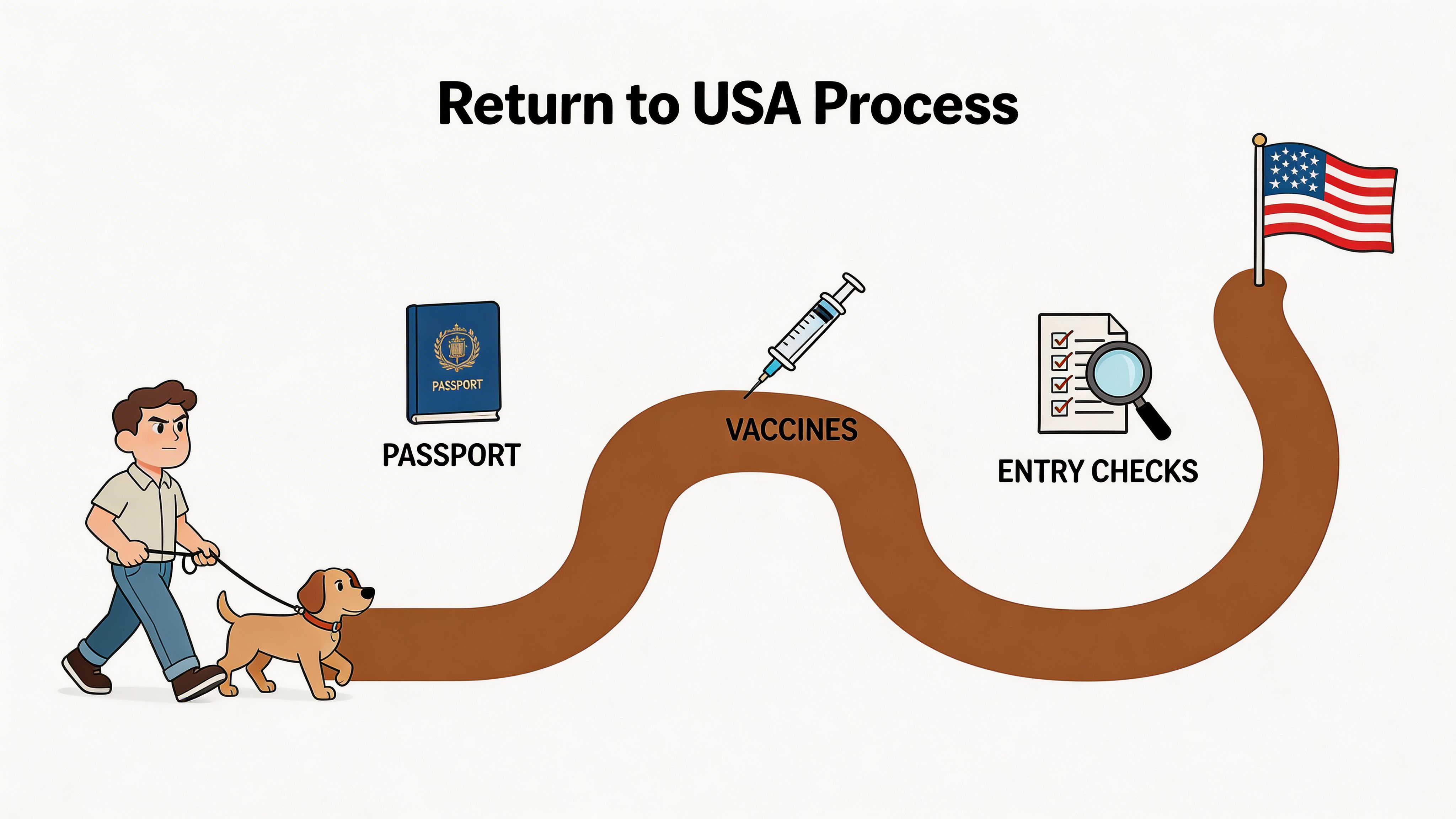
Re-entry to the US from Mexico now demands APHIS screwworm certification, and APHIS port statistics showed a 12% non-compliance rate in 2025 for this rule. A free CDC Dog Import Permit is also mandatory, and missing it accounts for 22% of re-entry denials for travelers from affected countries, according to Cascade Vet Clinics’ summary of Mexico travel certificates.
What you need before coming home
The return checklist is different from the outbound checklist. Don’t assume your Mexico-bound paperwork covers it.
For the trip back to the US, focus on these items:
Screwworm freedom certification from an authorized veterinarian in Mexico
CDC Dog Import Permit
Microchip compliance
Current supporting vaccination and health documents
A dog that appears healthy at inspection
Some owners get caught off guard here. Their dog entered Mexico without much friction, so they expect the same easy path on return.
How the screwworm certificate works
A veterinarian in Mexico must examine the dog and document that the dog is free of screwworm. This is not a casual note scribbled on a receipt. The wording needs to be clear and the document needs to come from the right professional.
In practical terms, you should:
Identify an authorized veterinarian in Mexico well before departure
Schedule the exam before your return date
Confirm the certificate clearly states that the dog is free of screwworm
Make sure the dog’s identifying details match the rest of your records
If you wait until the last minute, your options shrink quickly. In resort areas and popular travel cities, clinics may be busy, and not every clinic handles export-related paperwork.
The CDC permit is easy to overlook
The CDC Dog Import Permit tends to get missed because it sounds simple. It is simple. But simple doesn’t mean optional.
Owners often spend all their energy on the veterinary certificate and forget the online permit step. Then they show up with one critical document missing.
If I had to pick the most avoidable mistake on the return trip, it would be this: owners handle the vet exam and forget the CDC form.
A clean return-home workflow
Use this order:
Step | What to do in Mexico |
|---|---|
First | Locate the right veterinarian for the return paperwork |
Next | Schedule the screwworm exam before your return date |
Then | Obtain the screwworm certificate and review it carefully |
After that | Complete the CDC permit step and save the receipt |
Last | Travel with printed and digital copies of everything |
For a fuller walkthrough of the US side, this guide on returning with a dog to the USA is worth reviewing before you leave home.
How Digital Tools Prevent Travel Headaches
The hard part of pet travel usually isn’t the exam itself. It’s the admin. Dates, documents, signatures, vaccine records, country rules, airline rules, and return requirements can pile up fast.
That’s why digital workflows have become so useful for clinics and travelers. They reduce the chances of a preventable miss.

A major knowledge gap still exists around return travel. As of November 22, 2024, Mexico is affected with screwworm, and all dogs returning to the US must meet APHIS certification requirements. Many owners and veterinary teams remain unaware of that policy shift, creating a compliance challenge, as noted in Wise’s guide on traveling to Mexico with a dog.
Where manual systems fall short
Sticky notes, inbox searches, and scanned PDFs can work for a simple domestic trip. International travel is different.
Manual systems often fail when:
Dates change and nobody recalculates the valid document window
Airline rules differ from destination rules
Return-home requirements aren’t discussed during the first appointment
Clients lose forms across texts, email threads, and printouts
One missed item can turn a smooth plan into a kennel-sized headache.
What better systems do well
A good digital system helps owners and clinics keep the whole trip in view. Not just the outbound leg.
Useful tools should help with:
Task tracking based on the actual travel date
Document storage in one place
Requirement checks for both the destination and the return
Client communication so everyone sees the same checklist
If you want to review destination-specific planning in one place, this United States to Mexico pet travel tool is a practical resource.
Your Ultimate Mexico Pet Travel Checklist
A good checklist keeps this process from feeling bigger than it is. The key is to separate the trip into outbound and return tasks so nothing important gets buried.
Dog Travel to Mexico and US Return Checklist
| Timing | Task for Trip to Mexico | Task for Return to US |
|---|---|
| As soon as travel is booked | Confirm whether you’re flying or driving. Check airline pet rules if flying. | Review current US return requirements before you leave home. |
| Before the vet visit | Gather rabies records, prior travel records, and your itinerary. | Identify where you can obtain return paperwork in Mexico. |
| At the pre-travel exam | Ask for a health certificate if your airline requires one. Make sure parasite treatment is documented. | Ask your home clinic what records you should keep handy for the return exam. |
| Before departure | Pack printed and digital copies of your certificate, rabies document, and treatment records. | Plan time in Mexico for the return veterinary appointment. |
| On arrival in Mexico | Present your dog for SENASICA inspection in a clean carrier. | Keep your dog healthy, clean, and easy to examine before the return trip. |
| Shortly before returning to the US | No new Mexico-entry action needed. | Obtain the screwworm certificate, complete the CDC permit step, and verify your dog’s identification details. |
| Travel day home | Not applicable | Carry all return documents in print and on your phone. |
Quick answers to common questions
Do I need a health certificate for dogs to Mexico if I’m driving
Usually, Mexico’s process centers on inspection rather than a formal health certificate. But if you’re flying, the airline may still require one. That distinction matters.
Should I microchip my dog if Mexico doesn’t require it
For round-trip travel, yes. Mexico’s entry side may be simpler, but the return to the US is stricter, and identification matters much more there.
What about puppies
Puppies can raise extra complications because age, rabies status, and return requirements don’t always line up neatly. If your dog is very young, speak with your veterinarian well before booking travel so the timing works.
Can I pack bedding in the carrier
Use a clean carrier and keep it simple. Mexico’s inspection process is easier when the crate is tidy and free of items that can create extra questions or slow inspection.
Travel with duplicates. Paper copy in your bag, digital copy on your phone, and one extra set saved where another person can access it if needed.
If you remember one thing, make it this: getting your dog into Mexico and getting your dog back into the US are two different jobs. Plan both before you leave, and your trip is far more likely to stay on track.
Passpaw helps veterinary teams, pet travel professionals, and owners manage international pet travel paperwork without the usual chaos. If you want a simpler way to organize certificates, timelines, and return requirements for Mexico travel, take a look at Passpaw.

More articles
From regulatory changes to best practices for veterinarians and pet owners, our resources keep you ahead of the curve.