Are you a team member in a veterinary practice?
Are you a pet parent planning a trip with your furry pal?
Guide: Returning with a Dog to the USA - Travel Tips
Bringing your dog back home to the United States means you'll need to understand the health and paperwork rules from the CDC and USDA. The main goal is to show that your dog is healthy and ready for entry.
The basics? Your dog needs to be at least six months old, have a valid rabies vaccination, and be microchipped, with every detail properly recorded. But the requirements can change a lot depending on the rabies-risk status of the country you’re coming from.
Preparing Your Pup for a US Homecoming

Getting your four-legged family member back onto American soil might seem like a tall order, but it doesn’t have to be a stressful experience. With good planning and a clear guide, you can make the reunion smooth and simple. The rules are all there for one reason: to keep pets and people in the U.S. safe, especially from diseases like rabies.
Two main government agencies are involved, and knowing who does what will keep you organized.
The Centers for Disease Control and Prevention (CDC): Their job is all about public health. The CDC writes the rules to stop diseases that can pass from animals to humans from entering the country, and their number one focus is rabies.
The U.S. Department of Agriculture (USDA): This agency's Animal and Plant Health Inspection Service (APHIS) is focused on animal health. They make sure incoming dogs are healthy and won't be a risk to U.S. livestock or other animals.
Why Are These Rules So Important?
You’re definitely not alone in this. Around 1.2 million dogs cross U.S. borders every single year. This huge number is driven by everything from international pet adoptions and rescue missions to families simply moving back home. This large volume is what led the CDC to update its import rules to prevent the return of dog-spread rabies.
Think of it this way: following these rules isn't about jumping through hoops. It's about showing that your dog is healthy and not a risk. It’s like a wellness check on an international scale.
To help you get started, here's a quick look at what to expect based on where your journey begins.
Quick Guide to USA Dog Entry Requirements
Requirement | From a Rabies-Free or Low-Risk Country | From a High-Risk Country |
|---|---|---|
Minimum Age | At least 6 months old | At least 6 months old |
Microchip | ISO-compatible microchip needed | ISO-compatible microchip needed |
Rabies Vaccination | Proof of valid rabies vaccination | Valid rabies vaccination certificate needed |
Rabies Titer Test | Not usually needed | Often needed (serology test from an approved lab) |
Health Certificate | APHIS Form 7001 or similar | A CDC Dog Import Permit or reservation at a CDC-approved animal care facility may be needed |
Port of Entry | Any U.S. port of entry | Must enter through a port with a CDC quarantine station |
This table is just a snapshot, as rules can have specific details. Always check the latest requirements for your exact situation.
The Deciding Factor: Your Country of Origin
In the end, the specific rules you must follow come down to where you've been living or traveling with your dog. The CDC sorts countries by their rabies risk level. A dog coming from a country the CDC considers high-risk for rabies will face a much more involved process than a dog arriving from a rabies-free nation like Japan or the United Kingdom.
This guide will walk you through the key steps, from getting the right health certificates to understanding timelines and travel options. For a deeper look at getting organized for your trip, check out our guide on planning for pet travel.
Understanding CDC and USDA Health Rules
Trying to figure out the rules for bringing a dog back into the USA can feel like a crash course in government agencies. Don't worry, we've got you covered. The two big players you need to know are the CDC (Centers for Disease Control and Prevention) and the USDA (U.S. Department of Agriculture), and each one has a specific job.
The CDC's whole world is about protecting public health. That’s why their rules are so focused on preventing diseases that can jump to people, like rabies. The USDA, on the other hand, cares about animal health, making sure your dog isn't accidentally bringing in something that could harm farm animals or other pets in the country.
Let's break down what they actually need, so you can walk up to the border feeling confident, not confused.
The Rabies Vaccination Requirement
This is the big one. The key part of the CDC's rules is the rabies vaccination. Your dog must have a valid, unexpired rabies vaccine to be considered for entry.
But just getting the shot isn't enough. The timing and the paperwork have to be just right.
Timing Is Everything: If this is your dog's first-ever rabies shot, or if their last one expired, they must be vaccinated at least 28 days before arriving in the U.S. This waiting period is the time needed for the vaccine to build up good immunity.
Keep It Current: For dogs with a consistent vaccination history, just make sure the most recent booster was given before the previous one expired. No gaps.
Certificate Details: Your rabies certificate has to be in English (or come with a certified translation). It needs to list the dog's microchip number, the vaccine product info, the date it was given, and the signature of a licensed vet.
Think of that vaccination certificate as your dog's health passport. Every single detail will be checked by officials at your port of entry.
Why a Microchip is a Must-Have
A microchip is your dog’s permanent ID, and it's needed for re-entry into the USA. It’s the only way officials can connect your dog to its health records. If the microchip number on the paperwork doesn't match the chip they scan, you're looking at serious delays.
The U.S. requires an ISO-compliant microchip. These use a frequency that the universal scanners at all U.S. ports of entry can read. If your dog has an older, non-ISO chip, you'll have to bring your own matching scanner along for the ride.
A common mistake is thinking any old microchip will work. I've seen pet owners get into a real bind at the border because an official couldn't scan their dog's chip. Check that you have an ISO-compliant one long before you travel to avoid that stress.
The Definition of a "Healthy Dog"
Beyond specific diseases, the USDA says that any dog entering the country must be healthy. That sounds a little general, but for border officials, it’s quite specific. They'll perform a visual check of your dog right when you arrive.
They are trained to look for clear signs of sickness, like:
Open sores or wounds
Coughing or difficulty breathing
Vomiting or diarrhea
Being very thin or just looking unwell
If your dog seems sick, they'll call in a licensed veterinarian at the port of entry to perform an exam—at your cost. This is where a proper international health certificate becomes your best friend. It’s your vet’s official statement that your dog was checked and found healthy and free of disease.
How Rules Vary by Country
The rules are not one-size-fits-all. They change based on the rabies risk of the country you're coming from.
For example, a family returning from a rabies-free country like the United Kingdom has a pretty clear path. They’ll just need to show proof of the dog’s age, microchip, and a valid rabies vaccination certificate.
Compare that with someone traveling from a country the CDC sees as high-risk for rabies. Their journey is much more complex. They’ll almost certainly need a rabies titer test from an approved lab and might even have to apply for a CDC Dog Import Permit. It's a strict process, but it’s designed to keep rabies out of the U.S.
Your Essential Paperwork and Travel Timeline
When it comes to the paperwork for bringing your dog back to the USA, it’s less about the amount of documents and more about getting the timing right. I’ve seen it time and again: one small mistake in the timeline can cause a huge headache right before a flight. The real secret to a stress-free return is getting the order of events right so you aren't rushing for a last-minute vet appointment or an official stamp.
This isn’t just red tape. It's a system designed to confirm your dog’s identity, health, and vaccination history for the officials at the border. Every document has a job, from the rabies certificate showing immunity to the health certificate that acts as the final "all-clear" before travel.
The International Health Certificate
The most time-sensitive document you'll handle is the international health certificate. This is the official form your accredited veterinarian fills out, stating your dog is healthy and fit to travel. Think of it as your dog's "fit to fly" note, but with higher stakes.
This certificate is only valid for a short time. For entry into the United States, it generally must be issued within 10 days of your arrival. That tight window is firm, which means you have to schedule that final vet visit carefully. Every detail on the form must be perfect, matching your dog's microchip number and vaccination records. We go into more detail in our in-depth guide to the veterinary international health certificate.
Building Your Travel Timeline
Mapping out your timeline is the single best thing you can do to stay organized. The clock really starts ticking months before your flight, especially if you're coming from a country the CDC considers high-risk for rabies.
To make life easier when you're juggling forms, consider tools for making your travel documents searchable. This can be a real help when you need to pull up a specific detail in a hurry.
This visual breaks down the key milestones you need to hit.
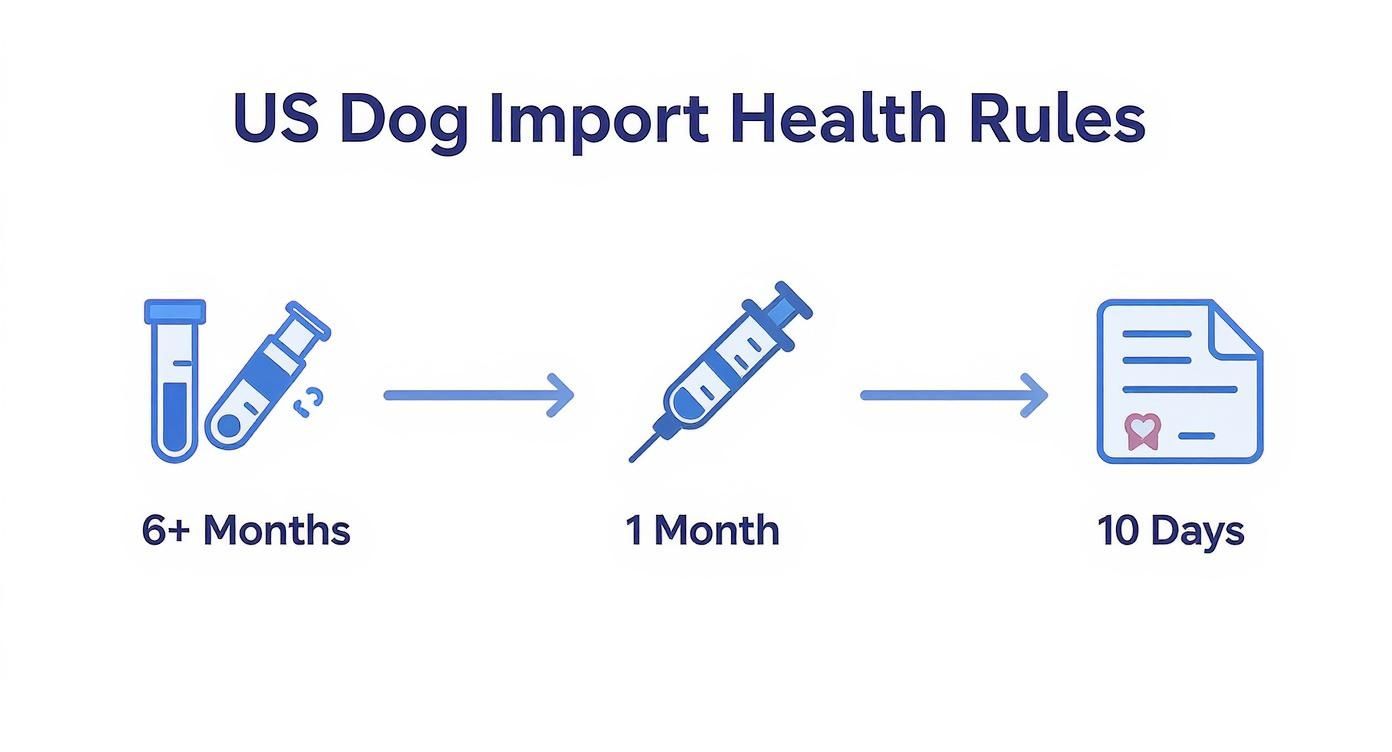
As you can see, the process can start more than six months out, especially if a rabies titer test is needed. It all leads up to that final vet visit just days before you fly.
Let's walk through a real-world example to see how this plays out.
Scenario: Returning from a High-Risk Country
Imagine you and your dog, Buddy, are returning from a country seen as high-risk for rabies. Here’s a rough idea of your timeline:
6+ Months Before Travel: Buddy needs a rabies titer test. You’ll visit your vet for a blood draw, which gets sent to a CDC-approved lab. Getting results can take weeks, sometimes even months, so starting early is key.
1-2 Months Before Travel: Flight booked? Great. Now's the time to gather your other documents. Double-check Buddy’s microchip information and make sure his rabies vaccination certificate is complete and correct.
10 Days Before Travel: This is the important window. You'll take Buddy for his final health check, where the accredited vet will examine him and issue the international health certificate.
7-9 Days Before Travel: Once the vet issues the certificate, you may need to get it approved by your departure country’s official government animal health authority. This stamp is what makes the document official for international travel.
The most common mistake I see is people not allowing enough time. They realize too late that a titer test is needed or that getting a government approval takes several days. Planning backward from your travel date is the only way to go.
Essential Document Checklist
Keeping your papers organized is half the battle. When you arrive at the U.S. port of entry, an officer will ask to see a specific set of documents. Having everything in order will make the inspection process much faster.
Your travel folder should contain:
Rabies Vaccination Certificate: Must be valid and show the microchip number.
Rabies Titer Test Results: If needed based on your dog's travel history.
International Health Certificate: Issued within 10 days of arrival and approved if necessary.
CDC Dog Import Permit: Only needed in specific situations for dogs from high-risk countries.
A little preparation here will make the final leg of your journey home with your dog as smooth as pawsible.
Choosing the Best Travel Method for Your Dog
Getting the paperwork squared away is a major step, but it's only half the journey. How your dog actually makes the trip back to the USA is just as important for their safety and well-being. Travel can be stressful for animals, so your top goal should be picking the method that keeps them as comfortable and calm as possible.
For most people bringing a dog back to the States, this means figuring out air travel. There are a few ways to fly, and the right choice comes down to your dog's size, breed, and personality. Each option comes with its own price and set of rules, so understanding them ahead of time will save you a world of trouble later.
Flying with Your Dog in the Cabin
This is the best option if you can make it work. Having your dog right there with you in the cabin means you can keep an eye on them, offer a comforting word, and manage their needs directly. It’s by far the least stressful way for a pet to fly.
But there’s a catch: this is an option only for small dogs.
Size and Weight Limits: Airlines are very strict about this. Your dog, inside their carrier, has to fit under the seat in front of you. Generally, this means a total weight of under 20 pounds (about 9 kg), but check your specific airline, as this can vary.
Carrier Requirements: The carrier needs to be well-ventilated, leak-proof, and large enough for your dog to stand up and turn around. I find that soft-sided carriers are often better because they have a little more give for fitting under the seat.
Booking is a Must: Don't just show up at the airport. Airlines only allow a few pets in the cabin on any given flight. You must reserve their spot in advance, which usually means calling the airline right after you book your own ticket.
If you have a toy breed or a small companion, this is the way to go. For everyone else, it’s just not an option.
When Your Dog Flies as Checked Baggage or Cargo
If your dog is too big for the cabin, they'll travel in a temperature-controlled, pressurized part of the plane. It sounds a little scary, I know, but airlines have set procedures to keep animals safe. The main difference between "checked baggage" and "cargo" is usually about whether you're on the same flight.
Flying as Checked Baggage: With this option, your dog is checked in at the ticket counter, just like a suitcase, and travels on the same flight as you. When you arrive, you'll either pick them up at the baggage claim or a special office.
Flying as Cargo: This is when your dog travels separately. It's common if you're using a professional pet transport service or if the airline's policy requires it. The drop-off and pick-up happen at a separate air cargo facility, not the main terminal.
No matter which route you take, you'll need to follow the airline's rules exactly.
A quick heads-up: many airlines have tightened their rules on flying pets as checked baggage. You must confirm the latest policies directly with your airline because these rules can change with little warning.
Before you book, it's a good idea to see how the different air travel options compare.
Air Travel Options for Your Dog
Travel Option | Best For | Key Things to Know |
|---|---|---|
In-Cabin | Small dogs (under 20 lbs), anxious pets, owners who want to be close by. | Limited spots per flight, strict carrier size and weight limits, needs booking in advance. |
Checked Baggage | Medium-sized dogs traveling on the same flight as their owner. | Not all airlines offer this, subject to weather restrictions, can be stressful for the pet. |
Cargo | Large dogs, pets traveling alone, or when required by airline policy. | Handled by special staff, often more expensive, drop-off/pick-up at a separate building. |
Each method has its place, but the goal is always to choose the one that provides the most safety and the least amount of stress for your dog.
Special Considerations for Air Travel
Unfortunately, not every dog is suited for flying, and not all airlines handle pets with the same level of care. Breeds with short snouts—think Bulldogs, Pugs, and Boxers—are known as brachycephalic or "snub-nosed" dogs. Many airlines won't allow them to fly in cargo at all. Their short snouts make them more likely to have breathing problems at high altitudes.
You also need to watch out for temperature restrictions. During very hot summers or freezing winters, airlines will refuse to transport animals in the cargo hold if the temperature at any point in the journey (departure, connection, or arrival city) is too extreme. It’s a safety measure, but it can cause major delays in your plans.
For a deeper look into these kinds of details, our guide on how to transport pets across the country has some great tips that are also useful for international moves.
Driving Across the Border from Canada or Mexico
If you’re coming back from Canada or Mexico, driving is a great alternative. It’s far less stressful for most dogs and gives you total control. You can stop for breaks whenever you need to, and there are no cramped carriers or noisy cargo holds to worry about.
When you get to a land border crossing, you'll still need all your CDC and USDA paperwork—the rabies certificate, health certificate, and microchip proof are all needed. An officer will check your documents and give your dog a quick look-over, much like they would at an airport. The whole process is usually very simple and makes for a much smoother homecoming.
What to Expect at the US Border

You’ve finally landed on U.S. soil. After a long journey, your homecoming is just moments away, but there's one last checkpoint to clear with your dog. This final step is the inspection at your U.S. Port of Entry, and knowing what’s coming will make the whole experience go a lot more smoothly.
The officials you’ll meet are from U.S. Customs and Border Protection (CBP). Their main job when it comes to your dog is to check their identity and make sure all the health paperwork is in perfect order. They work with the CDC and USDA to enforce the rules that keep both pets and people in the U.S. safe.
Confidence comes from being prepared. Keep your dog’s travel folder easy to grab with all the documents ready to go. A little organization here can turn a potentially stressful moment into a simple, routine check.
The Inspection Process
When it's your turn, you’ll need to declare that you are returning with a dog to the USA. The CBP officer will then ask to see your dog’s complete set of documents. This means having the rabies vaccination certificate, the international health certificate, and any other required paperwork—like a rabies titer test or CDC Dog Import Permit—ready to hand over.
First, the officer needs to make sure every detail matches. They will likely scan your dog's microchip and compare that number to the one listed on all your health documents. This is the moment where having an ISO-compliant microchip really helps, as it makes for a quick and easy scan.
Beyond the paperwork, the officer will also do a quick visual check of your dog. They’re trained to spot any obvious signs of illness. A dog that looks healthy, alert, and well-cared-for will almost certainly pass this part of the inspection without an issue.
Questions You Might Be Asked
CBP officers are thorough, so expect a few questions. Don't worry; they are usually very simple and are just meant to confirm the information in your documents.
You can probably expect them to ask things like:
Where are you and your dog traveling from?
How long have you been outside of the United States?
Is this your personal pet?
Your answers help them build a clear picture of your travel history and confirm that you've followed all the rules. Just be honest and direct.
A key piece of advice from experienced travelers is to stay calm and patient. The officers are just doing their job. A friendly, cooperative attitude goes a long way in making the inspection a positive experience for everyone, especially your tired pup.
What Happens If There Is a Problem
Even with the best preparation, sometimes issues come up. If a CBP officer finds an issue with your paperwork or has a concern about your dog's health, they will refer you to the CDC or USDA officials at the port.
This doesn't automatically mean a big problem. It could be something simple that needs clarification. In more serious cases, though, like an incomplete health certificate or a dog that appears sick, more steps will be needed. This might involve an exam by a licensed veterinarian, which would be at your own expense.
For travelers coming from high-risk countries who couldn't meet every single CDC requirement before their flight, there is another option. Dogs entering the U.S. from a high-risk country that can't meet all of the CDC's entry requirements must have a reservation at a CDC-approved animal care facility. These facilities, located at specific airports like JFK, LAX, and MIA, are set up to examine, revaccinate, and hold dogs to ensure they are not a public health risk. Pet owners have to arrange and pay for these services in advance, and the dog must fly directly into the airport where the facility is located.
In the end, being prepared for the border inspection is the final, important step in your dog’s journey home. A little organization ensures that your first moments back in the country are filled with relief, not paperwork headaches.
Common Questions About US Pet Travel
Figuring out the rules for bringing a dog back into the USA can be confusing, and it’s completely normal for questions to come up. Even with the best plans, you might run into a specific situation that leaves you wondering. This is a ruff process, but we can help.
We've pulled together some of the most common questions we hear from pet travelers just like you. Think of this as your quick-reference guide for those tricky "what if" situations, so you can feel confident about every step of your dog's journey home.
What Happens If My Dog’s Rabies Vaccination Expires Abroad?
This is a big one, especially for people on longer trips. If your dog’s U.S.-issued rabies vaccine is due to expire while you're overseas, you can't just wait until you get back. You must have them revaccinated by a licensed vet in the country you're in.
Make sure this new vaccination is recorded perfectly. The certificate needs to include your dog’s microchip number, the date it was given, and all the vaccine details—like the product name and serial number.
Heads up: if you’re in a country the CDC considers high-risk for rabies, the rules get even stricter. A new vaccination could reset the clock on other requirements, possibly meaning you need a new rabies titer test and another long waiting period. Planning ahead here is very important.
Do Puppies Have Different Import Requirements?
Yes, and these rules are very strict. The CDC requires all dogs entering the United States to be at least six months old. This is a firm minimum age that applies to all dogs, no matter where the puppy is coming from.
There’s a critical public health reason for this. Puppies usually can't get their first rabies shot until they're about three months old, and the vaccine needs time to become fully effective. The six-month requirement creates a safety buffer to ensure they're properly protected and are not a rabies risk.
The bottom line is simple: you cannot bring a puppy younger than six months old into the United States. There are no exceptions to this rule, so make sure your travel plans take this into account.
What If I Am Just Transiting Through a High-Risk Country?
This is a great question and one that surprises a lot of travelers. The answer really comes down to one thing: does your dog technically "enter" the high-risk country during your layover?
If you're just changing planes and your dog stays inside the airport for the entire layover, you generally don't have to meet the stricter rules for that high-risk country. Your dog is basically treated as if it came directly from your original, lower-risk location.
However, the moment you and your dog clear customs and step outside the airport—even for a few hours—the game changes. Your dog is now considered to have been in a high-risk country. From that point on, you must meet all of the CDC's tough requirements for dogs arriving from high-risk locations.
Can I Use a Pet Passport Instead of a Health Certificate?
While a "pet passport" is a very handy document for travel between many countries, especially within the EU, it's not a magic pass for U.S. entry. The United States does not officially recognize it as a standalone document for import. It's a great way to keep your dog's health records organized, but it can't replace the required U.S. paperwork.
When bringing a dog back to the USA, you will still need a separate international health certificate. This has to be issued by an accredited veterinarian in your departure country, usually within 10 days of your arrival in the States.
Think of your pet passport as a great supporting document. It’s smart to have it with you, but the international health certificate is the official paper that U.S. border officials will be looking for.
Trying to keep all this paperwork straight can be a headache, but you don’t have to do it alone. Passpaw provides a clear, simple platform for veterinary practices and pet owners to manage every part of the international health certificate process. We make sure every detail is right and every deadline is met.
Discover how Passpaw can make your pet’s journey home a whole lot easier.
More articles
From regulatory changes to best practices for veterinarians and pet owners, our resources keep you ahead of the curve.