Are you a team member in a veterinary practice?
Are you a pet parent planning a trip with your furry pal?
Ground Transportation for Pets: A Practical Guide
You've got the carrier by the door, the vet visit on the calendar, and a pet who has already figured out that something unusual is happening. Maybe it's a move across town, a winter visit to family, or a longer relocation that needs a bit more planning than a regular car ride. Ground transportation for pets can feel simple on the surface, but the calmest trips usually come from getting the details right early, especially when paperwork, handoffs, and the crate all have to line up.
For many families, the road is still the most practical way to move a pet. One market analysis estimates land transport held 64.9% of global pet travel services in 2024, and another projects ground transport alone at $386.4 million in 2025, with a path to about $716 million by 2034 at a 7.1% CAGR (Market.us pet travel services analysis). That scale matches what pet owners already do day to day, whether they're heading to the clinic, the groomer, boarding, or a new home.
A solid guide should help you sort the comfortable road-trip stuff from the parts that need real coordination. If you're comparing service types, planning a cross-border move, or helping clients through the process at a clinic, this is the kind of practical road map that keeps everyone calmer, pets included.
Why Ground Is Often the Easiest Way to Move a Pet
A family loads the dog into the SUV, checks the water bowl, and gives the cat carrier one last look before pulling out of the driveway. That scene is ordinary, and that is part of the reason so many pet trips happen on the road instead of in the air. A widely cited survey found 63.8% of pet owners prefer to travel with their pets by car or pick-up, and 56% of dog owners say they take their dogs on car rides at least once a month (Soocial pet travel statistics).
Ground is the default, not the backup plan
That habit shows up in the business side too. Analysts at Soocial report that the U.S. pet transportation services industry reached $2.2 billion in 2026 and included 22,134 businesses, with business count growth of 9.7% CAGR from 2020 to 2025. In plain terms, this is a real service category with repeat demand, not a once-in-a-while favor.
Ground also gives owners more direct control. You can stop for a break, watch how your pet is doing, and keep a closer eye on temperature and stress. That matters even more for shorter routes, senior pets, nervous travelers, and pets that do better with a familiar routine.
Practical rule: if your pet is likely to handle the car better than the airport, the road is often the calmer starting point.
The cost picture helps explain the choice too. One market analysis puts average ground transport pricing at $800 to $2,200, with domestic North American dog transport typically $800 to $1,600, while international air transport can run $2,200 to $5,400 (Market.us pet travel services analysis). That does not make ground automatically cheaper in every case, but it does show why people often see it as the baseline option.
Ground transport also fits the rest of the move more easily when the paperwork trail is already in motion. Crate size, vet timing, health certificates, and handoff instructions all have to line up, and a road trip usually gives you more room to correct a missed detail before it turns into a bigger problem. That is the same practical thread you see in Passpaw's guide to transporting pets across the country, where preparation sits at the center of the trip rather than as an afterthought.
For readers who want a practical moving checklist alongside this topic, advice from Get n Go Removals on moving with pets is a useful companion read because it keeps the focus on planning, not panic.
The Main Ways Pets Travel Over Land
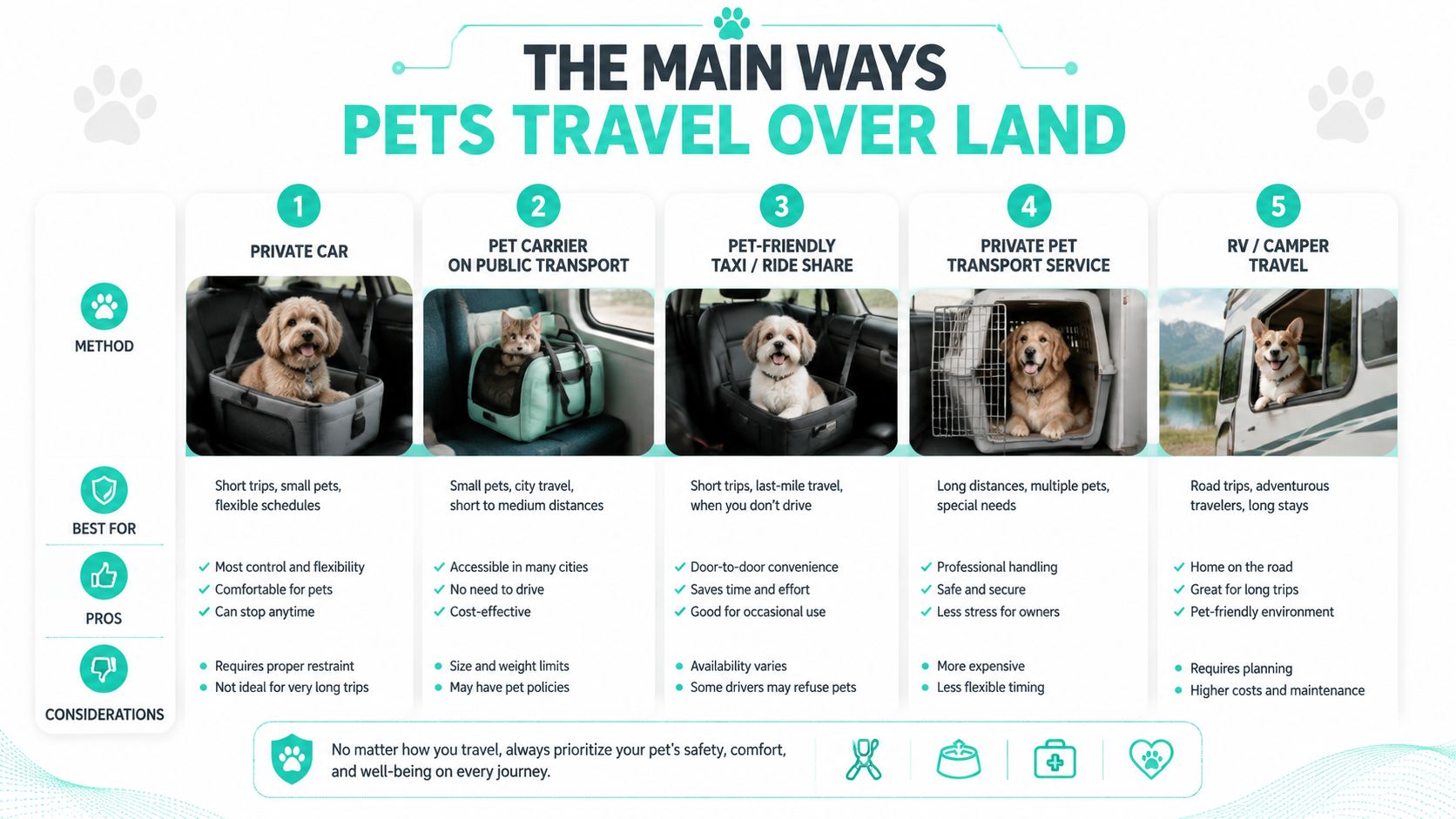
Not every road trip works the same way. Some pets ride in the family car, some use a pet taxi or ride-style service, and some travel with a commercial ground shipper while the owner stays home. The right choice depends on distance, temperament, and how much handling help your pet needs.
Three common setups
Private car travel gives you the most control. You choose the route, the stops, and the pace, which is often best for pets that know the family vehicle and settle better with familiar people nearby. It's usually the simplest option for short or medium trips.
Pet taxis and ride-style services sit in the middle. They're useful when you need pickup and drop-off help but don't need a full commercial shipping setup. These services can work well for vet visits, airport transfers, or local relocations, though you'll want to ask who's in the vehicle, whether pets ride alone or together, and how handoffs are managed.
Commercial ground shippers handle the logistics for you. That can be a relief for long relocations or multi-stop moves, but the service model matters a lot. Some providers cap shared rides, such as one listing a shared Group+ ground transport with a maximum of 4 pets, while other companies separate pricing and handling rules by species, which shows how much the setup changes the experience.
Good question to ask: will my pet ride alone, or with other animals, and what changes if the trip is shared?
Ground Transport Options at a Glance | Best For | Typical Cost Range | Key Tradeoff |
|---|---|---|---|
Private car with owner | Short trips, nervous pets, flexible schedules | Usually the lowest-friction choice, with costs tied to your own fuel and time | You manage every stop and every detail |
Pet taxi or ride-style service | Local handoffs, clinic visits, simple transfers | Varies by route and service type | Less control than driving yourself |
Commercial ground shipper | Longer moves, complex handoffs, owner not traveling | Often falls within the ground transport range of $800 to $2,200 (Market.us pet travel services analysis) | More structured, but you need to vet the provider carefully |
For a broader planning lens, Passpaw's transport pets across country guide fits well here because it helps readers think about transport as part of a full move, not just a ride.
The main takeaway is simple. If your pet does well with you in the car, start there. If you need help with logistics, compare the handling model as carefully as the price.
Paperwork, Health Certificates, and Cross-Border Basics
The part that trips people up most often isn't the driving. It's the paperwork sitting in the background while everyone focuses on the crate and the route. Vaccination records, microchip status, and vet paperwork can matter even on an ordinary trip, and they matter even more once you cross a border or hand your pet off to a transport company.
Keep the document chain together
A good habit is to treat every trip like a small file folder, not a single form. That folder usually starts with your pet's ID details, any vaccination records your vet has already issued, and notes about current health concerns. If a destination asks for a health certificate, that certificate needs to fit the timing of the trip, the destination rules, and the vet's appointment schedule.
That's where people often get caught out. They book the vehicle first, then scramble for the vet appointment later, only to learn the dates don't line up neatly. The cleaner move is to check the paperwork path before the booking is final.
For cross-border moves, the chain gets longer. One useful way to think about it is that the border doesn't replace the road trip, it adds another checkpoint to the same journey. Passpaw's international pet travel requirements guide is a helpful reference for that bigger-picture planning, especially if you're trying to understand how documents, timing, and destination rules fit together.
For logistics teams that already handle chain-of-custody issues in other freight settings, Peak Transport's guide for logistics managers on border shipping offers a useful mindset shift. The pet version is different, of course, but the core idea is similar, keep the handoff clean and the paperwork current.
Ask the vet before you assume the route is ready
A short vet visit can save a lot of confusion later. If your pet needs a health check, a microchip update, or a certificate, the clinic is the place to confirm what's current and what still needs attention. That's also the right time to ask about any condition that could affect travel comfort, especially if the pet is older, anxious, or has special handling needs.
The point isn't to make the trip sound harder than it is. It's to keep the paperwork from becoming the thing that slows down a move that could have been smooth from the start.
Welfare Rules of the Road
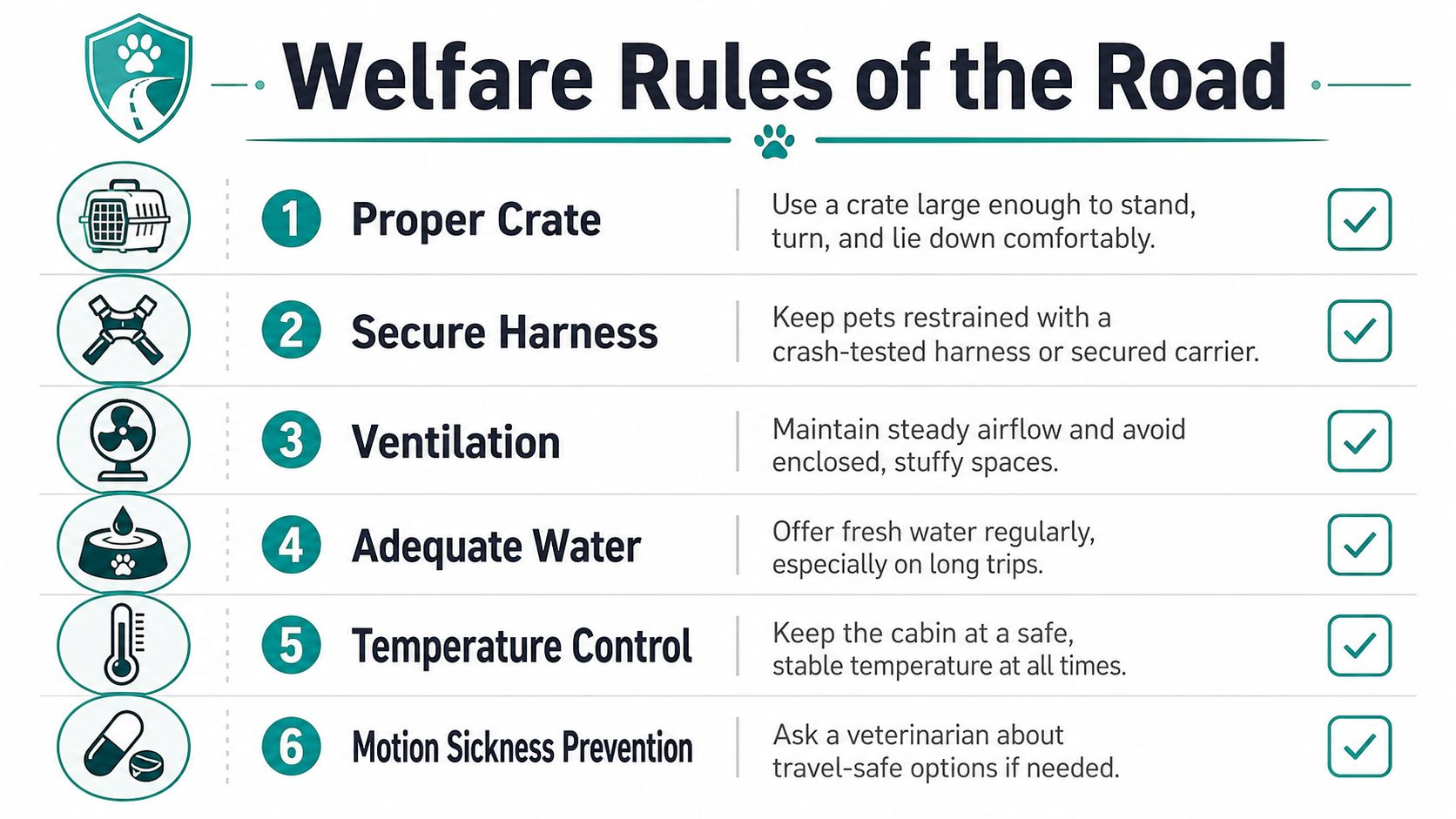
The crate, harness, and water bowl matter because pets don't just need to arrive, they need to arrive in decent shape. That sounds obvious, but the basics are where many trips go right or wrong. For ground transport of dogs and cats, one technical benchmark often used is that the enclosure should have ventilation openings totaling at least 14% of the combined surface area of all walls, with the openings placed so air can move even when the vehicle is stopped (WOAH land transport standard).
Crate size and airflow do more than people think
A useful sizing rule comes from the IATA container formula for a single animal, length = A + 1/2 B, width = 2C, and height = D + bedding, with snub-nosed breeds needing a 10% larger container (IATA live animals guidance). You don't need to do the math by hand every time, but the logic is important. Your pet should be able to stand naturally, turn, and lie down without being compressed.
That same idea shows up in U.K. carrier advice, which says the enclosure should be large enough for the animal to stand, sit, lie down naturally, and turn around easily, with no body part able to protrude or get trapped, and the door should stay locked when the owner isn't with the pet (U.K. carrier advice).
Canada's transport guidance adds a few practical details that translate well to road travel anywhere. Pets should ride in a securely fastened carrier or in a harness attached to a seatbelt or safety net, shouldn't roam in the back of pickup trucks, and should never be left in parked vehicles for more than very short periods because temperatures can change quickly (Canadian pet transport guidance).
Simple rule: if your pet can't breathe, balance, and settle, the setup needs adjusting before the wheels roll.
Watch for motion sickness and travel stress
Motion sickness can show up as drooling, restlessness, whining, or vomiting. A calmer drive often means fewer sudden turns, lighter meals before departure if your vet agrees, and a secure setup that keeps the pet from sliding around. Shade, fresh water, and regular checks matter more than trying to “push through” a rough ride.
For dogs and cats in commercial U.S. ground transport, the Animal Welfare Act regulations require a person accompanying them to check them at least once every 4 hours to confirm they can breathe normally, the temperature is within the required limits, and the transport rules are being met (9 CFR 3.18). That rule is a good reminder for anyone planning a long road trip, even if the trip is private.
How to Pick a Provider You Can Trust
A polished website can hide weak transport practices, so the better test is the way a company answers your questions. Ground transport works best as part of a compliance chain, with paperwork, crate sizing, handoffs, and vet coordination all lined up before the vehicle moves. If a provider gives clear explanations and has written policies, that is a good sign. If it avoids details about checks, temperature control, or emergency response, pause and look elsewhere.
Ask about handling, not just pickup time
A good provider should be able to explain exactly how your pet is managed during the trip. That includes whether animals travel together or separately, how often they are checked, what happens during delays, and how owners receive updates. Those are the details that matter for nervous pets, older pets, and breeds that need closer monitoring.
The practical questions often recommended in transport planning follow the same path. Ask about tracking, temperature control, breaks, emergency response, and whether multiple animals ride together. Those questions may sound simple, but they separate a service that looks fine on paper from one that fits the pet in front of you.
Here is a compact checklist you can use on a call:
Questions to Ask Any Ground Transport Provider | Questions to Ask | Good Sign |
|---|---|---|
Checking routine | How often is my pet checked during transit? | They answer clearly and match the answer to the route length |
Temperature control | How do you manage heat, cold, and parked stops? | They describe a written process, not a vague reassurance |
Shared vs private ride | Will my pet travel with other animals? | They explain capacity limits and how grouping works |
Emergency planning | What happens if my pet gets sick or distressed? | They name the next step and the contact chain |
Client updates | How will I hear progress during the trip? | They use a predictable update method |
If you want a deeper look at how to assess the full transport chain, see our guide to choosing an international pet shipper. For readers comparing providers in Australia, Australian pet moving advice is useful because it keeps the focus on practical preparation rather than hype.
Red flags are often obvious once you know what to look for
Vague answers are the first warning sign. So is a company that will not put basic policies in writing or hesitates when you ask for references. Those gaps matter because ground transport is a chain of small decisions, and each unclear answer makes the trip harder to manage.
If your pet has medical needs or a flatter face, the margin for error gets smaller. A provider that communicates well is usually the one that handles those cases with more care. That same steady communication also helps when a vet, a clinic team, and the transport company need to stay aligned on paperwork, crate fit, and handoff timing.
A Simple Timeline for Preparing Your Pet
The least stressful trips usually start weeks ahead of time. A pet who's already used to the crate, a file with the right documents, and a transport company that knows the plan all make travel day feel much less dramatic. The goal is boring, in the best possible way.
Four weeks out and earlier
Start with the vet. That gives you time to confirm health needs, sort out any paperwork, and ask whether travel timing makes sense for your pet's condition. If you already know this is a cross-border move, build in even more room for document checks and follow-up questions.
Crate practice can start now too. Leave the carrier out, feed treats near it, and let your pet enter on their own terms. The carrier should feel familiar before it ever becomes part of the trip.
Two weeks out and the middle stretch
This is the time to confirm the transport booking, check your pet's ID details, and make sure the crate fits properly. It's also a good moment to review temperature plans, feeding routines, and who gets the emergency call if something changes.
If you're working with a clinic or a travel platform, the paperwork review pays off now. Little corrections are easier now than on the morning of departure.
One day out
Keep the routine calm. Pack water, any approved medications, and the documents you've already checked. A final walk, litter box cleanup, or quiet play session can help your pet settle before the engine starts.
Then keep the handoff simple. Less excitement is usually better for everyone.
How Vets and Platforms Like Passpaw Fit In
Ground transport gets smoother when the clinic and the travel plan stop living in separate boxes. A vet can confirm the health side, the transport provider can manage the ride, and a platform can keep the paperwork and reminders from slipping through the cracks. That's where tools like Passpaw's pet travel workflow fit naturally.
The useful part is coordination, not automation for its own sake
For veterinary practices, the biggest win is often document discipline. Real-time validation can catch a missing item before it becomes a delay, and date-based task prioritization helps the team focus on the cases that need attention soonest. That matters when a pet's trip depends on a certificate, a microchip update, or a signed form that has to line up with the travel date.
Client communication matters just as much. A travel case usually involves more than one conversation, and people forget details when they're juggling a move. A structured system keeps those conversations in one place instead of scattered across calls, texts, and sticky notes.
Clinic-friendly takeaway: the best workflow is the one that lets the team answer travel questions without rebuilding the whole file every time.
Where the human part still matters
No platform replaces the conversation about whether a pet is fit to travel, or whether the family understands the handoff plan. That's still a person-to-person job. What software can do is remove the repetitive work so the vet, assistant, or coordinator has more time for those judgment calls.
For shippers and clinic teams, that means fewer missed steps and less backtracking. For owners, it means fewer surprises. And for the pet, it usually means a calmer trip with fewer moving parts.
Common Misconceptions and Quick Takeaways
People often assume ground transport is always cheaper than air. Sometimes it is, sometimes it isn't, because route length, handling, and service level all matter. Another common mistake is treating a crate like a plain box, when size and ventilation are central to comfort and safety.
Paperwork gets underestimated too. It's not just an airport issue. Once borders, timing windows, or health certificates enter the picture, the road trip becomes part of a broader compliance chain.
A few clean takeaways make planning easier. Pick the service model that fits your pet's temperament and your route, start the paperwork early, check the welfare basics before departure, and ask providers the questions they should be ready to answer. If your clinic uses a tool that keeps documents, tasks, and updates organized, that can take a lot of pressure off the people doing the work.
Good ground transport planning is mostly steady preparation. Do that well, and your pet has a much better chance of acting like a seasoned little road warrior.
If you're helping pets travel and want fewer last-minute scrambles, Passpaw keeps travel documents, task timing, and client updates in one place. It's a practical fit for veterinary teams and pet travel workflows that need more order and less back-and-forth. Visit Passpaw to see how it can support your next pet travel case.

More articles
From regulatory changes to best practices for veterinarians and pet owners, our resources keep you ahead of the curve.