Are you a team member in a veterinary practice?
Are you a pet parent planning a trip with your furry pal?
Ecuador Pet Travel Requirements: Complete Owner Guide 2026
You've packed the carrier, checked the airline's pet policy, and saved your passport in an easy-to-reach pocket. Your dog or cat is ready for the adventure, but the health certificate is still sitting on your veterinarian's desk. That's when many travelers discover that Ecuador pet travel requirements aren't just a list of documents. They're a sequence of dates that must line up.
The tricky part usually isn't the flight. It's the short pre-departure window for the veterinary exam, parasite treatment, certificate, and other records. One appointment that happens too early, or one document that isn't valid on arrival, can leave a perfectly healthy pet with paperwork that doesn't fit the route.
Heading for Introduction
Travel planning often starts with suitcases, airline reservations, and a careful search for pet-friendly accommodation. The paperwork tends to come later, especially when the owner already has a current vaccination booklet and assumes that will be enough. Ecuador's system requires more coordination: the pet's age, identification, vaccination status, clinical exam, parasite treatment, and export certificate all need to match the travel timeline.
A useful way to think about the process is as a row of connected paw prints. The first print is the pet's basic eligibility. The next is the rabies and vaccine record. Then come the parasite treatment and veterinary exam, followed by the export zoosanitary certificate. The final prints lead to airline submission and arrival inspection. If one print lands outside its permitted window, the whole trail may need to be checked again.
Ecuador's official guidance distinguishes between dogs and cats and other companion animals, and it also distinguishes between entry methods. A dog or cat arriving in the cabin or overland has a different permit situation from another type of pet. That's why a general international pet checklist can be misleading, even when it looks polished.
This guide translates the official requirements into a practical plan. Use the Passpaw pet travel planner to organize destination-specific tasks, then confirm the current details with your veterinarian, airline, and Ecuadorian authorities before departure. Rules and portal instructions can change, so treat the calendar as a planning tool, not a substitute for current verification.
Core Health and Documentation Basics
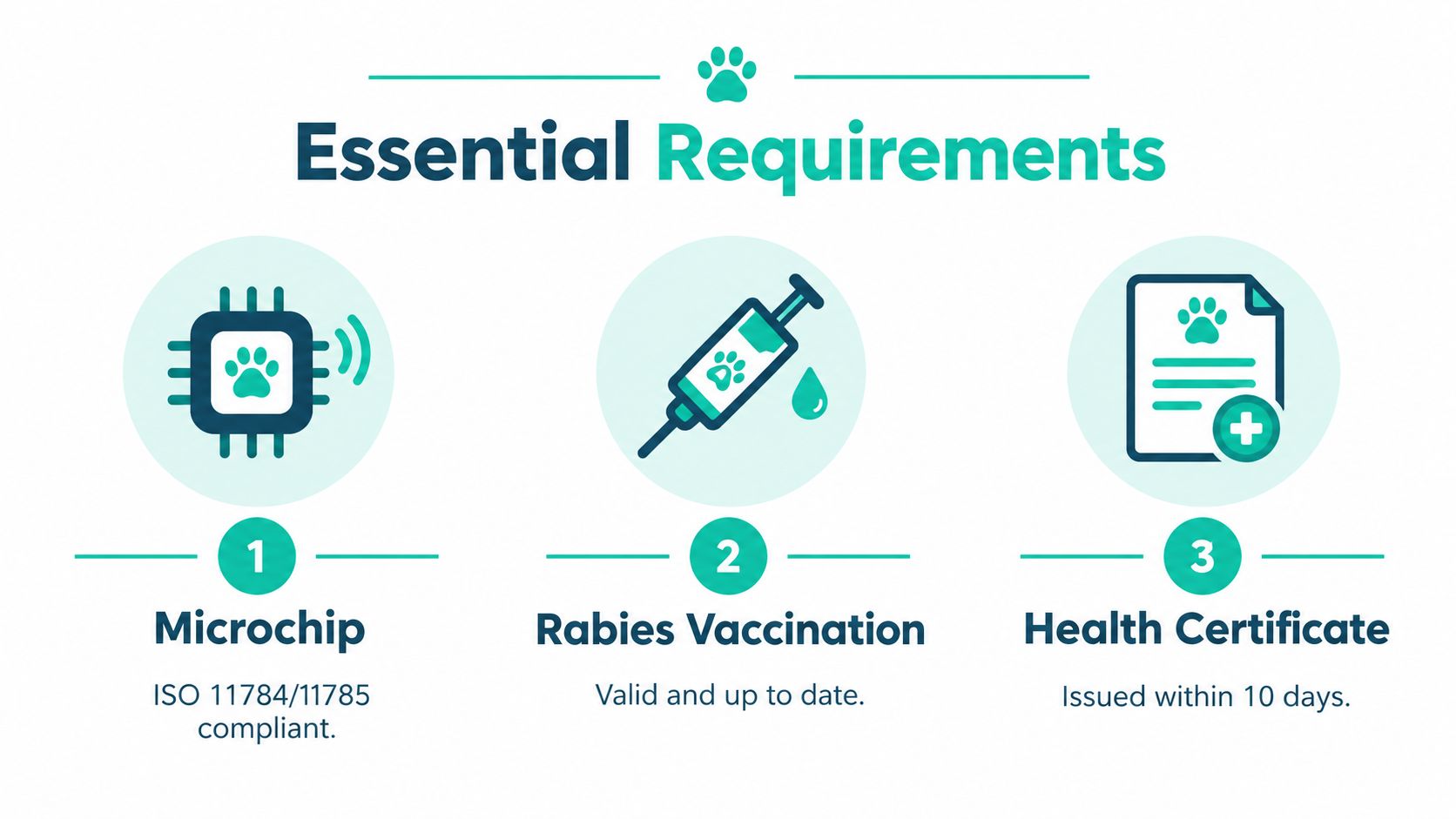
Before counting backward from your flight, make sure your pet meets the basic entry conditions. Ecuador's official animal-health guidance says conventional companion animals must be older than 4 months, identified by name, tattoo, or microchip, and accompanied by an export zoosanitary certificate issued or endorsed by the official veterinary service in the country of origin. The certificate must be in Spanish or English and has a validity window of no more than 10 calendar days before entry. Read the official Ecuador guidance on dogs and cats.
The basic eligibility check
Use this checklist with your veterinarian:
Age: Confirm that your pet is older than the required age at the relevant point in the journey.
Identification: Check that the name, tattoo, or microchip information is consistent across the pet's records and certificate.
Vaccines: Make sure the vaccines required by Ecuador are current at arrival. For dogs, the embassy guidance identifies distemper, leptospirosis, hepatitis, and parainfluenza among the key vaccines.
Rabies record: Keep the vaccination evidence available. Ecuador's requirements say rabies must still be valid on the day of entry.
Clinical examination: Arrange a veterinary examination within the permitted pre-travel period.
Parasite treatment: Have internal and external parasite treatments completed within the required look-back window, using products authorized in the country of origin.
Export certificate: Confirm who issues or endorses the certificate in your country. A routine vaccination booklet doesn't replace this document.
The identification detail is easy to overlook. If the certificate uses one version of your pet's name and the vaccination record uses another, ask the clinic how the records should be aligned before the final certificate is prepared. The goal is a clean paper trail that lets officials connect the animal in front of them to the documents in your folder.
The health certificate also has a job that a vaccine record doesn't. It confirms the pet's condition close to travel and ties the examination to the departure plan. For help understanding the role of this document, review this guide to a veterinary international health certificate.
Navigating Critical Pre-Travel Timelines
Your flight is booked, your pet's carrier is ready, and the clinic appointment seems far enough ahead. Then one date shifts and a treatment or certificate falls outside Ecuador's permitted window. Pet travel paperwork works like a set of overlapping timers. Each document must be valid on its own schedule.
Ecuador's official guidance places the veterinary examination within 10 days of travel. Internal and external parasite treatment must occur within 21 days before shipment, while the export zoosanitary certificate is valid for no more than 10 calendar days before entry. Check the official timing and health requirements.
Read the calendar backward
Start with the confirmed arrival date, then work toward the present. This method exposes the tight windows before an appointment or treatment is booked:
Arrival date: Rabies must be valid on the day your pet enters Ecuador.
Rabies first-vaccine rule: If the rabies vaccination is the first one used for entry, at least 14 days must pass after the shot before arrival. See Ecuador's rabies guidance.
Within 21 days before shipment: Internal and external parasite treatments must be completed during this look-back period.
Within 10 days of travel: The veterinarian must examine the pet.
No more than 10 calendar days before entry: The export zoosanitary certificate must be issued or endorsed within its permitted window.
These timers do not merge. A parasite treatment completed on time cannot make an examination valid if that examination happened too early. A current rabies vaccination also cannot replace the export certificate.
The look-back trap
Scheduling every veterinary action as early as possible often creates the wrong kind of safety. An examination may fall outside its allowed period, or a certificate may expire before arrival. The better sequence is to reserve the final veterinary visit close enough to departure to meet the examination rule, while allowing time for official endorsement and airline review.
Use the arrival date as the anchor:
Practical rule: Write the arrival date at the top of your calendar, then count backward for each requirement. Avoid treating all pet paperwork as one appointment or one deadline.
Record the airline itinerary beside these dates. A route change can alter arrival, which may affect the certificate, parasite-treatment window, or rabies waiting period. A pet travel deadline guide can help arrange the sequence, but your veterinarian and the current Ecuador guidance should determine the final plan.
Step-by-Step Submission and Arrival Process
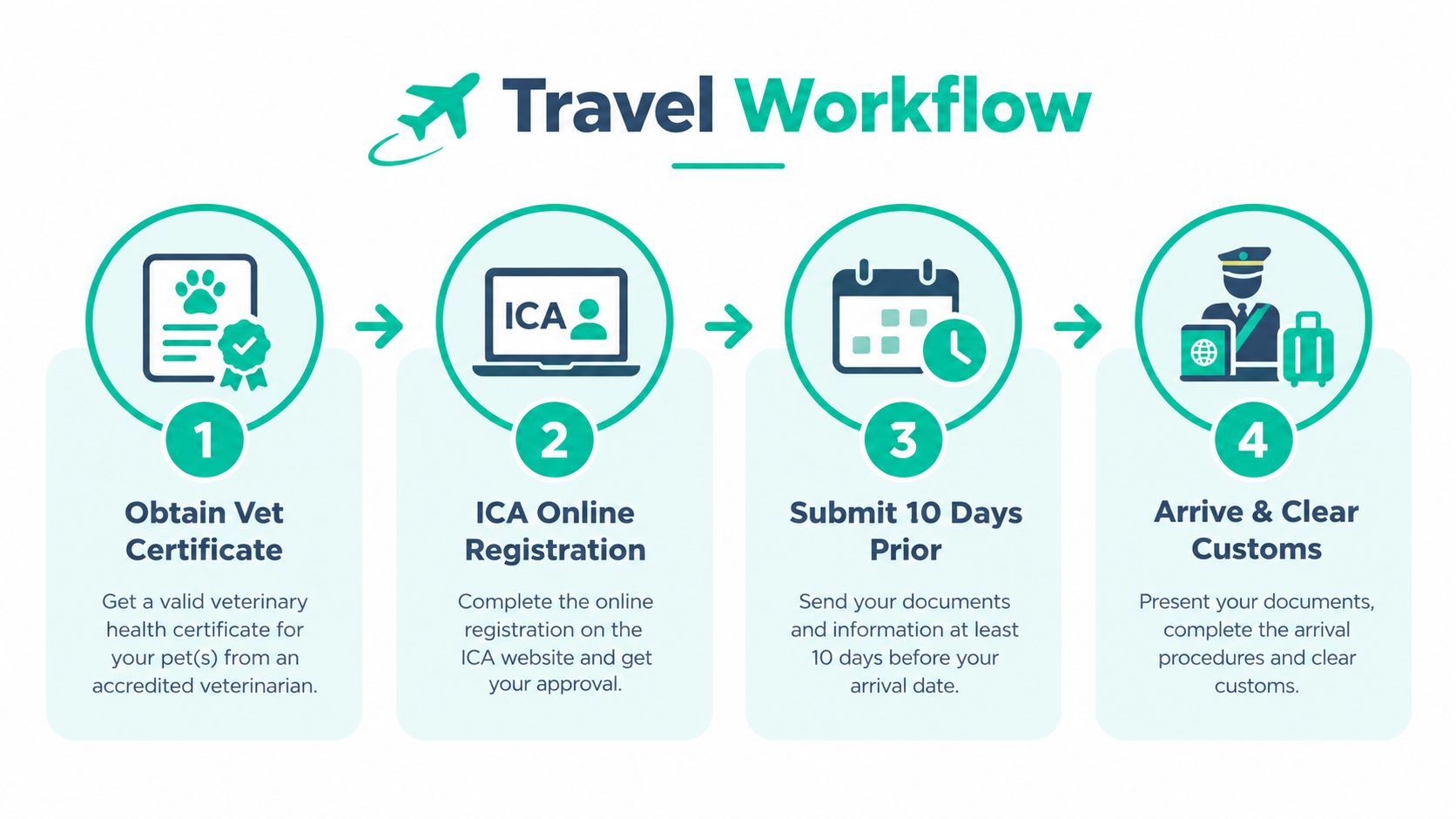
Once the dates are aligned, the process becomes easier to manage. Think of the submission as a handoff between three people: your veterinarian prepares the medical evidence, you provide the travel and identity details, and the Ecuadorian animal-health team reviews the pet on arrival.
Prepare the certificate package
Ask your veterinarian to verify the pet's identification, vaccination record, parasite treatments, examination date, and destination wording before the certificate is finalized. The export zoosanitary certificate must be issued or endorsed by the official veterinary service in the country of origin, so ask what endorsement route applies where you live.
Keep the documents together rather than scattering them across email, a phone gallery, and a suitcase pocket. The package can include:
Vaccination record: The record showing the required vaccinations and current rabies status.
Owner identification: Your passport details.
Airline information: The airline-issued air waybill when applicable.
Contact details: Your phone number and email address.
Export certificate: The official veterinary certificate for the pet's entry.
Send the arrival information
One Ecuador government page says these documents and contact details should be emailed to the arrival airport 72 hours before the pet lands. The same guidance says an AGROCALIDAD technician inspects the animal and issues the zoosanitary permit. Review the Ecuador government arrival submission page.
Use the current airport contact instructions for your route. Include the owner's name and contact details, passport information, flight and airline details, the air waybill when applicable, and the pet's supporting records. Save the sent email and any reply with the rest of the travel documents.
At the airport
Keep the original documents accessible during the journey. At arrival, follow the airport's instructions for presenting the pet and records to the AGROCALIDAD technician. The inspection connects the live animal with the paperwork and allows the official team to complete the relevant entry process.
For a route-specific planning example, review this United States to Ecuador pet travel workflow. Airline handling rules are separate from Ecuador's animal-health requirements, so confirm the carrier's pet reservation, carrier rules, and document deadlines directly with the airline.
Understanding Permit Exceptions and Variations
The word permit causes confusion because it doesn't apply in the same way to every pet or every route. The key questions are: Is the animal a dog or cat, and is it entering Ecuador in the cabin or overland?
Travel situation | Import permit position | Document still required |
|---|---|---|
Dog or cat arriving in the cabin | Official guidance says a zoosanitary import permit isn't required | Export zoosanitary certificate |
Dog or cat arriving overland | Official guidance says a zoosanitary import permit isn't required | Export zoosanitary certificate |
Pet other than a dog or cat | An import permit is required from Ecuador's Ministry of Agriculture | Follow the applicable species-specific process |
This distinction comes from Ecuador's official government guidance on the zoosanitary import process. Review the official permit information for companion animals.
Why route details matter
A dog traveling in the cabin and a dog moving through a cargo process may have different practical handoffs at the airport, even when the underlying health documentation is similar. Your airline may also ask for its own forms, booking details, or handling information. Those airline requirements sit alongside, rather than replace, Ecuador's animal-health rules.
Overland travel avoids some airline steps, but it doesn't erase the need for the export zoosanitary certificate. The same applies to a cabin journey. “No import permit” doesn't mean “no paperwork.”
Other companion animals
Birds, reptiles, and other animals shouldn't be placed automatically under the dog-and-cat checklist. Their permit, health, and entry requirements may follow a different process, so identify the species before booking travel or scheduling the final veterinary visit.
If you're unsure which category applies, ask the relevant Ecuadorian authority and your veterinarian for a route-specific answer. Species and arrival method should appear at the top of your planning notes, because that choice determines which document path you follow.
Finalizing Your Ecuador Pet Travel Plan
A reliable plan has three layers. First, confirm the pet's basic eligibility, identification, vaccines, rabies status, examination, parasite treatment, and export certificate. Second, place every action on a backward calendar so the 10-day, 21-day, and rabies waiting rules are treated as separate dates rather than one general deadline. Third, prepare the arrival submission with the owner's contact information, passport, vaccination record, airline details, and required certificate.
Review the current Ecuador government and AGROCALIDAD instructions before travel because portal fields, airport procedures, and country-of-origin processes can change. Ask your veterinarian to review the final dates, and ask the airline to confirm its own pet-handling requirements.
Your pet's paperwork should be as easy to follow as a leash. Keep the records together, save electronic copies, and carry the originals where you can reach them during the journey. With the dates checked carefully, the trip can focus on settling your companion into a new place instead of chasing a missing document.
Frequently Asked Questions for Pet Owners
Does a vaccination booklet replace the health certificate?
No. Ecuador requires an export zoosanitary certificate for dogs and cats, issued or endorsed by the official veterinary service in the country of origin. The vaccination record supports that certificate, but cannot replace it.
Does a first rabies vaccine work immediately?
No. If it is the first rabies vaccination used for entry, at least 14 days must pass before arrival, and the vaccine must remain valid on the entry date. Treat this as a calendar checkpoint. Other requirements may also look back from arrival, so the date of the appointment matters. Review the rabies timing source
Are breed restrictions covered by this checklist?
Breed rules and airline handling policies are separate from health documentation. Check the airline and current Ecuador guidance for your dog, route, and travel method.
Can I use the same documents for the return trip?
Not automatically. The return country may require different certificates, tests, or timing windows. Ask your veterinarian about those requirements before leaving Ecuador, rather than treating the outbound paperwork like a return ticket.
Passpaw helps veterinary practices and pet owners organize international health certificates, destination requirements, task sequencing, and due dates in one workflow. Visit Passpaw to plan Ecuador documentation around your travel dates and pet details.

More articles
From regulatory changes to best practices for veterinarians and pet owners, our resources keep you ahead of the curve.