Are you a team member in a veterinary practice?
Are you a pet parent planning a trip with your furry pal?
Bringing Dogs into the UK: A Pawsitively Simple Guide
Bringing your dog along for a new life in the UK is an exciting thought, but it's a journey that needs a bit of planning to go smoothly. The whole process hinges on a few key, time-sensitive steps: your dog must be microchipped, get a rabies vaccination, and then wait for a 21-day period before travelling.
Getting this timeline right is the key to a stress-free arrival.
Your UK Pet Travel Checklist
Thinking of bringing your canine companion to the UK? You're in good company. The UK is a nation of dog lovers, with an estimated 13.5 million dogs now living in British households. That's a huge jump from just a few years ago, and it means the process for bringing pets into the country is well-trodden, though it still needs careful attention to detail.
This guide is your roadmap. We'll walk through the essential steps to make sure you don't miss a beat and avoid any ruff patches when you land.
The Core Timeline for UK Entry
The real work begins long before you even think about booking a flight. The UK has strict rules in place to protect its animal population, so every step in the import process has a specific purpose and timeline. As long as you follow the correct sequence, it's actually quite straightforward.
Here’s the breakdown:
Microchip First: This is the absolute first step. Your dog must be fitted with an ISO-compliant 15-digit microchip before the rabies vaccination. If the vaccine is given first, it's not valid for travel, and you’ll have to get it done again after the microchip is put in.
Rabies Vaccination: Once the microchip is in, your dog can get its rabies shot. Your dog has to be at least 12 weeks old for this vaccination.
The 21-Day Wait: A 21-day waiting period starts the day after the vaccination. The vaccination day is counted as day 0. This means your dog is clear to travel to the UK on day 22.
This timeline is the foundation of the entire process.
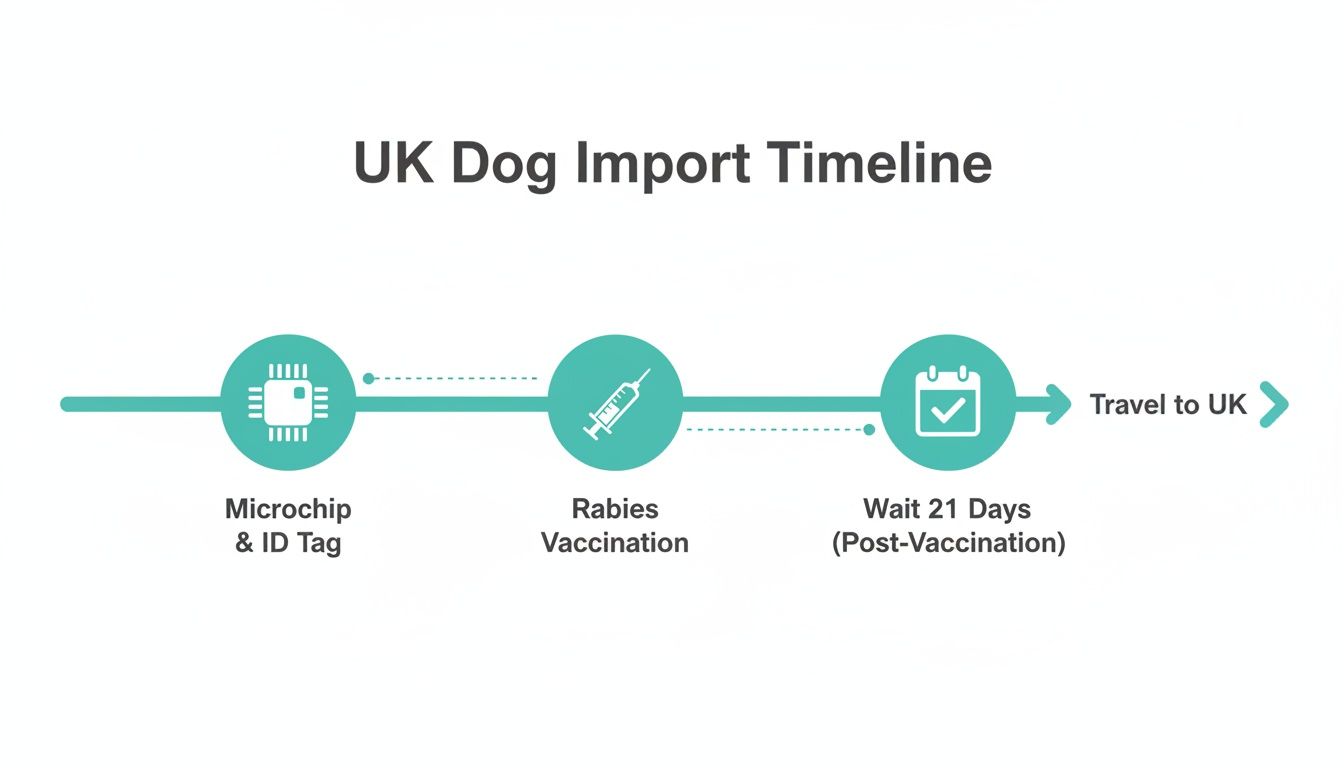
As the graphic shows, these actions must be completed in order. That 21-day wait is a crucial holding period before any travel can happen.
For a quick reference, here's a simple breakdown of the core requirements.
UK Dog Entry Requirements At a Glance
Requirement | Details and Timeline |
|---|---|
Microchip | Must be an ISO-compliant 15-digit microchip implanted before the rabies vaccination. |
Rabies Vaccination | Given after microchipping, when the dog is at least 12 weeks old. |
Waiting Period | A 21-day wait is required after the rabies vaccination before the dog can travel. |
Tapeworm Treatment | Needed for most dogs 1 to 5 days before arriving in the UK. Must be recorded by a vet. |
Health Certificate | An Animal Health Certificate (AHC) for travel from the EU or a GB Health Certificate for other countries. |
Following these steps correctly sets you up for a smooth entry process.
Why Are These Steps So Important?
These rules aren't just red tape; they're in place to keep all animals safe. The microchip offers a permanent and reliable way to identify your dog, linking them directly to you and their health records. The rabies vaccination and waiting period are vital for preventing the spread of the disease, protecting both the UK's animal population and public health.
Getting these initial steps right is the foundation for a successful and stress-free move. It’s all about making sure your dog is healthy, properly identified, and fully prepared for their new life in the UK.
If you're coming from a specific country, our guide on moving a pet from the United States to the United Kingdom offers more tailored advice. Proper preparation means your dog’s entry will be as seamless as possible, letting you focus on the excitement of your arrival.
Understanding the Core Entry Requirements
Bringing your dog into the UK isn't just a matter of booking a ticket. It involves a strict sequence of steps designed to protect the health of all animals, including your own. Think of it as a recipe: get the order and timing wrong, and the whole thing falls apart.
Let's walk through exactly what you need to do, and when.
Start with the Microchip
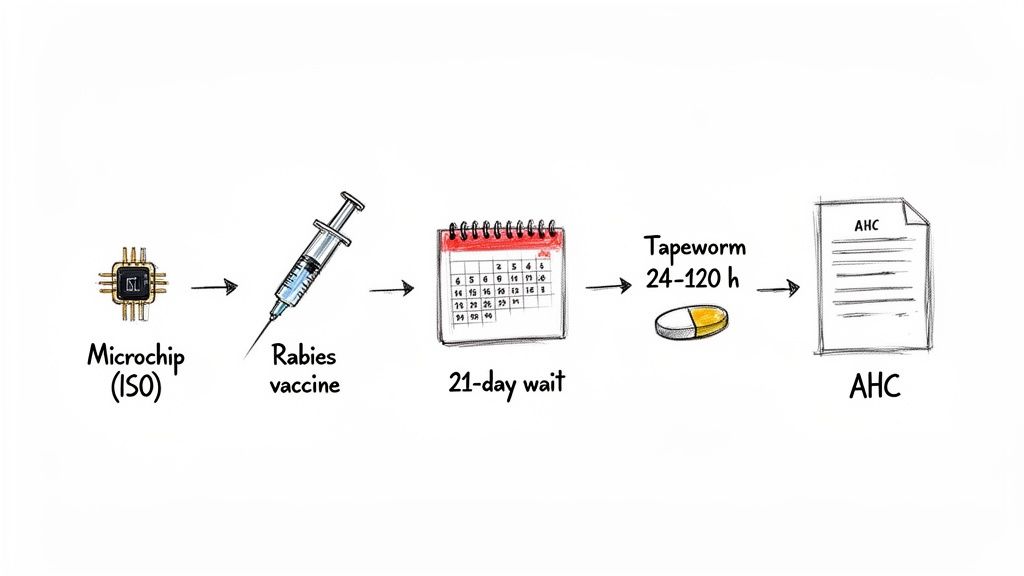
Before anything else, your dog must be microchipped. This is your dog's official ID, and it's the very first step. The chip has to be an ISO 11784/11785 compliant 15-digit microchip, which is standard for most vets, but it never hurts to double-check.
The timing here is key. The microchip must be implanted and scanned before the rabies vaccination is given. If your vet gives the vaccine first, it’s invalid for travel. You'll have to get them vaccinated all over again after the chip is in place, resetting your timeline.
Every time you visit the vet leading up to your trip, ask them to scan the chip. It's a simple check that ensures it's still working perfectly and can be read easily by officials.
The Rabies Vaccination and Waiting Period
With the microchip in, it's time for the rabies jab. Two crucial rules apply here.
First, your dog has to be at least 12 weeks old to even get the vaccine. This is a firm minimum, so younger pups are not able to travel.
Second, once the vaccine is given, a 21-day waiting period begins. This clock starts the day after the vaccination (Day 0 is vaccination day). Your dog will officially be cleared for UK entry on Day 22.
This 21-day wait is a must. It’s a vital safety measure that gives the vaccine time to become fully effective. Trying to enter the UK even a day early may lead to your dog being refused entry or placed into quarantine at your expense.
So, if your dog gets vaccinated on May 1st, the waiting period starts on May 2nd. The absolute earliest you could arrive in the UK would be May 23rd.
Tapeworm Treatment for Some Travelers
If you're bringing dogs into UK from most countries (excluding a few like Finland, Ireland, Malta, and Norway), you'll need to complete one more veterinary step: tapeworm treatment. This specifically targets the Echinococcus multilocularis tapeworm, which isn't present in the UK.
The rules for this treatment are very specific:
Must Be Vet-Administered: This isn't something you can do yourself. A licensed veterinarian must give the treatment and record it officially.
Must Contain Praziquantel: The product used must contain praziquantel or an equivalent ingredient effective against this specific tapeworm.
Timing is Everything: The treatment must be given no less than 24 hours and no more than 120 hours (that's 5 days) before your scheduled arrival time in Great Britain.
Getting this timing window right is essential. For example, if you're set to arrive in the UK at 4 PM on a Friday, the treatment must be done between 4 PM on the Sunday before and 4 PM on the Thursday before. Missing this window could risk serious delays or quarantine.
Your Key Document: The Animal Health Certificate
The final piece of the puzzle is your official travel document. For anyone traveling from an EU country or Northern Ireland, this is the Animal Health Certificate (AHC).
This multi-page document is issued by an official veterinarian in your departure country and shows your dog meets all UK entry requirements. It brings together the microchip number, rabies vaccination details, and tapeworm treatment information into one government-approved certificate.
Key facts about the AHC:
Issuance Window: Your vet must issue it within 10 days of your travel date.
Validity: It's valid for entry into Great Britain for 10 days from the date of issue, and for onward travel within the UK for up to 4 months.
One Trip Only: An AHC is a single-use document. For any future trips back to the UK, you’ll need a brand new one.
Without a correctly completed AHC, all your careful preparation is for nothing. It’s the document that border officials will look at closely to grant your dog entry.
Navigating Pet Travel Paperwork
If there's one part of bringing a dog into the UK that causes the most stress, it’s the paperwork. One wrong date or a missing signature can feel like a disaster, but it doesn't have to be so scary. Once you know what you're looking at, you can get everything in order with confidence.
The main document you’ll be dealing with is the Animal Health Certificate (AHC). Think of it as your dog’s single-trip ticket into Great Britain. It’s a multi-page certificate that officially confirms your dog is microchipped, properly vaccinated against rabies, and (if necessary) treated for tapeworm.
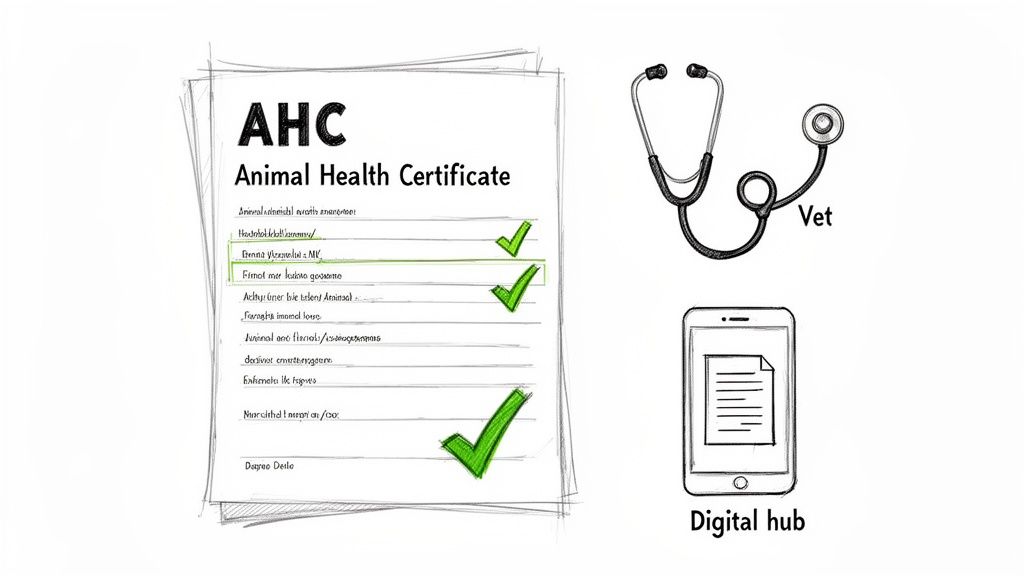
This certificate has to be completed and issued by an Official Veterinarian in your country of departure. Not just any vet can sign it off; they must have the proper government authorisation to handle international travel documents.
Breaking Down the Animal Health Certificate
The AHC is very detailed, and every single section must be filled out perfectly. Even a small error can lead to big problems at the border. The vet needs to record precise information, making sure every detail matches your dog’s records exactly.
Here’s what the AHC will contain:
Owner’s Details: Your full name and contact information.
Pet's Description: Your dog's breed, sex, age, and colour.
Microchip Information: The complete 15-digit number, plus the date of implantation and its location on your dog's body.
Rabies Vaccination Details: The date of the jab, the vaccine manufacturer, and its expiry date.
Tapeworm Treatment Records: If required, the exact date and time of treatment, along with the specific product used.
The vet’s signature and official stamp are what make the document valid. Without them, the certificate is just a piece of paper.
EU Pet Passports and Other Documents
What if you're not coming from an EU country? Or what if you already have a pet passport? The rules can get a bit confusing here, so let's clear them up.
If your dog has an EU Pet Passport issued in an EU country or Northern Ireland, it can be used instead of an AHC. Here's the catch: a pet passport issued in Great Britain (England, Scotland, or Wales) is no longer valid for travel into the UK.
For those coming from non-EU "listed" countries, you'll need a Great Britain Pet Health Certificate. This document is very similar to the AHC and serves the same purpose—it confirms your dog meets all UK entry rules. It's a good idea to check the specific requirements for your departure country to ensure you get the right paperwork.
Common Paperwork Pitfalls
It’s surprisingly easy to make a mistake when you’re juggling so many details. A simple oversight can cause significant delays or even result in your dog being put into quarantine.
The most common errors are often the simplest: an incorrect date, a swapped number in the microchip ID, or a missing signature from the vet. These small details are what border officials check first, so they have to be perfect.
Other frequent issues we see include:
Using a Non-Approved Vet: Only an Official Veterinarian can complete and sign travel documents.
Incorrect Timing: Getting the AHC issued more than 10 days before your travel date will make it invalid.
Hard-to-Read Handwriting: If officials can't read the vet's notes, they have the right to reject the document.
These issues show just how important careful checking and clear communication are between you and your vet practice. To get ahead of the curve, you can learn more about specific health requirements, like the details of a dog rabies titer test, and be even better prepared.
How Technology Helps Vets and Owners
With so much at stake, managing this process manually is a real headache for vet clinics. This is where digital platforms built for pet travel really shine. They create a central hub where all documents and deadlines are tracked, which greatly reduces the chance of human error.
For a busy vet practice, a system like Passpaw can manage all the moving parts. It helps vets prioritise tasks by travel date, check document details in real-time, and keeps pet owners in the loop. This helps ensure every last detail is correct, making the whole process smoother for everyone involved.
The steady rise in commercial dog imports into the UK further shows the need for accuracy. In 2019, 44,563 dogs were commercially imported, an 11.4% increase from just two years prior. This volume makes flawless documentation essential for protecting both animal welfare and public health. You can find more insights about UK puppy imports on the Royal Kennel Club website. By using specialised tools, vets can help ensure every dog's entry is fully compliant, whether it's a beloved family pet or a commercially imported animal.
Handling Special Travel Scenarios
Not every trip with a dog is a simple journey. You might be dealing with a brand-new puppy, a rescue dog with a hazy past, or the logistics of coming home after living abroad. These unique situations for bringing dogs into UK just need a bit of extra planning to make sure everything goes smoothly.
Getting a handle on the specific rules for your situation is the best way to avoid nasty surprises at the border. Let's walk through a few of the most common scenarios we see.
Bringing a Puppy into the UK
It’s an exciting thought—bringing a tiny puppy to its new home in the UK. But this is one process you absolutely can't rush. The UK is very strict about the minimum age for arriving puppies, and it all comes down to the rabies vaccination timeline.
Here's the breakdown of why you can't bring a very young puppy over:
A puppy must be at least 12 weeks old before it can even get its first rabies vaccination.
After that shot, there’s a 21-day waiting period before the puppy is cleared for travel.
Do the math, and you'll see the absolute youngest a puppy can be to enter the UK is 15 weeks old (12 weeks + 3 weeks). There are no exceptions here. This waiting period is a key public health measure to ensure the vaccine has become fully effective. If you’re planning a move with a puppy, you have to build this timeline into your plans right from the start.
Adopting and Transporting a Rescue Dog
Giving a rescue dog a new beginning in the UK is a fantastic, life-changing thing to do. That said, it often comes with its own unique hurdles, especially when the dog’s history is a bit of a mystery. You could be facing an unknown medical background or spotty vaccination records.
This is why working with a reputable, experienced rescue organization is so important when adopting from overseas. A good rescue knows the import rules inside and out. They will work to make sure every single requirement is met before the dog even begins its journey, handling the microchip, vaccines, and paperwork properly. It makes the whole process so much less of a headache for you.
A frequent hiccup with rescues is simply proving their age. If a vet can't confidently confirm a dog is over 12 weeks old, they can't give the rabies vaccine, and the entire travel plan grinds to a halt. The best rescues have systems for this, but it’s something to keep in mind.
They'll also be upfront about the dog's health and personality, which helps you prepare for your new family member. Adopting a rescue is wonderful, but partnering with the right people is what makes it a positive experience for everyone. If you're thinking about it, our guide on traveling to Europe with dogs might also be useful for understanding the bigger picture of pet travel.
Returning to the UK with Your Dog
What if you're a UK resident who’s been living abroad with your dog for a while? Coming home is pretty much the same process as moving to the UK for the first time. Your dog will have to meet all the standard entry requirements we've already covered.
One of the most common points of confusion is the old UK-issued pet passport. It is no longer a valid travel document for returning to Great Britain.
Instead, you will need one of these official documents:
An Animal Health Certificate (AHC) issued in the EU country you are travelling from.
A Great Britain Pet Health Certificate issued in the non-EU country you are travelling from.
A valid EU Pet Passport that was issued in an EU member state or another qualifying country.
For instance, if you moved from the UK to Spain with your dog and are now heading back, you can't just dust off your original British pet passport. You’ll need to go to an official vet in Spain and get an AHC before you travel. It feels like an extra step, but it's needed for getting your furry friend back home without any trouble.
Common Mistakes to Avoid for a Smooth Arrival
Bringing your dog to a new country is a huge milestone, but one small mistake in the process can turn a happy arrival into a stressful, expensive mess. The best way to ensure your journey is a walk in the park is to learn from the common slip-ups others have made.
Navigating the rules for bringing dogs into the UK is all about precision. A simple error can lead to heartbreaking delays, surprise quarantine costs, or even your pet being denied entry. Let's look at the most frequent pitfalls and, more importantly, how you can sidestep them.
Getting the Timing Wrong
The entire import process is a sequence of timed events. Getting the order or the dates wrong is probably the single most common mistake we see, and it can derail everything. It’s not just about doing the right things; it's about doing them in the exact right order.
These timing errors are particularly common:
Vaccinating Before Microchipping: This is a critical error. The microchip is your dog’s official ID and must be implanted and scanned before the rabies vaccine is given. If the vaccine comes first, it’s invalid for travel. You'll have to start over.
Missing the Tapeworm Treatment Window: For dogs coming from most countries, this is huge. The tapeworm treatment has to be given by a vet between 24 and 120 hours (that's 1 to 5 days) before you are scheduled to arrive in Great Britain. Arriving a few hours too early or too late makes the treatment void.
Miscalculating the 21-Day Wait: The 21-day waiting period after the primary rabies vaccine starts the day after the shot is given. Many people mistakenly count the day of the vaccine as Day 1. Trying to travel on what is actually Day 20 will get you turned away.
Think of it like baking a cake. You wouldn't put the frosting on before you've baked it. Each step in the pet travel process builds on the last, and the sequence is vital for a successful outcome.
Paperwork Problems and How to Prevent Them
Even with perfect timing, incomplete or incorrect paperwork can stop you dead in your tracks. The Animal Health Certificate (AHC) or Great Britain Pet Health Certificate is a detailed legal document, and you can be sure that border officials will check it closely.
A frequent issue is using a vet who isn't authorized to complete international travel forms. Only an Official Veterinarian (OV) can issue these certificates. Your regular vet may be wonderful, but if they don't hold this specific authorisation, their signature won't be valid for travel purposes.
Another classic problem is an incomplete certificate. Every single field must be filled out accurately—from the microchip number and scan date to the specific brand of tapeworm treatment used. Hard-to-read handwriting, a missing date, or a swapped digit can render the entire document void. This is where a digital platform like Passpaw is a lifesaver for vet practices, providing built-in checks and balances to prevent these simple but costly errors.
Arriving at the Wrong Place
This might seem obvious, but you can't just show up at any UK airport or port with your dog. You must enter through an approved Travellers' Point of Entry, where your transport company will check your pet's documents before you even board.
For example, arriving on a private boat at a small marina that isn’t an approved entry point is a no-go. Similarly, not all airlines are equipped or authorized to handle pet arrivals. You must book your travel with an approved carrier on an authorized route. Always confirm your chosen airline and arrival airport are on the official list before you book anything.
For a quick reference, here’s a look at the most common trip-ups and how to dodge them.
Common UK Pet Travel Pitfalls and How to Avoid Them
Even the most organized traveler can get tripped up by the small details. The table below highlights the frequent mistakes we see and the straightforward solutions to keep you on track.
Common Mistake | Why It's a Problem | How to Avoid It |
|---|---|---|
Incorrect Vet Paperwork | An incomplete or incorrectly filled-out certificate could be rejected at the border, leading to quarantine or refusal of entry. | Use a vet practice experienced in international pet travel. Double-check every single detail on the certificate before you leave the clinic. |
Tapeworm Treatment Timing | Missing the 1-to-5-day window makes the treatment invalid, a common reason for pets being held up at the border. | Create a calendar reminder for the earliest and latest possible times for treatment. Schedule the vet appointment well in advance. |
Using an Unauthorised Port | Arriving at a non-approved airport or seaport will likely lead to your dog being denied entry into the country. | Always check the official government list of approved Travellers' Points of Entry before booking your flight, train, or ferry. |
Avoiding these common mistakes is the key to a stress-free arrival, letting you and your dog start your new life in the UK on the right paw.
Your Top Questions About UK Dog Travel Answered
Even with careful planning, a few questions are bound to pop up when you're preparing to bring your dog into the UK. It's a big move, and wanting to get every detail right is completely understandable. We’ve gathered some of the most common queries we hear from both pet owners and veterinary teams to give you some quick clarity.
Think of this as your go-to guide for those last-minute "what ifs." Getting these answers sorted will help you feel confident that you've covered all your bases for a smooth arrival.
How Long Is an Animal Health Certificate Valid For?
This is all about timing, and it’s critical to get it right. An Animal Health Certificate (AHC) is valid for entry into Great Britain for just 10 days from the date it's signed by an Official Veterinarian. You have to complete your travel and physically enter the UK within that 10-day window.
Once you’re in the country, the certificate can be used for any onward travel within Great Britain for up to four months. But here’s the key thing to remember: an AHC is a single-use document. It’s your ticket in, and that’s it. For any future trips out of Great Britain and back in, you'll need a completely new AHC.
What Happens If My Dog’s Microchip Can’t Be Read?
This is a scenario that worries many pet owners, and for good reason. If a border official can't get a read from your dog's microchip on arrival, your dog could be denied entry. They could also be put into quarantine at your expense until their identity is sorted out. It’s a stressful, expensive situation that’s thankfully easy to avoid.
To prevent this nightmare, get into the habit of asking your vet to scan the microchip at every single appointment leading up to your departure. It's a simple check that confirms the chip is working and easy to find.
Also, take a moment to triple-check that the microchip number is recorded with 100% accuracy on all your documents, especially the AHC. A single typo can cause just as much of a headache as a faulty chip.
Can I Bring More Than Five Dogs Into the UK?
You can, but this is where things get a lot more complex. Bringing more than five dogs into the UK usually pushes you out of the "personal pet travel" category and into the world of commercial imports. This involves a different, and often stricter, set of rules designed for large-scale animal movements.
There is one major exception. If you and your pack are traveling to attend an official competition, show, or sporting event, you might be exempt from the commercial rules.
To qualify for this exemption, you may need to provide:
Written evidence that you are registered for the event.
Proof that every dog traveling with you is also registered for that same event.
If you don't fit these specific criteria, you’ll likely have to follow the commercial import process. It’s always smart to check the official government guidelines if you're traveling with a large group of dogs to make sure you're following the correct procedure. For those focused on single-pet travel, our guide on how to get a pet passport has more detailed info on the paperwork involved.
What Happens If a Dog Bites Someone in the UK?
Once you’ve successfully arrived, it's important to get up to speed on local laws around dog behavior. The UK takes dog control seriously. For example, if a dog attacks or even just worries livestock (like sheep), the owner could face a significant fine.
Likewise, an owner can be held responsible if their dog is considered "dangerously out of control" in a public space. This just shows the importance of keeping your dog on a lead where required and being mindful of your surroundings, especially when you’re out in the countryside.
Feeling more confident about the process? Passpaw helps veterinary practices manage all this paperwork with ease. Our platform simplifies the creation of Animal Health Certificates, reduces the risk of errors, and keeps clients informed every step of the way. Visit https://passpaw.com to see how we can make international pet travel a seamless experience for your clinic and your clients.
More articles
From regulatory changes to best practices for veterinarians and pet owners, our resources keep you ahead of the curve.