Are you a team member in a veterinary practice?
Are you a pet parent planning a trip with your furry pal?
A Pet Parent's Guide to Traveling to Europe with Dogs
Dreaming of sharing a croissant with your furry co-pilot in Paris? You’re in the right place. Taking your dog to Europe is an incredible experience, and with the right preparation, it's completely achievable. This guide is your roadmap, breaking down the entire journey into clear, simple parts.
Your European Adventure with Your Dog Awaits
Bringing your dog on a European getaway transforms a great trip into an unforgettable one. Imagine sipping espresso at a sidewalk café in Rome with your best friend at your feet or hiking together through the Swiss Alps. This isn't just a fantasy; it's a realistic goal for any dedicated pet owner.
But success depends entirely on careful planning.
The process is much more than just booking a flight. It's a journey through veterinary requirements, strict paperwork timelines, and airline rules. Every single step is important for a smooth, stress-free entry into the European Union. Overlooking just one detail can lead to frustrating delays or, in the worst-case scenario, your dog being denied entry.
Setting Your Pup Up for Success
To make sure your dog is ready for the journey and can handle new environments with ease, it’s a smart move to invest in proper dog training. A well-behaved dog makes navigating airports, public transport, and new accommodations far less stressful for everyone involved.
This guide is designed to remove all the guesswork. We’ll walk you through every key step, from essential vet appointments and document checklists to navigating the airport like a pro. Forget the confusion; our goal is to give you the confidence to make this trip an amazing adventure.
The key to a successful international trip with your dog is starting early and staying organized. The timeline isn't flexible, so building a checklist and sticking to it will prevent last-minute panic and potential travel issues.
We'll cover everything you need to know, broken down into a clear timeline. You'll learn about:
Microchips and vaccinations
Health certificates and country-specific rules
Airline and travel crate requirements
Arrival procedures at European airports
With this information, you'll be ready to embark on the journey of a lifetime.
The 6-Month Countdown to Your Dog's European Debut
Thinking about taking your dog to Europe is the fun part. Turning that dream into a reality? That takes a solid plan. I can't stress this enough: the whole process is a marathon, not a sprint. You really should start at least six months before you plan to leave.
This timeline isn't just a friendly suggestion; it's your roadmap to hitting every requirement without that dreaded last-minute scramble. Getting a head start gives you breathing room for required waiting periods and lets you fix any unexpected hiccups along the way. A little planning now saves a lot of stress later.
It's no surprise that more people are bringing their pets on holiday. They're family, after all. In the UK, about 26% of pet owners have taken their dogs abroad, and that number jumps to nearly 50% for adults aged 24–34. It's a clear shift toward shared adventures.
This visual breaks down the key steps, from the first vet visits to the final paperwork.
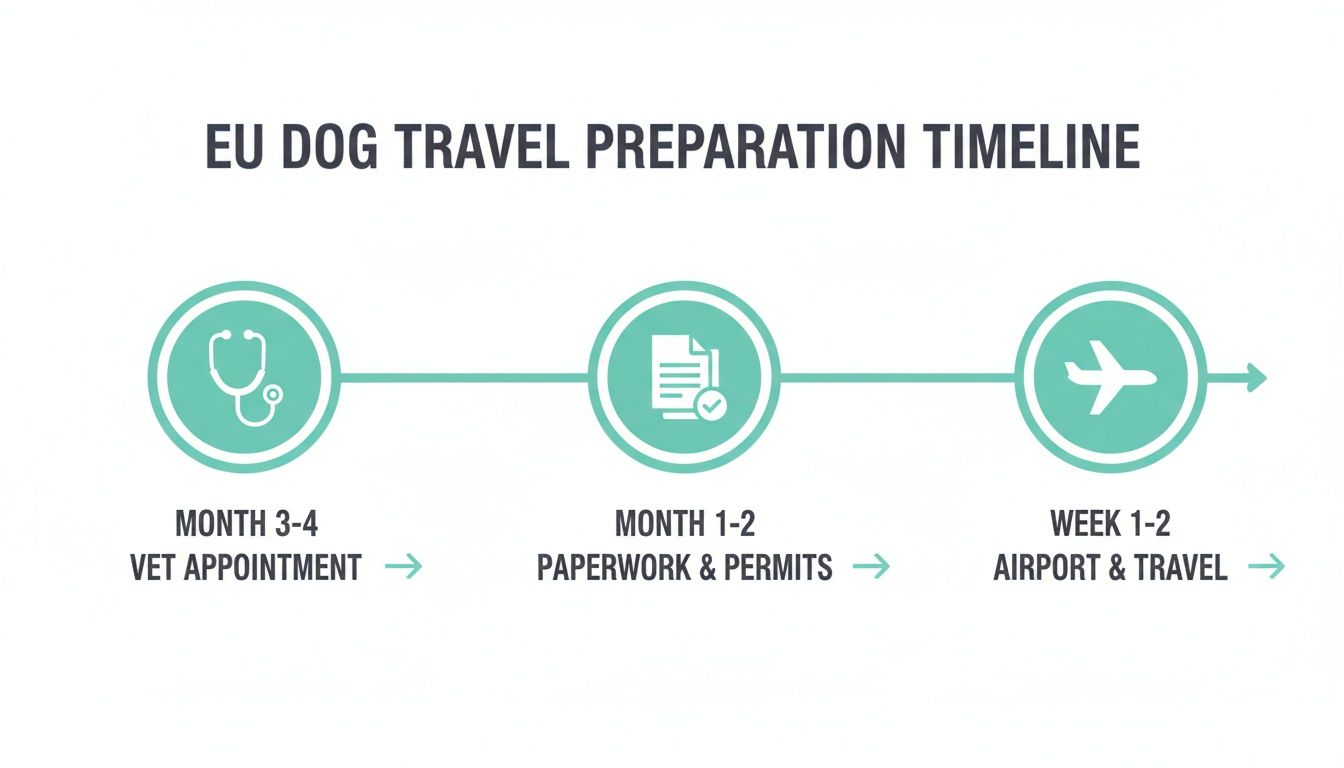
As you can see, the most time-sensitive steps—like microchipping and rabies vaccinations—happen months in advance.
Your 6-Month Game Plan: A Step-by-Step Breakdown
To make this manageable, I've put together a checklist that breaks down the entire process. This timeline is your guide to getting everything done, in the right order, without missing a beat.
Here's what your next six months will look like:
Dog Travel to Europe 6-Month Preparation Timeline
Time Before Travel | Action Required | Key Details & Tips |
|---|---|---|
6 Months+ | Verify Microchip | Must be an ISO 11784/11785 compliant 15-digit microchip. Have your vet scan it to confirm it works and is in the right place. |
5-6 Months | Administer Rabies Vaccination | Your dog must be at least 12 weeks old. The microchip must be implanted before or on the same day as this vaccine. |
4-5 Months | Rabies Titer Test (If Required) | Vet draws blood at least 30 days after the rabies shot. This is often needed for many countries outside the US/Canada. |
4 Months | Wait Period for Titer Test | A 3-month waiting period begins from the date the blood sample was drawn. This is why you need to start early! |
1-2 Months | Book Flights & Research Airlines | Confirm the airline's specific pet policies, crate requirements, and associated fees. Book a pet-friendly flight. |
Within 10 Days | Get the EU Health Certificate | Schedule an appointment with a government-accredited vet. The certificate is time-sensitive and must be completed close to your travel date. |
Within 10 Days | Official Endorsement | Your vet will submit the completed health certificate to the proper government agency for official endorsement. Plan for shipping time if needed. |
Travel Day | Final Checks | Have all original documents—the endorsed health certificate, rabies certificate, and titer test results—ready and accessible. |
Following this timeline takes the guesswork out of the equation. Each step builds on the last, setting you and your dog up for a smooth, successful journey to Europe.
First Things First: The Microchip Check
Before you do anything else, you need to confirm your dog has an ISO 11784/11785 compliant 15-digit microchip. This is the standard across Europe that can't be avoided. If your dog has a different chip, scanners at the border won't be able to read it.
Book a quick visit with your vet to have them scan the chip. This does two things: it verifies that the chip is ISO-compliant and confirms it hasn't moved and is still working perfectly. If your dog needs a new microchip, now's the time.
Important Reminder: The microchip must be implanted before the rabies vaccination. If a vaccine is given before the microchip is in place, it may be considered invalid for travel. You may have to do it all over again. This is a simple but common mistake that causes huge delays.
The Rabies Vaccination and Waiting Game
With the microchip confirmed, it's time for the rabies vaccination. Your dog must be at least 12 weeks old to receive it. This shot is your dog's ticket into the EU, but the timing is very important.
After the primary rabies vaccine, a 21-day waiting period begins. Your dog cannot enter the EU until those 21 days have passed. This gives the vaccine time to become fully effective and is a firm rule that catches a lot of people by surprise.
Let's recap that timeline:
Microchip First: Get the ISO-compliant chip implanted and scanned.
Administer Rabies Vaccine: The shot must be given on the same day as or after the microchip is implanted.
Wait 21 Days: The clock for EU entry starts the day after the vaccination.
This is also a great time to get organized. Grab a folder and start collecting all your dog’s travel documents, like the microchip certificate and vaccination records. Trust me, having everything in one place will be a lifesaver.
The Rabies Titer Test: An Important Step
Depending on where you live, your dog might need a rabies antibody titration test—often just called a titer test. It’s a blood test that measures the level of rabies antibodies to show the vaccine is working as it should.
Your vet must draw the blood sample at least 30 days after the rabies vaccination. After that, you may have to wait another three months from the date the sample was drawn before your dog can enter the EU. This three-month wait is exactly why starting six months out is so important.
For example, if the rabies vaccine is given on January 1st, the blood draw for the titer test can't happen before January 31st. Assuming the results are good, the earliest your dog could travel would be April 30th.
This test isn't required if you're coming from certain countries like the US and Canada, but it is for many others. Always double-check the rules for your specific country of departure. Nailing this step is a huge part of getting the necessary health certificates for your best friend.
Alright, you've survived the initial vet visits, the microchipping, and the vaccination marathon. Now comes the part that can feel like trying to solve a puzzle: the paperwork. But don't worry, once you know what to look for, it's a lot less intimidating than it seems. Getting these documents perfect is essential for a smooth arrival in Europe.
The star of the show is the EU Animal Health Certificate (AHC). This is your dog's official pass for the European Union, a multi-page document that pulls together all their key info—microchip number, rabies vaccine history, and a formal declaration of good health from your vet.
But this isn't just any form your local vet can sign off on. It has to be completed by a veterinarian who is officially accredited by the proper government body in your country (like the USDA in the United States). These are the vets with the authority to issue this specific international certificate.
The All-Important 10-Day Window
Here’s the detail that trips up so many pet owners: the timing on the AHC is very strict. Your accredited vet must complete and sign the certificate no more than 10 days before your dog is scheduled to arrive in the EU.
Let’s say you’re flying to Paris and you land on June 20th. The absolute earliest your vet can issue that AHC is June 10th. This tight window means you have to have that final vet appointment booked and your endorsement plan locked in. There's simply no room for error or last-minute changes.
This 10-day validity is designed to ensure the certificate reflects your dog's health right before travel. Waiting until the last minute is not your friend here; plan this final vet visit carefully.
And while you're focused on your pet's paperwork, don't forget your own. Understanding things like Schengen visa insurance requirements will make the entire process smoother for everyone involved.
Not All Countries Play by the Same Rules
While the AHC gets you through the main door into the EU, some countries have their own extra rules. This is where a little extra research saves a lot of headaches.
These country-specific requirements are all about protecting local animal populations from diseases that aren't common there. For a great overview of the basics, check out our guide on international pet travel requirements.
Here are a couple of the most common exceptions you'll run into:
Tapeworm Treatment (Echinococcus multilocularis): If you're heading to the UK, Ireland, Finland, Malta, or Norway, this one's for you. Your dog must get a specific tapeworm treatment containing praziquantel. The timing is key: it has to be given by a vet between 24 and 120 hours (that's 1 to 5 days) before you arrive.
Breed-Specific Legislation: This is a big one. Some countries, like Germany and France, have laws restricting certain breeds they consider "dangerous," which can include Pit Bull Terriers, Mastiffs, or Rottweilers. These rules can vary a lot, from requiring muzzles in public to outright entry bans. If you own one of these breeds, you absolutely must check the local laws for your destination.
A Tale of Two Itineraries
Let's see how this plays out in the real world.
Scenario 1: The Mediterranean Tour
You’re flying from Chicago to Rome, Italy, with plans to hop over to France and Spain.
Your key document is the EU Animal Health Certificate, issued within 10 days of your landing in Rome.
Because Italy, France, and Spain all follow the standard EU rules, you're all set. Once your AHC is stamped on arrival, it acts like a passport for travel between these EU countries for up to four months.
Scenario 2: The UK Adventure
You're flying from New York to London, but you have a layover in Amsterdam.
Your EU entry point is Amsterdam, so your AHC must be ready for Dutch officials to inspect.
Since your final stop is the UK, your dog needs that mandatory tapeworm treatment. An easy way to handle this? Schedule a vet visit in Amsterdam during your layover to get the treatment administered within that critical 1-to-5-day window before your final flight to London.
These examples show just how important it is to map out your entire itinerary and check the rules for every single country you plan to visit. Don't assume anything. The official government websites for each country's department of agriculture are your best source of truth—a quick check there can prevent a "ruff" arrival.
Choosing a Pet-Friendly Airline and the Right Crate
After months of paperwork and vet visits, it’s finally time to think about the flight itself. Your dog's comfort and safety are the top priority here, and that comes down to two big decisions: picking the right airline and getting the perfect crate.
Trust me, not all airlines handle pet travel the same way. Their policies can be very different, and a little research now saves a world of stress later. You want to walk up to that check-in counter feeling confident, not crossing your fingers.
Navigating Airline Pet Policies
First things first, you need an airline that not only allows pets but actually has a good reputation for it. You'll find yourself navigating a maze of rules about breed restrictions, weather limits (too hot or too cold), and how many total pets are allowed on each flight.
Your dog’s size is really the deciding factor. Smaller pups might get to fly in the cabin with you, but bigger dogs will travel as checked baggage or cargo.
In-Cabin Travel: This is usually an option for dogs under 20 pounds (carrier included). They'll stay in their carrier under the seat in front of you. These spots are very limited, so book as far in advance as you possibly can.
Cargo Travel: For larger breeds, the temperature-controlled, pressurized cargo hold is the only way to go. It's safe, but it’s a very different experience than being right there with you in the cabin.
Don’t just book the cheapest flight you find online. Your best bet is to call the airline directly to confirm their specific pet policies and book your dog’s spot on the phone. This is your chance to ask questions and get real peace of mind. Some airlines won't even let you book a pet online, so a call is often necessary.
Finding the Right Travel Crate
Once the flight is booked, your next mission is getting an IATA-compliant travel crate. The International Air Transport Association (IATA) sets the global standard for safely transporting animals, and airlines are very strict about these rules. They can—and will—turn you away if your crate doesn't meet every single requirement.
Think of it less as a box and more as a secure, mobile den for your dog's journey. A good crate is sturdy, has great ventilation, and gives your dog just enough room to be comfortable. For a deep dive into the specifics, you can learn more about selecting the best airline travel pet carrier.
An IATA-compliant crate must have:
Solid Construction: It needs to be made of rigid plastic, wood, or metal. Wire-mesh crates are a definite no-go for air travel.
Secure Locking: The door needs a spring-loaded lock that can’t pop open by accident. Many airlines now require metal bolts and nuts to hold the two halves of the crate together, not plastic clips.
Good Ventilation: Airflow on at least three sides is required, but four is highly recommended for long-haul international flights.
Solid Roof and Floor: The crate must have a solid, leak-proof floor and a solid roof.
Food and Water Bowls: It must have two empty bowls attached to the inside of the door so they can be accessed from the outside without opening the crate.
Getting the Crate Size Just Right
This is one of the most important parts of the process, and it's where a lot of people mess up. A crate that’s too small is unsafe and stressful. One that’s too big doesn’t give your dog that secure, den-like feeling they need to feel safe.
Airlines have a simple rule of thumb: your dog must be able to stand up, turn around, and lie down comfortably in a natural position.
To get the right measurements:
Length: Measure from the tip of their nose to the base of their tail (not the tip). Add a few inches to that number.
Height: While they're standing, measure from the floor to the top of their head or the tip of their ears—whichever is higher. The crate needs to be a few inches taller than that.
If you’re on the fence, always size up. A little extra space is way better than being denied boarding at the check-in desk.
Making the Crate a Happy Place
Please, don't let travel day be the first time your dog sees their crate. The goal is to get them comfortable with it weeks, or even months, ahead of time. You want them to see it as their own personal, safe space.
Start by just placing the crate in your living room with the door open. Toss some high-value treats in there, feed them their meals inside it, and put a favorite blanket or toy inside. Let them explore it on their own terms, no pressure.
Once they're comfortable going in and out, start closing the door for just a few minutes at a time while you're right there with them. Slowly increase the time until they're happy to just chill in the crate. This positive association is everything for reducing their anxiety on the day you fly.
Arriving in Europe and Clearing Pet Customs
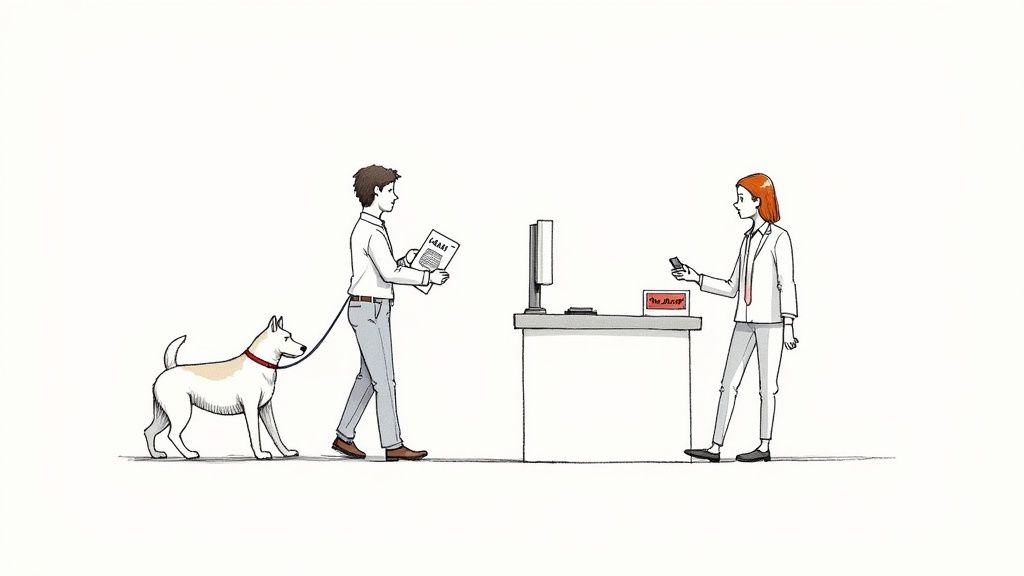
You’ve made it. After months of planning, vet visits, and careful packing, your flight has touched down in Europe. But before you and your furry copilot can head out to find the nearest park, there’s one last checkpoint to clear with your dog.
This final step happens at the airport’s border control post, sometimes called the Travelers’ Point of Entry. It’s a dedicated area where officials perform a final review to make sure every single detail is in order. Staying calm and organized here is the key to starting your adventure on the right paw.
What to Expect at the Border Control Post
Once you’ve collected your luggage and your dog, you'll be directed to the customs area for pets. Here, an official veterinarian or border agent will perform several key checks. It can feel a little nerve-wracking, but if you’ve followed all the steps, it’s usually a straightforward process.
Their main tasks are to:
Scan the Microchip: An agent will use a handheld scanner to read your dog’s ISO-compliant microchip, making sure the number perfectly matches all the paperwork.
Review Your Documents: They will examine every single page of your dog's file, from the endorsed health certificate to rabies vaccination records and titer test results.
Conduct a Visual Check: The official will also give your dog a quick visual once-over to confirm they appear healthy and match the description in your documents.
Having your papers in perfect order is a must. This is where a service like Passpaw truly shines, helping to ensure that every document is correct and validated before you ever leave home, which greatly reduces the chance of unwelcome surprises at the border.
Keep all of your dog’s original documents in a single, easily accessible folder. Fumbling through your carry-on adds unnecessary stress. Handing over a neat, organized file makes a great first impression and helps the whole process go much faster.
Making a Smooth Entry
The goal is to make this final step as seamless as possible. Officials are mainly concerned with health and safety, so showing that you're prepared goes a long way.
For instance, upon landing, immediately offer your dog some water and a chance to stretch their legs. A calm, comfortable dog makes the inspection process easier for everyone involved. And of course, always be patient and polite with the officials; they are simply doing their job to protect animal health within the EU.
The single most important document they will check is the Animal Health Certificate (AHC). This certificate is the cornerstone of your dog's entry file. If you need a refresher on the specifics, our guide on the veterinary international health certificate provides a detailed breakdown of what is needed.
Once the officials are satisfied, they will stamp your AHC. That stamp is your golden ticket. It officially validates the certificate and allows your dog to travel freely with you between EU member countries for up to four months.
Congratulations—your European adventure has officially begun.
Finding Pet-Friendly Stays and Activities Across Europe
You've made it. The paperwork is done, customs is behind you, and the real fun is about to start. But here's the thing about Europe: it's a mix of cultures, and that extends to how they welcome dogs. A little bit of planning on the ground goes a long way to making sure the trip is a blast for both of you.
Your first task is locking down a place to stay. While most booking sites let you filter for "pets allowed," you'll want to do a little more digging. Some hotels have surprising size restrictions or only set aside a few specific rooms for travelers with pets. My advice? Always call or email the property directly to confirm their policy before you book. Mentioning you have a dog with you upfront prevents any awkward check-in conversations.
Discovering Europe's Most Welcoming Cities
Some places just roll out the red carpet for dogs. A recent study of 40 popular European cities found a few clear winners. Helsinki took the top spot, but German-speaking cities weren't far behind—Munich and Zurich came in at 71% pet-friendly, with Berlin at 64% and Salzburg at 63%. It's a reflection of a culture where dogs are just part of daily life. You can see the full pet-friendly findings to help map out your route.
Beyond the hotel, you'll be navigating daily life together. Getting around and grabbing a bite to eat are two of the biggest hurdles. Luckily, many European cities have amazing public transport that's open to dogs, but the rules are rarely the same.
Public Transport: In places like Berlin and Vienna, it's totally normal to see dogs on trains and trams. You'll often need to buy a child's fare ticket for your pup, and officially, a muzzle might be needed. Keep one handy, even if it's not strictly enforced for a calm dog.
Dining Out: Countries like France, Italy, and Switzerland are famous for their café culture, and well-behaved dogs are usually welcome on outdoor patios. Sometimes they can even come inside. It’s always best to ask first, though.
Parks, Trails, and Open Spaces
One of the greatest joys of traveling to Europe with dogs is exploring the incredible parks and green spaces. From the massive Tiergarten in Berlin to the public footpaths that crisscross the English countryside, you'll have endless chances for your dog to get their zoomies out.
A quick heads-up before you unclip the leash: always check the local rules. Most city parks require dogs to stay on-leash, but you can usually find designated off-leash areas (look for signs like Hundezonen) where they can run free and make a few international friends. A little awareness goes a long way in making sure everyone has a "pawsitive" time.
Common Questions About European Pet Travel
Getting ready to fly to Europe with your dog can feel like a lot to remember. To help you feel more confident as you finalize your plans, we've pulled together some of the most common questions we hear from pet parents.
EU Pet Passport vs. a Health Certificate?
This is a big one. If your dog already has a pet passport that was issued in an EU member state, you're generally good to go for travel between other EU countries.
But if you’re coming from outside the EU—like from the US or the UK—you must get an official EU Animal Health Certificate (AHC). This certificate is your dog's one-way ticket for that initial entry into the European Union. Keep in mind, it's typically only valid for 10 days from the date it's issued, so timing is everything.
What if My Dog's Microchip Can't Be Read?
Honestly, this is a very difficult situation. An unreadable microchip at the border can bring your journey to a screeching halt, potentially delaying or even preventing your dog's entry. It's a "paws" in the action no one wants.
To prevent this headache, make sure your vet confirms the microchip is an ISO-compliant, 15-digit chip. It’s also smart to have them scan it a few times during your pre-travel checkups just to be certain it’s working perfectly. Some of the most seasoned travelers I know even carry their own backup scanner for total peace of mind.
A surprisingly common mistake is forgetting to check the microchip's function right before the trip. That one quick scan by your vet can save you from a massive problem at customs.
How Do I Handle Food and Water on the Flight?
Your airline-approved travel crate needs to have two empty bowls attached to the inside of the door—that’s standard. You can also give the airline staff a small bag of your dog's food, and they can offer it during a long layover if needed.
Now for the water, here’s a pro tip we've seen work wonders: freeze water in one of the bowls before you even leave for the airport. It melts slowly over the course of the flight, giving your dog a steady supply of water without the mess of a major spill from turbulence.
Ready to make your European adventure a reality? With Passpaw, you can simplify the entire documentation process. We help vets and pet owners manage and validate all the necessary paperwork, ensuring everything is in order before you fly. Get your documents right the first time and travel with confidence. Learn more at https://passpaw.com.
More articles
From regulatory changes to best practices for veterinarians and pet owners, our resources keep you ahead of the curve.