Are you a team member in a veterinary practice?
Are you a pet parent planning a trip with your furry pal?
Cost of Pet Travel Certificate: 2026 Guide
A pet travel certificate can cost anywhere from a few hundred dollars to well over $1,000, depending on where your pet is going and how much prep that country requires. For international trips from the U.S., the USDA APHIS endorsement alone now starts at $101 for a certificate with no lab tests and can rise to $275 or more for more complex cases.
If you’re reading this with flight tabs open, vaccine records half-found, and a dog or cat staring at you like they already approved the itinerary, you’re in the same place many owners reach before travel gets real. The surprise usually isn’t that paperwork exists. It’s how quickly the final bill changes once the destination, timing, and test list come into focus.
The cost of pet travel certificate work is rarely one flat fee. A simple trip to a lower-risk destination may stay in the lower hundreds. A move to a stricter country can stack veterinary visits, lab work, endorsement fees, shipping, and repeat paperwork if anything is off by a whisker. That’s why two clients can both say “international health certificate” and mean very different budgets.
Your Pet Travel Adventure and Your Budget
The first budgeting mistake I see is treating pet travel like buying one document. In practice, you’re paying for a process. That process can be short and straightforward, or it can stretch across multiple appointments and checks depending on the country’s rules.
A lower-complexity trip may involve a health exam, document preparation, and a final certificate. A more demanding trip can add microchip verification, vaccine timing review, blood testing, extra forms, and government endorsement. The destination decides how long the to-do list gets.
For many owners, the most useful starting point is this: budget by destination and timeline, not by pet alone. If your travel date is close, your options narrow. If your destination has strict entry rules, your veterinary team has more to prepare and verify. That extra work is where costs rise.
Here’s the practical way to frame it before you book anything nonrefundable:
Simple destination: Fewer forms, fewer visits, less chance of rework.
Moderate destination: More document review and stricter timing.
Complex destination: More hands-on prep, more testing, and very little room for mistakes.
If you want a broader look at related travel document expenses, Passpaw’s guide on how much a pet passport can cost is a useful companion read.
Practical rule: Get the country requirements confirmed before you compare clinic prices. A “cheap” quote often only covers the exam, not the full paperwork path.
Owners also tend to focus on the appointment fee and miss the cost of delay. If a country requires specific sequencing for microchip, vaccines, or testing, waiting too long can mean repeating part of the process. That’s where budgets go from manageable to hairy in a hurry.
Unpacking the Bill Every Fee Component Explained
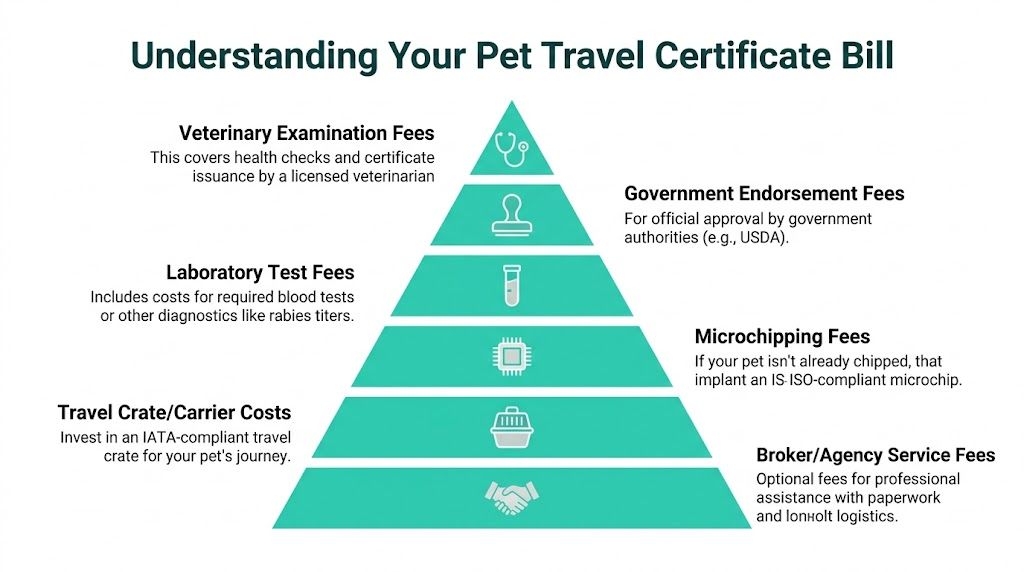
A pet travel invoice makes more sense once you split it into parts. Most families aren’t paying for one form. They’re paying for professional review, document prep, government handling, and whatever medical steps the destination requires.
The veterinary side of the bill
The veterinarian’s fee usually covers the exam and the actual certificate preparation. For international travel, that work often includes reviewing vaccine history, confirming identification details, checking timing windows, and filling out country-specific forms correctly.
A clinic may also need to verify whether your pet’s microchip is already in place and whether records line up exactly with the supporting documents. If they don’t, the team may have to pause and fix the paper trail before a certificate can be issued.
Common line items include:
Health examination and certificate prep: The visit where the veterinarian confirms your pet is fit to travel and completes the certificate paperwork.
Microchip placement or verification: Some countries require a compliant microchip before other steps count.
Vaccinations and supporting records: Rabies documentation is often the one owners know about, but record accuracy matters just as much.
Laboratory testing: Some destinations require extra diagnostics such as rabies titer-related testing.
The government fee that catches people off guard
For many international trips from the U.S., the health certificate must be endorsed by USDA APHIS. That fee changed significantly effective January 10, 2025. According to the USDA APHIS cost to endorse a pet health certificate schedule, the base fee is $101 per certificate for cases with zero laboratory tests. The fee increases based on the number of required lab tests and pets, including $160 for 1 to 2 tests with one pet, $206 for 3 to 6 tests with one pet, and $275 for 7 or more tests with one pet.
That matters because owners often hear “USDA endorsement” and assume it’s a small admin charge. It isn’t anymore. If your destination needs extensive testing, the endorsement fee moves up with that complexity.
Here’s a quick view of the APHIS endorsement structure:
APHIS endorsement scenario | Fee |
|---|---|
0 lab tests | $101 |
1 to 2 tests, 1 pet | $160 |
3 to 6 tests, 1 pet | $206 |
7 or more tests, 1 pet | $275 |
The expenses outside the certificate itself
Some costs sit beside the certificate rather than inside it. A travel crate, airline paperwork support, courier service, and destination-country entry charges can all affect the total spend. If your route includes customs processing, it’s smart to understand related import fees early so the border side of the trip doesn’t become an afterthought.
You can also review a more detailed walkthrough of USDA pet travel certificate requirements if you’re trying to understand where endorsement fits into the full process.
A clean invoice usually means someone did a lot of detail work behind the scenes.
That hidden labor is why the cheapest front-end quote doesn’t always produce the lowest final cost. If records are incomplete or country forms are handled casually, you may pay less at the first visit and more later fixing avoidable problems.
How Your Destination Dictates the Final Price
The single biggest factor in the cost of pet travel certificate work is the destination. Not the breed. Not the airline. Not even the length of the trip. The country’s import rules set the amount of veterinary time needed, and that drives your bill.
Lower-risk destinations
Some countries have a lighter process. The veterinary work is still important, but there are fewer moving parts and fewer opportunities for a timeline problem to ruin the plan.
According to Prospect Ridge Veterinary’s travel certification pricing overview, low-risk countries might cost $170 to $400 in vet prep, while high-risk destinations like the UK or Australia can require services costing $600 to $750 or more, not including USDA fees or lab work. The same source notes that complex destinations can take a veterinarian 2 to 4 hours to prepare multiple forms, review results, and ensure compliance.
Moderate to strict destinations
Planning starts to matter as much as money. The country may require more than one form, very specific timing, or extra supporting records. If any detail is missing, the clinic may have to revisit the entire file.
I often tell clients that stricter destinations are expensive for a boring reason. They require careful admin time. Nobody is paying for drama. They’re paying for accuracy.
A simple comparison helps:
Destination type | Typical veterinary effort | Budget effect |
|---|---|---|
Lower complexity | Basic exam and fewer forms | Usually the lightest cost |
Mid complexity | More review, tighter timing | Costs rise with coordination |
High complexity | Multiple forms, tests, and strict sequencing | Highest risk of added expense |
Timeline changes the destination cost
Two pets going to the same country can still have very different bills. If one owner starts early, the clinic can schedule each step in a calm sequence. If the second owner calls close to departure, every missing record becomes urgent.
That’s especially true for places that expect more than a final exam and signature. The farther ahead you start, the more likely your team can work through the list without repeat visits, overnight document shipping, or rushed corrections.
If your plans involve a domestic destination with its own unique entry rules, this guide to pet travel to Hawaii is worth reviewing. Hawaii often reminds owners that “domestic” doesn’t always mean “simple.”
Watch Out for These Pawsitively Sneaky Hidden Costs
Most owners budget for the appointment and maybe the USDA endorsement. The invoice gets slippery when the “small extras” start piling on. They’re not always large on their own, but they’re the reason an initial quote and a final total don’t always match.
The costs that appear late
Shipping and courier handling are common examples. If original documents need to move quickly between the clinic, owner, and endorsement office, those logistics can add stress and cost at the exact moment you have the least room to improvise.
Translation needs can also pop up, especially if a country wants supporting material presented a certain way. Some owners only learn this after the certificate is already being prepared.
A few common surprise areas:
Record cleanup: Old vaccine records with mismatched dates, names, or microchip numbers can trigger follow-up work.
Repeat paperwork: If the destination form changes or an airline asks for a different version, the clinic may need to revise the packet.
Appointment changes: Rescheduling close to the travel window can force the whole timeline to shift.
Return-trip confusion: Owners sometimes assume one certificate handles every leg of the journey, then realize they need fresh documents later.
Small errors are expensive because they usually show up at the worst possible point in the timeline.
Why rushed travel gets pricey
The late-start problem isn’t just emotional. It changes how many solutions are available. A clinic with enough lead time can often coordinate testing, forms, and signature windows efficiently. A clinic working against a near departure date has fewer options and less margin for correction.
That’s why I’d rather see an owner call “too early” than “just in time.” In pet travel, just in time is often already late.
For a fuller look at the budget items owners and clinics tend to miss, Passpaw’s article on the hidden costs of pet travel-don-t-realize-until-it-s-too-late) does a good job showing where these sneaky charges tend to surface.
Keeping Your Wallet Happy Tips to Reduce Pet Travel Expenses
You usually can’t make a strict country simple, but you can avoid paying extra for preventable problems. The most effective savings come from timing, organization, and asking sharper questions at the first appointment.

What actually helps
Start with records. Gather rabies certificates, microchip information, prior test results, and any destination forms before your first travel consult. Clinics work faster and more accurately when they aren’t reconstructing the history from screenshots and half-legible PDFs.
Then ask one very practical question: “What does your fee include?” Some quotes cover the exam only. Others include form completion, follow-up review, and submission support. That one question can save a lot of tail-chasing later.
Try these habits:
Start early: Extra time gives you options. It also lowers the chance that one missing item will force expensive scrambling.
Bundle work when appropriate: If your pet needs an exam and record review, ask whether those can be coordinated in one planned visit.
Use one organized document folder: Keep originals and digital copies together so nothing gets lost in email chains.
Confirm the final checklist in writing: A written list reduces misunderstanding between owner, clinic, and shipper.
Track everything like a project
Pet travel is paperwork-heavy enough that a basic tracking system pays off. Save receipts, upload records, and note dates for exams, vaccines, and document submissions. If you need a simple way to digitize paper bills and clinic paperwork, a roundup of best free receipt scanner apps can help keep your file from turning into a chew toy.
The owners who spend the least usually aren’t cutting corners. They’re staying organized and avoiding rework.
One more money-saving habit matters more than people expect. Don’t book the pet’s travel arrangement before you know the paperwork path is realistic. A nonrefundable flight creates pressure, and pressure makes expensive decisions look reasonable.
Real-World Travel Budgets Three Sample Case Studies
The easiest way to understand the cost of pet travel certificate work is to look at common travel situations. These examples aren’t universal quotes. They show how destination and timeline affect the total.
Max the Beagle going to Canada
Max’s owner is driving from the U.S. to Canada and starts planning early. The paperwork is relatively straightforward, and the clinic doesn’t need to manage a heavy testing pathway.
Likely budget shape:
Veterinary prep falls into the lower-complexity range often seen for lower-risk destinations.
The owner’s main expense is the travel exam and certificate preparation.
Because the file is clean and the timeline is comfortable, there’s less chance of extra admin cost.
This is the kind of case where owners are often relieved. The process still needs care, but it doesn’t sprawl.
Luna the Cat flying to an EU country
Luna’s owner has a longer checklist. The clinic reviews identification details, vaccine timing, and supporting records carefully because moderate-complexity destinations leave less room for informal fixes.
A realistic budget pattern may include:
Cost area | Likely impact |
|---|---|
Veterinary prep | Higher than a simple destination because of added document work |
Lab-related items | Possible, depending on route and requirements |
Government endorsement | Added on top of clinic fees if required |
Shipping or handling | More likely if paperwork needs formal movement |
For this kind of trip, owners usually feel the difference not in one giant fee but in stacked steps. Each one is reasonable on its own. Together, they create a noticeably bigger total.
Charlie the Golden Retriever heading to Australia
Charlie’s owner is dealing with one of the more demanding types of itineraries. The destination calls for more planning, tighter sequencing, and more veterinary time. Owners then transition from “certificate appointment” thinking to full process management.
The bill often grows for three reasons:
The veterinary team spends more time on the file.
Testing and supporting documentation are more involved.
There’s less tolerance for timing errors, so rushed corrections become costly.
The published ranges offer useful reference points. Prospect Ridge Veterinary notes that low-risk veterinary prep may start around $170 to $400, while high-risk destinations may run $600 to $750 or more in veterinary services alone, excluding USDA fees or lab work, as covered earlier from their pricing overview.
If your destination is strict, your cheapest option is usually starting sooner, not shopping harder.
These sample cases all share one lesson. The country isn’t just a line on the form. It determines how much work the clinic must do, how many steps the owner must track, and how forgiving the process will be if something slips.
Streamline Your Journey and Save with Passpaw
Manual pet travel workflows create predictable problems. Forms get started with missing records. Deadline windows are tracked in email threads. Country requirements are checked late. Then everyone spends time fixing a preventable issue instead of moving the case forward.
That’s where software can help. A tool like Passpaw gives clinics and pet owners a more structured way to manage international health certificate work. It’s designed to organize travel documents, validate details in real time, prioritize tasks by travel date and pet information, and keep communication in one place rather than scattered across calls and inboxes.
For veterinary practices, that kind of workflow matters because travel cases aren’t hard only when medicine is hard. They’re hard when details are fragmented. A centralized system helps staff see what’s missing, what’s due next, and which country-specific items need attention before the appointment window closes.
For owners, clarity is paramount. You want to know what has been submitted, what still needs action, and where the timeline could slip. Any system that reduces duplicate questions and document mistakes can also reduce the risk of paying twice for the same step.
Paperwork doesn’t need to be glamorous. It just needs to be accurate, visible, and easy to track.
Frequently Asked Questions About Pet Travel Costs
Does the certificate cost more if I have two pets
It can. The answer depends on which part of the process you’re asking about. Some clinic work may scale with the number of pets because each pet needs its own exam and records reviewed.
For USDA APHIS endorsement, the fee structure can also change with multiple pets in the same certificate context. In the USDA schedule cited earlier, some categories add a per-additional-pet amount when lab tests are involved. That’s one reason multi-pet travel should be priced as a custom plan rather than guessed from a single-pet quote.
How long is a health certificate valid, and do I need a new one for the return trip
Validity depends on the destination, airline, and trip type. There isn’t one universal answer that fits every itinerary. Some certificates are tied closely to the date of travel or date of entry, so the return leg may need fresh paperwork.
Ask your veterinarian and carrier this question before departure, not while you’re abroad. Return paperwork is one of the most common planning blind spots.
Are USDA fees refundable if my travel plans are cancelled
Don’t assume they are. Fee handling can depend on where you are in the process and whether endorsement work has already been performed. Before you submit anything, ask the clinic or endorsement office what happens if your trip changes.
The bigger lesson is to avoid locking in travel plans before your paperwork path is confirmed.
Do domestic health certificates cost the same as international ones
Usually not. Domestic travel is often simpler because the document path is shorter and country-level import rules don’t apply. International certificates tend to cost more because they involve more review, more forms, and sometimes government endorsement.
Why did one clinic quote much less than another
Often because they’re quoting different scopes of work. One clinic may be pricing the exam only. Another may be including document review, certificate preparation, revisions, and submission support. Ask for a written breakdown so you can compare the same services.
What’s the smartest first step if I’m still early in planning
Book a travel consult before you book the pet’s final itinerary. A good consult gives you the likely timeline, identifies missing records, and flags whether your destination is simple or strict. That one step can save money, stress, and a lot of last-minute barking at the printer.
If you want a clearer way to manage pet travel paperwork, Passpaw offers a structured platform for tracking requirements, organizing documents, and keeping travel cases moving without the usual spreadsheet-and-email scramble. For clinics and pet owners alike, that kind of visibility can make the process smoother and help avoid the avoidable costs that come from missed details.

More articles
From regulatory changes to best practices for veterinarians and pet owners, our resources keep you ahead of the curve.