Are you a team member in a veterinary practice?
Are you a pet parent planning a trip with your furry pal?
A Pet Parent's Guide to the Titer Test for Rabies in Dogs
A titer test for rabies in dogs is a simple blood test that checks the level of protective antibodies your dog has after being vaccinated. Think of it as a report card for their immune system, confirming the vaccine is doing its job and giving you the official proof needed for international travel.
What Is a Rabies Titer Test for Dogs
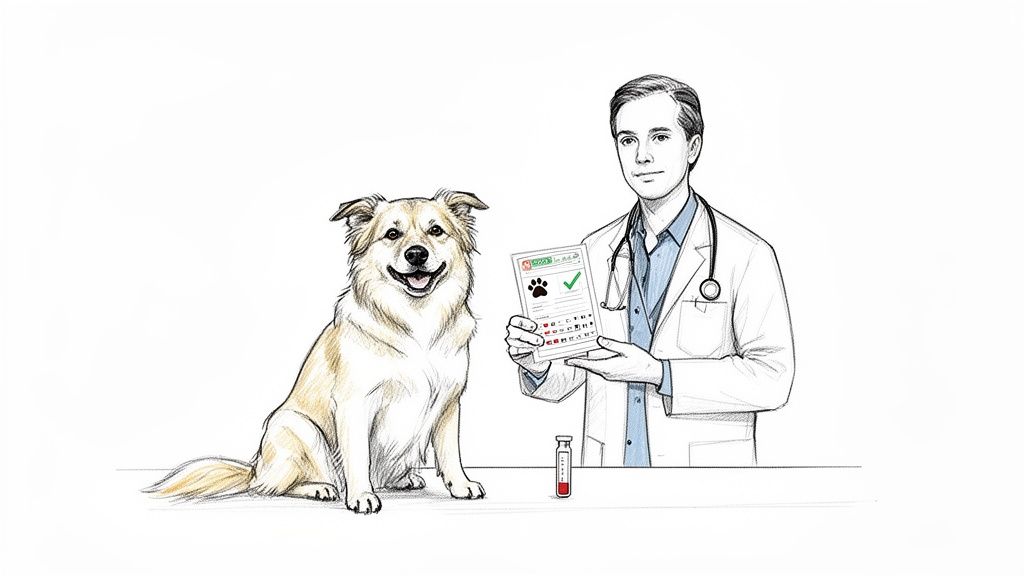
Planning a big trip abroad with your furry co-pilot? You've probably seen the term "rabies titer test" pop up, and it’s a key step for any globe-trotting pet. It's easy to get lost in the jargon, so let's clear things up.
First off, this test does not check if your dog has rabies. Instead, it’s a simple blood draw that confirms their immune system is primed and ready to fight off the virus, thanks to their vaccination. If the vaccine was the training session, the titer test is the final exam that proves your dog passed with flying colors.
Why This Test Is So Important
The number one reason for a titer test for rabies in dogs is to meet the entry rules of many rabies-free countries and regions. Places like Australia, Japan, the United Kingdom, and the entire European Union have rules in place to protect their local animals. A passing titer test result is your dog's golden ticket, showing they don't pose a risk of bringing the disease into the country.
Without this key piece of paperwork, your pet could be facing:
Long, stressful quarantine periods upon arrival.
Unexpected bills for quarantine kennels.
The upsetting possibility of being denied entry entirely.
A passing titer test is the internationally recognized proof that a dog’s rabies vaccine has produced an adequate immune response. This verification is the key to avoiding lengthy, costly, and emotionally taxing quarantine procedures at your destination.
The Science Behind the Test
So, what is the lab actually looking for? The test specifically measures rabies virus neutralizing antibodies (RVNA). These are special proteins the immune system creates after vaccination that can stop the rabies virus in its tracks. To really get it, it helps to understand the role of key immune soldiers like neutralizing antibodies.
This test isn't just a box to check; it provides scientific proof of your dog's protection. The rabies vaccine is a huge part of the pet travel puzzle, but it's not the only one. You can learn more about other essential shots in our guide to what vaccines do dogs need to fly. A little prep work now makes all the difference for a smooth journey later.
How the Rabies Titer Test Process Works
So, what actually happens when your dog needs a rabies titer test? It’s a process that sounds more complicated than it is, but it does need careful timing and good coordination with your vet. Let's walk through the journey, from a simple blood draw at your clinic to the special lab that does the heavy lifting.
It all starts with a simple blood draw. Your veterinarian will take a small sample from your dog, just like they would for a routine check-up. This part is quick and easy for your pup. The key here is timing. This blood sample has to be drawn at least 30 days after your dog's most recent rabies vaccination. That waiting period is important because it gives their body enough time to build up the antibodies the test is designed to measure.
From the Clinic to the Lab
Once the blood is drawn, it begins its journey. Unlike a lot of standard lab work, a rabies titer test can't be run at your local vet clinic. It has to be sent to a highly specialized, government-approved laboratory. Your vet team will carefully prepare the sample, usually spinning it in a machine to separate the liquid part (serum), and then package it according to shipping rules.
This step is very important. Only results from these approved labs are recognized by international authorities for pet travel. Using a non-approved lab could mean you'll get a certificate that isn't valid for travel, which can bring your plans to a screeching halt.
What Happens Inside the Laboratory
This is where the real science happens. At the lab, technicians are looking for one thing: Rabies Virus Neutralizing Antibodies (RVNA). Think of these as the elite soldiers of your dog’s immune system, created specifically to fight off the rabies virus after vaccination.
The test measures the amount of these antibodies in your dog’s blood, and the result is given in International Units per milliliter (IU/mL). To get the green light for travel, most rabies-free or rabies-controlled countries look for a result of at least 0.5 IU/mL.
You can think of it like a security checkpoint for your dog's immune system. The lab is confirming that your dog has enough "guards" (antibodies) on duty to neutralize any potential rabies threat. A result of 0.5 IU/mL or higher is the official all-clear that tells border officials your pet is protected and safe to enter.
There’s a very good reason for all this strictness. Globally, rabies is a major public health concern, causing around 59,000 human deaths every year. A staggering 99% of these cases come from the bite of an infected dog. By asking for proof of immunity through a titer test, countries are protecting their people and their local animal populations. You can learn more about worldwide rabies control efforts from the World Organisation for Aimal Health.
Getting that "pawsitive" result is the final key that unlocks your pet's travel plans, making sure they can join you on your next big adventure without any snags.
Navigating Pet Travel Rules and Timelines
When it comes to a titer test for rabies in dogs, timing isn't just important—it's everything. Think of preparing for international travel with your pet as a game of calendars and checklists, where every single step has to be done in the right order. One wrong move with the timeline can, unfortunately, put a stop to your trip.
The whole process kicks off after your dog gets a rabies vaccine. You can't just get the shot one day and head in for the blood test the next. Most countries insist on a waiting period, usually around 30 days, between the vaccination and the blood draw for the titer test. This pause is not optional; it gives your dog's immune system the time it needs to build up the antibodies the test is looking for.
The Waiting Game After the Test
Once your vet draws the blood sample and sends it off to an approved lab, the waiting isn't over. Not by a long shot. After you get that passing result, a second—and often much longer—waiting period begins. This is the time between the successful blood draw and the earliest date your dog can actually set foot in your destination country.
This period can be three months or even longer, all depending on where you're headed. It’s basically a quarantine-at-home phase that shows authorities your dog was protected well before the travel date. Trying to rush this or getting the dates wrong is one of the most common reasons pets are denied entry.
To help you picture how this all unfolds, here’s a simplified timeline of the key steps.
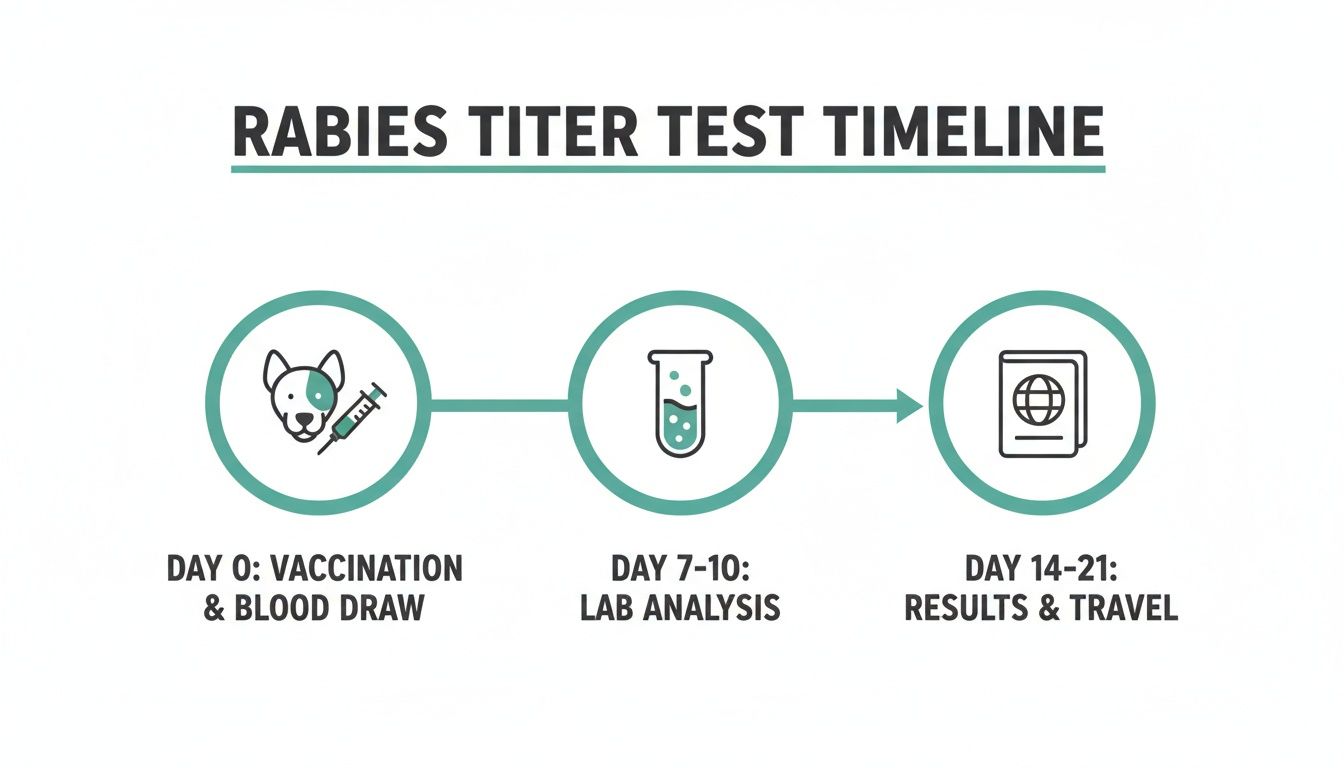
As you can see, from the initial vaccination to the day you fly, the process easily spans several months. This really drives home why planning far, far ahead is so important.
Country-Specific Rules and Common Mistakes
Every country plays by its own set of rules. What gets you into one destination won't necessarily work for another. Rabies-free places like the UK, Australia, and all the countries in the European Union have their own unique timelines and requirements. A one-size-fits-all approach is a recipe for a "ruff" experience.
Common mistakes can easily throw a wrench in your plans. Testing too soon after a vaccine, using a lab that isn't approved by the destination country, or having incorrect microchip details on the paperwork are all preventable errors that lead to heartbreaking delays and surprise costs.
The boom in pet travel has really driven the testing market. The global demand for rabies antibody titer testing was valued at $210 million in 2024 and is projected to more than double by 2033, all thanks to these international pet import rules.
To give you a quick idea of how different the rules can be, here’s a look at some popular destinations.
Key Rabies Titer Test Timelines for Popular Destinations
This table offers a quick glance at the typical waiting periods for common rabies-free regions. Just remember, these rules can and do change, so always double-check with the official sources for your destination country before making any plans.
Requirement/Step | European Union (e.g., France, Germany) | United Kingdom | Australia |
|---|---|---|---|
Microchip | Must be implanted before or at the same time as the rabies vaccine. | Must be implanted before or at the same time as the rabies vaccine. | Must be implanted before any procedures, including rabies vaccination. |
Rabies Vaccination | Must be given at least 21 days before travel. | Must be given at least 21 days before travel. | Must be administered by an approved veterinarian. |
Wait After Vaccination | Blood sample for titer test must be drawn at least 30 days after the rabies vaccination. | Blood sample for titer test must be drawn at least 30 days after the rabies vaccination. | Blood sample for titer test must be drawn 3-4 weeks after the rabies vaccination. |
Wait After Blood Draw | Must wait 3 months from the date of the successful blood draw before entry. | Must wait 3 months from the date of the successful blood draw before entry. | Must wait at least 180 days from the date the blood sample arrives at the lab before entry. |
Test Validity | Valid for the life of the pet, as long as rabies boosters are kept up to date. | Valid for the life of the pet, as long as rabies boosters are kept up to date. | Typically valid for 24 months, provided rabies boosters are current. |
As you can see, the waiting period for Australia is much longer than for the EU or UK. This highlights just how important it is to research your specific destination's rules the moment you know you might be traveling.
Getting all these details right takes careful attention. Our guide on international pet travel requirements breaks down more checklists to help you prepare. By starting early and checking every little thing, you can make the journey a smooth one for your furry family member.
Understanding Your Dog's Titer Test Results
After weeks of waiting, the email from your vet finally arrives with your dog’s titer test results. It can be a little nerve-wracking, but thankfully, reading the outcome is usually very simple. The entire test is designed to give a clear "yes" or "no" on your dog's rabies immunity for travel purposes.
When you open the report, you're looking for one key number. This figure shows the amount of rabies antibodies in your dog’s blood, measured in International Units per milliliter (IU/mL). It’s the official score that determines whether your travel plans get the green light.
The Passing Grade for Travel
For nearly every country requiring a titer test for rabies in dogs, the magic number is ≥0.5 IU/mL. A result of 0.5 IU/mL or higher is considered a “pass.” It’s the proof officials need that your dog’s immune system responded properly to the vaccine and is ready for international travel.
Think of it like a simple pass/fail exam. A score of 0.5 IU/mL is all you need.
A "pawsitive" outcome: This is the key piece of paper you need to move forward with your pet’s travel plans.
Green light for travel: It confirms your dog meets the immunity requirement, allowing you to proceed to the next step, which is usually a waiting period.
This passing certificate is a non-negotiable part of your pet’s travel paperwork. For a deeper dive into what makes vaccination records official, you can check out our guide on getting proof of a rabies vaccine.
What Happens If the Result Is Too Low
Getting a result below 0.5 IU/mL can feel like a setback, but don't panic. This isn't an uncommon scenario, and it definitely doesn't mean your dog is sick or that you did something wrong. It just means their individual immune response didn't quite hit the level needed for travel.
A low titer result isn't a health emergency; it's a solvable paperwork problem. It simply means the immune response wasn't strong enough for international travel standards, and the next step is to boost it.
If your dog’s test comes back low, the process is simple and effective. Your veterinarian will give another rabies vaccine, known as a booster. This extra shot is designed to create a stronger, more measurable immune reaction.
After the booster, the clock resets. You'll need to wait another 30 days (or whatever your vet recommends) before drawing blood for a new titer test. This really highlights why it's so important to start the travel prep process as early as possible. A low initial result can easily add a couple of months to your timeline, so building in extra time from the start is the best strategy for a stress-free journey.
Titer Tests vs. Regular Rabies Vaccinations
This is a really common point of confusion, so let's clear it up right away: a titer test for rabies in dogs is not a replacement for a regular rabies vaccination. They do two completely different, though related, things. Getting this right is the key to keeping your dog safe at home and ready for travel.
Think of it like this: the rabies vaccine is the training program for your dog's immune system. The titer test is the final exam that proves the training was successful and your dog is ready for the "big leagues" of international travel. One simply doesn't work without the other.
Two Different Jobs
A rabies vaccination is a proactive step. It causes your dog's body to create the protective antibodies it needs to fight off the virus. It's a preventive measure that is often required, forming the foundation of public health and responsible pet ownership.
The titer test, on the other hand, is a measurement. It just checks the level of antibodies that are already there. It doesn't give any immunity itself; it only confirms the immunity that the vaccine already built.
The rabies vaccine is the shield that protects your dog. The titer test is the certificate that proves the shield is strong enough to meet international standards. Your dog needs both to be fully covered.
Why You Can't Skip the Vaccine
Because rabies is so serious, many jurisdictions have rules that require dogs to stay current on their rabies shots. This rule stands firm, no matter what a titer test result says. The test is simply an extra layer of verification needed for crossing certain borders.
There’s a good reason for this. While a titer test is a fantastic tool for proving protection for travel, it isn't a substitute for regular shots. In the United States, for instance, individual states often set rabies vaccine requirements, and they may not accept titers for that purpose. You can learn more about how vaccine and titer regulations differ from the experts.
For your dog to be compliant with local rules and prepared for a trip abroad, they need both pieces of the puzzle: a consistent, up-to-date vaccination record and, when required, a valid titer test certificate. Wondering about that vaccine schedule? Check out our article on how often dogs need rabies vaccinations. Keeping that schedule is always the first step to any successful international journey.
Let's face it, planning a big trip is complicated enough. When you add a furry co-pilot to the mix, the paperwork and rules can feel like a whole other level of confusing. If you're looking at the titer test for rabies in dogs, you’ve probably got some questions.
We hear them all the time from owners and vet teams alike. Getting clear, straightforward answers is the first step to making this whole process feel a lot less daunting. Let’s break down the big ones.
How Long Is a Rabies Titer Test Good For?
This is easily the most common question we get, and the honest answer is: it depends. There’s no universal rule, and how long your dog's titer test is valid is entirely up to your destination country.
For many places, like the EU, a passing titer test is valid for the life of your pet. But there’s a huge catch—their rabies vaccinations can never lapse. If you’re even one day late for a booster, that lifelong validity goes out the window, and you’re back to square one.
Other countries play by different rules. For instance:
Some might only accept a test for a set period, like 24 months, no matter how perfect your dog's vaccine record is.
Travel regulations are always changing. What was true last year might not be true today.
The golden rule? Always, always check the specific rules for your destination country well before you plan to travel. Never assume one country’s requirements are the same as another’s.
What’s the Real Cost of a Rabies Titer Test?
The price tag for a rabies titer test can vary quite a bit, but you should probably budget somewhere between $200 and $500. It’s not just one fee, but a bundle of different services rolled into a single process.
So, what are you actually paying for?
The Blood Draw: Your vet’s fee for collecting the sample.
Sample Prep: The clinic's time to process the blood (spinning it down to get the serum) and package it correctly for shipping.
Shipping: The cost to get that precious sample to an approved lab, often overnight and under specific conditions.
The Lab Test: The fee the laboratory charges to actually run the analysis.
It’s very important that the test is performed by a lab officially approved by your destination country. Your vet can make sure the sample goes to the right place, so you don't get any "ruff" surprises from border officials when you land.
Uh Oh. What Happens If We Miss a Rabies Booster?
Missing a rabies booster is a big deal when it comes to international travel. If there's any gap in your dog’s vaccination history, most countries will immediately consider your existing titer test no longer valid.
This means you have to start the whole clock over again. The timeline would look something like this:
Get your dog re-vaccinated for rabies.
Wait the required 30 days before a new blood sample can be drawn for the test.
Draw blood for a new titer test for rabies in dogs and wait for the results.
Once you have a passing result, you still have to complete the destination’s waiting period, which can be 3 months or even longer.
This mistake can lead to major travel delays and extra costs. Staying on top of your dog’s vaccination schedule is the single best thing you can do to keep your titer test valid and your travel plans on track.
Feeling buried in timelines and paperwork? Passpaw is built to make managing international health certificates and travel rules simple. Our platform helps veterinary practices keep every detail organized, from titer results to vaccine records, ensuring your furry family member has a smooth and successful journey. See how we do it at https://passpaw.com.

More articles
From regulatory changes to best practices for veterinarians and pet owners, our resources keep you ahead of the curve.