Are you a team member in a veterinary practice?
Are you a pet parent planning a trip with your furry pal?
Cats to Germany: Your 2026 Relocation Guide
Moving to Germany with a cat rarely feels complicated at first. Then the details stack up fast. You may already have a flight in mind, a lease under review, and a rough moving date, but your cat's entry process runs on its own schedule, and German import rules do not forgive steps taken in the wrong order.
I see the same problem again and again. Owners focus on travel bookings first, then discover their vet needs to confirm microchip timing, vaccine dates, and the exact paperwork path for the country of departure. By that point, a simple plan can turn into a scramble.
The good news is that this process is manageable when you treat it as a workflow rather than a last-minute form chase. The cat's identification, the veterinary record, the health certificate, any required endorsements, and the original documents all need to line up. That is true for pet owners and for veterinary teams helping them. Modern digital tools help keep records organized, reduce version errors, and make it easier to spot missing steps before airport check-in.
Germany is well set up for life with pets, and daily life after arrival is often easier than the import stage. If you want a practical sense of what that looks like, this guide to life with pets in Germany is a helpful companion. Entry compliance is the part that needs discipline first.
A calm move usually starts with one question: what does your specific cat need, based on where you are traveling from and when each requirement was completed? That is the question to answer before anything else.
Your German Adventure Awaits Your Cat Too
A typical cats to Germany plan doesn't fail because people don't care. It fails because they're handling ten moving parts at once and assume the cat paperwork will be the easy bit.
One week you're comparing neighborhoods in Berlin or Munich. The next, your vet asks when the microchip was placed, your airline asks about the carrier, and someone in a relocation group says a scanned certificate should be fine. That's the moment stress spikes.

Germany is a country where pets are part of daily life, and if you're curious about what life can look like after arrival, this overview of pets in Germany is a useful companion read. The travel part, though, needs its own discipline.
What a calm plan looks like
The owners who get through this smoothly usually do three things well:
They start with the cat, not the flight. Identity and rabies timing come before route shopping.
They treat the paperwork as a workflow. Vet appointment, signatures, endorsement, original document handling, and airport timing all connect.
They don't improvise in the final week. Last-minute fixes are where the claws come out.
Germany isn't hard for prepared travelers. It's hard for rushed travelers.
That's the tone to keep in mind all the way through. You don't need luck. You need the right sequence, the right documents, and enough runway to correct anything early.
Preparing Your Cat The Core Health Requirements
Before anyone signs a certificate, your cat needs the health basics handled in the correct order. The process then either stays tidy or turns into a hairball.
Start with the microchip
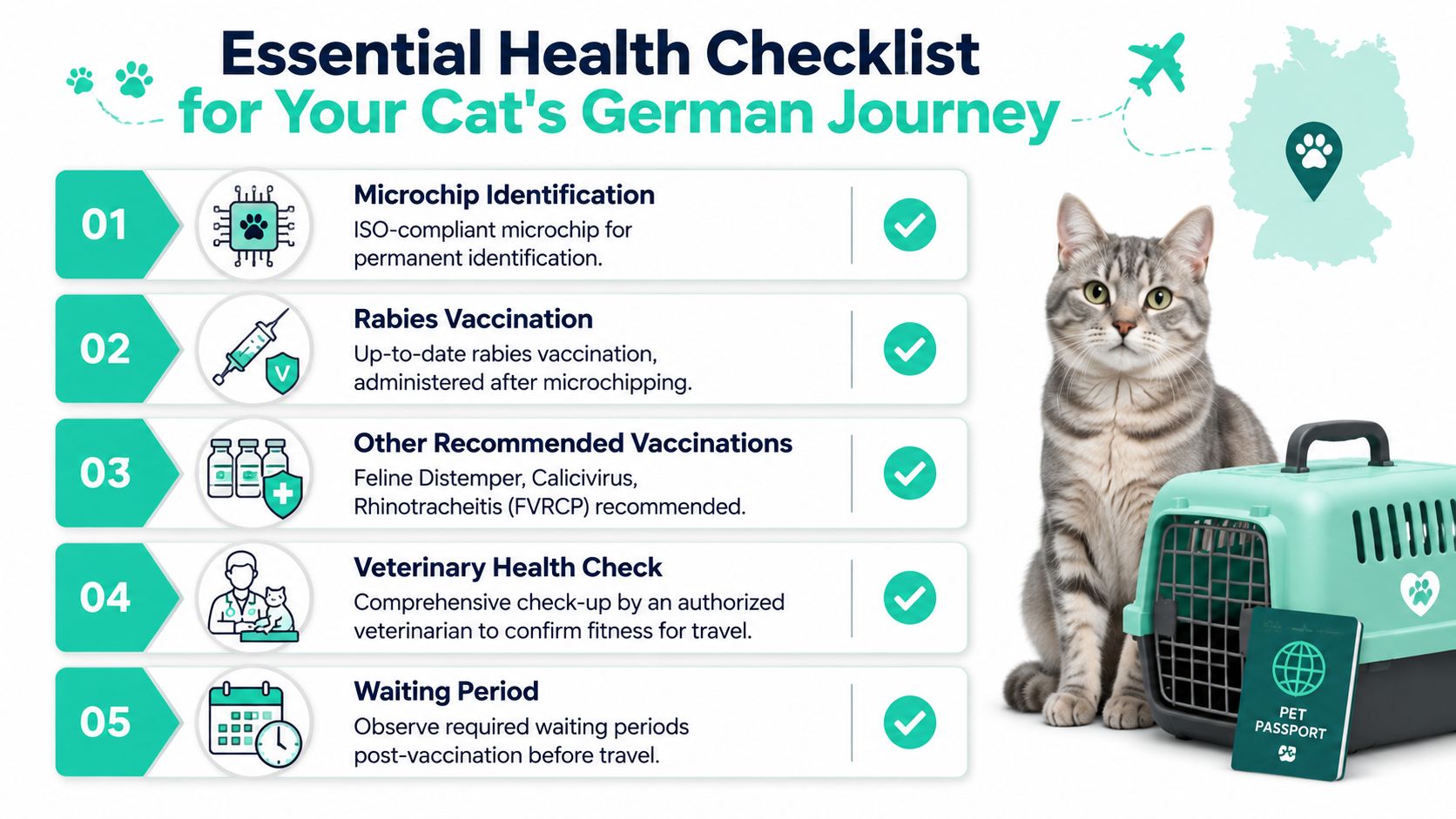
For cats entering Germany from the U.S., the required sequence begins with an ISO-compliant microchip. That chip has to go in first, before the rabies vaccination tied to travel eligibility.
Critical order: Microchip first. Rabies vaccination second. If the vaccination happened before the microchip, that sequence can create a compliance problem.
That order matters because the travel documents connect the cat's identity to the vaccine record. If those records don't line up cleanly, you may need to redo steps instead of updating paperwork.
A practical move is to ask your clinic to scan the chip at every travel-related appointment and confirm the recorded number matches every document exactly. One digit off is enough to create trouble later.
Rabies timing is not flexible
After microchipping, your cat needs a valid rabies vaccination. For U.S. travelers, there's a required wait of at least 21 days after a primary rabies shot before travel, as explained in PetRelocation's Germany guidance.
That waiting period isn't a paperwork formality. It's part of the travel eligibility timeline. Owners often run into problems when they count from the appointment date incorrectly or assume a recent shot means they can fly right away.
The same source notes the main failure modes for U.S. travelers are sequence errors and timing errors, especially microchipping after vaccination, missing the 21-day immunity period, or assuming an electronic certificate will clear border inspection. It also states that the endorsed paper original is mandatory.
What your vet team should verify early
A strong travel prep visit usually checks more than “Is the cat healthy?” It should confirm that the records support the actual import pathway.
Use this as a working list:
Chip status: Confirm the chip is ISO-compliant and readable.
Rabies record: Make sure the vaccine was given after the microchip and will still be valid at travel time.
Name matching: The owner name, cat description, microchip number, and vaccine details should match across records.
Travel readiness: Bring your cat's existing records together in one place, including any cat vaccination record history your clinic may need to review.
A cat can be healthy and still not be document-ready. For Germany, those are two separate checks.
Some clinics also discuss general travel fitness, crate comfort, and stress management at this stage. That part is smart, but it doesn't replace the import sequence. Health prep for cats to Germany starts with identity, rabies timing, and records that can stand up to inspection.
Decoding the Paperwork EU vs Non-EU Travel Rules
The paperwork path depends on where the trip begins. That's the fork in the road that clears up most confusion.
Two routes that look similar but aren't
Here's the practical split:
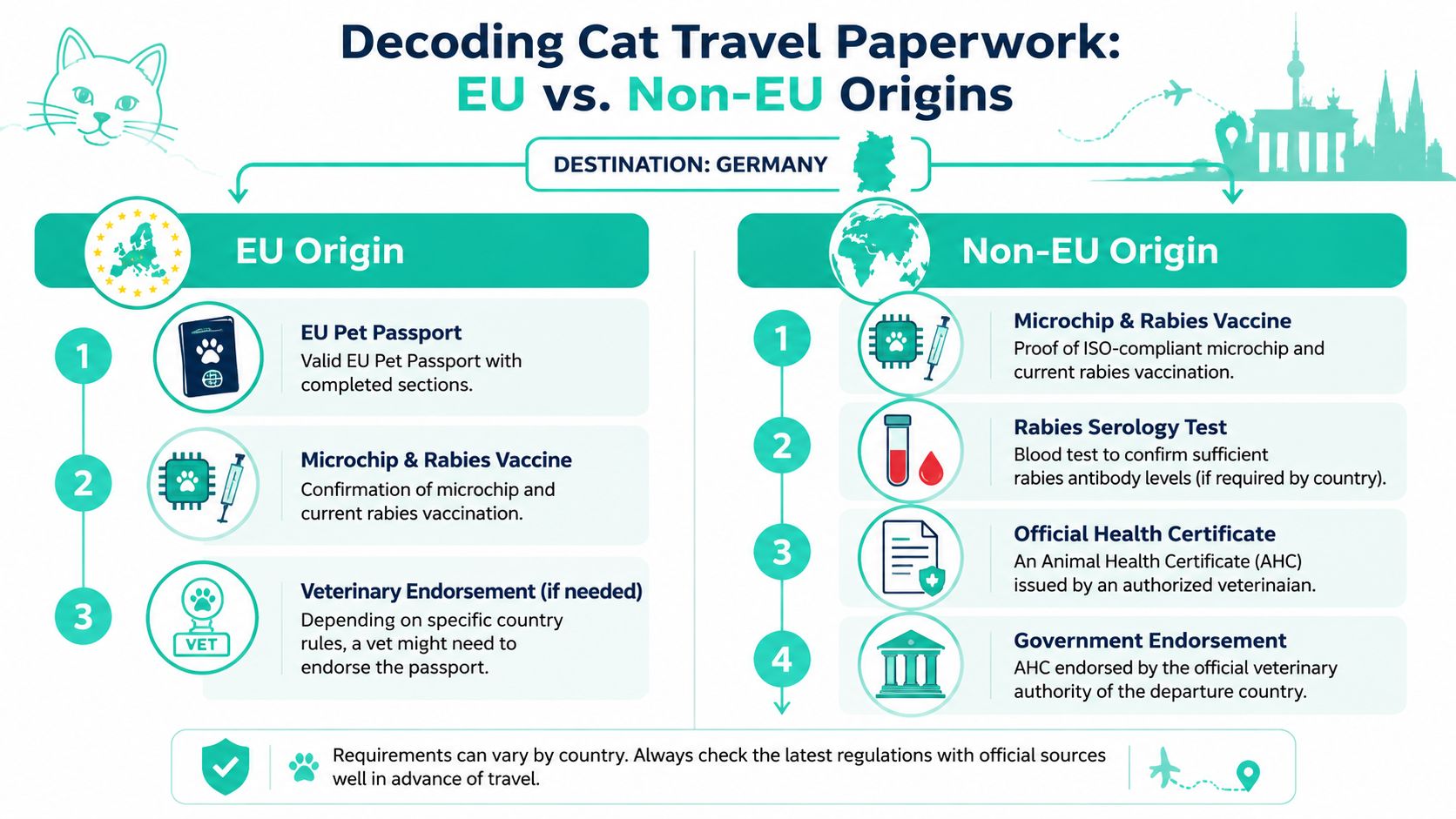
Origin | Main document path | Key issue |
|---|---|---|
From an EU member state | EU Pet Passport route | Passport details must be valid and current |
From a non-EU country | Health certificate route | Endorsement and country risk status matter |
For owners moving within the EU, the process is usually more straightforward. The EU Pet Passport is the anchor document, and the cat's microchip and rabies details need to be correctly entered and current.
For owners arriving from outside the EU, Germany uses the EU health certificate pathway. That's where many people underestimate the amount of coordination involved.
Non-EU travel means listed country versus higher-risk route
Not every non-EU departure country triggers the same steps. The biggest difference is whether the route requires rabies serology, also called a titer test.
Germany's official guidance states that for cats entering from high-rabies-risk or rabies-status-unknown countries, a rabies antibody titration test is required. The blood sample must be taken at least 30 days after vaccination and not later than 3 months before entry, and Germany notes the earliest import age for a young animal is 7 months because the vaccine, waiting period, blood draw timing, and entry wait all have to line up, as explained by the German Federal Ministry's pet entry rules.
That changes the planning calendar completely.
If your route requires serology, this stops being a short admin task and becomes a multi-month plan.
A simple way to consider this:
EU origin: keep the passport valid and records clean.
Non-EU listed country: health certificate workflow, plus the usual identity and rabies compliance.
Non-EU higher-risk country: health certificate workflow plus titer timing, which adds a long lead time.
What owners often miss in the document phase
The most common confusion isn't the name of the form. It's the dependency chain.
The vet can't fix a sequencing mistake with nicer paperwork. If the microchip and vaccine sequence is wrong, the document reflects the problem.
The route determines the burden. A cat leaving from one country may need a very different timeline than a cat leaving from another.
Costs vary by clinic and country. If you're budgeting the certificate side of travel, Get Pet Vet's guide to AHC costs gives a useful real-world frame for the document portion.
For owners trying to organize the whole process in one place, broad international pet travel requirements can help you map the destination rules before you book anything irreversible.
The biggest win here is choosing the correct lane early. Once you know whether you're in the EU passport route, the standard non-EU health certificate route, or the titer route, the rest of the plan gets much easier to manage.
The Final Countdown Your Pre-Travel Timeline
The last stage is where good plans wobble. Not because the rules change, but because the timing gets tight.
For U.S. cats to Germany, the final document step is short-dated. The bilingual EU health certificate must be ink-signed by a USDA-accredited veterinarian, then physically endorsed by USDA APHIS, and the endorsed certificate must be used within 10 days of APHIS endorsement for travel to the EU. That makes the closing phase a logistics sprint, not a casual form upload.
Build backward from the flight
A workable final timeline usually starts with the intended arrival date and moves backward through each dependency.
Choose the flight only after the health timeline is secure. Direct routes are often easier to manage than multi-leg trips.
Book the final vet appointment close enough to travel. The certificate details need to match the actual trip.
Allow time for physical endorsement handling. This isn't a digital clearance exercise.
Keep the original document protected and accessible. Don't pack it in checked luggage.
If you're traveling with more than one animal, remember that Germany follows EU entry rules that have applied since 29 December 2014, including a limit of 5 pets per person for non-commercial transport, and all pets are subject to document and identity checks on entry, according to World Bank trade-linked Germany entry notes.
Flight prep that actually helps
Owners often spend a lot of time shopping carriers and not enough time preparing the cat to use one calmly.
A better pre-flight routine looks like this:
Leave the carrier out at home: Let your cat sleep in it, sniff it, and claim it.
Use familiar bedding: A known smell can take the edge off airport and cabin stress.
Confirm airline pet rules directly: Carrier dimensions, check-in timing, and seasonal limits vary.
Keep a paper folder: Put the endorsed certificate, vaccine record copies, and booking details together.
The crate isn't just transport equipment. It's part of the cat's stress management plan.
What does not work at the end
These are the habits that create last-minute panic:
Booking first and solving documents later
Assuming a courier delay or office closure won't matter
Bringing only scans on a phone
Changing flights after the certificate is prepared without checking document impact
If you're driving into Germany after entering the EU elsewhere, the same mindset still applies. Your route, first entry point, and original paperwork all matter. Treat the final week like a live operations window, because that's exactly what it is.
For Vets and Pros A Smarter Workflow for Pet Travel
A Germany case often looks manageable until the clinic tries to build the file. The owner has one vaccine record on a phone, the microchip number in an old invoice, a flight already booked, and urgent questions about timing. The veterinarian still has to confirm eligibility, prepare the right certificate path, and make sure every detail matches before the papers leave the practice.
That is why pet travel is a workflow problem as much as a medical one.
For clinics and travel coordinators, the pressure rarely comes from one hard rule. It comes from handoffs. Reception collects partial history. A nurse chases dates. The vet reviews the record. The owner sends another attachment that changes the timeline. If no one is working from the same case view, small errors survive long enough to become expensive ones.
The friction points are predictable:
Records are scattered: Vaccine history, chip details, owner messages, and draft documents sit in different places.
Deadlines get missed: Endorsement windows and waiting periods are easy to lose track of when the team is managing travel cases alongside routine appointments.
Clients need repeated coaching: The same questions about originals, signatures, routing, and timing come up in every case.
One mismatch creates rework: A single wrong digit in the microchip field can force the team to stop, verify, and correct documents under time pressure.
Teams that handle these cases well build a repeatable intake and review process. They collect the chip number early, verify the rabies sequence against the destination rule set, assign task ownership, and track deadlines in one place. That reduces stress for staff and gives owners clearer answers sooner.
Digital tools help because they reduce the two mistakes I see most often in export work. Missing information at intake, and inconsistent information across documents. A shared platform with case timelines, destination-specific requirements, document upload, and status tracking gives the clinic and the owner one working record instead of a chain of emails.
That matters for accredited veterinarians in particular. Clinics that are building or refining export services can use resources like this USDA accreditation guide for veterinarians to tighten their process around who prepares what, when records are reviewed, and how endorsement readiness is checked before submission. Passpaw itself is a cloud-based tool for organizing pet travel document workflows, checking destination requirements, and keeping the team aligned on tasks and dates.
Owners do not judge the case by how hard the regulations are. They judge it by whether the process feels controlled.
A cleaner workflow protects appointment time, cuts avoidable back-and-forth, and lowers the odds of last-minute document failure. For Germany-bound cat travel, that is often the difference between a routine departure and a preventable crisis.
Common Pitfalls and Final Questions Answered
Most cats to Germany issues come down to a short list of avoidable mistakes. The trick is catching them before the airport does.
The pitfall list
Sequence mistakes: The chip and rabies order must line up with the import pathway.
Timing mistakes: Waiting periods and endorsement windows don't bend because the flight is convenient.
Document assumptions: A phone scan is not the same as the required original paper.
Transit confusion: Multi-leg trips can change what has to be ready at the first EU arrival point.
A particularly common snag is transit. The USDA notes that under EU transit rules, certain pets transiting the EU to a final destination outside the EU may not need an EU health certificate, but if your itinerary includes a stopover or multi-leg route into Germany, the paperwork must comply with German entry rules at the first point of entry, as explained in the USDA APHIS Germany pet travel guidance.
Final questions owners ask right before departure
What happens when I land in Germany?
Expect document and identity checks. Border officials may review the paperwork and verify the cat's identification against the records. Smooth entry usually comes down to whether the documents are complete, original, and consistent.
Can I travel with a cat that has an ongoing health issue?
Often yes, but the travel decision should be discussed with the treating veterinarian well before the final certificate appointment. Import compliance and travel fitness are related, but they aren't identical.
What if I'm entering Germany by car instead of flying?
The route still matters. If you enter the EU in another country first, that first entry point can drive the inspection and document expectations. Don't assume that driving makes the paperwork looser.
Is a layover in the EU “just a layover”?
Not always. That's why transit planning deserves as much attention as the certificate itself. A route that looks harmless on a booking screen can create a paperwork problem if the first EU stop becomes the practical point of entry.
The safest mindset is simple. Treat the itinerary and the paperwork as one package.
If you're coordinating a move and want the paperwork side to feel less chaotic, Passpaw gives pet owners, clinics, and travel coordinators one place to manage requirements, documents, and deadlines for international pet travel. For cats going to Germany, that kind of shared workflow can help prevent the small mistakes that cause the biggest delays.

More articles
From regulatory changes to best practices for veterinarians and pet owners, our resources keep you ahead of the curve.