Are you a team member in a veterinary practice?
Are you a pet parent planning a trip with your furry pal?
What Is an Export Certificate: 2026 Pet Travel Explained
You've booked the flight. You've found the pet carrier. You may have even practiced the airport walk with a very unimpressed cat or an overexcited dog. Then the paperwork appears, and one phrase keeps popping up: export certificate.
That's usually the moment people get nervous.
I've seen this happen with first-time pet parents and with veterinary teams helping clients move abroad. The travel plan feels clear until the documents enter the chat. Then simple questions turn into stressful ones. Is this just a vet note? Is it the same as a pet passport? If I already have it, can the airline or border staff still say no?
Those are fair questions. Pet travel paperwork can feel like a game of fetch where the ball keeps landing in a different country.
The short answer is this. An export certificate is an official document used to show that something being exported meets the importing country's requirements. In pet travel, that usually means the health paperwork that supports your pet's legal entry into another country. The tricky part is that the certificate isn't just about what was true on the day it was issued. It also has to match the destination country's current rules when your pet travels.
That's where many people get caught off guard.
If you're still sorting out the travel side of the journey, this guide to pet friendly private jet travel is a useful overview of how transportation options affect the experience for pets and owners alike.
Your Pet's Ticket to Ride An Introduction
A family plans a move overseas with their terrier. They've done the big things right. Vaccines are current, the crate is airline-ready, and the new apartment allows pets. Then the destination country updates one entry rule after the health paperwork has already been prepared.
Suddenly, the document that looked complete isn't enough.
That's the part most basic guides skip. People often treat pet travel paperwork like a fixed pass. Get the stamp, put it in a folder, head to the airport. In real life, an export certificate works more like a time-sensitive snapshot. It shows that your pet met certain entry conditions at a specific point in time. If those conditions shift before travel, the document may need to be reviewed or redone.
A good certificate helps. A current certificate helps even more.
For pet travel, the export certificate is usually the international health certificate or closely related official paperwork used for border entry. It pulls together the facts officials care about most, such as your pet's identity, vaccination status, treatment history, and exam details.
What matters is not just having a certificate. What matters is having the right certificate, completed in the right order, within the right timeframe, for the right destination.
That sounds like a lot, but it becomes manageable once you know what each piece does and why timing matters so much.
What Exactly Is an Export Certificate
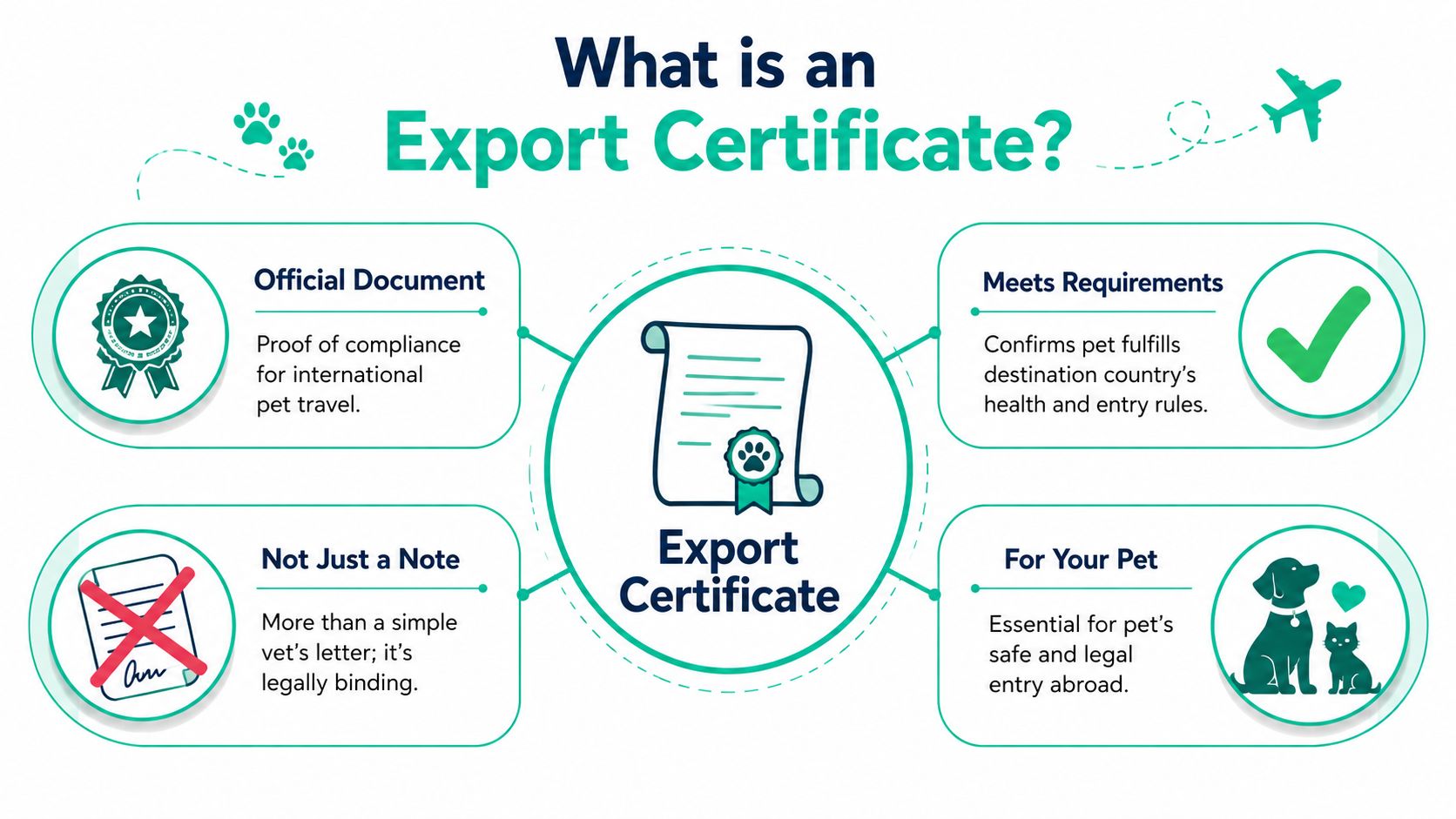
An export certificate for a pet works differently from a personal passport. A passport mainly establishes identity. An export certificate records that the pet met a destination country's entry conditions at the time the document was completed and endorsed.
That difference matters more than many owners expect.
In trade settings, an export certificate is an official attestation from a competent authority. The FDA explains, in its guidance on food export certificates, that a certificate is not the same as product approval and does not block later regulatory action if problems are found. The same basic principle helps explain pet travel paperwork. The certificate is evidence for the receiving country. It is not a forever guarantee.
For pets, that evidence usually appears in the form of an international health certificate tied to one destination and one travel window. If you want a fuller explanation of the document itself, this guide to a pet health certificate for international travel breaks down the core purpose and contents.
Why the word “certificate” causes trouble
The word sounds permanent. It suggests a finished task, like a diploma or a business license hanging on a wall.
Pet export paperwork behaves more like a dated lab result. It can be accurate on Tuesday and unusable on Friday if the destination country changes a form, adds a treatment rule, shortens the exam window, or starts requiring a different endorsement path. That is the dynamic validation crisis behind pet travel paperwork. The document itself is static, but the rules it must satisfy can change while travel plans are still in motion.
Veterinarians see the practical side of this quickly. A certificate may be completed correctly, based on the rules available that day, and still need revision before departure because the destination authority updates its instructions. First-time pet owners often assume the mistake must be in the clinic paperwork. Sometimes the paperwork is fine. The rulebook moved.
What the certificate is actually proving
For border officials, the export certificate usually answers a small set of questions:
Is this the identified animal that is supposed to travel?
Were the required vaccines, tests, and treatments completed in the right order?
Did a licensed veterinarian examine the pet within the required time window?
Has the proper authority endorsed the paperwork, if the destination requires that step?
So the certificate is less a permission slip and more a compliance snapshot. It shows that the pet matched the destination's checklist at a specific moment.
That is why a simple note saying a dog or cat is healthy does not carry much weight at the border. Officials are not asking only, “Does the pet look well?” They are asking, “Does this record match our current import rules, line by line, today?”
That last word, today, is the part many guides gloss over. For pet travel, understanding an export certificate means understanding both the document and the moving target behind it.
The Different Breeds of Export Certificates
A pet owner may hear “export certificate” and assume there is one standard form for every international trip. In practice, the term works more like “medical record.” It describes a category, not a single document.
That distinction matters because pets travel under a narrower, more change-sensitive set of rules than ordinary goods. A certificate for a product might confirm origin or legal sale status. A certificate for a live animal has to match species-specific, country-specific, and often date-specific entry rules that can shift while travel is being arranged.
A quick way to sort them out
Certificate type | What it generally helps prove | Why authorities care |
|---|---|---|
Certificate of Origin | Where goods come from | Tariff treatment and trade agreement review |
Certificate of Free Sale | That a product is legally marketed in the country of origin | Regulatory review for imported goods |
Certificate of Health | Health-related compliance for certain exports | Entry and safety checks |
Pet international health certificate | A pet's travel-specific compliance details | Border clearance for live animal entry |
For pet travel, the document that usually matters is the international health certificate. It is the version built around an individual animal, a specific itinerary, and the destination country's current import instructions.
The easiest comparison is this. A general export certificate often supports the movement of goods in a broad category. A pet certificate works more like a timed exam paper tied to one patient. If the destination changes the question set, yesterday's correct answer can stop being acceptable.
Why the pet version needs closer attention
Veterinary teams often see this firsthand. The owner brings in vaccine records, the pet is examined, the form is prepared, and everything looks in order. Then the destination updates a treatment window, changes an endorsement rule, or revises the accepted certificate template. The document itself has not changed, but its validity may have.
That real-time validation problem is what makes pet certificates different from the examples people find in broader export guides. The challenge is not only filling out the right form. It is confirming that the right form is still the right form close to departure.
A missing tapeworm treatment time, an outdated annex, or one digit wrong in a microchip number can stop clearance at the border. For a first-time pet owner, that can feel arbitrary. For a veterinarian, it usually reflects a system that checks precise compliance points, not general good intent.
If you want a practical explanation of how this document differs from routine clinic paperwork, this guide to the pet health certificate process is a helpful reference.
To border officials, the certificate is working proof that this specific pet met this specific country's requirements at the time of review.
Anatomy of a Pet Health Certificate
A pet health certificate works like a snapshot taken on a moving train. The details on the page may be accurate when the veterinarian signs it, but a destination country can still change the rules before departure. That is the part many pet owners find surprising, and many clinics end up managing in real time.
The details that usually matter most
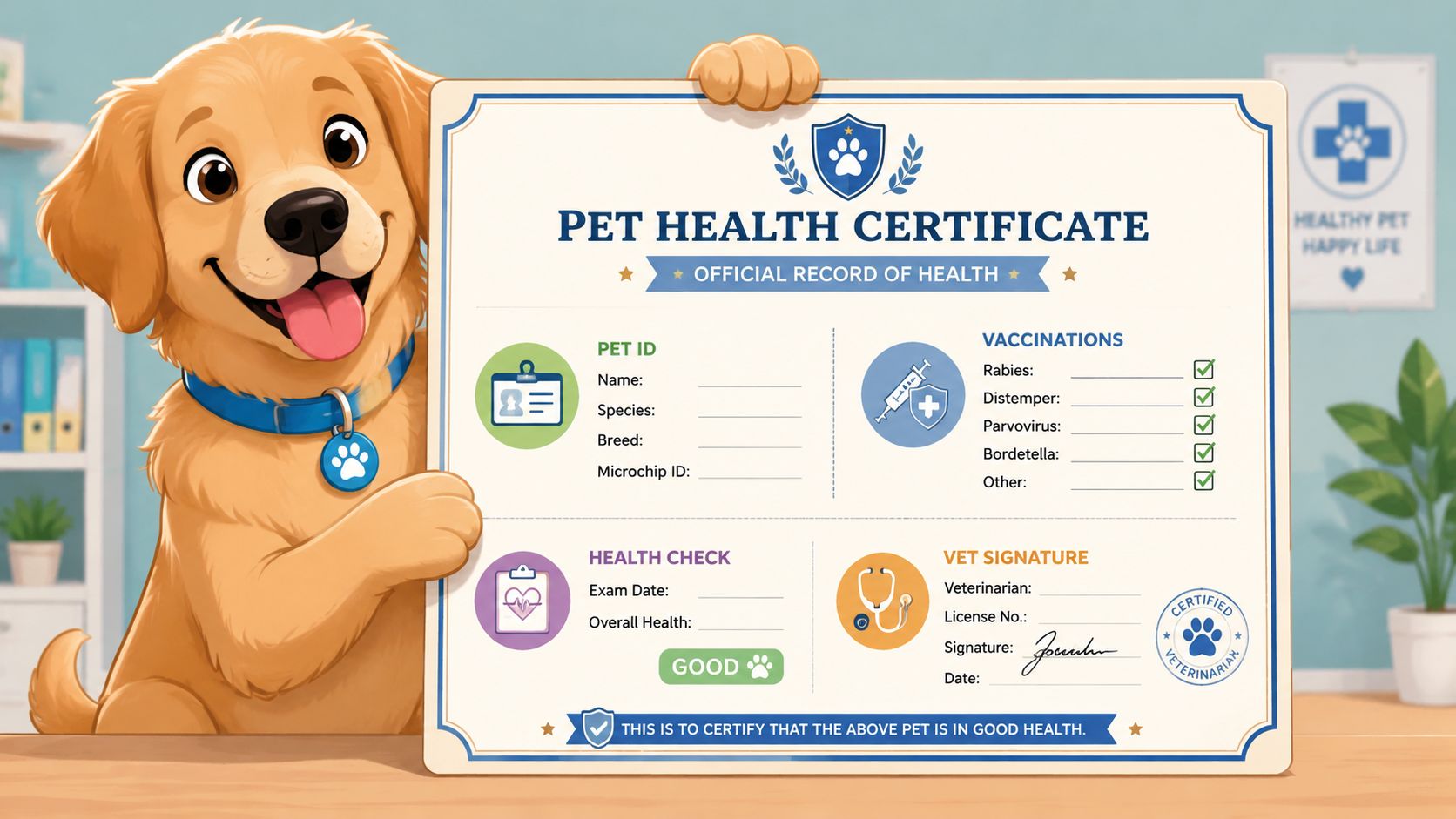
Most pet travel certificates contain the same core fields, but each one serves a specific border check.
Pet identification. Species, breed, sex, color, age, and the microchip number help officials confirm that the animal in front of them matches the animal in the records.
Owner information. This ties the pet to the person legally responsible for the trip and the supporting paperwork.
Veterinary exam details. The certificate records when the accredited veterinarian examined the pet and whether it appeared fit for travel at that time.
Vaccination records. Rabies information is often the focal point, including the vaccination date, product details, and how that vaccine lines up with the microchip record.
Treatments and testing. Depending on the destination, this may include parasite treatment, blood testing, or other lab evidence completed inside a strict time window.
Official signatures and endorsements. Some countries accept only a specific certificate version, signing format, stamp, or government endorsement path.
Why each line exists, and why timing changes everything
Each line answers a border question.
Pet identification answers, “Is this the same animal named in the lab report and vaccine record?” Vaccination and treatment entries answer, “Was the requirement completed in the right order and within the accepted dates?” The signature and endorsement section answers, “Was this document issued through the approval process this country currently recognizes?”
That last word matters. Currently.
A certificate can be complete and still fail review if the destination changes a treatment window, switches to a new template, or revises how endorsement must be done. For example, the treatments and testing section may have been correct on signing day, but a rule update can make that same entry too old, too early, or recorded on the wrong form by departure day.
That is the real-time validation problem. The paper is static. The rulebook is not.
Why one-size-fits-all fails
Two certificates can look nearly identical and lead to very different outcomes. One may clear without issue. The other may be rejected because the microchip was entered with one digit off, the rabies vaccine was given before the chip was implanted, or the parasite treatment fell outside the accepted hour range.
For first-time pet owners, this can feel picky. For veterinary teams, it helps to view the certificate as a customs checklist rather than a routine medical summary. Every field has to match the destination's current logic, not just general good clinical recordkeeping.
If you want a plain-language companion explanation, this guide to what a pet health certificate is and how it works gives the broader picture.
A pet health certificate works like a custom clearance form for one animal, tied to one itinerary, under one country's current rules.
That is why copying an older certificate, reusing a friend's template, or relying on a checklist from months ago creates risk. The certificate is only as good as the rules it is being measured against on the day it is reviewed.
Your Step by Step Guide to Getting a Certificate
Your exam is booked. Your flight is on the calendar. Then the question that catches many owners and even busy clinics appears: which certificate, signed by whom, and how close to departure?
The safest way to handle it is to treat the certificate like a timed clearance process, not a single form. A boarding pass is only useful for the right flight on the right day. Pet export paperwork works in much the same way. It has to match the destination's current rules, your pet's records, and the travel timeline at the same time.
Start with the destination, not the appointment
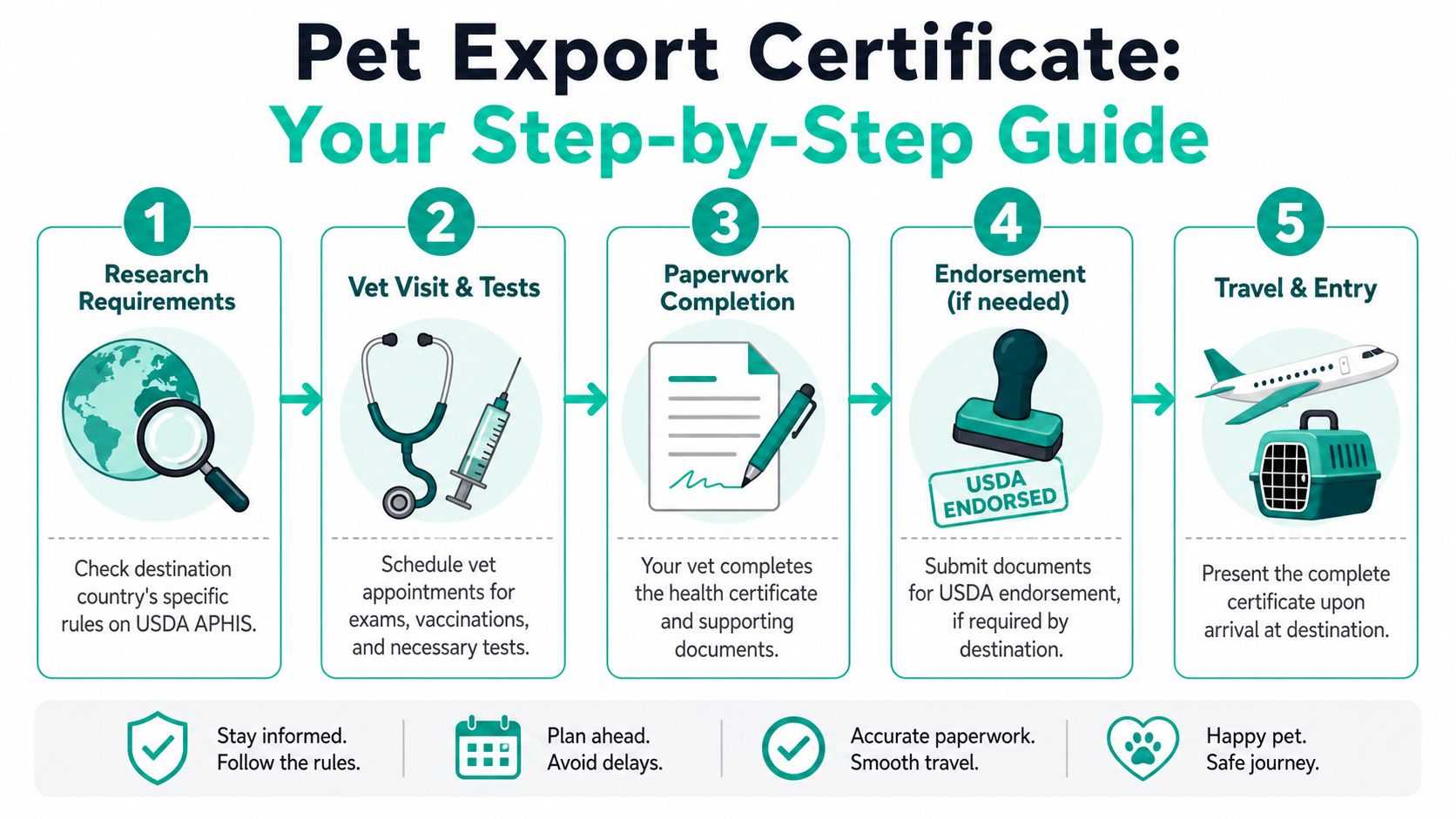
A common early mistake is booking the exam before confirming what the destination country requires. That can leave you with the wrong certificate, a lab test drawn too early, or a treatment given outside the accepted window.
A better sequence is:
Check the current rules for the destination country and any transit country.
Confirm the itinerary so the certificate matches the actual route and departure date.
Count backward from travel to schedule exams, tests, treatments, and submission steps in the right order.
This order matters because some requirements age out quickly. Others create waiting periods. A document can be accurate on the day of the visit and still become unusable if a rule changes or the travel date shifts.
Book a veterinarian who handles travel certificates
International pet travel paperwork is not the same as a routine wellness visit. The clinic needs to know the destination's format, timing rules, and whether an official endorsement is part of the process.
When you call, ask direct questions:
Do you prepare international pet health certificates for this destination?
What records should I send before the appointment?
Do any tests or treatments need to happen before the exam date?
Will this certificate need government endorsement after the veterinarian signs it?
Those questions save time because they surface gaps early, while there is still room to fix them.
Gather records before anyone starts typing
Certificate errors often begin long before the form is filled out. They start with missing vaccine documents, an unclear microchip number, or records from different clinics that do not line up neatly.
Bring or send these ahead of the exam:
Microchip record
Rabies certificate
Other vaccine history, if required
Lab results
Treatment dates and products used
Travel itinerary
Owner and consignee contact details
Earlier import or export paperwork, if relevant
For veterinary teams, this step works like medication reconciliation. You want one clean, consistent file before the final document is created.
Complete the exam and certificate inside the valid window
Many countries allow only a short period between the clinical exam and arrival or departure. That means timing is part of the document's validity, not an administrative detail.
This is also where real-time validation issues show up in practice. If the destination updates a form, changes a treatment window, or adds an endorsement rule after the appointment, a certificate that looked complete can suddenly need revision. Static paperwork is vulnerable to moving rules.
For a plain-English walkthrough of the endorsement stage, this guide on how to get a USDA-endorsed pet health certificate explains the handoff clearly.
Get endorsement if the destination requires it
Some certificates are not ready for travel when the veterinarian signs them. They also need review and approval from the relevant government authority.
That extra step matters because a signed form and a travel-ready form are not always the same thing. Before you treat the file as finished, confirm that every required signature, stamp, upload, and supporting record has been completed in the correct order.
Practical rule: A certificate is only ready when it matches the current country rules, the pet's records, and the departure timeline all at once.
Common Pitfalls That Can Ground Your Pet
Most travel problems don't come from dramatic mistakes. They come from small, ordinary ones. A date entered in the wrong box. A treatment given outside the accepted window. A certificate prepared as if rules stayed frozen after issue.
The biggest blind spot is thinking the certificate stands alone. In some export contexts, that assumption causes immediate trouble. For certain non-prescribed goods, a high percentage of rejected export certificate applications fail because the exporter applied for the certificate without a prior, valid export permit, rendering the certificate legally void, as noted by Passpaw's export compliance guidance.
The pet travel version of that same problem
In pet travel, the equivalent mistake is assuming that once the certificate exists, it's automatically enforceable. That isn't always true.
A certificate can still fail in practice when:
The destination requirements changed after issue
A required prior step wasn't completed
The travel date moved outside the allowed window
Supporting records don't match the certificate exactly
The static document problem
This real-time validation issue often catches people off guard. Owners often think of the health certificate as a final product. In reality, it's often more like a live compliance file trapped in a static document.
That's why the final pre-travel check matters so much. A certificate that was correct when signed may need review again before departure if rules, routing, or dates change.
A short caution list
Before you leave for the airport, review these details one more time:
Names and numbers. Your pet's microchip number and identifying details should match every record.
Dates. Exam, vaccination, and treatment timing should line up with the destination's rules.
Signatures and stamps. Missing validation is a common paperwork trap.
Current rules. Check whether anything changed after the certificate was prepared.
A little extra checking can save a lot of tail-chasing later.
How Passpaw Tames the Paperwork Tiger
The hardest part of pet export paperwork isn't just collecting information. It's keeping the whole file aligned while dates, requirements, and travel plans move around.
That's where software can help, especially for veterinary practices managing multiple cases at once. Passpaw's pet travel workflow tools are designed for handling international health certificate tasks, organizing travel-specific requirements, and supporting document management when destination rules need close tracking.
For clinics and pet owners, the practical value is simple. A system that checks documents against current destination requirements can reduce the risk of treating the certificate as static when the rules are not. It can also help teams organize tasks by travel date, collect complete information earlier, and keep communication in one place.
That matters for privacy, too. Travel files often contain medical records, owner details, and identification information. If your team is thinking about safer document exchange practices in general, these tools to protect sensitive information offer useful context for handling paperwork securely.
The goal isn't to make bureaucracy cute. Some paperwork will always be a bit ruff. The goal is to make the process clearer, more current, and less fragile when timing matters.
If you're coordinating pet travel and want a simpler way to manage certificates, changing destination rules, and client communication, take a look at Passpaw. It's built to support veterinary teams and pet owners through the international pet health certificate process with clearer workflows and fewer last-minute surprises.

More articles
From regulatory changes to best practices for veterinarians and pet owners, our resources keep you ahead of the curve.