Are you a team member in a veterinary practice?
Are you a pet parent planning a trip with your furry pal?
Flying With United Airlines Pets: A 2026 Guide
Planning to fly with your furry co-pilot on United? It’s absolutely paw-sible, but your options hinge almost entirely on one thing: your pet’s size. The path you take is decided by whether they can fit in a carrier under the seat in front of you.
Small pets can fly in the cabin with you, while larger animals would need to travel through United’s PetSafe cargo program (when available).
Understanding Your Pet's Travel Options on United
Figuring out airline pet policies can feel overwhelming, but on United Airlines, it boils down to two main paths. Your pet will either travel with you in the cabin or as special cargo through a program called PetSafe.
Think of it like choosing a seat on the plane. In-cabin travel is like an economy seat for your pet, tucked safely under your own. PetSafe, on the other hand, is a specialized shipping service for animals, with its own set of rules, handling procedures, and dedicated space.
In-Cabin vs. PetSafe: The First Big Decision
Your first and most important step is figuring out which category your pet falls into. The difference is simple but important, as it determines everything that comes next.
Generally, only small dogs and cats can fly in the cabin. If your pet is too large to stand up and turn around comfortably inside a carrier that fits under the seat, then PetSafe is the other option to consider, if available.
The rules for each travel method are completely different:
In-Cabin Travel: This is for small pets who can remain in their approved carrier for the entire flight. The carrier must fit neatly under the seat, which means size and weight limits are very strict.
PetSafe Cargo: This service is designed for larger animals that can't fly in the cabin. It uses pressurized, temperature-controlled cargo holds but involves a more complex booking process and has very specific crate rules.
Key Takeaway: The single biggest factor determining how your pet flies on United is whether they can fit in a carrier under the seat. This simple test will direct all your next steps.
To help you see the differences more clearly, here is a quick comparison of the two programs. Understanding these points will get you ready for the next steps in booking your pet’s flight.
United Airlines Pet Travel Options At a Glance
The table below breaks down the key differences between flying with your pet in the cabin and using the PetSafe program.
Feature | In-Cabin Pet Travel | PetSafe Cargo Travel |
|---|---|---|
Pet Location | Under the seat in front of you | Pressurized, temperature-controlled cargo hold |
Eligible Pets | Small dogs and cats only | A wider variety of animals, but with breed restrictions |
Size Limit | Must fit in a small, airline-approved carrier | Based on crate and animal weight; for larger pets |
Booking | Added to your own reservation | Separate booking process with specific requirements |
Once you've figured out whether your pet will be flying in the cabin or via PetSafe, you can move on to the specific requirements for booking, crate preparation, and paperwork.
Flying With Your Pet in the Cabin
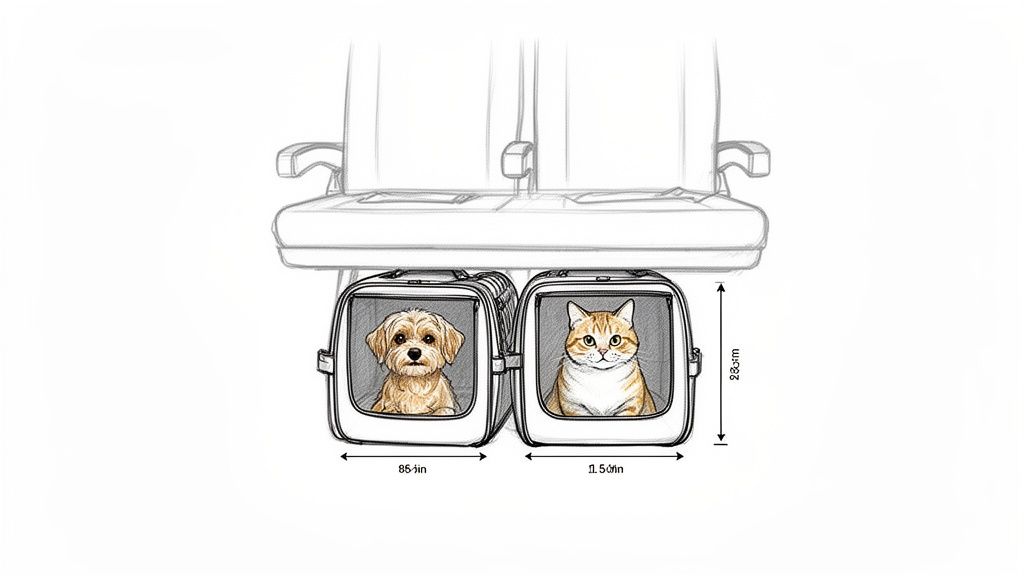
For a lot of us, the thought of our furry friend flying in the cargo hold is simply a no-go. The good news? United Airlines gets it. If you have a small dog or cat, they can travel right there with you in the cabin, tucked safely under the seat in front of you.
This is a hugely popular option, which means you need to be on the ball. As soon as your travel plans are set, book your pet’s spot. United only allows a handful of pets in the cabin on each flight, and those slots fill up fast. Don't let this be a last-minute scramble!
Understanding In-Cabin Eligibility
First things first, your pet has to be a household dog or cat. They also must be able to stay comfortably inside their closed carrier for the entire flight. This is a strict rule for the safety and comfort of everyone on board.
Now, let's talk baggage. The key thing to remember is United's “one-plus-one” rule. Your pet's carrier counts as one of your baggage items. From there, you can bring either a personal item or a standard carry-on, but not both.
Option 1: Your Pet Carrier + a Personal Item (like a purse or small backpack)
Option 2: Your Pet Carrier + a Carry-on Bag (which will have to go in the overhead bin)
This means you’ll have to pack smart and decide what’s more important: the extra personal bag or the larger carry-on.
Approved Carrier Dimensions
This might be the single most important step. If your carrier doesn't fit under the seat, you and your pet won't be flying. United is very specific about the maximum dimensions for both hard and soft-sided carriers.
Carrier Size Requirements:
Hard-sided kennels: Maximum dimensions are 17.5 inches long x 12 inches wide x 7.5 inches high.
Soft-sided kennels: Recommended maximum dimensions are 18 inches long x 11 inches wide x 11 inches high.
In our experience, soft-sided carriers are usually the better bet. Their flexibility gives you a little more wiggle room to fit into the under-seat space, which can vary from one plane to the next. For a complete breakdown, you can learn more about the United Airlines pet policy for in-cabin travel.
Critical Tip: Be aware that some aircraft, like the Boeing 737 MAX, have notoriously tight under-seat spaces. On these planes, the carrier height limit can be as low as 10 inches. Always, always check your aircraft model in your reservation to avoid a very stressful surprise at the gate.
Booking Your Pet's Spot
Adding your pet to your flight is pretty straightforward. When you're booking your own ticket on the United website, just look for the "Add pets" option during the process.
The fee for an in-cabin pet is currently $125 each way. Keep in mind there’s also an additional $125 service charge for any stopover longer than four hours on a domestic flight or more than 24 hours on an international itinerary.
What if you have two small pets? United allows this, but you'll need to purchase a second, adjacent seat for the second pet. Each animal needs its own approved carrier, and you'll have to pay the $125 pet fee for each one. This just ensures both of your companions have their own designated under-seat space.
Understanding the United PetSafe Cargo Program
So, what happens if your furry travel companion is too big to fit under the seat in front of you? Or if you’re traveling with an animal other than a small dog or cat? In those cases, the conversation turns to cargo, and for United, that means the PetSafe program.
It's important to understand that PetSafe is a completely different ballgame from bringing a pet in the cabin. This is a dedicated animal cargo service. Your pet travels in a temperature-controlled, pressurized hold—not with the luggage. This means a separate booking process, different drop-off and pickup spots, and a much stricter set of rules designed for the complex logistics of transporting live animals.
Who Can Use the PetSafe Program
While in-cabin travel is strictly for small dogs and cats, the PetSafe program was historically the solution for a much wider range of animals. However, here's the most important thing you need to know right now: United's PetSafe program has been suspended for the general public for quite some time.
As of 2026, this cargo service is almost exclusively reserved for active-duty U.S. military personnel and U.S. State Department Foreign Service Officers traveling on official orders.
For most pet owners, this means you'll need to look at other airlines if your pet is too large for the cabin. It’s always smart to compare your options, and our guide on which airlines accept dogs in cargo is a great place to start your search for alternatives.
Even when it was open to everyone, the program had major restrictions, especially around certain breeds—rules that reflect serious safety concerns across the entire airline industry.
Brachycephalic (Short-Nosed) Breed Restrictions
One of the trickiest issues in pet air travel involves brachycephalic, or short-nosed, breeds. We’re talking about dogs and cats with those adorable flat faces, like Pugs, French Bulldogs, and Persian cats. Their unique anatomy makes them extremely vulnerable to breathing problems, particularly under the stress and altitude changes of air travel.
United’s history with these breeds is complicated. For a while, United was one of the few carriers that would accept them in cargo, a policy that sadly came with a high price.
An analysis of government incident reports from 2015 to 2017 revealed a startling statistic: 40% of all dog deaths on United flights involved high-risk brachycephalic breeds. These numbers highlight the real dangers these pets face in a cargo hold.
The Crate Is Your Pet’s First-Class Suite
When your pet travels as cargo, their crate is more than just a box—it's their personal safety pod for the entire journey. The requirements for cargo crates are much stricter than for in-cabin carriers, because that crate has to do all the work of keeping your pet safe and secure without you there. An approved crate is a must.
Key Crate Requirements for Cargo Travel:
Construction: The kennel must be made of hard plastic, wood, or metal. No wire-mesh cages are allowed, period. The top and bottom halves must be fastened with metal nuts and bolts. Plastic clips or latches are a definite no-go.
Ventilation: To ensure proper airflow, the crate must have ventilation openings on all four sides.
Security: The door must be made of metal and have a secure locking mechanism that your pet can’t paw or nudge open.
Sizing: This is absolutely critical. Your pet must have enough space to stand up, turn around completely, and lie down comfortably in a natural position. But it can't be too big, either, which can be just as dangerous during turbulence.
Important Insight: A scary number of cargo incidents occur when a frightened animal tries to break out of its kennel. In fact, reports from 2016-2017 showed that 20 of 27 animals injured in United's cargo holds hurt themselves by clawing or chewing their way out of their containers. This statistic is a powerful reminder of why having a strong, secure, and perfectly sized crate is vital for your pet's safety.
A Look at United’s Pet Safety Record
When it comes to flying your pet, safety is everything. The cost and booking process are important, but what really matters is knowing your furry family member is in good hands. This isn't about scaring you; it's about being a diligent pet parent and looking at the hard numbers before you make a decision.
Let's be honest, an airline’s marketing can paint a rosy picture. That’s why we have to turn to the official data reported to the Department of Transportation. These are the stats covering pet loss, injury, or death during transport, and they give us a factual baseline for comparing airlines.
No airline has a perfect record, and incidents, while rare, can happen. The key is to look at the frequency of these incidents, which can vary dramatically from one airline to another. This helps you weigh the real-world risks, especially if your pet will be traveling in the cargo hold.
Understanding the Incident Data
To really gauge an airline's safety performance, we need to look at the incident rate, not just the total number of incidents. The rate is calculated based on how many pets are flown, giving us a fair, apples-to-apples comparison. A higher rate means, proportionally, more pets have run into trouble.
The historical data is revealing. Between January 2015 and December 2020, United Airlines transported over 448,000 animals. During this period, its incident rate was 1.6 per 10,000 animals flown.
Breaking that down further, United recorded 45 pet deaths—which was 40% of all pet deaths reported by major U.S. carriers. The airline also had 42 pet injuries, making up over 50% of total pet injuries industry-wide. If you want to dig deeper into the numbers, you can explore the full analysis of pet-friendly airline data.
This chart gives you a quick visual of how United’s more recent incident rate compares to a top competitor.
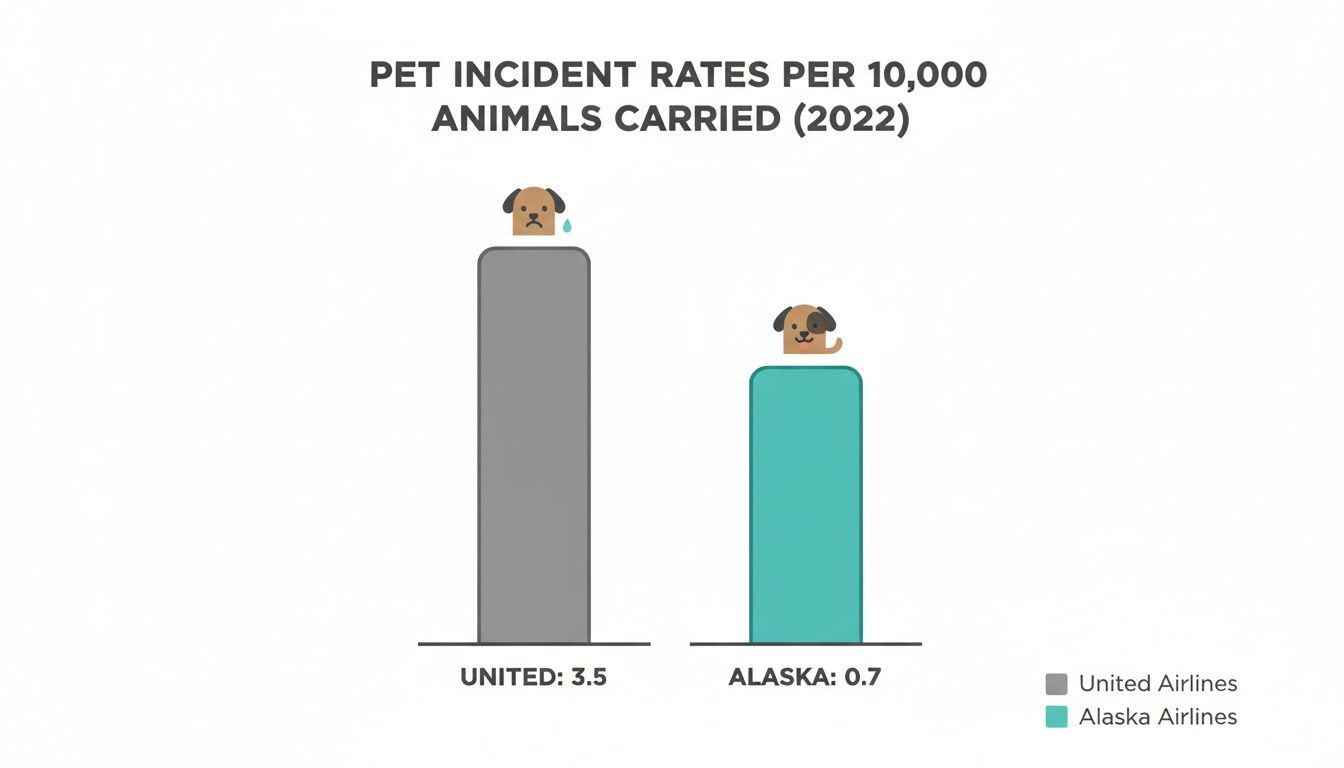
As you can see, some airlines have consistently maintained much lower incident rates, even while transporting a massive number of animals.
A Tale of Two Airlines
When you put United's numbers next to another major player in pet travel, like Alaska Airlines, the difference is striking. It’s not a small variation; it's a significant gap you can't really ignore. This isn’t a simple “good vs. bad” airline debate, but a look at how different operational approaches lead to vastly different outcomes.
During that same 2015-2020 period, Alaska Airlines flew over 730,000 animals—that's roughly 282,000 more than United. Yet, their incident rate was just 0.26 per 10,000 animals. By this metric, Alaska was more than 6 times safer.
This kind of objective data cuts through the noise. It shows that things like breed acceptance policies, strict crate enforcement, and ground handling procedures have a measurable impact on pet well-being. It’s a powerful reminder that an airline’s internal policies and focus directly affect the safety of the animals in their care. This is an important piece of the puzzle to consider when deciding if flying with United is the right choice for your pet.
How Safety Incidents Shape Pet Owner Choices
An airline’s safety record isn't just numbers on a page. For pet owners, it's the ultimate measure of trust and the single biggest factor when deciding who to fly with. A history of safety incidents—or a clear lack of them—tells you a lot about an airline's culture and priorities.
This became incredibly clear between 2017 and 2018, a period that completely reshaped the pet travel landscape with United Airlines at the center of it all. What happened then is a powerful lesson in accountability and shows just how fast pet owners will change course when safety is on the line.
The Power of a Pet Owner’s Choice
Before this period, United was far and away the most popular airline for animal transport. In 2017, they flew a staggering 138,178 animals—carrying over 23,000 more pets than their nearest competitor. But that market leadership turned out to be more fragile than anyone thought.
In early 2018, a series of high-profile, tragic incidents sparked a crisis of confidence. In one case, a dog headed for Kansas was wrongly flown to Japan. In another deeply upsetting event, a French Bulldog puppy died after a flight attendant reportedly insisted its carrier be stored in the overhead bin. The public backlash was immediate and fierce. You can read more about these events and the fallout in news reports from that time.
The consequences were clear. Following the incidents and resulting public outcry, United saw a 27% drop in the number of pets it transported between 2017 and 2018. This wasn't a minor dip; it was a mass exodus of pet owners to other airlines.
This sharp decline proved that pet owners absolutely vote with their wallets. When an airline’s safety is called into question, they will actively search for what they feel are safer alternatives. The events led United to suspend its entire PetSafe cargo program for a top-to-bottom review of its policies and procedures.
What This Means for Your Decision
The story of United's past challenges offers a critical takeaway for every pet owner: history matters. An airline's track record gives you real insight into its operational culture and how it truly handles the responsibility of caring for your pet. It’s a key piece of the puzzle you should use when making your booking.
This isn't to say an airline can't learn and improve. In fact, many of the safety protocols and breed restrictions you see today across the entire industry are a direct result of lessons learned from these incidents.
For pet owners, this history highlights a few key points:
Transparency is important: Airlines that are upfront about their policies and incident rates empower you to make an informed choice.
Your choice has power: The market responds directly to consumer demand for higher safety standards.
Past performance is a fair indicator: An airline’s long-term safety record is a valid tool for assessing potential risks.
Ultimately, it’s smart to weigh all your options, especially when alternatives like dedicated pet courier services that specialize in ground or air transport exist. Your peace of mind is what’s most important, and choosing the right travel partner for your pet is a decision that deserves careful research.
Preparing Your Pet For a Successful Flight
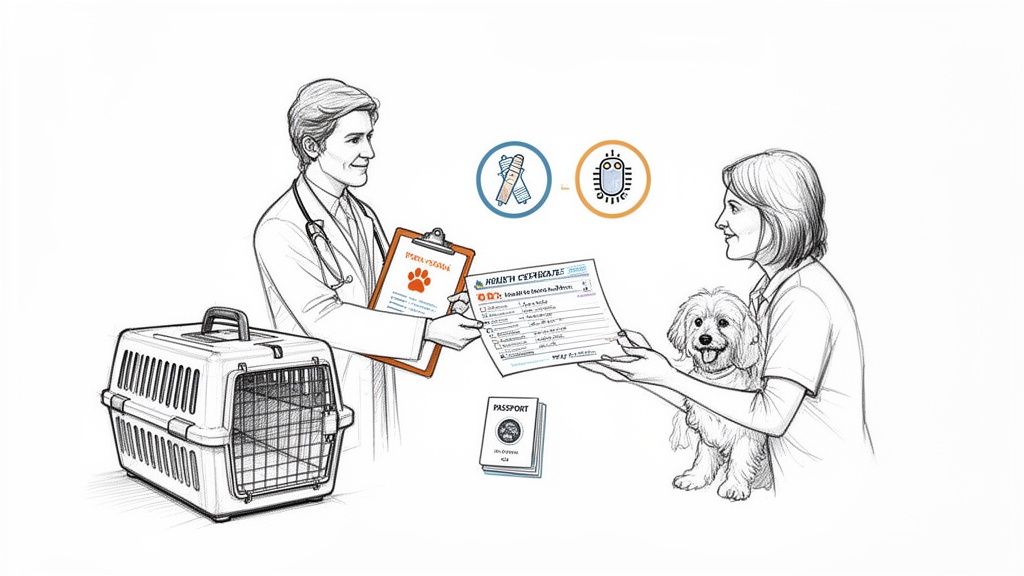
You’ve figured out the airline policies and found the right crate. Now comes the part that can trip up even the most organized pet owners: the paperwork. Honestly, managing the required documents can be the most stressful part of the entire journey.
This is where a little preparation goes a long way, making the difference between a smooth check-in and a last-minute panic at the airport ticket counter.
No matter where you're flying, your pet needs a health certificate. Think of it as their official passport to fly, issued by a veterinarian. It shows your pet is healthy, fit for travel, and up-to-date on crucial vaccinations like rabies.
For international trips, the paperwork gets much more complicated. You’ll likely need an International Health Certificate (IHC), which comes with a maze of rules about microchips, specific vaccines, and parasite treatments required by your destination.
Managing Complex Travel Documents
The rules for IHCs can be incredibly finicky. A tiny mistake—like a treatment done on the wrong date, a misread microchip number, or even using the wrong color ink—can get your pet denied entry. It often feels like a high-stakes game where you don't know all the rules.
This is exactly why we built Passpaw. It's a system designed to help veterinarians and pet owners get this critical paperwork right every single time. Passpaw organizes all the moving parts, tracks deadlines, and helps ensure every requirement for your specific destination is met.
By automating workflows and creating clear checklists, Passpaw helps eliminate the human errors that can completely derail travel plans. It gives your vet the tools they need to prepare fully compliant documents, which in turn gives you peace of mind that everything is truly in order.
Preparing Your Pet Mentally and Physically
Beyond the paperwork, getting your pet ready for the flight itself is crucial. The goal is a calm, comfortable experience, and that starts long before you head to the airport.
Crate Acclimation: Start by helping your pet see their carrier as a safe den, not a scary box. Place their favorite blanket and toys inside, and try feeding them treats or even full meals in the carrier to build a strong positive association. This is a real treat!
Simulate the Experience: Get them used to the motion and sounds of travel with short, practice car rides in their carrier. It’s a great way to ease them into the sensations they'll feel on the plane.
Keep Calm: Your pet feeds off your energy. If you're stressed and anxious, they will be too. Projecting a calm, confident attitude can have a massive impact on their state of mind.
Preparing your pet's mind and body is just as important as the paperwork. You can learn more about effective strategies with these three new science-backed ways to reduce stress and improve pet health.
By following these steps, you ensure your pet is not just document-ready, but also mentally prepared for their journey under United Airlines pets policies. For even more tips on gear, check out our guide on choosing the perfect pet carrier for air travel.
A Few Common Questions About Flying with United
Planning to fly with your pet always brings up a few last-minute questions. We get it. To help you feel confident on travel day, we’ve put together some straightforward answers to the questions we hear most often about the United Airlines pets policy.
How Much Does It Cost to Fly a Pet on United?
The cost really depends on how your pet is traveling—in the cabin with you or as cargo. Plan on this fee being a one-way charge, so you'll pay it for each leg of your journey.
For a small pet joining you in the cabin, United charges a service fee. As of early 2026, this fee is $125 each way. Keep in mind, if you have a domestic layover that's longer than four hours, an extra $125 charge will apply.
When the PetSafe cargo program is available, the costs are more varied. The final price depends on your pet’s size, the combined weight of your pet and their crate, and your destination. These fees can range from several hundred to well over a thousand dollars.
What Happens if My Flight Is Canceled or Delayed?
Flight disruptions are always stressful, but it's good to know United has a plan for furry travelers. If you're flying with a pet in the cabin and your flight gets canceled, the airline will do its best to get you on the next pet-friendly flight with available space.
For pets flying via the PetSafe program, a dedicated team steps in. They have procedures to ensure your pet is cared for, which may include moving them to an approved kennel facility for shelter, food, and water until they can be safely rebooked on a new flight.
Traveler's Tip: Always keep both digital and physical copies of your pet's health certificate and vaccination records on you. If travel plans go sideways, you'll have everything you need right at your fingertips.
Can I Sedate My Pet for the Flight?
This is a question we hear a lot from well-meaning owners who worry about their pet's comfort. However, both United Airlines and the American Veterinary Medical Association strongly advise against sedating or tranquilizing pets for air travel.
Sedatives can interfere with a pet's ability to regulate their body temperature and keep their balance, which poses serious health risks at altitude. A much safer approach is to focus on positive crate training to help your pet feel secure in their carrier. Your veterinarian is the best person to consult for advice tailored to your specific pet's health and temperament.
Feeling overwhelmed by international pet travel paperwork? It's a common feeling. Passpaw was created to streamline this exact process for both veterinarians and pet owners, ensuring every document is accurate and ready for your destination. Find out how Passpaw can bring some much-needed peace of mind to your next trip.
More articles
From regulatory changes to best practices for veterinarians and pet owners, our resources keep you ahead of the curve.