Are you a team member in a veterinary practice?
Are you a pet parent planning a trip with your furry pal?
UK Pet Travel Quarantine: How to Avoid It in 2026
You've booked the flight, found a pet-friendly place to stay, and started imagining your dog or cat trotting through a UK park like they own the place. Then you see the phrase “UK quarantine” and your stomach drops.
That reaction is normal. I've watched plenty of careful, loving pet owners go from excited to panicked in about thirty seconds. The good news is that UK pet travel quarantine usually isn't the default problem people think it is. In most cases, it's a preventable paperwork and timing problem.
The UK system is much more like preventive care than punishment. If your pet's ID, vaccine history, travel route, and documents all line up, quarantine is generally avoidable. If something is missing or out of order, that's when trouble starts. This is why the small details matter so much, especially the ones many quick guides gloss over.
Your UK Pet Adventure and the Quarantine Question
If you're researching UK pet travel quarantine, you're likely in one of two situations. You're either planning well ahead and trying to do everything right, or you've already noticed one odd detail in the rules and you're worried you missed something important.
That worry usually centers on one question: “Will my pet be taken away and put in quarantine when we land?”
For most prepared travelers, the answer is no. UK entry is generally designed so that quarantine can be avoided if the pet has the required chain of controls in place, including microchip identification, rabies vaccination, and correct travel documentation, as explained by Pets Abroad UK's guide to avoiding quarantine. The catch is that this chain has to be complete, and it has to be in the right order.
Why the fear is so common
Pet travel rules mix medical records, border procedures, and booking logistics. That's an awkward combo. A pet owner may be very organized and still get tripped up by one date, one missing signature, or one vaccine that was given before the chip was recorded.
I've seen owners spend hours comparing airline crates and ferry options but only give a quick glance to the actual document sequence. That's backwards. Travel bookings matter, but paperwork is what keeps your trip from going to the dogs.
If you're also sorting out onward travel after arrival, practical planning helps lower stress. For example, if you'll be traveling within Britain after landing, it can help to line up cheaper train tickets early so you're not juggling pet paperwork and last-minute transport costs at the same time.
Practical rule: Treat your pet's documents the same way you'd treat a surgical checklist. Every item matters, and the order matters too.
What owners most often misunderstand
A lot of people assume quarantine is a standard holding period for all incoming pets. That used to be much closer to the truth than it is today. Now, quarantine is more often the backup plan when officials can't confirm compliance.
Here's the calmer way to understand this:
Your pet isn't being judged on appearance. Healthy-looking pets can still have document problems.
The rabies record alone isn't enough. It has to connect properly to the microchip.
Good intentions don't fix sequence errors. If the prep was done in the wrong order, border staff can't let it pass.
Pre-departure review is your safety net. Checking everything before travel is far easier than fixing it after arrival.
That's the heart of UK pet travel quarantine planning. Prevention beats correction every time.
How the UK Pet Travel Scheme Works Today
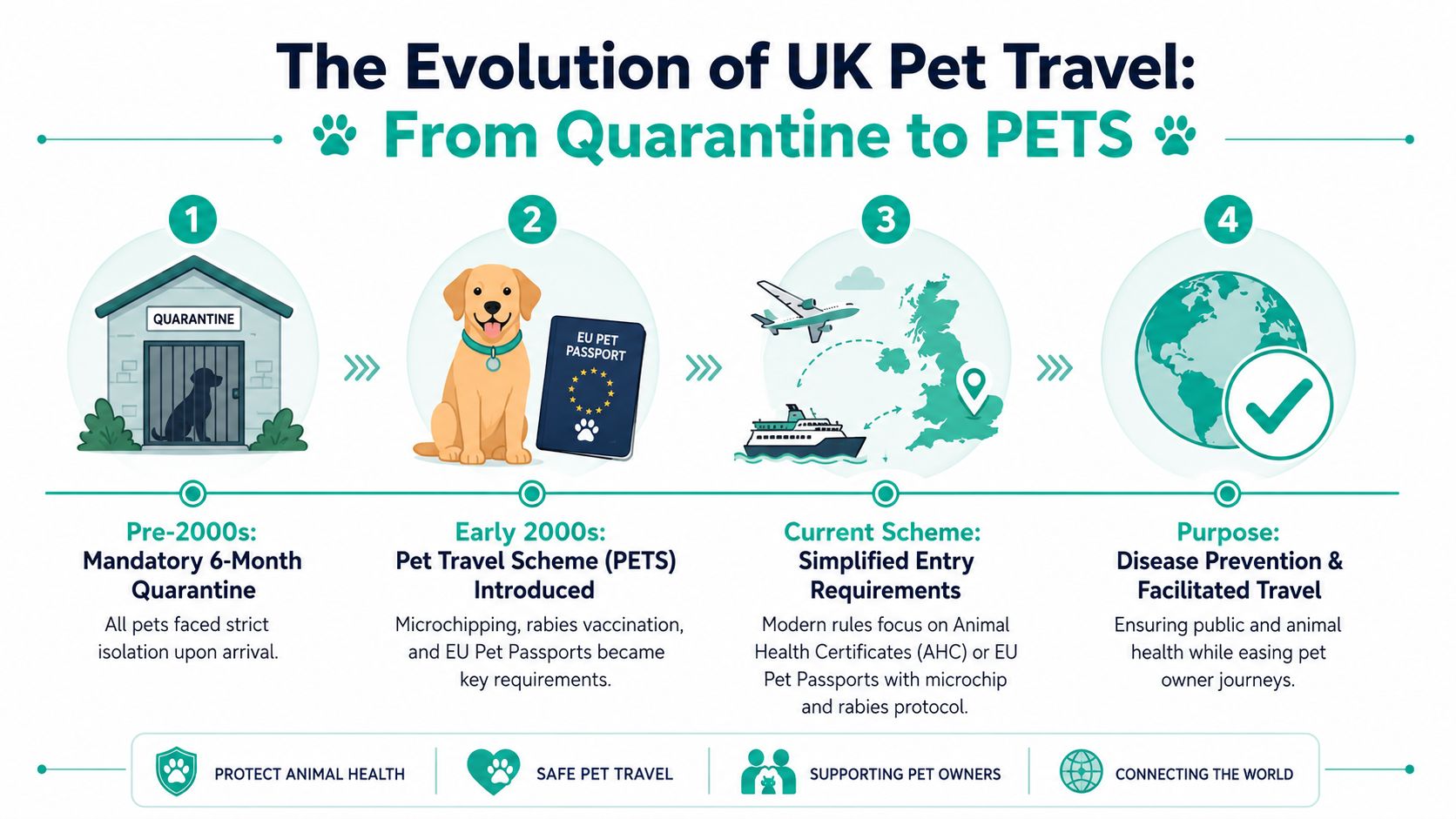
The UK's current system makes more sense when you know what it replaced. Historically, the country relied on automatic isolation. That old model changed in a major way on 11 December 2002, when the UK extended the Pet Travel Scheme to the United States and moved away from the default six-month quarantine approach toward a risk-based system built around microchip identification, rabies vaccination, blood testing, and waiting periods, according to this historical overview of the PETS change.
The system is about biosecurity, not punishment
That shift matters because it changed the logic of entry. The UK no longer treats every pet as if it needs lengthy isolation by default. Instead, officials look for evidence that the animal can be safely admitted under a controlled process.
In plain English, the modern approach says this: prove the pet's identity, prove rabies controls were followed properly, use the right route, and carry the right documents.
That's why UK pet travel quarantine now feels less like an old-fashioned kennel policy and more like a chain-of-custody process. Each step supports the next one.
If a rule seems oddly specific, it's usually because border staff need to verify it quickly and consistently on arrival.
Why owners still get confused
The current scheme is simpler than the old blanket quarantine model, but it still asks owners to think in timelines. You can't just “have the documents.” You need the documents to reflect the right order of events.
That's where many trips wobble. Owners focus on the destination but forget that the UK system also cares about route approval, timing windows, and whether the records tell a clear story. If the story doesn't line up, the animal can't be treated as fully compliant.
For readers tracking rule updates over time, Passpaw has a useful summary of recent pet travel changes in early 2025. It's worth reviewing if your planning started months ago and you're relying on old notes or screenshots.
The practical takeaway
Think of the UK scheme as a “show your work” system. The pet may be perfectly healthy, but the records still have to prove that the required safeguards happened properly.
That's a much better setup than automatic six-month isolation. It's also unforgiving when people rush.
The Paw-sitive Path to Avoiding Quarantine
You arrive at check-in with a healthy pet, a folder full of records, and a booked route. Then one detail breaks the chain. The microchip was scanned after the rabies vaccine date. The tapeworm treatment was given a few hours outside the allowed window. The form lists one digit of the chip number incorrectly. That is how a routine trip turns into quarantine.
Avoiding quarantine works like preventive care. You are not trying to fix a problem at the airport. You are building a clean, checkable timeline weeks or months earlier, so every record supports the next one.
The core checklist for most pets
For Great Britain entry, pets that fail to meet the rules can be placed into quarantine at the owner's expense for a prolonged period. The safest approach is to treat the process as a strict sequence, not a pile of documents.
Use this checklist in order:
Microchip first
The chip must be in place before the rabies vaccination used for travel. If the order is wrong, the vaccine may not count for entry purposes.Rabies vaccination next
Check that the vaccine record is complete, legible, and tied to the correct microchip number.Wait the full 21 days after a first rabies vaccination
Day counting causes trouble. The vaccination day is day 0, so travel cannot happen until the full waiting period has passed.Match every detail on the travel document
Names, dates, species, sex, age or date of birth, and microchip number need to line up across every record. Border checks often fail on simple mismatches.Use an approved route and approved transport setup
A valid vaccination record does not fix a route problem. Entry rules and transport rules have to match.If traveling with a dog, schedule tapeworm treatment inside the allowed window
This step has a narrow timing range before arrival. Too early and it fails. Too late and it fails.
That order matters more than many owners expect. A pet can be fully healthy and still be treated as non-compliant if the paperwork shows the right care happened in the wrong sequence.
Where owners get caught
The biggest trap is assuming each requirement stands alone. It does not. UK pet travel records work more like a relay race. Each handoff has to happen in the right order, and the baton is the microchip number.
A common example looks harmless at first. A dog receives a rabies vaccine during a routine visit. Later, the owner books UK travel and learns the chip was implanted afterward, or the number was never copied onto the vaccine record. The owner still has a vaccinated dog. The border process still sees a broken timeline.
Dogs add one more failure point. Tapeworm treatment is often missed because it happens close to departure, when owners are already juggling flights, crates, and final packing. I have seen careful people do everything right for months, then lose the whole plan because that last appointment landed outside the permitted window.
Dogs, cats, and ferrets do not have identical risk points
Dogs, cats, and ferrets all need the main identity and rabies steps to line up properly. Dogs usually need extra attention at the end because of tapeworm treatment timing.
Cats and ferrets are simpler in that one respect. They still get into trouble when owners relax too early and stop checking the records line by line. A missing chip number or date mismatch can cause as much trouble as a missed treatment.
The safest pet travel plans are a little boring. Boring is good. Boring means every box was checked in the right order.
If your pet is coming from an unlisted or higher-rabies country
The timeline gets longer and less forgiving. The sequence usually goes microchip, rabies vaccination, rabies antibody blood test after the required wait, then a further waiting period after a successful result before travel is allowed. For dogs, tapeworm treatment still has to be timed correctly before arrival.
That is why last-minute planning fails so often on this route. Owners sometimes focus on the vaccine and miss the later waiting period, or they assume a blood test can be done immediately after vaccination. It cannot. The calendar has to be built carefully from the start.
If you want a clearer explanation of the blood test stage, Passpaw has a practical guide to rabies titer testing for dogs.
Two habits that prevent expensive mistakes
Build the schedule backward from your arrival date. Start with the UK entry date, then place each medical and document step where it belongs.
Run a document audit before you confirm final travel. Scan the microchip, compare every record, and check each date as if you were the border official reviewing it.
That is the ideal paw-sitive path. Fewer surprises, fewer rushed fixes, and a much lower chance of unintended quarantine.
Navigating the Pet Travel Paperwork Maze
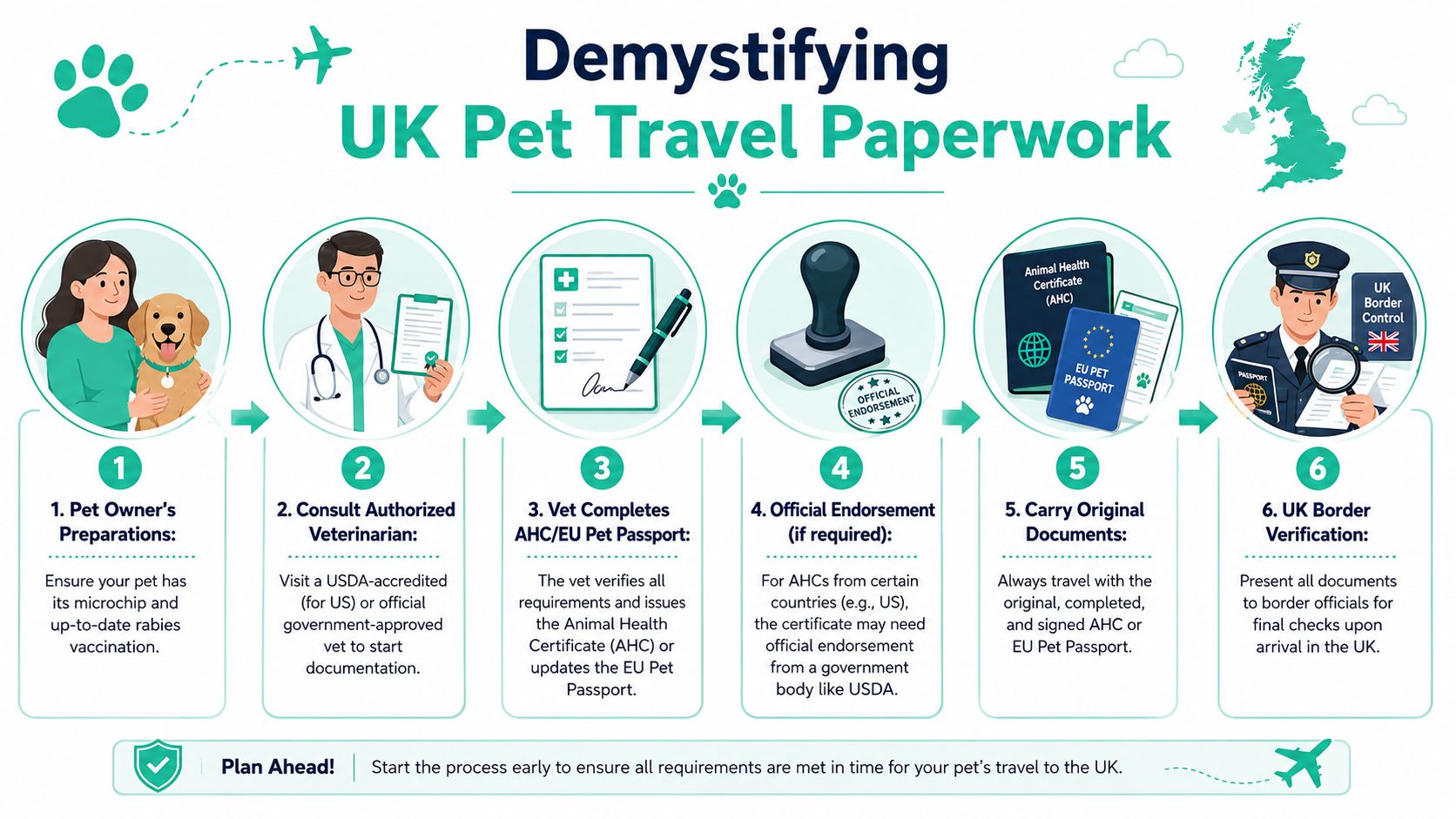
Healthy pets get quarantined for paperwork mistakes more often than owners expect. That's why I tell people to stop thinking of documents as “admin” and start thinking of them as part of the medical protocol. The UK border team isn't only checking whether your pet had care. They're checking whether the records prove the care happened in the required way.
The microchip timing trap
Here's the trap I wish every owner and every general practice team would put in bold at the top of the file: the pet must be microchipped before the rabies vaccination used for travel compliance. According to GOV.UK guidance on bringing a pet to Great Britain, USDA APHIS data showed that 15% of rejected pet travel documents between 2023-2024 involved documentation errors related to microchip timing and vaccination sequence.
That number gets my attention because it points to a very specific kind of human error. Not a sick pet. Not a dramatic emergency. A sequence problem.
Why this catches good owners off guard
The most common version goes like this:
The pet got a rabies vaccine.
Later, someone realizes the chip wasn't in place first, or the chip wasn't properly tied to that vaccine record.
A booster is given later, and everyone assumes the file is now fine.
The paperwork still tells a messy story.
That's the “microchip-timing paradox” people stumble into. They know the pet is now chipped and vaccinated, so they think they're compliant. But border review looks at the documented sequence, not the owner's intention.
Field note: If the vaccine and chip history isn't crystal clear to a stranger reviewing the paperwork at a desk, you should assume it needs more work before travel.
Paperwork review should be active, not passive
Veterinary practices and pet owners both benefit from a workflow mindset. Don't just gather forms. Review them as if you're trying to catch an error before the border official does.
Look closely at:
Chip number consistency
The same number must appear everywhere it should, with no transposed digits.Vaccination dates and product details
The record should be complete and easy to follow.Name matching
Owner and pet details should be consistent across all documents.Timing logic
The dates must tell a compliant sequence, not just list completed events.Original paperwork handling
Keep signed originals organized and protected during travel.
For U.S. travelers, a practical overview of the documentation path is in this USDA pet travel guide from Passpaw. Tools such as government checklists, clinic review protocols, and document-management platforms like Passpaw can help practices track deadlines and catch mismatches before endorsement or travel.
A simple clinic-style review method
If I were checking your file at a travel appointment, I'd review it in this order:
Checkpoint | What I'm asking |
|---|---|
Identity | Is the pet clearly linked to one scannable chip number? |
Rabies record | Is the vaccine tied to that chip in the right sequence? |
Timeline | Do all waiting periods make sense on the calendar? |
Route | Does the planned arrival method fit the rules? |
Border packet | Are the originals complete and ready to present? |
That kind of review isn't glamorous, but it keeps your trip from turning into a kennel comedy no one wanted.
What Happens If Your Pet Is Quarantined
You land, collect your bags, and expect the last step to be simple. Then an official cannot clear your pet because one part of the record does not line up. That is how quarantine usually starts. Not with a dramatic medical problem, but with a file that leaves a gap the border team cannot ignore.
If that happens, your pet may be held in quarantine at your expense for an extended period. The hard part for owners is that the outcome often turns on paperwork sequence and proof, not on how healthy or well cared for the pet is. A calm explanation can help with simple questions, but it cannot replace missing evidence.

What quarantine is actually like
Owners often picture quarantine as punishment. It is closer to a holding pattern. Border authorities use it when they cannot safely release the pet into the country under the rules they must enforce.
For the pet, the experience depends on temperament, routine, and length of stay. Some animals settle into kennel care better than owners expect. Others struggle with the change in sounds, smells, handling, and separation. Even in a well-run facility, it is still an unfamiliar place after a tiring trip.
For the owner, the stress usually comes in waves. First there is surprise. Then there are calls, fees, questions about paperwork, and the sinking feeling that a preventable mistake has turned into a long delay.
The failure points that lead to quarantine
Quarantine usually follows one unresolved problem or a few small ones that stack up together. In practice, these are the traps I would worry about most:
A sequence problem
The record does not show the required steps happened in the correct order. Microchip timing is a classic example. If the chip and rabies paperwork do not tell a clear timeline, officials may treat the preparation as invalid.A timing problem
One required wait period or treatment window does not fit the travel date.An identity problem
The pet exists on paper, but the documents do not tie cleanly to one scannable animal. A single wrong digit can cause that.An entry-route problem
The pet arrives on a route or under a booking setup that does not meet the entry conditions.
A good way to understand it is this: border clearance works like a chain of custody in a clinic lab. If one link is weak, staff cannot just assume the sample is fine. With pet travel, if one link in the record is weak, officials may stop release until the risk is addressed.
What owners can do if it happens
Start by asking exactly what point failed. Do not ask only, “Can my pet still get in?” Ask, “Which document, date, or requirement could not be accepted?” That question gets you closer to the core problem.
Then gather your originals and request clear instructions on the next step. In some cases, the issue is about proof and can be clarified. In others, the pet must remain in quarantine while the authorities and facility follow procedure. Keep notes, names, and timestamps for every conversation.
This is also the moment when organization matters more than emotion. If you used a structured checklist before travel, such as a pet travel planning checklist, pull it out and compare it against the concern raised at entry. You are looking for the exact break in the chain, not a general sense that something “should be okay.”
The practical lesson
Quarantine is usually the end result of a preventable paperwork failure that was missed earlier. That is why I treat pet travel prep like preventive care. You check the weak points before they become expensive problems.
If your pet does end up staying at a facility, ask what comfort items are permitted and how updates are handled. Some owners also use this waiting period to compare GPS trackers for dogs before reunion, especially if the pet will be adjusting to a new home base after release.
The safest plan is simple. Do not prepare for the border by asking, “Do I have the documents?” Prepare by asking, “Could a tired official, seeing this for the first time, follow the story from chip to arrival without any doubt?” That question prevents a lot of quarantine cases.
Final Checks Before Your Pet's UK Arrival
The last few days before travel are when rushed mistakes happen. By this point, most owners are juggling luggage, flight times, pet carrier prep, and their own nerves. This is when a short, firm checklist helps most.
Your final pre-travel review
Start with documents. Put every original paper in one waterproof folder. Keep it in hand luggage, not buried in checked baggage or stuffed into the side pocket of a pet crate.
Run this review:
Check the pet's identity details against every document.
Confirm your route and booking still match the plan you prepared for.
Review timing-sensitive treatments if you're traveling with a dog.
Make sure your carrier setup is ready with absorbent bedding and familiar scent items if allowed by your carrier.
If you want a structured way to keep these steps in one place, the Passpaw pet travel planner is useful for tracking the moving parts before departure.
The dog-specific last-mile task
For dogs, the final vet visit often matters most because of tapeworm timing. Don't estimate. Don't rely on memory. Put the treatment window on your calendar and confirm the recorded time is correct.
This is also a good moment to think beyond the border check. If your dog will be adjusting to a new environment, some owners like to compare GPS trackers for dogs before arrival, especially if they'll be staying somewhere unfamiliar or moving through several locations.
Travel-day handling tips
Keep your border packet easy to reach. Border checks go more smoothly when you can hand over the documents without rummaging through your bags while your pet is getting restless.
A quick day-of list:
Feed lightly if advised by your vet and keep your routine calm.
Arrive with extra time so you're not making panicked decisions.
Carry backup copies for your own reference, even if originals are what matter.
Have the pet's microchip information handy in the same folder as the rest of the travel papers.
This stage should feel boring. That's a compliment. Boring travel days usually mean you prepared well.
Common Questions About UK Pet Travel
What about rabbits, birds, or other pets?
The standard pet travel scheme discussed here focuses on dogs, cats, and ferrets. Other species can fall under different import rules. If you're traveling with a rabbit, bird, or another companion animal, don't assume the dog-and-cat process applies.
Can I visit my pet if quarantine happens?
That depends on the facility and its policies. Some locations may allow limited contact or updates, while others may restrict access for operational or biosecurity reasons. You need to confirm that directly with the relevant facility if quarantine becomes part of the process.
Do the same rules apply if I'm only transiting through the UK?
Transit can still create compliance questions depending on how the journey is arranged. If your pet is entering the UK system in a way that triggers import checks, the rules may still matter. Don't assume a layover means no review.
What's the safest mindset for owners?
Act early, check sequence before dates, and have a veterinary team or travel professional review the paperwork with fresh eyes. Most UK pet travel quarantine problems are preventable, but only if someone catches the issue before departure.
Passpaw helps veterinary teams and pet owners manage international pet travel paperwork with destination-specific planning, document workflows, and health certificate support. If you want a clearer path through UK entry prep, you can learn more at Passpaw.

More articles
From regulatory changes to best practices for veterinarians and pet owners, our resources keep you ahead of the curve.