Are you a team member in a veterinary practice?
Are you a pet parent planning a trip with your furry pal?
Pet Health Certificate for International Travel Cost
TL;DR: A pet health certificate for international travel cost typically ranges from $400 to $1,200+ per certificate, depending on destination rules, veterinary services, lab work, and government endorsement fees. Below, I break down what makes up that total so you can budget with fewer surprises.
You’ve booked the flight, checked the pet carrier, and started imagining your dog trotting through a new city or your cat settling into a new home abroad. Then the paperwork enters the chat.
For many pet owners, the first real jolt isn’t the form itself. It’s the estimate. International pet travel often sounds simple until a clinic explains that your pet may need a specific exam, destination paperwork, timed treatments, government endorsement, and possibly lab testing before wheels-up. That’s when a lot of people ask the same question: why does this cost so much?
The short answer is that you’re not paying for a single sheet of paper. You’re paying for a regulated process with tight timing, country-specific rules, and very little room for error. Some parts are medical. Some are administrative. Some are government fees. All of them matter.
Your Ticket to Global Adventures The Pet Health Certificate
A common version of this story starts with a happy plan and a sudden snag. A family is moving overseas. Their dog has always been healthy, vaccinations are current, and they assume the last step is just getting a note from the vet. Then they learn the destination has its own import form, the exam has to happen in a narrow travel window, and only certain veterinarians can complete the certificate.
That moment feels frustrating because the document sounds simple. In practice, it rarely is.
What owners often call “a travel form” is really a coordinated process that ties together your pet’s identity, vaccine history, exam findings, test results, parasite treatment timing, and destination-specific import language. If even one detail is off, the issue may not show up until airline check-in or border inspection. That’s why clinics treat these appointments differently from a routine wellness visit.
Why the price can feel like sticker shock
The wide range catches people off guard. Some countries are relatively straightforward. Others require more documentation, more review, and more lead time. That’s why the total typically ranges from $400 to $1,200+ per certificate, with some clinics grouping destinations by complexity and starting around $400 for Level 1 countries and $600+ for Level 3, not including separate USDA fees or lab work, according to Prospect Ridge Veterinary Hospital’s travel certificate pricing.
Practical rule: If a quote sounds high, ask what’s included before assuming it’s overpriced. In pet travel, the exam is only one piece of the bill.
Some clinics include more hands-on paperwork support. Others separate the exam, form preparation, treatments, lab work, and endorsement handling into different charges. Neither model is automatically wrong. What matters is understanding what you’re buying.
What usually works and what doesn’t
A few patterns come up again and again in real pet travel planning:
What works: Starting early, even when the final exam must happen close to travel.
What works: Asking for an itemized estimate tied to your exact destination.
What doesn’t: Assuming a standard vaccine record can substitute for an export certificate.
What doesn’t: Waiting until the airline asks for paperwork.
The good news is that once you see the cost in pieces instead of one intimidating lump sum, it becomes much easier to plan without chasing your tail.
What Is an International Pet Health Certificate
An international pet health certificate is the official veterinary document that supports your pet’s entry into another country. I often describe it as your pet’s health passport, but with more legal precision and less room for improvisation.
It doesn’t just say your pet looks healthy. It usually confirms identity details, vaccination status, exam findings, and any destination-specific requirements that apply to that country. That may include rabies documentation, microchip information, parasite treatment timing, or laboratory results.

It’s more than a vaccine record
A lot of owners already have a rabies certificate and a copy of their pet’s medical history. Those documents are useful, but they usually aren’t enough on their own for international travel.
The international certificate ties the record together in the format required by the destination. That distinction matters. Border authorities and airlines don’t want a stack of “close enough” documents. They want the right form, signed by the right veterinarian, completed in the right time window.
For anyone who wants a clear overview of how these documents differ, Passpaw has a helpful explainer on the international pet health certificate process.
Why countries require it
Countries use pet import rules to manage animal health risk at the border. That’s the same broad public-health logic behind other cross-border checks involving animals and animal products. If you want a wider trade context, Multica Group’s overview of veterinary sanitary and phytosanitary controls is a useful reference.
The certificate helps officials answer a few basic questions:
Is this the same pet described in the paperwork
Is the pet clinically fit to travel
Does the vaccine and treatment history match the destination’s import rules
Has an authorized veterinarian completed the form properly
A travel certificate protects more than your itinerary. It helps protect the destination country, the airline process, and your pet from avoidable disruption.
Why the veterinarian matters
Not every veterinarian handles international travel paperwork. In many cases, the certificate must be completed by a USDA-accredited veterinarian when the pet is departing from the United States. That’s one reason these appointments often cost more than a standard visit. The clinic isn’t just examining the pet. The veterinarian is also matching medical records to country rules, completing formal export paperwork, and managing timing that can be very strict.
That’s also why “I already have all the records” doesn’t always shorten the process as much as owners expect. Good records help a lot, but they still have to be reviewed and translated into the exact document set the destination requires.
The Complete Cost Breakdown for a Pet Health Certificate
A pet owner often calls expecting one flat certificate fee. By the end of the conversation, the underlying question is usually, “What exactly is included, and what will be added later?” That distinction matters because the total cost is built from separate clinical, administrative, and government steps.
For most international trips, the pet health certificate for international travel cost is better understood as a package of line items than a single price. In practice, the total commonly lands somewhere in the $400 to $1,200+ per certificate range, depending on the country’s entry rules, the clinic’s pricing model, and whether government endorsement or extra testing is required, as noted earlier.
Some hospitals quote one bundled travel fee. Others split the work into exam, paperwork, diagnostics, and endorsement charges. Neither approach is wrong, but itemized quotes usually make it easier to compare clinics and avoid surprise add-ons.
The main pieces of the bill
Service Component | Typical Cost Range (USD) |
|---|---|
International health certificate total | $400 to $1,200+ |
Clinic fee for lower-complexity destination certificate | starting at $400 |
Clinic fee for moderate-complexity destination certificate | starting at $500 |
Clinic fee for higher-complexity destination certificate | starting at $600+ |
Veterinary appointment fee for certificate process alone | $395 to $750 |
USDA endorsement fee with no lab tests | $101 |
USDA endorsement fee with 1 to 2 lab tests for 1 pet | $160 |
USDA endorsement fee with 3 to 6 lab tests for 1 pet | $206 |
USDA endorsement fee with 7+ lab tests for 1 pet | $275 |
Prospect Ridge Veterinary Hospital’s international travel certificate pricing page is a useful example of how clinics separate destination complexity into different starting fees.
If you want a broader point of comparison beyond health certificates alone, this guide on how much a pet passport can cost helps show how document pricing changes by document type and travel system.
What each component usually pays for
The veterinary appointment fee usually covers the clinical exam, record review, and the veterinarian’s judgment that the pet is fit to travel on the required timeline. It may also include checking vaccine dates, microchip information, parasite treatment history, and whether the destination form can legally be signed that day.
The certificate preparation fee reflects staff time as much as doctor time. Someone has to match your pet’s records to the destination’s instructions, complete the correct version of the form, verify dates, and catch details that can cause rejection at endorsement or entry. One wrong microchip digit can turn a routine file into an urgent rewrite.
The diagnostics and treatment costs vary the most. Some trips need no additional testing. Others require bloodwork, parasite treatment, vaccine boosters, or supporting lab results before the certificate can be issued.
Then there is the government side of the bill. In many US departures, USDA endorsement is a separate charge from the clinic fee. Owners who budget only for the vet visit often miss that piece.
Costs owners regularly miss
The certificate itself is only part of the expense. The surrounding medical work often changes the total more than the form does.
Common add-ons include:
Pre-travel vaccines or boosters if the current record does not meet the destination’s timing rules
Microchip placement or verification if the pet is not chipped or the number is missing from prior records
Timed parasite treatment when a country requires treatment in a narrow pre-entry window
Lab fees for destinations that require titers or other supporting tests
Recheck or rewrite fees if travel dates shift and the paperwork falls outside the valid window
I usually tell owners to ask for two numbers. First, the clinic’s expected fee for a straightforward certificate. Second, the likely total if the pet needs updates, testing, or endorsement handling. That question gets much closer to the actual budget.
A lower quote can still produce a higher final bill. One clinic may quote only the exam and form completion. Another may include record review, submission help, and revision time in a higher upfront fee. The cheaper option on the phone is not always the less expensive option by departure day.
Why Your Pet Travel Costs Might Change
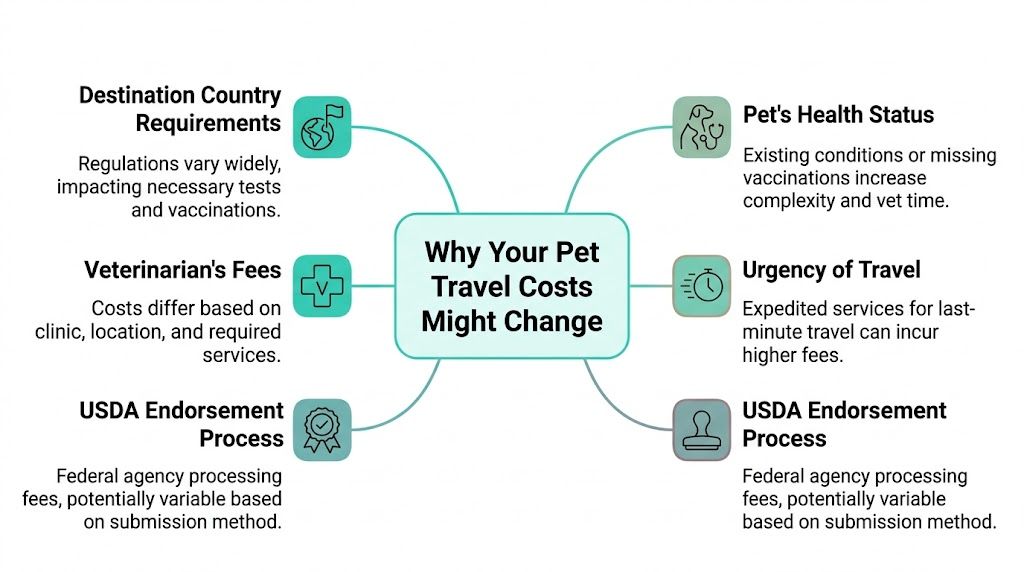
Two pets can leave from the same city, see different clinics, and travel in the same week, yet the final bills can look very different. That isn’t random. It’s usually the result of a few variables stacking together.
The big one is the destination itself. Some countries accept a simpler process. Others have stricter import conditions, longer lead times, and more paperwork. Once you add your pet’s current records, your travel timeline, and the clinic’s workflow, the number can move fast.
Destination changes everything
One of the clearest examples is the difference between US and non-US pricing models. Clarendon Animal Care notes that US veterinary appointment fees for the certificate process alone range from $395 to $750, while an EU pet passport often costs €100 to €300 without separate government endorsement fees, showing a very different structure in how travel documents are priced across markets, as outlined by Clarendon Animal Care’s international travel cost overview.
That matters because owners often search online, find a price from another country, and assume it should apply to their trip. It usually doesn’t.
A few hidden variables that drive cost
Some cost drivers are obvious. Others appear unexpectedly.
Your pet’s record quality: If the microchip details, vaccine dates, and prior documents are clean and complete, the clinic can work faster. If records are scattered or inconsistent, staff spend more time verifying everything.
Travel urgency: Last-minute travel tends to be expensive because the clinic has less flexibility to fit in exams, paperwork review, and corrections.
Clinic workflow: Some practices do a high volume of travel cases. Others handle them only occasionally. That affects how they price the administrative side.
Number of pets: Group travel can create efficiencies in some parts of the process, but other parts still multiply.
Why non-US comparisons can be confusing
Owners moving between regions often expect the same pricing logic everywhere. That’s where things get fuzzy. In some markets, the official travel document model is more centralized. In others, private veterinary time and government endorsement are split into separate charges.
The same trip can feel “cheap” in one country and “expensive” in another because the fee structure is built differently, not because one side is doing less work.
A practical mindset helps here. Don’t ask only, “What does the certificate cost?” Ask, “Which steps are included in this system, and which are billed separately?” That question is much more likely to get you to a realistic quote.
Decoding the USDA Endorsement Fee
For pets leaving the United States, the USDA endorsement fee is one of the most misunderstood line items. Owners often think the clinic invented it or marked it up. In reality, it’s a separate government fee tied to the certificate endorsement process.
This step matters because the endorsed document is often the final version needed for international travel from the US. The veterinary clinic prepares the certificate. The USDA endorsement confirms that the export paperwork meets the required standard for the destination.
The fee is fixed by the government
As of 2026, the official USDA APHIS endorsement fee starts at $101 for a certificate with no lab tests and increases to $275 for a certificate requiring 7 or more lab tests, with added charges possible for multiple pets on the same certificate, according to the USDA APHIS endorsement fee schedule.
The official tiers for one pet are:
No lab tests: $101
1 to 2 lab tests: $160
3 to 6 lab tests: $206
7+ lab tests: $275
For owners trying to understand the process itself, this guide on getting a USDA-endorsed pet health certificate lays out the steps clearly.
Why this fee catches people off guard
The endorsement fee feels abstract because it doesn’t happen in the exam room. You don’t see a vaccine administered or a blood sample drawn. But it’s still a required part of many US export cases.
That’s why I encourage owners to separate the bill into two mental buckets:
Clinical and administrative work done by the veterinary practice
Government endorsement cost charged by USDA APHIS
If you’re leaving from the US, treat the endorsement fee as mandatory planning money, not a maybe.
That won’t make the bill more fun. But it does make it easier to budget without surprises.
How to Reduce Your Pet Travel Certificate Costs
You usually can’t make international pet paperwork cheap. You can make it less wasteful.
Most avoidable expense comes from preventable problems: incomplete records, missed deadlines, rushed appointments, or using the wrong form for the destination. The trick is to reduce rework. That’s where owners save the most money and the most stress.
Start early and keep your records tidy
The cheapest fix is usually the one you make before anything goes wrong.
If you know international travel might happen, pull together your pet’s records early. Check the microchip number, rabies certificate, vaccine dates, and any prior test results. A clean file helps the clinic see gaps before they become urgent.
A few habits make a real difference:
Keep one master file: Store vaccine records, lab results, and prior travel documents together.
Use the exact travel itinerary: Country requirements can change based on final destination and route.
Ask for an itemized estimate: That lets you see whether the quote includes just the exam or the full paperwork path.
Schedule before peak panic: Clinics get swamped when owners wait until the final window.
Choose process support when the case is complex
When a trip involves strict country requirements, digital workflow support can prevent expensive mistakes. One option is Passpaw’s online pet health certificate workflow, which helps veterinary practices and pet owners manage documents, task timing, and compliance steps in one place.
That kind of tool won’t remove government fees or erase destination rules. What it can do is reduce the chance of avoidable errors, missed steps, and duplicate work. In complex travel cases, that matters.
What saves money and what only looks like it will
Some shortcuts help. Some backfire.
Helpful shortcut: Combine travel planning with a records review before the final certificate window opens.
Bad shortcut: Booking the cheapest appointment without confirming the clinic handles international paperwork.
Helpful shortcut: Confirm whether the veterinarian is authorized for the certificate type you need.
Bad shortcut: Assuming airline staff will catch paperwork problems in time to fix them.
Reality check: The most expensive certificate is often the one that has to be redone under deadline.
A little planning isn’t glamorous, but it’s the closest thing this process has to a magic bone.
Frequently Asked Questions About Pet Travel Costs
These are the questions owners ask when the quote is on the table and the travel date is getting close. The short answer to most of them is that the final price depends on which part of the process changed, the clinic’s role, and how strict the destination country is.
Is the cost per pet or per certificate
Usually both costs show up somewhere in the file.
The exam, record review, and any required treatments are usually charged per pet because each animal has to be assessed and documented individually. The certificate itself may be prepared as one document or as separate documents, depending on the destination’s rules and whether your pets can travel under the same paperwork. That is why two pets going on the same flight do not always cost only slightly more than one.
Ask for the quote broken into clinic services, government fees, and shipping or courier charges if those apply.
How long is an international health certificate valid for
The useful answer is this: valid for what step?
A certificate may need to be issued within a certain number of days before departure, but the exam date, parasite treatment timing, and endorsement timing may each have their own deadlines. For example, if a country accepts a certificate only within a short window before entry and your flight moves back by two weeks, the original document may no longer be usable even though your pet is still healthy. In that situation, the cost is not just a reprint. It may mean a new exam, a new certificate, and another endorsement fee.
What happens if my trip is delayed after the certificate is issued
Call the issuing clinic the same day you learn about the delay.
Some delays can be managed with a date review and minor corrections. Others trigger a full reset because one timed step has fallen outside the destination’s rules. The deciding factor is usually not the airline delay itself. It is whether the new travel date still fits the certificate, treatment, and endorsement timeline required by the destination country.
Do I have to pay again if there’s a mistake on the form
Sometimes yes, sometimes no. The difference usually comes down to where the mistake happened and how far the paperwork has already moved.
A spelling correction caught inside the clinic may be simple. A wrong microchip number, wrong destination, or wrong travel date can be much more expensive because those errors can invalidate the document. If the certificate has already been signed, submitted for endorsement, or shipped, correction may involve new professional time, new government processing, and new courier costs. Ask the clinic one direct question: “If we find an error after issuance, which fees would be repeated?”
Why do online prices seem so inconsistent
Because many published prices describe only one slice of the job.
One practice lists the exam fee and leaves out paperwork. Another quotes a package that includes the exam, certificate preparation, and staff time spent checking destination rules. A third price may come from another country, where government handling, veterinary pricing, and export procedures work differently. The only fair comparison is an itemized one.
That matters more with complex destinations, where the certificate itself may be only one part of the total cost.
Is a higher quote always a bad sign
No. A higher quote can reflect more work being done correctly the first time.
Clinics that handle international travel regularly often charge for record auditing, treatment timing checks, form preparation, endorsement submission, and revision support if a problem appears before departure. A lower quote may still be fine, but only if it clearly states what is included and what will cost extra later. In practice, the cheapest starting number is often not the lowest final bill.
If you're coordinating international pet travel and want a cleaner way to manage the moving parts, Passpaw offers a cloud-based workflow for pet travel documentation, including requirement tracking, document management, and communication support for veterinary teams and pet owners.

More articles
From regulatory changes to best practices for veterinarians and pet owners, our resources keep you ahead of the curve.