Are you a team member in a veterinary practice?
Are you a pet parent planning a trip with your furry pal?
Your Complete Guide to the KLM Pet Policy
Planning to bring your furry co-pilot along on a KLM flight? You're in luck. The KLM pet policy is pretty helpful, allowing small cats and dogs in the cabin and larger pets in the hold. But where your pet can fly depends on their size, breed, and your travel route.
Figuring out these rules is the first step to making sure your journey is smooth and stress-free.
A Pet-Friendly Overview of Flying with KLM
Flying with a pet can feel like a big project, but KLM provides clear options for your four-legged family members. Think of it like booking your own seat: your pet has a couple of main choices, and the right one comes down to their needs and size.
The first option is flying right there in the cabin with you, like a special carry-on. The second is traveling in the climate-controlled hold, which is a safe and secure space, similar to checking in delicate luggage. This isn't just a matter of choice; it's all based on specific rules.
In-Cabin vs. In-Hold Travel
Your pet's size is the number one thing that decides where they'll be on the plane. For everyone's safety and comfort, only small pets can fly in the cabin.
KLM is known as a solid choice for pet owners traveling across Europe and beyond. Their policy allows one small dog or cat per passenger in Economy on all routes. If you're flying Business Class, this option is only available on flights within Europe. For a deeper dive, you can explore how KLM stacks up against other pet-friendly airlines.
This decision tree gives you a quick visual to see where your pet fits in.
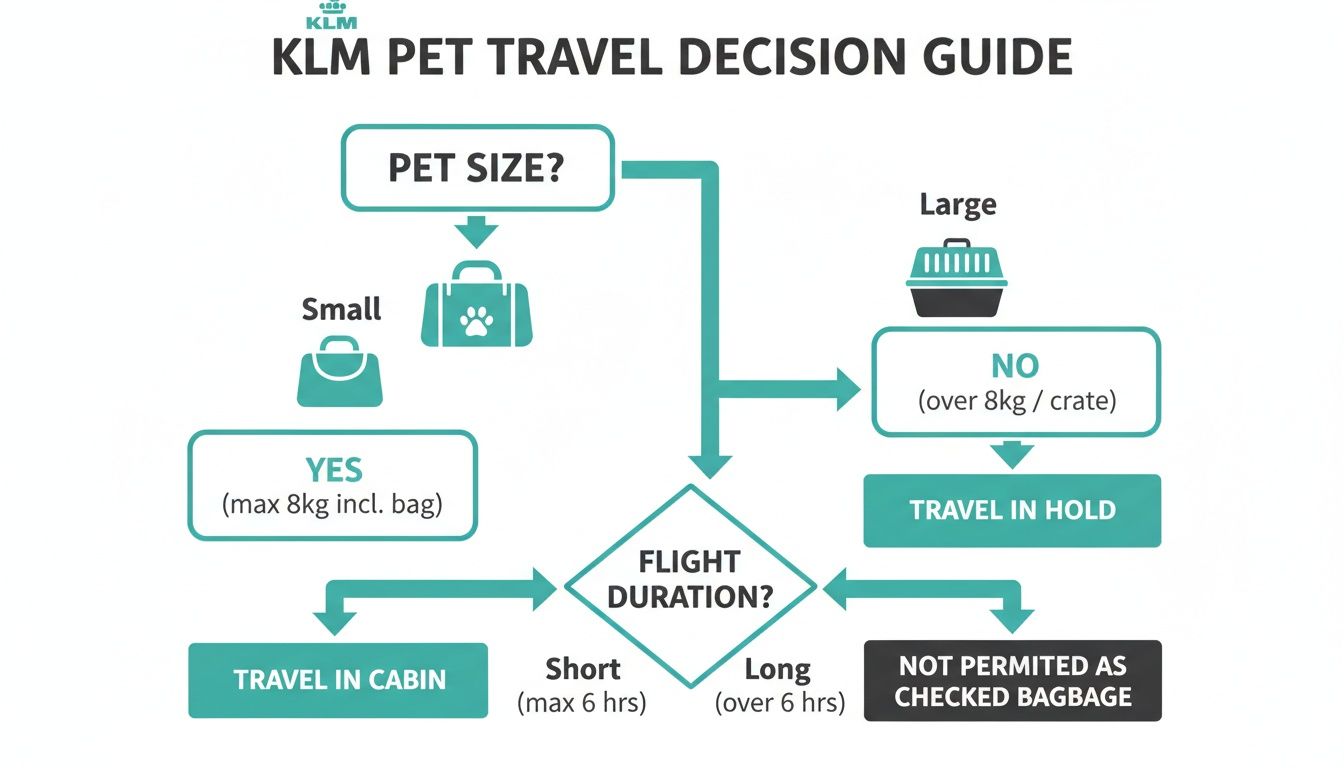
As you can see, the first question is always about size, which immediately points you toward either the in-cabin rules or the hold/cargo policies.
To make things even clearer, here's a quick summary of the travel options available on KLM flights. This table will help you quickly identify which category your pet likely falls into.
KLM Pet Travel Options at a Glance
Travel Option | Pet Size and Weight Limit | Location on Aircraft | Best Suited For |
|---|---|---|---|
In-Cabin | Small dogs and cats in a carrier, max 8 kg (18 lbs) total weight. | Under the seat in front | Tiny pets that can comfortably fit in an approved carrier. |
In-Hold | Larger dogs and cats, up to 75 kg (165 lbs) total weight. | Pressurized, heated hold | Medium to large pets that exceed in-cabin size limits. |
As Cargo | Pets traveling alone or exceeding hold weight/size limits. | Cargo compartment | Unaccompanied pets or those too large for the checked hold. |
Understanding these categories is the foundation for a successful trip, but there are a few more important details to keep in mind.
Key Factors to Consider
Beyond just size, a few other things play a huge part in planning your pet’s trip.
Breed Restrictions: Certain breeds, especially snub-nosed (brachycephalic) dogs and cats, face specific rules. This is because they can have trouble breathing at high altitudes.
Destination Rules: Every country has its own import requirements, from certain vaccinations to detailed international health certificates.
Aircraft Type: Not all planes are equipped to carry pets in the hold, so your specific flight really matters.
The single most important thing to remember is to plan ahead. Pet spots on KLM flights are limited, and you should reserve your pet’s spot by phone after you book your own ticket. You can't do this part online.
Getting these details sorted out early makes the whole process so much less stressful. It means you won’t be scrambling for documents at the last minute or running into unexpected restrictions at the airport. Once you know whether your pet will be your cabin companion or a hold traveler, you can prepare everything you need for a perfectly smooth takeoff.
In-Cabin Travel with Your Carry-On Companion
Want to keep your furry friend close on your next KLM flight? Bringing them into the cabin is a great option for small pets. They'll be tucked safely in their carrier under the seat right in front of you for the whole journey.
Of course, keeping everyone safe and comfortable is the top priority. The KLM pet policy has some very specific rules you'll need to follow, so let's walk through exactly what you need to know.
First up, this option is only for small dogs and cats. KLM has a firm combined weight limit for your pet and their carrier: no more than 8 kg (about 18 lbs). This ensures the carrier fits properly and safely under the seat.
Carrier Requirements and Dimensions
Think of your pet’s carrier as their personal ticket to the cabin—it has to meet KLM's standards. It needs to be well-ventilated and secure, but also roomy enough for your pet to stand up and turn around without struggling.
KLM's maximum dimensions for an in-cabin pet carrier are 46 x 28 x 24 cm (L x W x H). This size is specifically designed to slide under a standard Economy Class seat.
Here’s a quick rundown of the carrier rules:
Type: You can use either a hard-sided or soft-sided carrier. A soft-sided bag is often a bit more forgiving when fitting it into that snug under-seat space.
Security: The carrier must be fully enclosed and escape-proof. Your pet has to stay inside for the entire flight.
Ventilation: It needs good airflow from at least two sides to keep your little traveler comfortable.
A proper carrier is a huge part of a stress-free flight. For some practical tips, this guide on choosing the best cat carrier for air travel has some great insights. And if you want a broader look at different options, our own guide to the best airline-approved pet carriers is a good place to start.
How to Book Your Pet In-Cabin
You can't just add a pet to your booking like you would an extra suitcase. It’s a two-step process, and you need to move fast because KLM has very few pet spots available on each flight. Booking early isn't just a suggestion—it's very important.
Follow these steps to lock in their spot:
Book Your Own Ticket First: Go ahead and book your flight on the KLM website or through your travel agent.
Call KLM Immediately: The moment you have your confirmation, pick up the phone and call KLM's customer service to request a spot for your pet. You should do this at least 48 hours before your flight.
Wait for Confirmation: KLM will check for availability and confirm your pet’s spot. You can usually see the status of this request in the "My Trip" section of your online booking.
A quick word of advice: Pet spots are granted on a first-come, first-served basis. If you wait even a day to call, those spots could be gone. Make that phone call your number one priority right after you book your seat.
The fee for an in-cabin pet depends on your route but generally falls between EUR 70 and EUR 500 each way. This covers the special handling and guarantees your pet's space on board.
Check-In and Boarding Process
When travel day arrives, your routine will be a little different. You can't check in online or at a kiosk when you're flying with a pet. You’ll need to head straight to the airport check-in counter. For international flights, plan to get there at least three hours early to avoid any last-minute rush.
At the counter, the KLM staff will do a few things: confirm your pet's reservation, look over their health documents, and check the carrier to make sure it meets all the rules. Once you get the all-clear, you'll get your boarding pass and can head to security.
Remember, during boarding and for the entire flight, your pet must stay inside their carrier, which needs to be stowed under the seat in front of you. A good tip is to line the carrier with an absorbent pad and toss in a favorite toy or blanket to help them feel more at ease.
Hold and Cargo Travel for Larger Pets
If your pet is too big to fly in the cabin, don't worry—they won’t have to miss out on the adventure. KLM provides a safe and secure way for larger dogs and cats to travel in a climate-controlled, pressurized compartment in the hold. This process is just as careful as in-cabin travel, designed to keep your companion comfortable from takeoff to landing.
However, it's not quite as simple as checking an extra bag. Getting a handle on the difference between flying in the hold versus as cargo, along with the specific rules for each, is the key to a stress-free journey for everyone.
Checked Baggage vs. Cargo: What's the Difference?
Think of a pet traveling in the hold (also called checked baggage) as flying on the same "ticket" as you. You'll check them in at the passenger terminal, and they'll be on your same flight. This is the go-to option for most people traveling with their larger pets.
KLM Cargo, on the other hand, is a separate, specialized service. It's designed for pets who might be traveling alone, are too large for the checked baggage limits, or are heading to a country that requires all incoming animals to arrive as manifest cargo. It's a more detailed process handled by a dedicated cargo team.
Weight Limits and Kennel Requirements for the Hold
KLM has very specific rules for pets traveling as checked baggage to make sure they're safe and have enough room. You'll want to get the measurements just right—a kennel that’s too small will be rejected, and one that’s too large might not even fit on the aircraft. This isn't the time for a ruff estimate!
One of the most important numbers in the KLM pet policy is the 75 kg (165 lbs) combined weight limit for a pet and its kennel traveling in the hold. Kennels are also capped at 122 x 81 x 89 cm on mainline flights, or a smaller 102 x 69 x 76 cm on European routes using certain aircraft. These dimensions cover most medium to large dogs but will push oversized pets into the specialized cargo service.
Your pet's kennel should be IATA-compliant. That means it needs to be:
Hard-sided: Made of hard plastic or fiberglass.
Securely fastened: Metal nuts and bolts are suggested—plastic clips may not be accepted.
Well-ventilated: At least two sides must have proper ventilation.
Spacious: Your pet has to be able to stand up, turn around, and lie down naturally.
A crucial tip: get your pet comfortable with their kennel long before you travel. Make it their safe space by putting a favorite blanket or toy inside and giving them treats. This small step can make a huge difference in reducing their stress on flight day.
Breed and Aircraft Restrictions You Should Know
Not all pets or planes are cleared for hold travel. Like many airlines, KLM has certain restrictions to protect the well-being of some animals and to accommodate aircraft limitations.
Snub-Nosed (Brachycephalic) Breeds
Because of their breathing sensitivities at high altitudes, many snub-nosed breeds like Pugs, Bulldogs, Boxers, and Persian cats are not allowed to travel in the hold on KLM flights. If your pet falls into this category, they might still be able to fly in the cabin (if they're small enough) or via KLM Cargo, which has special procedures for these breeds.
Aircraft-Specific Rules
You'll need to check your flight details carefully, as certain aircraft in KLM’s fleet are not equipped to carry animals in the hold.
No Hold Travel Permitted On: Boeing 787-9, Boeing 787-10, and Airbus A321neo aircraft.
KLM Cityhopper Flights: Pets aren't allowed in the hold on flights lasting more than two hours.
Before you book, it's wise to review the aircraft models on your itinerary. The table below breaks down these limitations to help you plan accordingly.
Aircraft and Route Restrictions for Pets in the Hold | |||
|---|---|---|---|
Aircraft Model | Restriction Type | Recommended Alternative | Common Routes Affected |
Boeing 787-9, 787-10 | Complete restriction in the hold | Fly on a different aircraft (e.g., Boeing 777, Airbus A330) or book through KLM Cargo. | Long-haul intercontinental routes to North America, Asia, and South America. |
Airbus A321neo | Complete restriction in the hold | Choose a flight operated by a different aircraft or contact KLM for alternative routing. | Primarily medium-haul European routes. |
KLM Cityhopper (Embraer) | Time-based restriction | Book flights under 2 hours or explore alternative routes with mainline KLM aircraft. | Shorter European flights connecting through Amsterdam. |
If your flight plan includes one of these restricted planes, you’ll need to either find an alternative flight or make arrangements through KLM Cargo. For a broader look at how different carriers handle pets, check out our guide on other airlines that take dogs in cargo.
The KLM Animal Hotel at Schiphol Airport
So, what happens if your pet has a long layover in Amsterdam? They get a mini-vacation at the KLM Animal Hotel! This one-of-a-kind facility at Schiphol Airport is designed to give traveling animals a comfortable and safe spot to rest between flights.
During their stay, pets are given a clean kennel with fresh water and food. They're also watched over by trained animal stewards who make sure they’re doing well before they continue their journey. This commitment to animal welfare gives owners peace of mind, knowing their companion is in good hands during a transfer. It's a truly purr-fect solution for long-haul travel.
Navigating Pet Travel Documents and Health Forms
Figuring out the paperwork for your pet’s trip can honestly feel more complicated than the flight itself. Getting every single form right is very important—a small mistake can cause a massive headache at the airport. The KLM pet policy, like every airline's, relies on you having the correct documents. The good news? Breaking it down makes it all feel much more manageable.
Think of your pet's paperwork as their passport and visa rolled into one. Each document is there for a reason: to show they are healthy, properly vaccinated, and cleared to enter your destination. If you're missing even one piece of that puzzle, your travel plans can come to a screeching halt.
The Most Important Pet Travel Documents
While the exact requirements vary depending on where you're headed, a few core documents are almost always on the list. Getting these sorted out should be your top priority. Don't let the paperwork give you paws!
Here are the essentials you’ll almost certainly need:
International Health Certificate: This is the main part of your pet's travel file. It's an official form filled out by an accredited veterinarian, confirming your pet is healthy and fit to fly. For many countries, this certificate also needs to be endorsed (stamped and signed) by a government agency like the USDA.
Vaccination Records: Proof of a current rabies vaccination is needed for most international flights. The timing here is key—the shot must be given after the microchip is implanted and at least 21 days before you travel.
Import Permits: Some destinations, especially rabies-free countries like Australia or Japan, require you to get a special import permit ahead of time. You have to apply for this permit well in advance, as the approval process can sometimes take weeks or even months.
Timing is everything with these documents. An International Health Certificate is often only valid for a very short window, sometimes just 10 days before travel. This means you have to schedule your final vet visit to line up perfectly with your flight date.
Why Timing and Accuracy Are So Important
Airlines and border officials are very strict about paperwork. A single wrong date, a missing signature, or a form that's expired by just one day could result in your pet being denied boarding. This isn't just an annoying delay; it can be a heartbreaking and costly situation.
Every country plays by its own set of rules. For example, heading to the European Union requires a specific "EU Health Certificate," while other places might demand proof of recent parasite treatments. Trying to keep all these details straight is a huge challenge, especially when regulations can change.
For a deeper dive into the specific forms you might need, check out our complete list of essential travel documents for pets.
How Passpaw Simplifies the Paperwork Puzzle
This is where having the right tool can completely change the game. The process of gathering, completing, and checking pet travel documents is full of tiny spots where things can go wrong. We built Passpaw to solve this exact problem by creating a clear, organized workflow for both veterinarians and pet owners.
This screenshot shows how the Passpaw dashboard helps veterinary practices manage multiple pet travel applications at once.
The platform brings all the necessary information into one place, flagging upcoming deadlines and required documents so nothing falls through the cracks.
Instead of messy paper folders and confusing email chains, Passpaw becomes the single source of truth. Vets can see exactly what each pet needs based on their specific travel date and destination. The system automatically sends reminders for health certificate deadlines and government endorsements, turning what used to be a last-minute scramble into a calm, proactive process. This clarity between the vet clinic and the pet owner ensures everyone is on the same page, making the journey so much smoother for you and your furry friend.
Your Pre-Flight Checklist for a Smooth Takeoff
Getting your pet ready for a flight takes a bit more planning than just tossing their favorite squeaky toy in a bag. But with a solid timeline, what seems like a big task can become a totally manageable—even exciting—part of your travel adventure.
Think of this as your pet’s personal travel itinerary. Following this checklist will keep things running smoothly and ensure nothing gets missed in the weeks and days leading up to your flight.
6-8 Weeks Before Your Flight
You’ll want to get the ball rolling early, especially since KLM has limited spots for pets on each flight. The sooner you start, the better your chances are.
Book Your Ticket and Reserve Their Spot: This is your first and most important move. Book your own flight, then immediately call KLM to add your pet to your reservation. You can't book pet spots online, and they fill up fast, so don’t put this off!
Begin Crate Training: If your pet isn’t already a pro at relaxing in their carrier, now’s the time to start. The goal is to make the kennel a happy, safe space filled with treats, toys, and comfy blankets. This is a huge step in reducing their travel day anxiety and is a key part of the KLM pet policy for animals traveling in the hold.
Schedule an Initial Vet Visit: Chat with your veterinarian about your travel plans. They can give your pet a checkup to confirm they’re healthy enough to fly, double-check microchip details, and start mapping out the timeline for any necessary vaccinations and paperwork.
2-4 Weeks Before Your Flight
With your pet’s spot on the plane secured, it’s time to shift focus to the finer details. This is all about getting the carrier squared away and making sure your pet is fully prepped for the journey.
And speaking of carriers, if you're traveling with a feathered friend, choosing the right one is key. This guide to a travel cage for birds is a great resource for figuring out the right size, materials, and safety features to keep them secure.
During this time, you should also:
Finalize Your Pet’s Carrier: Go back and measure your carrier one more time to be certain it meets KLM’s specific dimension and material rules. Slap a label on it with your name, phone number, and your pet’s name.
Gather Essential Supplies: Start putting together a small travel kit for your pet. Think a small bag of their food, a familiar blanket or toy to comfort them, a leash and harness for airport walks, and any medications they need.
Confirm All Travel Details: Take another look at your flight itinerary. Pay close attention to the aircraft type, as a last-minute swap could potentially affect your pet’s travel arrangements.
One of the biggest trip-ups I see is people assuming all the paperwork is standard. Every country has its own quirky rules. You should double-check the specific health certificate and import requirements for your destination to avoid getting turned away at the airport.
The Final Week Before Takeoff
The countdown is officially on! This last week is all about final health checks and getting everything in order for a calm, stress-free travel day.
The "Fit-to-Fly" Vet Appointment: This is the big one. Your accredited vet will complete the International Health Certificate during this visit. Timing is everything here, as the certificate is often only valid for 10 days. This is the final green light confirming your pet is healthy and ready to go.
Organize All Documents: Get a waterproof folder and put all your pet’s documents inside—the signed health certificate, vaccination records, and your KLM reservation confirmation. Keep it somewhere you can grab it in a second, as you’ll need it at the check-in counter.
Grooming and Comfort: A little primping can go a long way. Give your pet a light grooming and trim their nails to make sure they don't get snagged on the carrier. And remember, a tired pet is a calm pet, so make sure they get plenty of exercise in the days before you leave.
Your KLM Pet Travel Questions, Answered
Even when you think you have everything covered, a few last-minute questions always pop up. The KLM pet policy is pretty detailed, but some scenarios are more common than others. We've pulled together the questions we hear most from fellow pet travelers to give you clear, direct answers.
Think of this as your quick-reference guide for those "what if" moments. From figuring out layovers to making sense of breed rules, these answers should iron out any final wrinkles in your plans.
What Happens If My Flight Has a Layover in Amsterdam?
This is a big one for long-haul flyers. If your pet is traveling in the hold and you have a layover at Amsterdam Airport Schiphol (AMS), they get a welcome break at the famous KLM Animal Hotel. It’s a dedicated facility where they’re given fresh water, food, and a clean space to stretch their legs and rest. Honestly, it’s a huge relief for owners.
For pets flying in the cabin with you, they’ll need to stay inside their carrier during the layover. It's also worth knowing that KLM has specific rules about connection times—pets traveling as checked baggage might not be allowed on trips with layovers longer than three hours.
Are Any Dog or Cat Breeds Banned on KLM Flights?
Yes, and this is for safety reasons. KLM restricts certain snub-nosed (brachycephalic) breeds from traveling in the hold because they can struggle with breathing issues at high altitudes. It’s a precaution for animals that are more sensitive to changes in air pressure and temperature.
This list includes popular breeds like:
Pugs
Bulldogs (all types)
Boxers
Persian cats
Himalayan cats
These breeds might still be okay to fly in the cabin if they meet the size and weight limits. If not, you may need to book them through KLM Cargo, which has specialized climate-controlled conditions and handling procedures. Always check with KLM about your specific breed long before you book anything.
How Do I Actually Book My Pet on a KLM Flight?
This is where many people get tripped up. You cannot add your pet to your booking online when you buy your own ticket. It has to be done over the phone.
Here’s the step-by-step:
Go ahead and book your own flight on the KLM website or through a travel agent.
The moment you get your booking confirmation, call KLM's customer service to request a spot for your pet.
You should do this at least 48 hours before your flight, but our advice is to call right away. Spots for pets are very limited and fill up fast.
After you've made the request, you can usually track its status in the "My Trip" section of your KLM account. Don't put this off—it’s the single most important step to get right.
The biggest mistake travelers make is thinking they can add a pet online later. That phone call is necessary and time-sensitive. It's what actually secures your pet's spot on the plane.
Can I Bring an Emotional Support Animal on KLM?
KLM's policies on emotional support animals (ESAs) have changed to match updated international regulations. As a result, ESAs are generally not treated as a separate category from standard pets.
This means if you have a small animal that previously flew as an ESA, it will likely now have to meet the regular KLM pet policy for in-cabin travel. Your pet will need to be in an approved carrier that fits under the seat in front of you, and you'll have to pay the standard pet fee.
Only officially certified and trained service dogs are usually allowed to travel in the cabin without a carrier, and they must meet strict documentation and behavioral standards. It's always best to double-check the most current rules directly with the airline.
Planning a trip with a pet has a lot of moving parts, but getting the paperwork right is the one thing that can make or break your journey. Instead of wrestling with confusing forms and tight deadlines, let Passpaw simplify it all. Our platform gives you and your vet a clear, organized workflow to make sure every document is perfect and ready on time. Ready for a trip without the stress? Learn more at https://passpaw.com.
More articles
From regulatory changes to best practices for veterinarians and pet owners, our resources keep you ahead of the curve.