Are you a team member in a veterinary practice?
Are you a pet parent planning a trip with your furry pal?
How to Get a Dog to Hawaii Without Quarantine
You’re probably here because you’ve heard the same scary phrase every pet owner hears about Hawaii: 120-day quarantine. That’s enough to make anyone pause a move, delay a vacation, or wonder whether bringing the dog is even realistic.
The good news is that it is. Hawaii’s system is strict, but it isn’t a mystery. If you follow the right steps in the right order, many dogs can arrive through Direct Airport Release, which lets them leave the airport with you instead of going into quarantine. According to state data summarized by Travel Nuity, 98% of compliant pets achieve immediate release, and pets that don’t meet the rules can face quarantines of up to 120 days (Travel Nuity’s Hawaii dog travel guide).
I’ve seen the same pattern over and over. Owners assume the hard part is the vet work. Vets assume the hard part is the lab work. In practice, the biggest troublemaker is usually the calendar. A dog can be healthy, vaccinated, microchipped, and still miss quarantine-free entry because one document arrived late or one date was counted from the wrong event.
That’s why the safest way to think about how to get a dog to hawaii without quarantine is this: it’s a project, not a single appointment. The medicine matters. The paperwork matters. But timing is the leash that keeps the whole plan from running off.
Bringing Your Dog to Paradise The Quarantine-Free Way
A lot of owners start with the same hope. They’re moving to Oahu, settling into Maui, or planning a longer stay on Kauai, and they want the dog with them for the whole adventure. No one wants to board a family pet for months while life starts in paradise.
Hawaii’s reputation for strict entry rules is well earned. The state has been rabies-free since 1915, and that’s the reason the import process is so careful. Before the system changed, all pets were subject to 120-day quarantine, but the current Direct Airport Release pathway gives owners a much better option when everything is done correctly. A useful overview of that framework appears in this State of Hawaii animal quarantine guide.
What Direct Airport Release actually means
Direct Airport Release, often shortened to DAR, is the program that allows a dog to arrive and skip quarantine entirely. It isn’t a shortcut. It’s a checklist with no wiggle room.
The dog must be properly identified, properly vaccinated, properly tested, and properly documented. The forms also have to arrive on time. If those pieces line up, the arrival experience can be straightforward instead of stressful.
Practical rule: Hawaii rewards preparation, not improvisation.
Why owners get nervous for no reason
Most anxiety comes from hearing half the story. People hear “Hawaii quarantine” and stop there. They don’t hear the second half, which is that there is a quarantine-free path for dogs that meet the entry requirements.
That said, “possible” and “automatic” aren’t the same thing. The dogs who breeze through are the ones whose owners and veterinary teams treated the process like a timeline with checkpoints, not a pile of forms to finish the week before departure.
If you approach it that way, a dog on a Hawaiian beach is very achievable. Paws crossed isn’t enough. A dated checklist is.
Your Dog's Pre-Travel Health Checklist
The medical side of Hawaii travel is very specific. Veterinary teams can save owners a lot of grief by getting each step right the first time.
The sequence matters just as much as the items themselves. One out-of-order action can force a redo.
Start with the microchip
Hawaii requires an ISO-compatible microchip, and it needs to be implanted before any rabies vaccinations tied to the Hawaii process. That ordering matters because the microchip is the dog’s identity anchor across the vaccine records, lab result, and final documents.
If the chip is placed after the relevant rabies vaccines, the paperwork trail gets messy fast. Hawaii wants to see one dog, one identity, one continuous record.
Rabies vaccination has to be a series, not a guess
For DAR, the dog needs two rabies vaccinations at least 30 days apart. The rules also require careful date handling around the dog’s age and the most recent vaccine.
Here’s the practical takeaway for owners and clinics:
Don’t assume one vaccine is enough. Hawaii wants a documented two-shot history for this pathway.
Check the timing before booking flights. Owners often choose travel dates first, then ask whether the vaccine history works. That can backfire.
Use the same identifying details everywhere. The dog’s name, microchip number, and vaccine dates need to match across records.
The FAVN test is where accuracy matters most
After the rabies series, the next major requirement is the OIE-FAVN rabies antibody titer test. This must be run through a USDA-accredited lab, and the result must be at least 0.5 IU/mL to qualify.
The Hawaii Vacation Guide’s summary of the rules states that the process requires the microchip first, then two rabies vaccinations at least 30 days apart, then waiting over 30 days after the second shot before running the OIE-FAVN test, with a qualifying result of ≥0.5 IU/mL. It also notes that the final USDA-endorsed health certificate must be issued within 14 days of arrival and confirm the pet is free of parasites (Can you bring your dog to Hawaii).
A deeper explainer on the lab side is helpful if you’re still sorting out the bloodwork piece. This overview of the dog rabies titer test is a good starting point.
The final health certificate isn’t just a formality
This is the part owners often treat as the “last signature.” It’s more than that. The health certificate ties together the pre-travel exam, confirms the dog shows no clinical signs that would raise concerns, and documents the dog’s current status close to travel.
A careful veterinarian should verify:
Item | Why it matters |
|---|---|
Microchip is readable | The chip must match the rest of the file |
Rabies records are complete | Missing dates or mismatched product info can create delays |
FAVN result is on file | No result, no DAR qualification |
Dog is free of parasites | Ticks and similar issues can derail release at arrival |
Certificate timing fits travel | Too early or incomplete can create problems |
A Hawaii file usually fails because of a detail that looked small at the time.
What works best in practice
Veterinary teams do well when they treat Hawaii travel as a separate workflow, not a routine wellness visit. Owners do well when they bring all prior rabies records before the first planning appointment.
The simplest approach is to gather everything before anyone promises a travel date:
Microchip record
Full rabies certificate history
Lab submission details for the FAVN
Planned island of arrival
Tentative flight window
That up-front organization keeps the process from becoming a game of fetch with missing paperwork.
Mapping Your Timeline to Avoid Quarantine
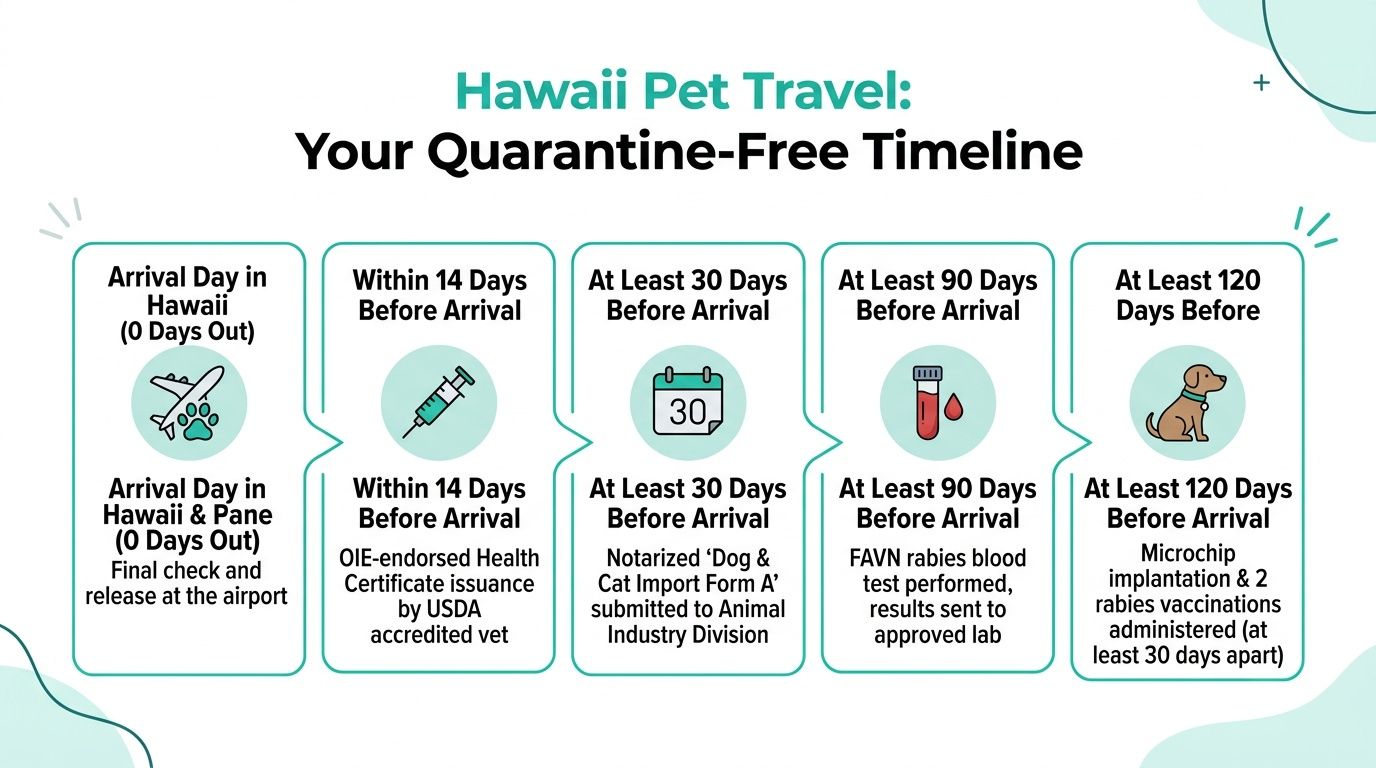
The easiest way to manage Hawaii travel is to work backward from the day you want your dog to land. That keeps everyone focused on the deadlines that control eligibility.
Many otherwise solid plans often fail at this point. The medical steps are only part of the puzzle. Hawaii also has mandatory waiting periods and document deadlines that don’t care whether the flight was already booked.
Start from arrival day and count backward
If the dog is entering Oahu, the documents need to be submitted at least 10 days before arrival. If the dog is headed to a Neighbor Island such as Maui or Kauai, the lead time is 30 days. Hawaii also requires a mandatory 30-day wait after the OIE-FAVN sample is collected before the pet can enter. The fee for DAR is $185 per pet, compared with $244 for the 5-day quarantine program (Travel Nuity’s breakdown of Hawaii pet entry).
Those numbers shape the whole calendar.
A practical reverse timeline
Use this as a planning model rather than a last-minute checklist.
Within 14 days of arrival
This is the final exam and document window. The licensed veterinarian issues the health certificate, and the file should already be complete enough that nobody is scrambling for old vaccine records or missing lab data.
At this stage, owners should avoid changing flights unless absolutely necessary. Last-minute changes ripple through everything.
More than 30 days before arrival
The dog must already have cleared the waiting period after the FAVN sample collection. If the blood was drawn too late, there’s no way to “rush” this part.
For teams handling Neighbor Island travel, this stage is also where the administrative side gets tighter. The island-specific approval path is less forgiving because there are more moving pieces.
Earlier than that
The two rabies vaccinations and the FAVN setup must already be in place, and the microchip has to be tied to all of it. If the dog is early in the rabies series, the timeline may push travel back.
That’s why many clinics prefer to start Hawaii files well ahead of the intended move. It leaves room for normal delays like appointment availability, shipping time, and owner questions.
Timeline traps that fool smart people
The process sounds simple when reduced to a list. It gets harder when dates begin interacting.
Here are the traps I see most often:
Counting from the wrong date
Owners may count from the lab result date instead of the sample collection date. Hawaii cares about the required wait after sample collection.Booking flights before confirming eligibility
This is common with relocations. The owner books the move, then asks the clinic to “fit the dog into the timeline.”Assuming Oahu and Neighbor Islands work the same way
They don’t. Neighbor Island entry needs more lead time and more coordination.Treating the health certificate as the main deadline
It’s only one piece. By the time you’re in the certificate window, the hard planning should already be done.
If you’re trying to solve a Hawaii file in the final two weeks, you’re usually solving a scheduling problem that started months earlier.
A simple owner and clinic workflow
The smoothest files usually follow a shared workflow like this:
Stage | Owner action | Vet action |
|---|---|---|
Planning | Choose target arrival island and rough travel window | Review vaccine history and microchip status |
Medical prep | Approve needed appointments quickly | Complete rabies series and submit FAVN correctly |
Admin prep | Return forms and records fast | Assemble final packet and verify dates |
Final travel window | Avoid unnecessary itinerary changes | Issue health certificate inside the allowed window |
For clinics that want fewer surprises, this resource on the USDA-endorsed pet health certificate process helps frame the final paperwork stage.
What a good timeline feels like
A good Hawaii timeline feels almost boring. That’s a compliment. The appointments are booked in order, the paperwork is checked before submission, and the owner isn’t texting from the airport asking whether the dog can still qualify.
When the file feels rushed, it usually is. Hawaii travel rewards early planning and punishes heroic last-minute efforts.
Common Mistakes That Derail Your Hawaii Pet Travel Plans
Most failed Hawaii plans don’t fail because the dog was unhealthy. They fail because someone assumed a rule was flexible when it wasn’t.
The most expensive example is paperwork timing. Owners often believe that if they’ve completed the medical steps, they can sort out the forms right before the flight. That’s not how Hawaii works.
Missing the submission deadline
If paperwork doesn’t reach the Animal Quarantine Station at least 10 days before arrival, the pet is automatically moved from the $185 Direct Release program to the $244 5-Day-or-Less Program. That’s a 32% cost increase. The same source notes that this is a common issue for travelers planning last-minute trips or relying on slower paper-based submission methods (Tailwind Global Pet’s Hawaii transport note).
That’s the trap many guides underplay. People think in terms of pass or fail. In reality, there’s a costly middle ground where the dog may still travel, but not under the release plan the owner expected.
Small errors with big consequences
Some mistakes look tiny on paper but create a chain reaction.
The microchip and rabies records don’t line up
If the dog’s ID trail is inconsistent, the file becomes harder to validate. A clinic may know it’s the same dog. Hawaii needs the documents to prove it cleanly.
The owner assumes any vet or lab workflow will do
Hawaii files reward precision. If a clinic doesn’t handle pet travel often, routine habits can cause trouble. The dog may still be perfectly healthy, but a preventable paperwork mismatch can put the whole plan on the back paw.
Parasites are discovered late
A dog can be medically prepared for Hawaii and still hit a problem at inspection if external parasites are found. That’s why the final exam and coat check matter. “Looks fine to me” isn’t a travel protocol.
What doesn’t work
These owner habits create avoidable problems:
Waiting to gather records until the last minute
Old rabies certificates have a way of disappearing when you need them most.Treating every island like the same arrival process
Oahu and Neighbor Islands don’t use the same timing rules.Booking first and validating later
This puts the veterinary team in a rescue role instead of a planning role.Sending paperwork without a date audit
One wrong assumption about timing can change the outcome and the fee.
The Hawaii process is unforgiving in a very ordinary way. It usually fails on calendars, labels, and missing attachments.
What works instead
Good files are dull in the best way. The owner keeps a single folder with all vaccine records. The clinic checks every date against the travel plan. Someone confirms receipt before assuming the paperwork is safely in the system.
That kind of discipline isn’t glamorous, but it’s what keeps a beach arrival from turning into a kennel surprise.
Navigating Airlines and Your Arrival Day in Hawaii
Arrival day should feel calm. That only happens when the airline plan matches the Hawaii approval plan.
A frequent mistake is focusing so much on the state requirements that the flight logistics get less attention than they deserve. Airlines have their own pet policies, their own documentation checks, and their own cutoffs.
Pick the flight around the dog, not just the fare
For Hawaii pet travel, the “best” itinerary isn’t always the cheapest or shortest on paper. It’s the one that fits the dog’s size, crate setup, approved route, and arrival process.
Owners should confirm:
Whether the airline accepts pets on the specific Hawaii route
Whether the dog can travel in cabin or as manifested cargo
What paperwork the airline wants to see before check-in
Whether the arrival time creates problems for inspection
This guide to which airlines allow pets in the cabin is useful when comparing options.
If your dog gets nervous during travel, it also helps to talk with your veterinarian early about behavior support, crate comfort, and non-sedation strategies. Some owners also look into natural supplements for dog anxiety as part of the prep routine.
What happens when you land
For dogs using the direct release pathway, Daniel K. Inouye International Airport (HNL) is the key entry point. The dog is inspected at the airport quarantine holding facility before release.
The Hawaii Vacation Guide notes that after arrival at HNL, pets are inspected for ticks, parasites, and signs of disease, and if pre-cleared, they may be released after inspection. It also notes that arrivals before late afternoon may be handled the same day, while later arrivals can shift release to the next morning (Hawaii direct airport release process).
That means owners should think about arrival timing as a practical issue, not just a booking preference.
Neighbor Island arrivals need tighter coordination
If the final destination is a Neighbor Island such as Kauai, Maui, or Kona, the file gets more delicate. A Neighbor Island Inspection Permit, or NIIP, must be secured online. According to the source summary, that permit becomes invalid if flight plans change by more than 5 days, which affects 15-20% of travelers in user reports. The same source notes that parasite detection during inspection can lead to up to 25% of pets being held for a mandatory 5-day quarantine (YouTube summary of Neighbor Island direct release details).
That’s why I tell owners to treat Neighbor Island travel like a coordinated handoff, not a casual connection.
Arrival day checklist
A practical final check looks like this:
Task | Why it matters |
|---|---|
Bring your full document set | Airline staff and inspectors may ask for records |
Confirm permit details before departure | Neighbor Island paperwork must match the itinerary |
Check the dog carefully for parasites before travel | This is one of the easiest ways to lose a smooth release |
Keep your phone on after landing | You may need to coordinate quickly with airline or inspection staff |
The smoother the pre-travel prep, the less dramatic arrival day becomes. That’s the goal. No surprises, no frantic gate calls, no paperwork scavenger hunt while your dog wonders why paradise smells like jet fuel.
How Vets and Owners Can Streamline the Process
Hawaii pet travel doesn’t require magic. It requires organization that holds up under pressure.
That’s where many teams struggle. The process crosses appointments, lab work, owner communication, flight timing, and final document review. A clinic might handle the medical side well but still lose time chasing forms. An owner might be committed and responsive but miss a critical date because no one translated the rules into a calendar.
What strong coordination looks like
The best clinic-owner partnerships usually share a few habits:
One source of truth
Everyone works from the same travel date, same island, same rabies records, and same microchip details.Deadline tracking tied to the trip date
Not a sticky note. Not a memory. A system.Document review before submission
It’s faster to catch a mismatch before the packet goes out than after the state receives it.Clear communication with the owner
Owners need to know what’s urgent, what can wait, and what can’t be changed casually.
Why a workflow tool makes sense
This is exactly the kind of travel case that benefits from a purpose-built platform instead of email chains and manual spreadsheets. Veterinary teams need a way to track task order, validate document completeness, and keep owners updated without turning every Hawaii file into a custom project.
Pet owners benefit too. They don’t just want to know the rule. They want to know whether their dog is on track today, what still needs attention, and what could trigger a delay.
Good Hawaii travel planning feels less like “hoping everything is okay” and more like checking completed boxes in the right order.
Passpaw fits that workflow well because it gives practices tools for real-time document validation, task prioritization by travel date, and cleaner client communication. That doesn’t remove the rules. It makes them manageable.
For owners, that means fewer blind spots. For clinics, it means less time reconstructing timelines from scattered emails and attachments. And for the dog, it means a better shot at the kind of arrival everyone wants: leash on, tail wagging, quarantine avoided.
If you're planning a Hawaii move or guiding clients through one, Passpaw helps keep the process organized from the first rabies record to the final travel documents, so fewer details slip through the cracks and more pets arrive ready for a paws-itively smooth release.
More articles
From regulatory changes to best practices for veterinarians and pet owners, our resources keep you ahead of the curve.