Are you a team member in a veterinary practice?
Are you a pet parent planning a trip with your furry pal?
Health Certificate for International Travel: A Pet Guide
You’ve booked the flight, checked the carrier rules, and maybe even picked the hotel with the best dog-friendly walking route. Then the paperwork hits. Suddenly the trip feels less like a getaway and more like a scavenger hunt through vaccine records, microchip details, signatures, and deadlines.
That’s normal. A health certificate for international travel can look intimidating the first time because it sits at the intersection of medicine, border control, and logistics. But it’s manageable when you treat it as a timeline problem instead of a last-minute form.
Planning Your Pet's Globetrotting Adventure
The first international trip with a pet usually starts with excitement and then quickly turns into questions. Can your dog fly on the date you booked? Does your cat’s rabies certificate match the microchip record? Does the destination want a standard form, a country-specific form, or both?

The key mindset shift is this. The certificate isn’t random bureaucracy. It’s your pet’s official travel document, built to show that identification, vaccination, testing, and exam findings all line up.
That matters because border health rules exist for a reason. In human travel, 43–79% of travelers on trips to destinations in Asia or Africa developed a travel-related illness in the studies summarized by this travel medicine review. Different species and different diseases are involved in pet travel, of course, but the logic is similar. Countries want a documented way to reduce health risk at the border.
Why the process feels so strict
A pet travel certificate isn’t just asking, “Does this animal look healthy today?” It asks a longer chain of questions:
Identity: Is this the same animal named in every document?
Timing: Were vaccines, tests, and treatments done in the right order?
Eligibility: Does the destination accept those records in that format?
Proof: Can an airline agent, customs officer, or government vet verify it quickly?
If any link in that chain breaks, the trip can go sideways fast.
A smooth pet trip usually comes from boring prep. That’s a compliment.
Owners often do best when they start with their pet’s basics before touching the travel forms. Breed traits, size, and temperament can affect crate choices, flight planning, and handling on arrival. If you’re still gathering those basics, Creatures dog profiles can be a useful starting point for understanding common breed characteristics.
The practical way to think about it
Don’t think of the certificate as one appointment. Think of it as a project with three moving parts:
Medical readiness
Document accuracy
Timing against travel dates
Get those three right, and the rest becomes much less ruff.
Understanding Your Pet’s Official Travel Document
An international health certificate is a veterinary document that confirms your pet was examined and that its records meet the destination’s import rules. For U.S. departures, the document process usually runs through a USDA-accredited veterinarian and often requires USDA APHIS endorsement before travel.
Who handles what
This process works best when everyone knows their role.
Pet owner: gathers prior records, confirms travel dates, and provides exact destination details
USDA-accredited veterinarian: examines the pet, reviews compliance, and completes the certificate
USDA APHIS: endorses the paperwork when the destination requires federal approval
If one person guesses instead of verifies, errors creep in. Most certificate delays don’t happen because the exam was hard. They happen because one detail on one supporting document doesn’t match the rest.
The main U.S. form
For many trips out of the United States, the primary document is USDA APHIS Form 7001. Since April 2020, USDA-accredited veterinarians have been able to submit health certificates electronically through VEHCS, and a hard copy still has to travel with the pet, as explained in this overview of the USDA APHIS Form 7001 and VEHCS process.
That digital shift helped clinics in a practical way. It reduced some of the back-and-forth that used to happen with paper handling, but it didn’t remove the need for careful review. Digital submission doesn’t fix a wrong microchip number or an expired vaccine.
What the certificate actually pulls together
A good way to picture the file is as a stack of matching records:
Identification details such as species, breed, sex, age, and microchip
Vaccination records that meet destination rules
Lab results when required
Treatment records for parasite protocols when required
Clinical exam findings from the issuing veterinarian
Endorsement paperwork if the country wants federal signoff
If you want a plain-language walkthrough of the form itself, this guide to the APHIS 7001 health certificate is useful because it shows how the core document fits into the larger travel packet.
Practical rule: The certificate is not a substitute for every other travel document. It works only when the supporting records match it exactly.
What works and what doesn’t
What works is building the certificate from verified records outward. What doesn’t work is trying to “clean it up” at the final appointment by filling gaps from memory. Border paperwork has very little patience for “close enough.”
Navigating Country-Specific Pet Travel Rules
There isn’t one universal health certificate for every destination. Each country writes its own entry rules, and the certificate has to match that country’s expectations closely. That’s why two pets leaving on the same day from the same clinic can have very different prep timelines.
The core items most countries care about
For dogs leaving the U.S., rabies documentation is often the anchor requirement. A primary rabies vaccination must be given at or after 12 weeks of age, and many destinations also require a rabies titer test done at least 30 days after vaccination, with a valid result of ≥0.5 IU/ml, according to USDA APHIS pet travel guidance.
Beyond rabies, clinics usually review a familiar set of items:
Microchip details: The number has to match across the certificate and supporting records.
Vaccination timing: Some destinations care not just that a vaccine was given, but when it was given relative to microchipping.
Lab testing: Some countries want serology or other test results attached.
Parasite treatment: Dogs entering certain places may need treatment recorded within a strict time window.
Form selection: Some countries accept a standard structure, while others want their own certificate language.
A sample comparison
The table below isn’t a substitute for checking the destination’s live rules. It shows why “my friend did this last year” is a risky planning method.
Requirement | European Union | United Kingdom | Japan |
|---|---|---|---|
Microchip | Commonly required and must match records | Commonly required and closely checked | Commonly required as part of identity verification |
Rabies vaccine | Required for eligible entry documentation | Required for eligible entry documentation | Required, often with close attention to timing |
Rabies titer | May be required depending on origin and route | May be required depending on origin and route | Often part of a longer prep process |
Parasite treatment | May apply depending on route and species | Often a key dog-entry item | Destination-specific review needed |
Certificate format | Country-specific entry paperwork may apply | Country-specific entry paperwork may apply | Country-specific entry paperwork may apply |
Timeline pressure | Moderate to high if testing is needed | Moderate to high because timing windows can be tight | Often longer due to sequencing requirements |
For a broader destination lookup, clinics and owners often use country databases such as the supported countries directory to identify where the rules start to diverge.
The hidden complexity is sequencing
People often focus on the form itself because it’s visible. The harder part is sequencing. If a destination expects microchipping before a vaccine, or vaccination before a titer, a late discovery can collapse the whole timeline.
That’s why experienced coordinators obsess over order of operations:
Confirm the destination and route.
Confirm the pet’s identification record.
Review vaccine history.
Decide whether testing is needed.
Count backward from the flight date.
Countries usually don’t reward effort. They reward a file that matches their rulebook.
Why country research can’t be casual
A pet owner may read one airline page, one clinic blog, and one social post, then assume they have the full picture. They usually don’t. Airlines, countries, and return-entry requirements can all create separate layers.
The certificate has to satisfy the destination first. Then the airline’s handling rules have to fit around it. If those two don’t line up, your travel day can still stall even when the medical work was done correctly.
Your Step-by-Step Guide to Getting the Certificate
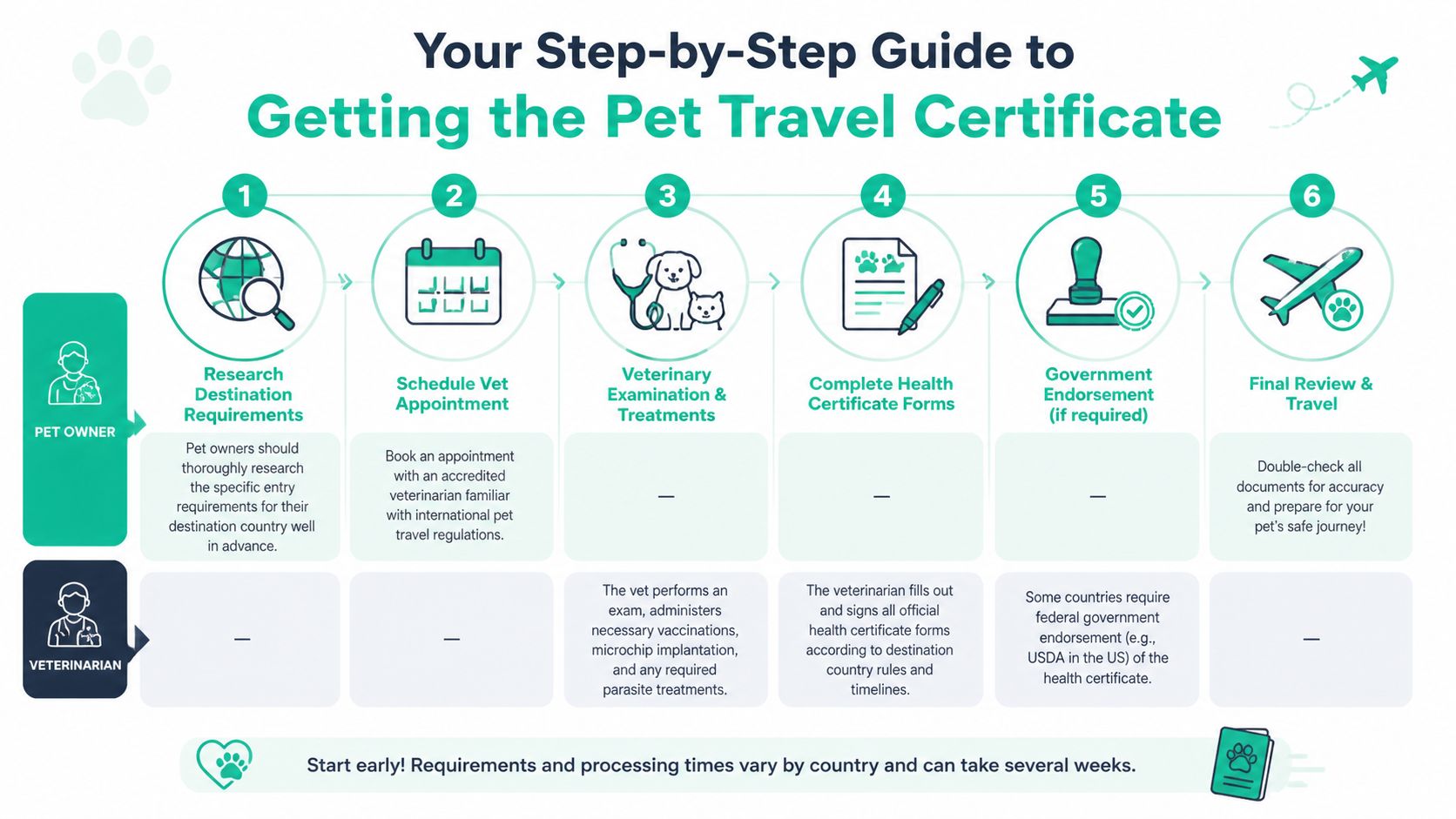
The best health certificate files are built backward from the departure date. That keeps the final exam inside the valid window while giving enough time for vaccines, tests, corrections, and endorsement.
Start with records, not the exam
Before anyone books the final certificate visit, gather every relevant record in one place. That includes prior rabies certificates, microchip paperwork, lab reports, and any past travel documents. If the pet has seen multiple clinics, combine those records early.
This is also the point to book with a veterinarian who handles international travel paperwork regularly. The appointment itself may be quick. The preparation around it is not.
Work through the timeline in order
Here’s the sequence that works in practice.
Confirm the destination requirements
Match the country, species, and travel route. Connecting through another country can affect the paperwork.Book the first planning visit
This visit is for review, not just signatures. The vet team checks whether the current records already support travel or whether something needs to be repeated.Complete vaccinations, microchip updates, and tests
If the file needs a rabies booster, titer, or other required item, do it on the correct schedule. Don’t assume an old record will be accepted.Handle destination-specific treatments
Some countries require treatment entries within a narrow window. Those entries need to land in the right place on the certificate.Schedule the final health exam close to departure
International certificates are often valid for about 10 days, largely because airlines use that window, as noted in this guide on how to get a health certificate for a dog. Some countries use even tighter timing.Get endorsement and review the final packet
Before travel day, confirm that the endorsed document, supporting records, and hard copy are all ready to go.
What clinic managers should watch closely
Clinic workflow breaks down when travel cases are treated like regular wellness visits. They need different scheduling logic.
Front desk screening: Ask destination, species, and travel date before booking.
Record intake: Request outside records before the doctor visit.
Form review: Assign one team member to compare every ID field across documents.
Owner communication: Give written deadlines so no one relies on memory.
The final exam is the last step in a chain. It shouldn’t be the first time anyone looks for missing records.
What pet owners can do to help
Owners make the process much easier when they bring exact travel information, not rough plans. “Europe in June” isn’t enough. The clinic needs the country, departure date, route, and whether the pet will return through a different country.
That level of detail feels picky, but it saves everyone from chasing their tail later.
Avoiding Ruff Patches in Your Pet Travel Plans
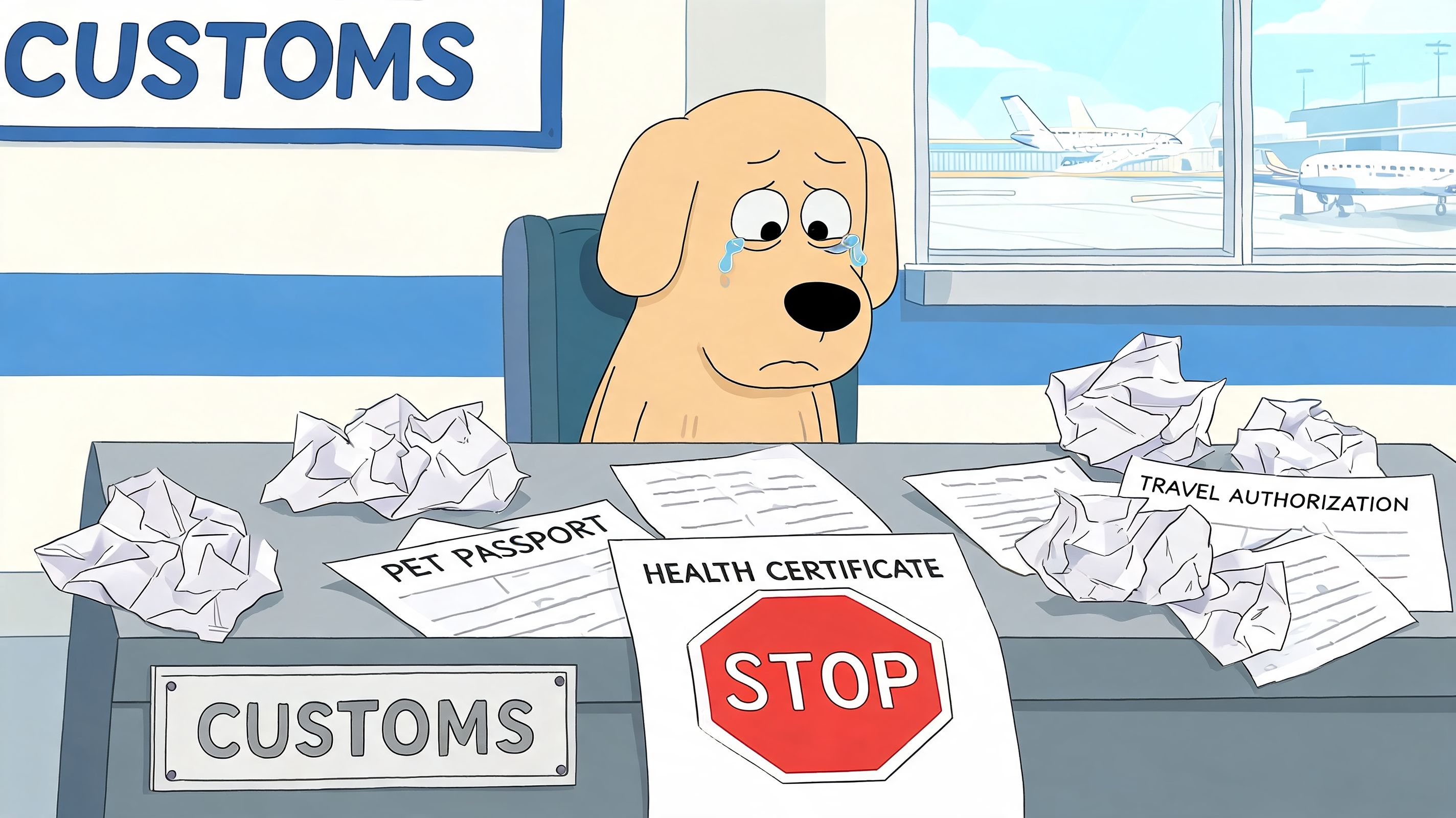
Most failed travel files don’t fail for dramatic reasons. They fail because of tiny mismatches that nobody caught in time. One digit is off. One signature is missing. One treatment lands outside the accepted window.
The biggest tripwire is document mismatch
According to USDA APHIS training materials, a mismatch between the microchip ID on the health certificate and the one on the rabies vaccination report leads to 100% rejection at the border, and incomplete or mismatched documents can trigger quarantine or denial of entry, with costs that can exceed $5,000, as shown in this USDA APHIS training example.
That’s why experienced teams don’t “eyeball” records. They compare them character by character.
Common mistakes and the fix for each
Microchip numbers don’t match
What happens: the file can be rejected even if every vaccine is current.
Fix: scan the microchip and compare the number against every supporting document before submission.The final exam is booked too early
What happens: the certificate may expire before the flight.
Fix: count backward from the actual departure date, not the week you hope to travel.A non-accredited clinic starts the paperwork
What happens: the owner loses time and may need to repeat steps with the correct veterinarian.
Fix: verify accreditation before the first travel appointment.Blank fields or altered entries remain on the form
What happens: endorsement delays, airline questions, or border problems.
Fix: run a final line-by-line review before anything is submitted.
What doesn’t work
A lot of owners assume the paperwork can be patched together in the final week. That approach almost always creates stress because travel files depend on earlier decisions. If the sequence was wrong months earlier, a rushed signature won’t fix it.
A simple error-proof routine
Use this checklist before the document leaves the clinic:
Scan the chip live: Don’t rely only on old records.
Match names and dates: Owner name, pet name, and travel date must align across forms.
Review supporting attachments: Rabies records and lab reports should mirror the certificate.
Print the travel packet: Keep the hard copy clean, legible, and ready to accompany the pet.
Border officials don’t know your pet. They know your paperwork.
Automating the Process with Passpaw
The hardest part of international pet travel isn’t filling out one form. It’s keeping the entire file current while rules, dates, and supporting records shift under you. That’s where manual workflows start to wobble.
Why spreadsheets and sticky notes break down
A major gap in most pet travel advice is how to deal with changing regulations after planning has already started. Industry data cited in this overview of travel certification workflow challenges says manual checks for rule updates fail up to 30% of the time, while cloud platforms with real-time validation against 150+ country databases can reduce errors by 85%.
That’s the practical case for automation. Not because software is flashy, but because pet travel rules are moving targets.

What an automated workflow should do
A useful system should help a clinic or travel coordinator do four things well:
Validate destination rules in real time
Prioritize tasks by departure date
Keep owners updated without endless email threads
Flag record mismatches before the final exam
Passpaw is one example of that type of tool. Its platform features focus on document management, task tracking, validation, and communication around international pet travel compliance.
Why this matters beyond veterinary medicine
Other regulated fields learned this lesson earlier. Law firms, for example, increasingly use structured software to manage rules, documents, and deadlines instead of relying on memory and inbox searches. If you want a cross-industry comparison, these AI-powered legal tools show how professionals handle detail-heavy workflows when the cost of an error is high.
The same principle applies here. A living ruleset is easier to manage in a system than in a binder.
Good automation doesn’t replace judgment. It gives the team more time to use judgment where it matters.
Your Pet Travel Certificate Questions Answered
How do I handle travel for multiple pets
This is one of the most common stress points, especially for families moving abroad. The challenge isn’t just volume. It’s that each pet may have a different vaccine history, microchip record, or species-specific requirement.
That matters more now because this area is getting more complex. In this overview of travel health certificates for exotic and avian pets, pet bird exports are noted as up 25% year over year, some destinations require 6–7 month preparation timelines, and 62% of multi-pet owners reported significant delays. The practical fix is to build a separate timeline for each animal, then manage them under one departure calendar.
How long is a health certificate valid
The answer depends on who is checking it. Airlines often work with a short validity window, and some destinations have their own limits. That’s why clinics usually schedule the final exam close to departure instead of as soon as the owner asks for paperwork.
If the trip date shifts, don’t assume the document still works. Ask the issuing clinic to review the timing against the destination and airline rules again.
Is an international certificate the same as a domestic one
No. Domestic travel paperwork is usually simpler. International travel often requires a country-specific form, stricter timing, and government endorsement depending on the destination.
That’s why a routine “fit to fly” visit is not the same thing as preparing a full international packet.
What if the rules change after my certificate is issued
This is the problem most first-time travelers don’t see coming. A file can be correct when it’s prepared and still become outdated if the destination adjusts its import rules.
When that happens, the safest response is to re-check the live requirements immediately and ask the issuing clinic whether any step needs to be repeated or re-issued. Static checklists help at the start. Dynamic review helps at the finish.
If you’re planning pet travel and want a clearer path through the paperwork, Passpaw provides a structured way to manage timelines, documents, and destination-specific requirements without relying on scattered notes and manual follow-ups.
More articles
From regulatory changes to best practices for veterinarians and pet owners, our resources keep you ahead of the curve.