Are you a team member in a veterinary practice?
Are you a pet parent planning a trip with your furry pal?
German Shepherd Command Guide: 8 Essential Skills for 2026
Your German Shepherd flies out of the car at a busy rest stop before you've got a solid grip on the leash. Or it's 2 a.m. in a hotel room and he's pacing, whining, and scratching at the door every time someone walks past in the hall. If that sounds familiar, you're not alone, and you don't need flashy tricks to fix it.
You need a small set of German Shepherd command skills that work where life really happens. At doors. At counters. In parking lots and vet waiting rooms. This list gives you eight of them, in order from the easiest place to start to the skills that take a bit more patience.
For each one, you'll get a difficulty level, a plain timeline for practice, the most common pitfall, and a few tips you can use today. This breed was built for work. German Shepherds moved from herding in late-19th-century Germany into police and military service by the time of World War I in 1914, as the VCA Hospitals breed history explains. That's good news. Most of them love having a clear job, even if that job is just sitting nicely while you find your room key.
Keep sessions short, reward fast, and don't try to teach everything at once. A little steady practice beats one long, tiring session every time. Think of it as a path, not a test. By the end, travel feels calmer, and your dog knows what to do at each stop along the way. No need to feel ruff about where you're starting.
1. Sit

Sit is where most teams should start. Your dog puts his rear on the ground and stays there until you release him. It's simple, it's easy to reward, and it becomes the polite starting point for almost everything else. At a check-in counter, a solid sit gives you two free hands for paperwork instead of a wrestling match.
Difficulty is low. For many German Shepherds, the idea clicks in a few short sessions at home. Making it work with people, bags, and noise around takes longer. Plan on daily practice at home first, then in your driveway, then in a quiet part of a parking lot.
How to Build a Sit That Holds Up
Puppy classes often start here because you can see the win right away. The American Kennel Club puppy training timeline for German Shepherds advises teaching sit early and asking for a sit before valued rewards like food, play, or going outside. That turns daily life into practice without adding extra work.
Reward fast: Pay with a treat or praise right after the rear hits the floor.
Use real moments: Ask for sit before meals, at doorways, and before you clip on the leash.
Keep it short: End while your dog is still keen, not bored or bouncing.
The most common pitfall is saying "sit, sit, sit" until the word stops meaning anything. Say it once. Wait a beat. Help with a treat lure over the head if needed, then reward. If your dog pops up the second the treat appears, you're moving too fast for that place. Step back to a quieter spot and build up again. Small wins stack up fast with this breed.
2. Down
Roll out a mat in a vet waiting room and ask for Down. Your dog lies flat on his belly, elbows and hips on the ground, and settles there. That's a very different picture from a dog sitting up, staring at every door that opens. Down asks for calm, and for many dogs it asks for trust too, because it's harder to spring up and move.
Difficulty is low to medium. A dog who already sits well can usually learn the move at home in short daily sessions. Holding it while a clinic phone rings or another dog walks past takes more weeks of slow steps. Don't rush this one on cold tile or hot pavement. Comfort matters.
Start From Sit, Not From Standing
From a sit, bring a treat down between the front paws and slightly forward. Reward small steps at first. Elbows bending counts. One elbow down counts. A full, sloppy flop isn't the goal on day one.
Use a soft spot: A mat or blanket tells your dog this is a rest place, not a push-up contest.
Reward calm: Pay for slow, smooth moves and a soft body, not speed.
Pause if he pushes back: If he resists, stop and reward the try instead of pressing on his shoulders.
Many dogs learn Down as a mid-level skill after Sit in obedience classes, and service and working dogs use it to rest calmly during long shifts. Your travel version is the same idea at a smaller scale. Hotel lobby, cafe patio, long check-in line. The most common pitfall is forcing the position with pressure on the back. That teaches stress, not rest. If your dog won't settle, the place may be too hard right now. Make it easier and try again.
3. Stay

Stay means hold that sit or down until you come back and release your dog. It's pure self-control. For travel, it's gold. You can open a crate, step to a counter, or load a bag without your dog drifting off to say hello to strangers.
Difficulty is medium. The move itself is easy. Holding still while you walk away is the hard part. Build it in tiny steps over weeks, not days. A short stay beside you in the kitchen comes long before a stay in a busy terminal.
Change One Thing at a Time
Airport and travel programs lean on stay so dogs can wait at counters and in carriers. Police K9 teams use it for controlled work. At home, copy that same clear setup.
Practical rule: Build time, distance, or distraction. Pick one. Never raise all three in the same session.
Use the same release word every time, such as "free" or "okay," and return to your dog before you reward at first. That teaches him that waiting for you pays. End the rep before he breaks, so he gets to win.
The most common pitfall is walking too far, too soon, then calling the dog to you out of the stay. That muddles the lesson. Was he supposed to hold, or come? Keep stay and come separate for now. If he gets up, don't scold. Calmly reset, make the next try shorter, and reward success. Steady beats fancy here, paws down.
4. Come (Recall)

A leash slips at a rest stop. A gate doesn't latch at a rental house. Come, also called recall, is the command that brings your dog back to you fast. It's the most important safety skill on this list, and it's the one owners most often ruin by accident.
Difficulty is medium to high. Your dog may learn the word at home quickly. A dependable recall around squirrels, other dogs, and open space takes much longer. An owner-reported summary linked to a German Shepherd training timeline estimated dependable off-leash recall often took 6–10 weeks or longer, even though basic cues were often learned within roughly 2–6 weeks with daily practice. Plan for the long game.
Make Coming Back the Best Deal
Search and rescue dogs rely on strong recall in open areas, and sports like agility and obedience test it too. Your dog doesn't need that level, but he does need a fat history of wins.
Pay big: Use cheese, chicken, or a favorite toy. Recall should feel like winning the lotto.
Use a long line: Practice in a fenced or low-risk area so you can guide him in without chasing.
Keep one clear cue: A special word or whistle used only for recall stays sharp.
The most common pitfall is calling your dog for things he hates, like a bath, nail trim, or the end of play, every single time. He learns that coming to you ends the fun. Call, reward, and often release him back to play. And never punish a slow return. If he came back, he did the job. Reward it like you mean it.
5. Heel
Walking through a crowded station with a strong German Shepherd pulling toward every smell is no one's idea of a good trip. Heel fixes that picture. Your dog walks beside you, usually on your left, shoulder near your leg, keeping your pace without pulling ahead or lagging behind.
Difficulty is medium to high. A few good steps beside you at home can come quickly. A true heel past food stalls, luggage, and other dogs takes steady practice over months in harder and harder places. Start where your dog can think. A quiet street beats a market on day one.
Reward the Spot, Not the Finish
Obedience events judge heeling as teamwork. In Beginner Novice, heel on leash is worth 40 points out of 200 points across five exercises, and handlers may use verbal commands and encouragement, according to the German Shepherd Dog obedience summary. Guide and service dog teams practice the same close walking in busy public spots.
Reward often in position: Feed small treats at your leg while he's in the right spot.
Change direction: Turn often so your dog learns to watch you, not the horizon.
Use simple gear: A well-fitted harness or collar and a short, loose leash work well.
The most common pitfall is only rewarding at the end of a long walk, so the middle falls apart. Short, happy bursts of heel with lots of pay work better than one long drill. If he surges ahead, stop or turn instead of dragging him back. You're teaching a place to be, not winning a tug match.
6. Leave It
Someone drops fries in an airport food court. There's a pill bottle under a hotel bed, or trash by a gas station bin. Leave It tells your dog to ignore that thing and look back at you instead. For a mouthy, curious German Shepherd, this one can prevent a vet visit.
Difficulty is medium. Ignoring a treat in your closed hand is the easy first step. Ignoring a dropped sandwich around strangers is a later level. Build it week by week, from boring items to better ones. If you want a step-by-step plan after this list, you can teach your dog to leave it with a fuller real-world routine.
Trade, Don't Just Block
Start with a treat in a closed fist. Wait. The moment your dog pulls his nose away, mark and reward from your other hand. He learns that leaving the thing gets him a better thing from you.
A peer-reviewed survey of 364 dog owners summarized in the Animal Welfare training methods study found owner-rated obedience improved as more tasks were trained with rewards. Object release was one of the tasks where method mattered. That fits Leave It perfectly. Reward the look back at you, not just the act of ignoring.
The most common pitfall is repeating "leave it, leave it" in a louder voice while your dog keeps sniffing. Say it once, calmly. Then help him win by stepping back or making the item easier. Working dog programs use this same skill to keep dogs on task. Your job is smaller, keep the fries on the floor and your dog with you.
7. Wait
Wait is the car door command. It's also the hotel door, crate door, and front gate command. Your dog pauses and doesn't move forward until you release him. It's shorter and lighter than Stay. You're not asking him to hold a position while you leave. You're asking for a brief pause so no one bolts into a parking lot.
Difficulty is low to medium. Most dogs pick up a short wait at a home doorway in daily practice fairly fast. A calm wait at an open car door with traffic going past takes more built up habit. Use it before every walk and it becomes part of the routine.
Doors Teach the Lesson for You
Stand in the doorway yourself at first. Open the door a crack. If your dog pushes forward, close it gently. When he pauses and looks at you, say your release word and go through together. Households with many doors use wait for the same reason travel handlers use it at carriers. It stops escapes before they start.
Wait is a pause button, not a freeze. Short, clear, and released by you.
For extra clarity, compare it with formal obedience work. The AKC Obedience Regulations set out a stand-stay sequence with the orders "Stand your dog," "Leave your dog to get your leash," and "Back to your dog." Your wait is far simpler than that, which is why it works so well for daily travel moments.
The most common pitfall is forgetting the release. Your dog waits, gets bored, and helps himself. Always tell him when he can move. Start with a few seconds, then build. A dog who waits at a door is a dog you can travel with in peace.
8. Place (Settle on a Mat)
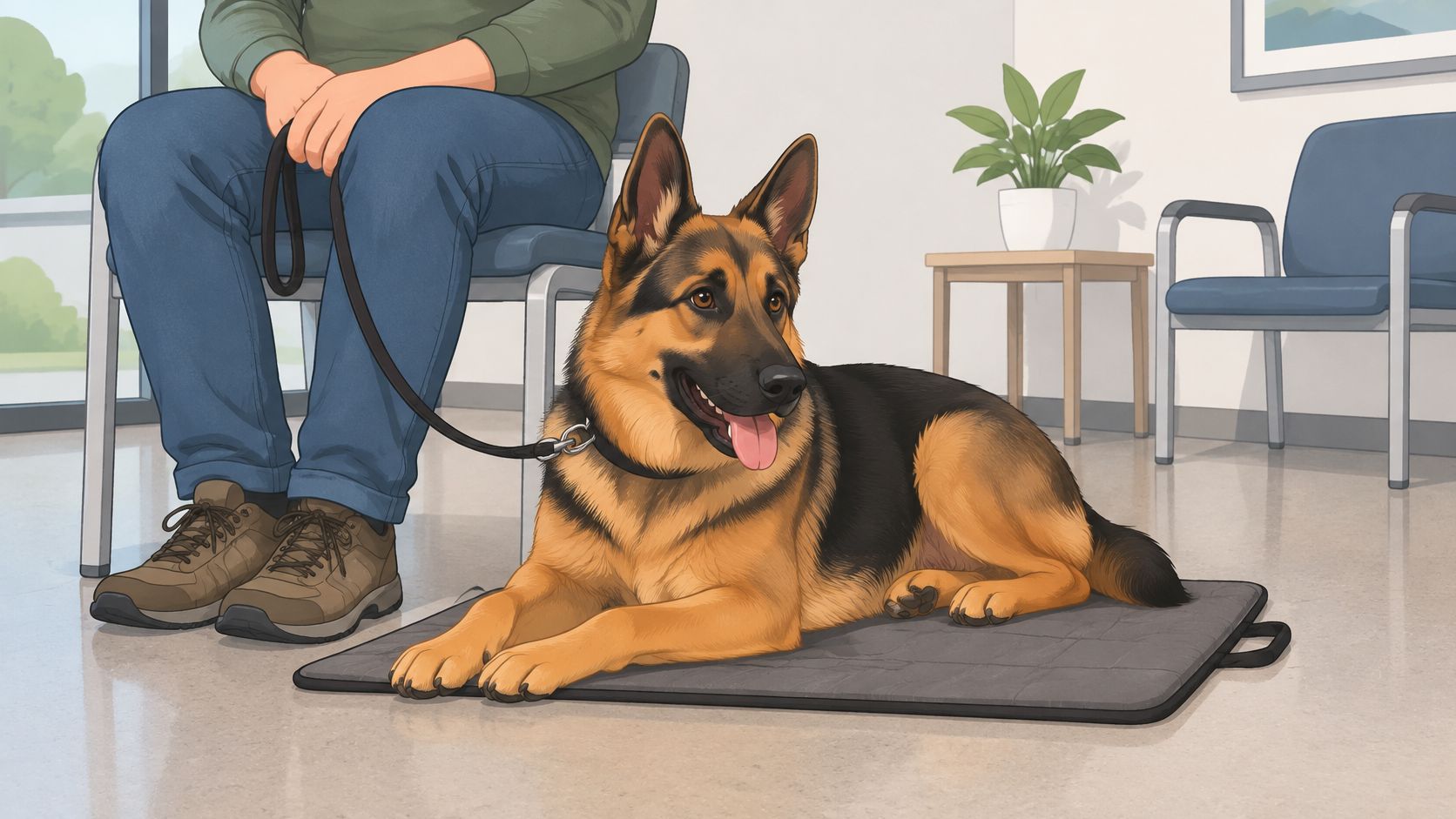
Place sends your dog to a mat, bed, or towel and asks him to settle there. Bring the same mat to a hotel, a vet clinic, or a friend's house and you've brought a piece of home with you. For a breed that likes to patrol new rooms, a known spot lowers stress for both of you.
Difficulty is medium. Going to the mat at home is the first step. Relaxing there while people walk past takes longer. Build short settles at home, then try the mat in the yard, then in a quiet new place. Add time slowly and reward calm, not just position.
Make the Mat the Best Seat in the House
Many clinics like owners to bring a mat so dogs can wait calmly, and working dog handlers use mat work for rest during long shifts. Cooperative skills like calm handling and settling are a big gap in many basic guides, as recent German Shepherd care guidance notes when it recommends comfortable handling and gradual exposure to new people and places. Place fills that gap well.
Use the same mat: Practice and travel with one mat so the smell and feel stay familiar.
Reward quiet: Treat soft eyes, a sigh, or a hip rolled to one side.
Add a chew: A long-lasting chew or puzzle on the mat helps longer waits.
The most common pitfall is using place as a time-out after your dog does something wrong. Then the mat means trouble, not rest. Keep it positive. Send him there before he gets wound up, pay him well, and release him while he's still calm. Soon the mat does half the work for you.
German Shepherd Commands at a Glance
Item | Main Use | Key Pitfall | Travel Value |
|---|---|---|---|
Sit | Calm, basic position and foundation for other commands | May depend on visible treats without practice | Helps the dog wait calmly at counters and during paperwork |
Down | Encourages calm resting and settling | May be uncomfortable or difficult for dogs with joint or back issues | Useful in waiting rooms, vet visits, and rest periods |
Stay | Holds a position until released | Requires consistent practice and release cues | Helps the dog remain settled during check-in, boarding, and handling |
Come (Recall) | Returns the dog to the handler when called | Distractions can undermine reliability | Helps guide the dog through airports, rest stops, and unfamiliar places |
Heel | Keeps the dog walking beside the handler | Can be tiring and requires consistent rules | Improves control in crowded stations, airports, and parking lots |
Leave It | Prevents the dog from approaching or taking unsafe items | Can be unreliable around tempting items without practice | Keeps the dog away from spills, trash, and unfamiliar objects |
Wait | Pauses the dog before moving through an exit or doorway | May be confused with Stay | Supports safe exits from vehicles, carriers, and crates |
Place (Settle on a Mat) | Sends the dog to a designated spot to relax | Distractions may prompt the dog to leave the mat | Provides a familiar resting spot in hotels, clinics, and waiting areas |
Start Small, Practice Daily, and Travel With Confidence
You don't need to teach all eight commands this month. Pick two or three, practice for about five minutes a day, and add harder places only after your dog wins at the easy ones. One clear cue, one quick reward, lots of small reps in real life. That's how good manners turn into habit.
If travel is your goal, start with Sit, Wait, and Stay. Those three cover counters, car doors, crates, and hotel doors, the spots where things go wrong most often. Add Place next if your dog struggles to settle in new rooms. A mat in a strange hotel can change the whole night.
Then build safety with Come and Heel. Recall protects your dog at rest stops and in open areas. Heel protects your shoulder and your nerves in crowded stations and parking lots. Leave It and Down round out the set for food courts, waiting rooms, and long delays where calm matters more than speed.
Keep your methods kind and clear. In a 2025 survey of 500 eligible U.S. dog owners, 97.2% used verbal praise and 86.4% used treats or toys at least sometimes, as reported in the 2025 owner training practices study. Praise and treats travel well. They fit in a pocket, and they build trust.
I'd skip harsh tools for reliability. A 2025 Scottish Government review of aversive training devices reports research generally links aversive-based training with poorer welfare and more stress-related behavior and aggression than reward-based methods. Use a long line, barriers, good timing, and professional help if fear, lunging, or guarding shows up. That is good handling, and it keeps the trip safer for everyone.
This breed learns fast, and a quick study at home still needs proofing on the road. A sit that is rock solid in your kitchen can fall apart beside a luggage carousel. Practice where you will need the skill: the driveway, the vet's lobby, a busy parking lot on a Saturday morning.
The AKC lists heel, sit, stand, down, stay, and come as core commands for dogs aged 5 months and older in its basic obedience class, as set out in the American Kennel Club guide to getting started in obedience. It also stresses home practice in short sessions mixed with play and rewards. Train a little, play a little, end on a win.
If a trip with paperwork is coming, check destination rules early instead of leaving documents to the last week. Passpaw's Travel Prep Planner is available to try, and your veterinarian remains responsible for signing and submitting any health certificate. Pair calm handling with clean paperwork, and you and your dog can head out with real confidence. That's a pretty paw-some place to be.
Ready to pair strong commands with smooth paperwork for your next trip? Visit Passpaw to try the Travel Prep Planner and see how we help you and your veterinarian track destination requirements, documents, and deadlines in one clear place.

More articles
From regulatory changes to best practices for veterinarians and pet owners, our resources keep you ahead of the curve.