Are you a team member in a veterinary practice?
Are you a pet parent planning a trip with your furry pal?
Dog Health Certificate for Travel Cost Explained (2026)
TL;DR: For budgeting purposes, think of domestic dog health certificates as roughly $200 to $500, while international travel usually lands around $500 to $1,500+, depending on the destination’s rules and required testing. Verified pricing shows international certificates commonly run $510 to over $1,100 overall, with USDA endorsement fees alone ranging from $101 to $275, plus $21 for each additional pet on the same certificate.
If you're reading this with airline tabs open, vaccine records half-located, and a growing suspicion that nobody is giving you the same answer twice, you're not alone. This is one of the most common stress points I see when people plan pet travel. One clinic says one price. Another gives a much higher estimate. Then you learn the certificate fee isn't the whole bill anyway.
The reason the dog health certificate for travel cost feels slippery is simple. You're not buying one document. You're paying for a chain of medical, administrative, and timing-sensitive steps, and the exact chain changes by destination.
A quick domestic trip may need a straightforward exam and certificate. An international move can involve microchip review, vaccine timing checks, lab work, parasite treatment, country-specific forms, USDA endorsement, and extra coordination with your vet team. That's why two owners can both say, “I need a health certificate,” and get very different quotes.
The good news is that the price usually makes sense once you break it apart. That’s what follows.
Preparing for Your Pet's Big Adventure
A typical call sounds like this. A dog owner is moving abroad in a few weeks, has already booked flights, and just found out the paperwork may cost far more than expected. They’ve seen one website mention a simple exam fee, another mention USDA endorsement, and a third mention blood tests. Nobody has tied it together.
That gap is where most of the panic starts.
The hard part isn’t only the price. It’s that the total comes from several moving pieces, and each country builds a different recipe. One destination may ask for little more than a recent exam. Another may trigger lab work, extra declarations, treatment windows, and government review. If you’re also sorting out flight gear, this is the point where a practical resource like MyPetGuider’s ultimate guide to pet carriers for small dogs can help on the comfort side while you handle the paperwork side.
Why quotes feel all over the map
Owners often expect a health certificate to work like a standard office visit. It doesn’t.
A travel certificate quote may include some of these items, but not all:
The appointment itself: Exam time, record review, and travel planning.
Medical updates: Vaccines, parasite care, or microchip checks if your records aren’t travel-ready.
Country paperwork: Some destinations require much more than one form.
Government processing: International certificates often need endorsement after the vet signs them.
Practical rule: Ask every clinic whether the quote covers only the appointment, or the full travel packet including labs, treatments, and endorsement.
That one question saves a lot of tail-chasing.
If you want a clean starting point before you call your clinic, a structured planning tool like the Passpaw pet travel planner can help you organize destination details, dates, and required steps. Even if your final paperwork goes through your veterinarian, showing up prepared makes the process much smoother.
What Exactly Is a Dog Health Certificate
A dog health certificate is an official veterinary document stating that your dog was examined and appears healthy for travel, with required vaccines and supporting details documented for the destination. In practice, many people treat it like a passport for the pet, which is close enough to be useful.
For local or interstate travel, that certificate may be fairly simple. For international travel, it usually becomes a formal compliance document that has to match the importing country’s exact rules. That’s where mistakes happen. A healthy dog can still be delayed if the dates, wording, microchip details, or supporting records don’t line up.

What the certificate is meant to prove
At its core, the document answers a few basic questions for airlines, border officials, and destination authorities:
Is this dog healthy enough to travel
Is the dog properly identified
Are required vaccines current
Were any destination-specific steps completed on time
Those sound simple, but they become very specific once a country sets its own rules.
Domestic and international are not the same job
A domestic certificate is often more straightforward. The vet examines the dog, confirms the needed information, and issues the document. Fees for that kind of certificate are commonly much lower than international pricing. In the verified examples, some clinics charge $100 to $170 for simple domestic certificates, while international work is much higher because it includes more complexity and endorsement steps, as described in this detailed dog health certificate for travel overview.
International certificates are more demanding because the veterinarian isn’t just filling out a form. They’re matching your dog’s records to destination rules, required timing windows, and official formatting. In many cases, the certificate also needs government endorsement after the clinic finishes its part.
A health certificate is only as useful as its timing and accuracy. A correct form completed outside the accepted window can still cause travel problems.
That’s why experienced clinics spend so much time on details that owners don’t always see at first. The paperwork itself is visible. The planning behind it is the actual work.
Breaking Down the Total Cost of a Health Certificate
A client calls on Monday because her dog is flying Friday. She has a quote from one clinic, a different number from a USDA-accredited hospital, and no idea why the gap is so wide. That confusion is normal. The total is rarely one fee. It is a chain of costs, and the destination decides which links get added.
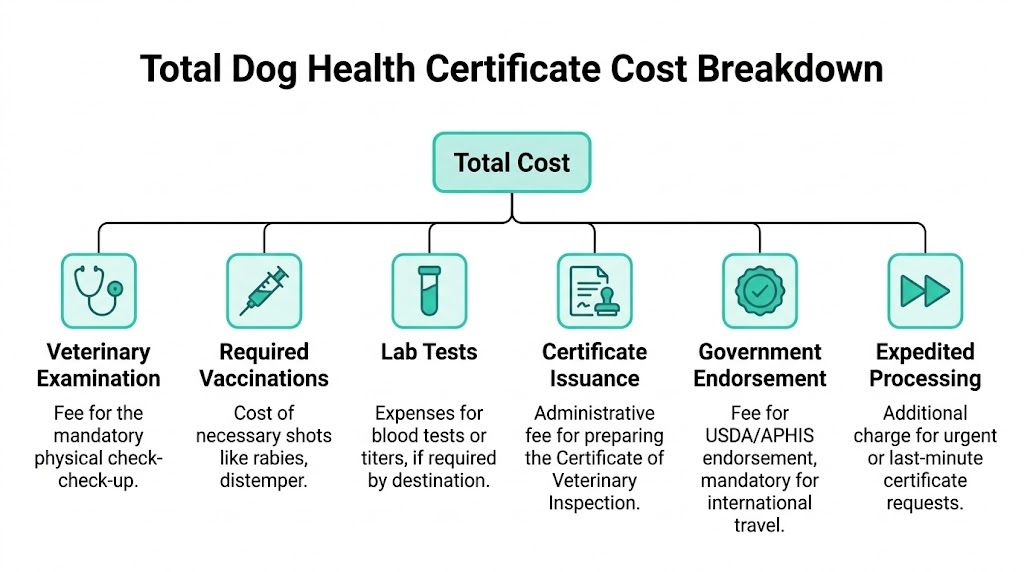
The core cost buckets
The cleanest way to budget is to separate clinic charges from government charges, then isolate anything triggered by the destination.
Cost Component | Typical Price Range (USD) | Notes |
|---|---|---|
Domestic health certificate | $100 to $170 | Verified examples show simple domestic certificates in this range. |
Country complexity tiers | $400+, $500+, $600+ | Prospect Ridge Vet lists Level 1 at $400+, Level 2 at $500+, Level 3 at $600+, excluding separate USDA fees. |
International appointment example | $750 | Polk Street Animal Hospital charges this for the international appointment alone. |
USDA endorsement, no lab tests | $101 | Standardized fee for the first pet on a certificate with no tests. |
USDA endorsement, 1 to 2 lab tests | $160 | Standardized fee tier. |
USDA endorsement, 3 to 6 lab tests | $206 | Standardized fee tier. |
USDA endorsement, 7+ lab tests | $275 | Standardized fee tier. |
Additional pet on same certificate | $21 | Added per extra pet. |
Research consultation | $85 or more | Some clinics charge for destination research time. |
The USDA endorsement tiers above come directly from USDA APHIS endorsement pricing.
What the quote usually includes
An international certificate quote often combines work owners do not always see on paper. The clinic may be reviewing vaccine dates, confirming microchip records, checking country-specific declarations, preparing the certificate, and handling endorsement instructions. Some destinations also add blood tests, parasite treatment, or extra forms that are separate from the exam itself.
That is why two dogs can both need a "health certificate" and still receive very different estimates.
In practice, the bill usually falls into three layers:
Clinic work, such as the exam, record review, form preparation, and administrative handling
Government fees, especially USDA endorsement
Destination-triggered extras, such as lab tests, parasite treatment, or supporting declarations
The USDA fee is the budgeting trap
This is the charge owners miss most often.
USDA endorsement is not a flat add-on. The fee changes based on whether laboratory tests are part of the packet. A straightforward certificate with no tests is endorsed at the lowest tier. Add one or two tests, and the fee jumps. Add several tests, and it climbs again. If you are traveling with more than one pet on the same certificate, there is also an added per-pet charge.
That structure matters because the destination often decides whether your certificate stays in the lower fee tier or moves into a more expensive one. A country that requires no lab work creates one budget. A country that requires multiple test results creates another.
Fixed charges versus variable charges
Some costs are fairly predictable once the appointment is booked:
The exam
Certificate preparation
USDA endorsement
Clinic administrative or research fees
Other costs remain variable until the destination checklist is confirmed:
Lab tests
Microchip placement or correction
Rabies booster if timing is off
Parasite treatment
Extra country forms or declarations
Owners planning a broader documentation budget can compare this with Passpaw’s guide on how much a pet passport costs, especially if they are trying to separate certificate fees from the rest of the travel paperwork.
The practical question is not "What does a dog health certificate cost?" The practical question is "Which pieces does my destination require?" That is where the actual total comes from, and it is why USDA fees create so many last-minute surprises.
Key Factors That Influence the Final Price
The single biggest price driver is destination. Not distance. Not airline. Not dog size. Where your dog is going determines how much verification your veterinarian has to do, what lab work may be needed, and whether government endorsement becomes simple or expensive.
A trip to a less restrictive destination usually stays on the lighter side. A trip to a tightly controlled destination can become a checklist with very little wiggle room.
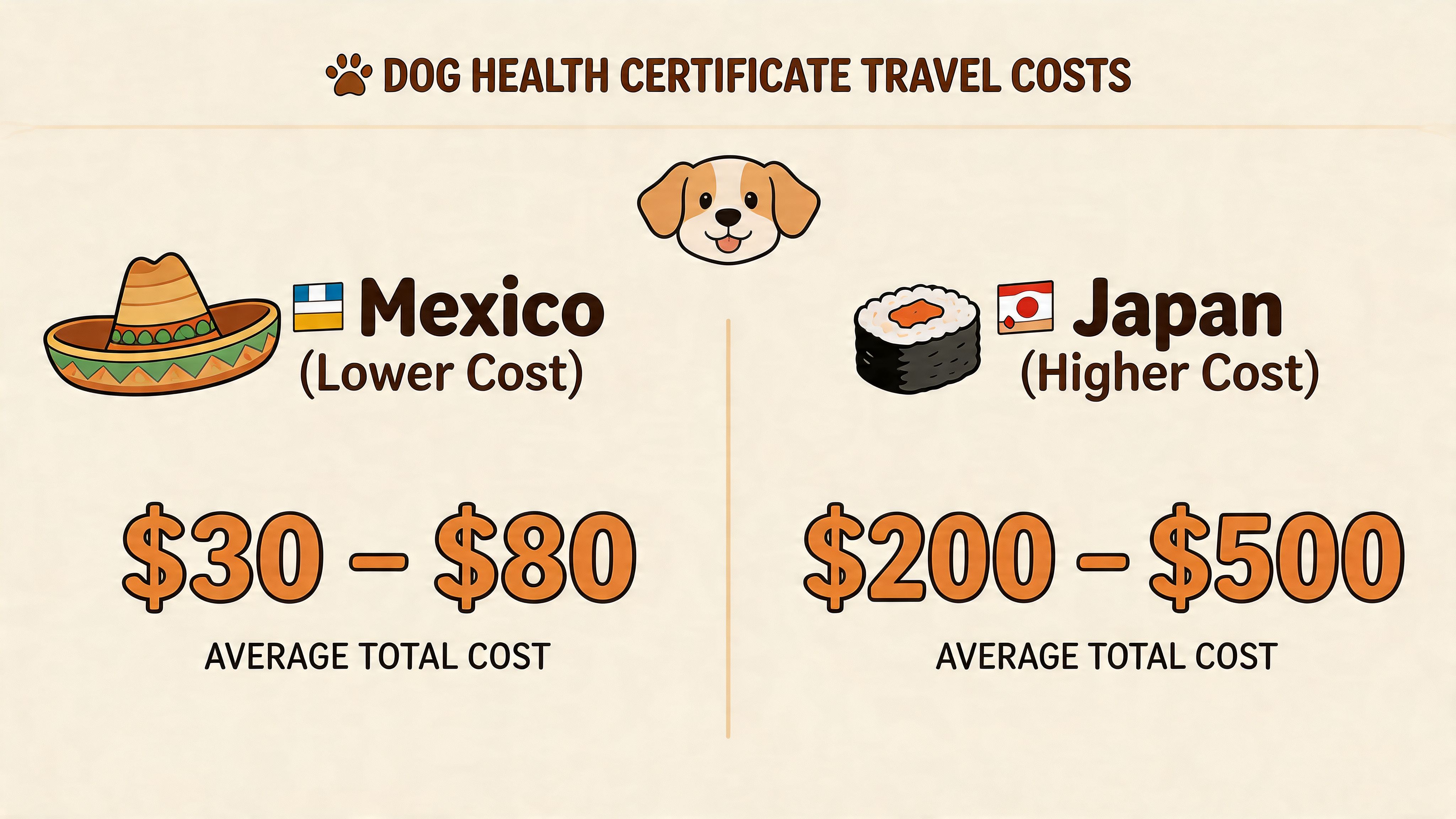
Destination rules shape the bill
Some clinics classify countries by complexity. Verified examples show Level 1 at $400+, Level 2 at $500+, and Level 3 at $600+, and those figures can still exclude separate USDA fees. That tells you something important. The higher cost isn’t arbitrary. It reflects more staff time, more compliance checks, and more supporting requirements.
The same pattern appears in clinic-specific pricing. One verified example lists $750 for an international appointment alone, before endorsement charges are added.
Hidden USDA fee jumps catch owners off guard
This is the budgeting trap I wish more clinics explained clearly from the start.
Many owners assume USDA endorsement is a flat add-on. It isn’t. The fee escalates based on how many lab tests the destination requires. Verified reporting notes that owners are often surprised by this structure. The base endorsement fee is $101, but a trip requiring a rabies titer can push the endorsement cost to $160+, and that one detail can make quotes come in 50 to 100 percent lower than the actual total if the test-driven fee tier wasn’t included upfront, as noted in this breakdown of pet health certificate costs.
Other cost triggers that matter
Beyond destination and endorsement, a few practical issues affect what you pay:
Timing problems: If you start late, your clinic may need to compress appointments, paperwork, and follow-ups into a tight window.
Record gaps: Missing vaccine dates, unclear microchip information, or outside records can create extra work.
Multiple pets: USDA endorsement adds $21 per additional pet on the same certificate, and clinic handling may rise too.
Special handling: Some destinations need extra declarations or country-specific forms.
When owners say, “I just need the certificate,” what they usually mean is, “I need everything required to make the certificate valid for this destination.”
That distinction matters. The certificate is the final product. The cost comes from the process needed to make it acceptable.
Real-World Cost Examples for Popular Destinations
A client calls on Tuesday with a Friday flight to Denver. Another calls the same morning about flying to Japan next month. Both ask the same question: “How much is the health certificate?” In practice, those are two very different estimates, because the certificate fee is only one line item. The actual total depends on which cost components that destination activates.
A straightforward domestic trip
For a routine domestic trip, the quote is usually built around the exam and the paperwork. In many clinics, that means a standard office visit, certificate completion, and basic record review. There is usually no USDA endorsement, no import permit review, and no country-specific testing schedule to manage.
That is why domestic pricing often feels predictable. The process is shorter, and there are fewer ways for the case to expand.
A moderate international trip
A moderate-complexity international destination usually adds several layers at once. The dog may need a travel exam, document preparation, vaccine verification, possible lab work, and USDA endorsement if the destination requires federally endorsed paperwork. That endorsement piece is where many owners get surprised, because the USDA fee is not always the same from one case to the next.
I tell owners to stop looking for one international number and start asking which pieces are included. A quote can rise quickly if the destination requires extra forms, test results, or more clinic time to verify the timeline.
A high-complexity destination
Some destinations trigger almost every cost category. These are the trips that involve timed treatments, strict microchip and rabies sequencing, multiple forms, and very little room for correction if one date is off. In those cases, the certificate is still the final document, but the bill reflects the coordination work behind it.
High-control destinations also tend to create more recheck risk. If records are incomplete, if a lab result is missing, or if the destination changes a form requirement, the case can require another appointment or another round of paperwork. That extra labor is part of the price.
Why Hawaii can price more like international travel
Hawaii catches owners off guard more than almost any other route. It is a U.S. destination, but the entry process often behaves more like a controlled import program than a simple domestic flight. Depending on the dog’s history, owners may need to account for document review, strict timing, and supporting records that go well beyond a basic certificate visit.
Australia, New Zealand, Japan, and some island destinations create the same budgeting problem for a different reason. The total is not driven by distance. It is driven by how many boxes the destination requires you to check, and whether those boxes trigger USDA endorsement, testing, extra declarations, or repeat visits.
Here is the practical way to compare trip types:
Simple domestic route: exam and paperwork are usually the main costs
Moderate international route: exam, paperwork, endorsement, and possible testing often all appear on the estimate
High-control destination: the estimate may include several appointments, tighter timing, more documentation work, and higher endorsement-related costs
If two quotes are far apart, one clinic is not automatically overcharging. The destination may be creating a different stack of required costs. That is the part owners need to see clearly before they budget.
Tips for Managing Pet Travel Costs and Timelines
The cheapest fix in pet travel is usually early planning. The most expensive fix is last-minute correction.
I’ve seen owners save themselves a lot of money just by checking records before they book flights. If your dog’s vaccine history, microchip information, and travel destination are clear early, your clinic can usually map the process more efficiently. If any of those pieces are fuzzy, the work expands.
What helps keep costs under control
Start before you need the final certificate: Some destinations require steps that happen well before the exam date.
Bring complete records: Rabies certificates, microchip details, prior lab results, and destination information matter.
Ask for a destination-specific estimate: General pricing is less useful than a quote built around your route.
Bundle what you can: If your dog needs an exam, vaccine review, and travel planning, it’s often easier to coordinate them thoughtfully instead of scattering them across visits.
Confirm who handles endorsement: Some clinics manage the entire process. Others complete only the veterinary portion.
Where people accidentally spend more
A common hidden cost is research time. Some clinics charge $85 or more just to work through a country’s requirements, especially when the rules are unusual or the owner arrives without complete trip details. Verified reporting also notes that automating research and workflow can reduce those manual hours and potentially cut ancillary costs by 30 to 50 percent while reducing expensive mistakes, as described in this international health certificate pricing page.
That doesn’t mean every clinic fee is avoidable. It means preparation changes how much billable problem-solving your case requires.
A simple pre-appointment checklist
Before you call your veterinarian, have these ready:
Travel dates
Destination country or state
Airline information if relevant
Microchip number
Rabies certificate and vaccine history
Any forms already sent by the airline or destination authority
A well-prepared owner often gets a clearer quote faster, because the clinic doesn’t have to spend the first part of the appointment untangling the basics.
That’s not glamorous advice, but it works.
How Passpaw Prevents Costly Travel Certificate Errors
The hardest part of pet travel paperwork isn’t usually the exam. It’s managing the chain of details without missing one.
That’s where software helps. Veterinary teams dealing with international certificates often spend a lot of time checking country requirements, tracking timing windows, preparing documents, and communicating with owners about missing pieces. Those tasks are repetitive, but the consequences of error aren’t small. A wrong date, incomplete field, or missed requirement can derail the trip.
Passpaw gives practices a cleaner way to manage that workflow. Its tools focus on real-time document validation, deadline-based task tracking, and coordinated communication, all of which help reduce the kinds of manual mistakes that make travel cases expensive.
If your team is interested in the broader operational side of reducing repetitive admin work, this article on how to automate data entry with AI is also a useful read. The same principle applies in pet travel. Fewer manual handoffs usually means fewer preventable errors.
For clinics evaluating workflow support, the best place to review the platform is the Passpaw features page. In a process this detailed, accuracy isn’t just nice to have. It’s what keeps a travel plan from going off-leash.
If your practice handles international pet travel, or you're a pet owner working with a clinic that wants a smoother process, Passpaw can help simplify the paperwork, reduce preventable errors, and keep travel timelines on track. It’s built for the practical messiness of pet travel compliance, so you can spend less time untangling forms and more time getting dogs where they need to go safely.
More articles
From regulatory changes to best practices for veterinarians and pet owners, our resources keep you ahead of the curve.