Are you a team member in a veterinary practice?
Are you a pet parent planning a trip with your furry pal?
Your Guide to the Dog Health Certificate for Travel
Planning a trip with your furry co-pilot is exciting, but it all starts with one crucial document: a dog health certificate for travel. You might also hear it called a Certificate of Veterinary Inspection (CVI), but either way, it's the official paper that shows your dog is healthy and ready for the journey. For most airlines and nearly all international destinations, this isn't optional—it's a must-have.
Your Pet's Passport To Adventure
Think of a dog health certificate as your pet's official passport. It’s more than just a piece of paper; it’s the document that confirms your dog is healthy, up-to-date on all vaccinations, and free from any diseases that could be spread to other animals or people. Trying to travel without it can lead to stressful delays at the airport, unexpected quarantine, or even being denied entry at your destination.
This certificate is so important for a few key reasons:
Following the Rules: It’s your proof that you’ve met the animal health rules set by airlines, states, and foreign countries.
Public and Animal Safety: It plays a big role in preventing the spread of diseases like rabies across borders.
Peace of Mind: Nothing beats having official verification from your veterinarian that your dog is fit for the journey.
Understanding The Key Components
Getting the certificate means a trip to a USDA-accredited veterinarian, who will perform a health check and verify all the necessary information. The specifics can change depending on where you're going, but almost every health certificate covers the same core elements. This consistency helps officials everywhere get a clear snapshot of your pet's health status.
This process has become so routine that it’s now a huge industry. The global market for pet travel health certificates hit about USD 1.14 billion in 2024, with millions of pets flying commercially each year in the U.S. alone.
Before you get started, it's a good idea to get familiar with the whole process. Our complete guide on the pet health certificate for travel walks you through exactly what to expect. Knowing the steps is the best way to make sure your trip is a tail-wagging success from start to finish.
To give you a quick overview, here's a breakdown of what's involved in getting a health certificate for your dog.
Dog Health Certificate Quick Reference Guide
Key Aspect | What It Means for You |
|---|---|
Veterinarian Type | Should be issued by a USDA-Accredited Veterinarian for international travel. |
Health Exam | Your dog needs a physical exam to confirm they're healthy and free of disease. |
Vaccinations | Rabies vaccination should be current. Other vaccines may be needed by your destination. |
Microchip | A 15-digit ISO-compliant microchip is the standard for international travel. |
Parasite Treatment | Some countries require specific treatments for fleas, ticks, or tapeworms. |
USDA Endorsement | For international travel, the certificate usually needs to be officially endorsed by the USDA. |
Timeline | This is critical. Most certificates must be issued within 5-10 days of your arrival. |
Getting the timing right is probably the most common challenge pet owners face.
A common mistake is underestimating the timeline. For international travel, many countries require the health certificate to be issued within 10 days of arrival, leaving a very small window to get everything done.
This tight turnaround means you can't leave things until the last minute. By understanding exactly what the certificate involves, you can start gathering records and schedule your vet visit with plenty of time to spare, avoiding that last-minute scramble.
Your Pre-Travel Planning Checklist
Getting a dog health certificate for travel isn't a one-and-done vet visit. It's a process, and a little planning upfront makes all the difference between a smooth trip and a last-minute panic.
Think of yourself as your dog's personal travel agent. The very first step, before you even think about calling the vet, is to become an expert on your destination's import rules. These aren't just suggestions; they're strict requirements designed to protect local animal populations.
Research Your Destination and Airline Rules
Every single country, and even some states like Hawaii, has its own unique playbook for letting pets in. The paperwork that works for a road trip to Canada might get you turned away at the border in Japan. Start by going straight to the source: the official government website for your destination. You're usually looking for the ministry of agriculture or a similar department.
Airlines have their own rules, too, and they can be just as important. They’ll have specific policies on carriers, breed restrictions, and the exact timing for when the health certificate must be issued. A quick look at the pet travel section of your airline's website will tell you everything you need to know.
I can't stress this enough: don't rely on third-party websites or old forum posts for this information. Rules can and do change without warning. Using an outdated checklist can lead to trouble. Always, always go directly to the official government and airline sources.
Check Your Dog's Microchip
For international travel, a microchip is pretty much always needed. Most countries now require a 15-digit ISO 11784/11785 compliant microchip. This is the global standard, which means scanners all over the world can read it.
What if your dog has an older 9 or 10-digit chip? It probably won't be readable at your destination. You have two options here:
Have your vet implant a new, ISO-compliant chip.
Travel with your own compatible microchip scanner.
Here's a crucial detail: the chip should be implanted before the rabies vaccination is given. If the vaccine was administered first, your dog might need a whole new rabies shot after the chip is placed to meet the rules for many countries.
Gather All Necessary Medical Records
Once you know the rules, it's time to pull together your dog's paperwork. This goes beyond just the rabies certificate, though that's obviously a huge piece of the puzzle. You'll need their complete health history. This handy timeline gives you a good visual of the key stages.
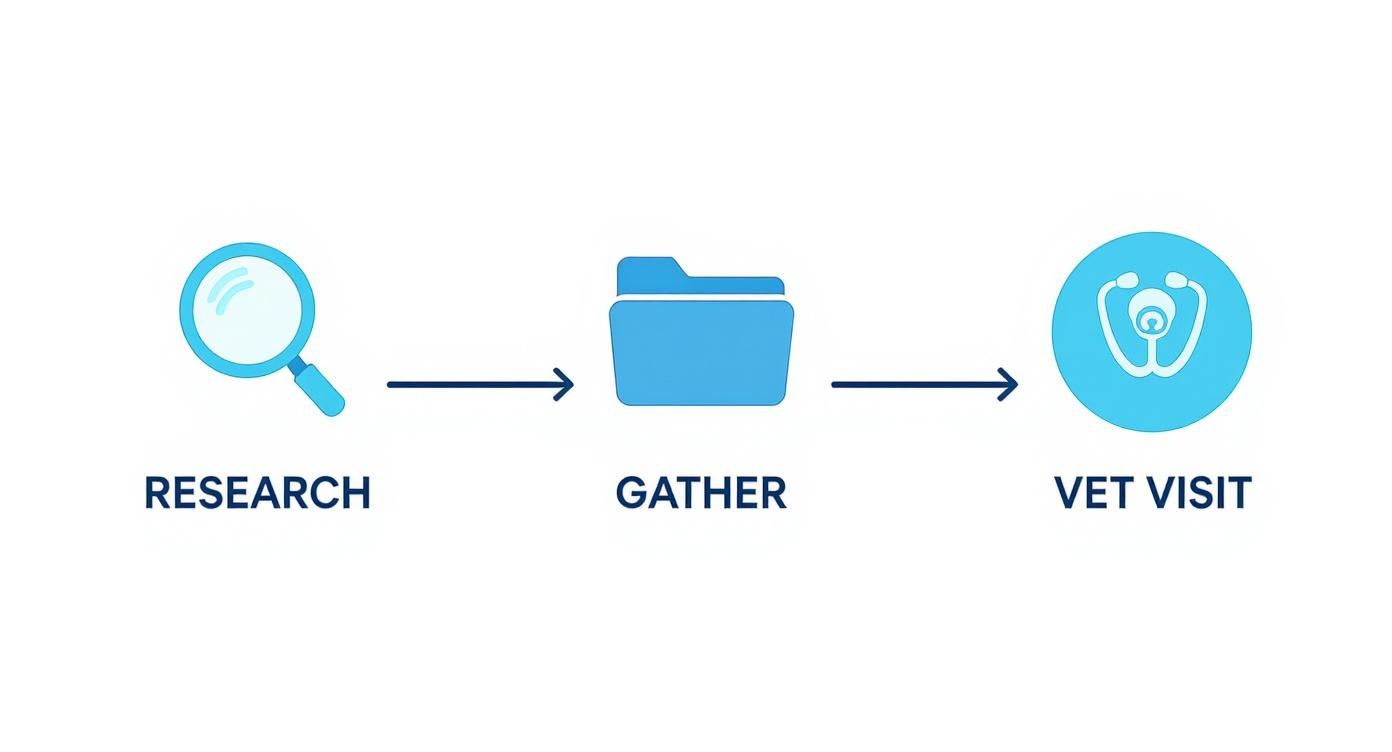
As you can see, the real work starts long before the vet appointment. Having all your documents organized in a single folder will make the vet visit so much more efficient and ensures you don't miss any critical details.
Here’s a quick checklist of the documents you’ll want to have on hand:
Rabies Vaccination Certificate: This needs to show the microchip number, the date of vaccination, and the vaccine's expiration date.
Other Vaccination Records: You'll need proof of other core vaccines, like DHPP (distemper, hepatitis, parainfluenza, and parvovirus).
Parasite Treatment History: Many destinations require specific flea, tick, and deworming treatments within a certain window before arrival, so have those dates and product names ready.
Getting everything in order ahead of time is a total game-changer. If you want a little help staying on track, our interactive pet travel planner breaks down all these steps into a clear timeline. A little organization now will make the whole process feel a lot less ruff.
The Vet Visit: What to Expect
The vet appointment is probably the single most important step in getting your dog health certificate for travel. A little preparation here goes a long way in making the whole experience smoother for you, your pet, and the clinic staff.
Think of this visit as less of a routine check-up and more of a specific, detailed examination. The entire purpose is to certify that your dog is healthy and ready for the journey ahead. Knowing what's coming will help you stay calm and ensure everything gets done right the first time.
One thing that catches many pet owners by surprise is that for international trips, you can't just go to any veterinarian. You'll almost always need a USDA-accredited veterinarian. These are vets who have completed specialized training and are authorized by the U.S. Department of Agriculture to handle the complex paperwork international pet travel demands. If your regular vet isn't accredited, don't worry—they can usually refer you to one who is.
Preparing for the Appointment
Walking into the clinic organized is the best way to guarantee a successful visit. The accredited veterinarian is there to verify your dog's health, but they’re relying heavily on the documents and information you bring with you. Being prepared isn't just a suggestion; it's a necessity.
Here’s a quick list of what you should have in hand:
Your Dog's Complete Medical History: Bring everything. This means all vaccination records, microchip details, and any notes on past surgeries or health conditions.
Proof of Rabies Vaccination: The original, signed rabies certificate is essential. The vet needs to confirm that the microchip number and vaccination dates line up perfectly. You can learn more about the specifics of a valid proof of rabies vaccine.
Detailed Travel Itinerary: Your vet needs your exact destination address—not just the city or country—plus your departure and arrival dates. This is critical for getting the certificate's timeline right.
Your Contact Information: Make sure you provide your full name, current address, and phone number, as this will all go on the official certificate.
A quick tip from experience: Be upfront about any pre-existing conditions your dog has, no matter how minor they seem. An accredited vet knows how to properly document these issues so they don’t become red flags for border officials. Honesty and thoroughness are your best friends here.
The Head-to-Tail Examination
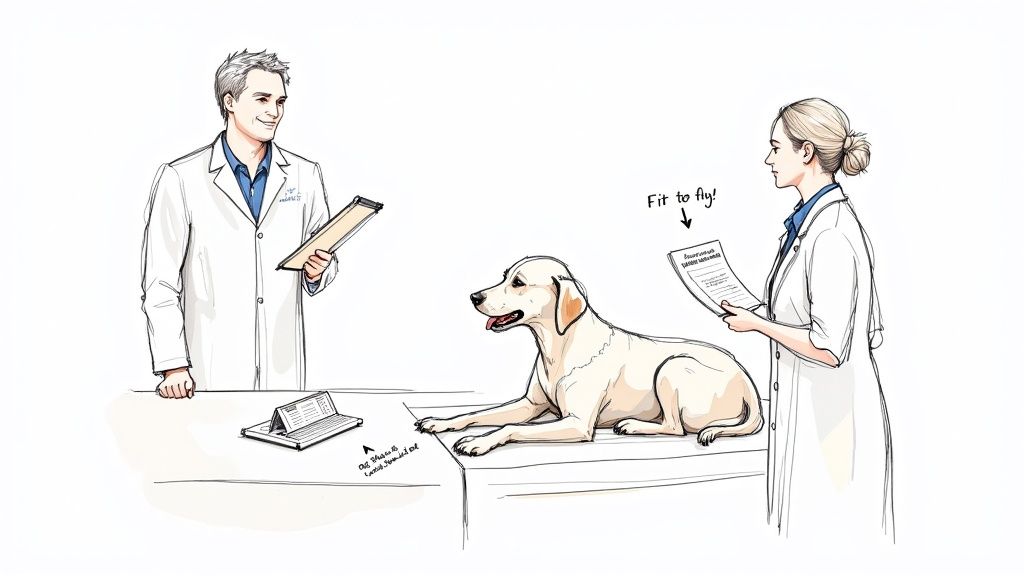
Once the paperwork is squared away, the vet will perform a comprehensive physical exam. They are looking for any signs of infectious or contagious diseases. It’s a true head-to-tail inspection to officially declare your dog "fit to fly."
During this exam, the veterinarian will:
Scan the Microchip: First, they'll use a scanner to make sure the microchip is present, readable, and matches the number on your documents.
Check Vitals: This is the standard stuff—listening to your dog's heart and lungs and taking their temperature.
Inspect Skin and Coat: The vet will check for fleas, ticks, or any signs of skin disease.
Examine Eyes, Ears, and Teeth: They'll look for any signs of infection or other health concerns in these areas.
This exam is meant to be thorough. When a vet signs that health certificate, they are putting their professional license on the line. They need to be 100% confident in your dog's health. It’s a serious process, but it's all designed to keep your pet safe during travel.
Understanding the Official Forms
After the exam, the vet will tackle the official health certificate forms. These documents can look pretty intimidating, filled with specific fields and technical jargon. Don't be shy about asking your vet to walk you through it.
In fact, it's a great idea to review the form together before you leave the office. A simple typo in a microchip number or an incorrect date can cause massive headaches down the line.
Your vet will use the USDA's Animal and Plant Health Inspection Service (APHIS) website to find the specific export requirements for your destination.
This is where they can select a destination and pull up the exact forms and regulations. This ensures every requirement is met for that specific country. Using this resource, the vet will complete the right version of the dog health certificate for travel, which is often a multi-page document recording all the critical details we've discussed.
Take a moment to double-check that your name, your dog's info, and your travel dates are all correct on the final form. It's one of the smartest things you can do to prevent any last-minute drama. Consider it the final 'paws' before you're cleared for takeoff.
Domestic vs. International Rules: A Whole Different Ball Game
Thinking about the rules for your dog's health certificate can feel a little overwhelming at first. But once you break it down, the main thing to remember is this: where you're going completely changes the paperwork game.
A road trip from California to New York has a completely different set of rules than a flight from New York to Paris.
The Simplicity of Domestic Travel
For travel within the United States, things are generally much more straightforward. While the rules can vary from state to state, a standard health certificate, often called a Certificate of Veterinary Inspection (CVI), issued by a licensed veterinarian is typically all you need.
This domestic certificate usually gives you a 30-day window from the date it's issued, offering a good amount of flexibility for your travel plans. That said, you should always double-check the specific rules for your destination state and your airline. A quick hop to a neighboring state might not require one at all, but a flight to a place like Hawaii comes with much stricter regulations to protect its delicate ecosystem.
The Leap to International Travel
International travel is where the complexity really ramps up. When you're crossing borders, you're not just dealing with an airline's policy anymore—you're meeting the official import requirements of an entire country. This is where the process gets far more detailed and the clock starts ticking.
For starters, a standard certificate from your local vet just won't fly. International travel almost always requires a USDA-endorsed health certificate. This means the document has to be filled out by a USDA-accredited veterinarian and then sent to the USDA's Animal and Plant Health Inspection Service (APHIS) for the official government stamp of approval. It’s the federal government’s way of certifying that your dog meets the destination country’s health standards.
The biggest hurdle for most pet owners is the timeline. For international trips, the health certificate must typically be completed and endorsed within just 10 days of your arrival. This tight window leaves very little room for error and makes careful planning absolutely essential.
A Tale of Two Destinations
To really see how much the rules can differ, let's compare two popular international destinations: the European Union and Japan.
The European Union (EU): The EU has a fairly standardized system. This makes travel between member countries relatively smooth. Travelers from the U.S. can't get an actual EU Pet Passport, but they must obtain an EU Health Certificate that meets the same strict standards.
Japan: Known for its stringent biosecurity, Japan has one of the most demanding import processes on the planet. The checklist often includes multiple rabies vaccinations, a rabies antibody blood test (FAVN test) that needs to be done months in advance, and a mandatory 180-day waiting period after the blood sample is drawn.
While some regions are moving toward more standardized systems like the EU, most countries still have their own unique set of rules. For any dog traveling abroad from the United States, a USDA-endorsed health certificate issued by a USDA-accredited vet is the usual starting point.
Getting the All-Important USDA Endorsement
The USDA endorsement is a critical step you generally cannot skip for international journeys. After your accredited vet completes the health certificate, it has to be submitted to your state's APHIS Veterinary Services office for the final sign-off. In some cases, this can be done digitally, which is a huge time-saver, but sometimes it requires shipping the physical paperwork via overnight mail.
This extra step is what makes planning an international trip with your pet so much more involved. It adds another layer of verification and another tight deadline to your calendar. To help you manage this crucial part of the process, our guide on how to get a USDA-endorsed pet health certificate breaks down every step in detail.
Ultimately, whether your trip is across the state or across the ocean, the key is to research your specific destination far in advance. Understanding these core differences is the first step toward a stress-free trip for you and your furry co-pilot.
Common Mistakes and How to Avoid Them
Even the most buttoned-up pet owner can hit a few snags trying to get a dog health certificate for travel. A tiny oversight can quickly snowball into a massive headache, but knowing where others have stumbled is the best way to keep your own journey smooth. Consider this your field guide to navigating the common pitfalls and keeping your travel plans locked in.
With more people bringing their furry family members along for the ride, the process has become more routine but no less demanding. By 2025, it's estimated that 37% of families now travel with their pets, which marks a 19% increase over the past decade. This boom means airlines and border officials are scrutinizing paperwork more closely than ever. You can dig into more stats about the rise of pet-friendly travel on worldcarepet.com.
Mismanaging the Tight Timeline
Losing track of the calendar is probably the most frequent mistake we see. For the majority of international trips, the health certificate has to be issued and then endorsed by the USDA within 10 days of your arrival. That window is tight, especially when you start adding in the time for vet appointments and shipping paperwork back and forth.
The best strategy is to plan backward from your arrival date. Here’s how that might look:
Day 1 (Arrival): Your documents must be valid on this day.
Days 2-3 (Pre-Arrival): This is your actual travel time.
Days 4-10 (Pre-Arrival): This is your sweet spot for the vet visit and USDA endorsement. Always aim for the very beginning of this window to create a buffer for the unexpected.
Get that USDA-accredited vet appointment on the books for day 10 or 9 before arrival. It’s a simple move that gives you precious time to fix any errors or deal with delays without putting the whole trip at risk.
Overlooking Pre-Existing Conditions
Does your dog have a chronic issue that’s well-managed, like mild arthritis or a stable heart murmur? It is absolutely essential to get out in front of this. A common misstep is to cross your fingers and hope no one notices, but transparency is always the better route.
An experienced, USDA-accredited vet knows exactly how to document these conditions properly. They can clearly state that the condition is chronic, stable, and poses no threat to public health or other animals. Trying to hide something can make officials question the credibility of the entire certificate.
Don't hesitate to walk your vet through your dog's complete health history. Proper documentation isn't about hiding flaws; it's about painting an honest and complete picture of your pet's health. A well-documented, stable condition is almost never a barrier to travel.
Small Errors With Big Consequences
Sometimes, it’s the tiniest details that cause the biggest train wrecks. A single transposed digit in a microchip number or a misspelled name can render the entire document invalid. These clerical mistakes are shockingly common, yet they are completely preventable.
Pay close attention to these specific areas:
Mismatched Microchip Numbers: The number on the health certificate must be a perfect match with the one on the rabies certificate and, most importantly, the one that pops up when scanned.
Incorrect Dates: Give all dates a second look. Make sure vaccination dates and the exam date are all recorded correctly and make sense chronologically.
Last-Minute Rule Changes: Regulations can and do change. A week before your vet visit, do one last check of the airline and country requirements to ensure nothing has been updated.
The single best way to avoid these issues? Just 'paws' and double-check everything before walking out of the vet’s office. Taking five extra minutes to review every single field on the dog health certificate for travel with your vet can save you from a world of stress and potential heartbreak at the check-in counter.
Your Top Questions Answered
Traveling with a pet can bring up a laundry list of questions. Unsurprisingly, figuring out the details of a dog health certificate for travel is usually at the top of that list. Let's walk through some of the most common queries we get from pet owners gearing up for a trip.
How Long Is a Dog Health Certificate Valid For?
This is a big one, and the answer is all about your destination. If you're traveling domestically within the U.S., a health certificate is typically good for 30 days from the issue date. That gives you a nice window of flexibility for road trips or flights across state lines.
International travel, however, is a different story. The rules get much stricter. Most countries demand that the certificate be completed by your vet and officially endorsed by the USDA within 10 days of your arrival. That timeline is tight, so you have to confirm the specific window for your destination country and schedule your vet visit accordingly. There isn't much wiggle room, which is exactly why planning ahead is so important.
Do I Need a Special Kind of Veterinarian?
For most domestic trips, any licensed veterinarian can issue a standard health certificate, often called a Certificate of Veterinary Inspection (CVI). It’s a pretty routine task for them.
But when you're heading abroad, you'll almost certainly need to see a USDA-accredited veterinarian. These are vets who have taken extra training and are officially authorized by the U.S. government to handle the complicated international travel forms. Their accreditation is proof that they know the specific import rules for other countries. Before you book anything, ask your regular vet if they are accredited. If not, they can usually refer you to a colleague who is. This is a crucial step you can't skip.
What Happens If There Is a Mistake on the Form?
A simple typo or a wrong date on that health certificate can snowball into a massive headache. We're talking about stressful travel delays, unexpected fees, or—in the worst-case scenario—your pet being denied entry when you land. Airline staff and border officials look at these forms with a fine-toothed comb, so every detail has to be perfect.
That’s why it is so important to review the entire document carefully before you walk out of the vet's office. A quick double-check is your best defense. If you spot an error after it’s been submitted or endorsed, you might have to start the whole process over again. Nobody wants that stressful and expensive ordeal.
Take a few extra minutes to confirm every single detail, from the spelling of your name to the last digit of the microchip number. It’s a small action that can save you from a world of trouble and give you huge peace of mind.
Can I Use a Digital Health Certificate?
The good news is that the process for getting a dog health certificate is getting more digital. Many accredited vets now use online platforms, like the USDA’s Veterinary Export Health Certification System (VEHCS), to complete and submit the forms electronically. This can really speed up the USDA endorsement part of the process.
Even though much of the submission and review happens online, you will almost always need a physical, printed copy of the final, endorsed certificate with you when you travel. While some countries are starting to accept digital versions, a hard copy is still the gold standard and your safest bet. The best practice? Keep a printed version in your travel folder and have a digital copy saved to your phone as a backup. That way, you’re ready for anything, making your travel day a little less ruff.
Getting a pet ready for travel is a complex puzzle, but you don't have to solve it alone. Passpaw helps veterinary practices and pet owners navigate the entire health certificate process, making sure every detail is right and every deadline is met. We help turn confusion into confidence, making global adventures with your best friend easier than ever.
Ready for a smoother journey? See how we can help at https://passpaw.com.

More articles
From regulatory changes to best practices for veterinarians and pet owners, our resources keep you ahead of the curve.