Are you a team member in a veterinary practice?
Are you a pet parent planning a trip with your furry pal?
What Are Coggins: A Clear Guide for Horse Owners
If you're a horse owner, you've probably heard the term "Coggins test" tossed around at the barn or before a show. It's a key part of responsible horse ownership, but what exactly is it?
Think of a Coggins test as a health passport for your horse. It's an important blood test that screens for Equine Infectious Anemia (EIA), a serious and incurable disease affecting horses, donkeys, and mules. This simple test shows your horse is free of the disease and safe to be around other equines.
Your Essential Guide to the Coggins Test
When it comes to keeping horses, a negative Coggins certificate is more than just a piece of paper—it's your commitment to protecting the health of the entire equine community. You'll likely need one for just about everything: traveling across state lines, competing at shows, selling a horse, or even just boarding at a new stable.
So, why is this one test so important? It all comes down to the disease it screens for: Equine Infectious Anemia, or EIA. A Coggins test, named after its creator Dr. Leroy Coggins, is the best way to detect antibodies to this lifelong virus. The real danger is that EIA is often invisible; many infected horses show no symptoms at all, becoming silent carriers that can spread the virus through biting insects or unclean needles.
Why This Test Is So Important
Let's get straight from the horse's mouth—the main purpose of a Coggins test is prevention. By identifying infected horses, we can isolate them and stop the virus in its tracks before it spreads to healthy animals.
This proactive approach is important because:
EIA has no cure. Once a horse is infected, it's infected for life.
Symptoms can be hidden. An infected horse might look perfectly healthy while posing a risk to every other horse it meets.
The virus is easily transmitted.
A Coggins test isn't just about following rules; it's a community effort. Every owner who tests their horse helps create a safer environment for every equine, from a top-level competitor to a beloved pasture companion.
Ultimately, this simple blood draw gives you peace of mind, knowing you're doing your part to keep every horse safe. It’s a small step that makes a world of difference.
The Hidden Threat of Equine Infectious Anemia
So, what’s the big deal with this simple blood test? Why is it such a common part of modern horse ownership? The answer is a serious, incurable disease called Equine Infectious Anemia (EIA). Understanding EIA is the key to understanding why every single Coggins test is so important.
At its core, EIA is a virus that affects horses, donkeys, and mules—and there's no cure. Often called "swamp fever," it's mostly spread by biting flies like horseflies and deerflies. They act like tiny, dirty needles, transferring infected blood from one horse to another. Unclean equipment, from surgical tools to syringes, can also pass the virus along.
The Danger of Silent Carriers
The real problem with EIA isn't just that it's incurable; it’s how sneaky it can be. Many infected horses show no outward symptoms. They eat, act, and look completely healthy, all while carrying the virus for life.
These asymptomatic carriers are the biggest risk. A single, healthy-looking horse can unknowingly spread the disease through an entire barn, showground, or trail system. You simply can't look at a horse and know if it’s a carrier. Testing is the only way to be sure. It's a lot like public health screenings for people—the best way to stop a widespread outbreak is to find the silent carriers.
Think of the Coggins test as a surveillance system. By identifying infected horses—especially those without symptoms—it stops the silent spread of EIA in its tracks, protecting the entire national horse population.
And this strategy has worked incredibly well. Widespread Coggins testing has been a game-changer for controlling EIA. Back in the early 1970s, about 4% of tested horses in the U.S. were positive. Today, that number has dropped significantly. In 2022, out of more than 1.3 million tests run in the U.S., only 96 positive cases were found. To see more on these stats, check out this insightful article on Horse Nation.
Without this test, the risk to our horses would be much higher. A Coggins is far more than just a piece of paper you need for travel; it’s our frontline defense against a disease with no cure. Every negative test result adds to a collective safety net, making sure our events, trails, and barns stay safe for everyone.
How the Coggins Testing Process Works
So, you know a Coggins is important, but what actually happens during the test? Let’s pull back the curtain on the journey from the stable to the lab. The great news is that the whole thing is handled by a licensed veterinarian, so it's professional, safe, and pretty simple for you and your horse.
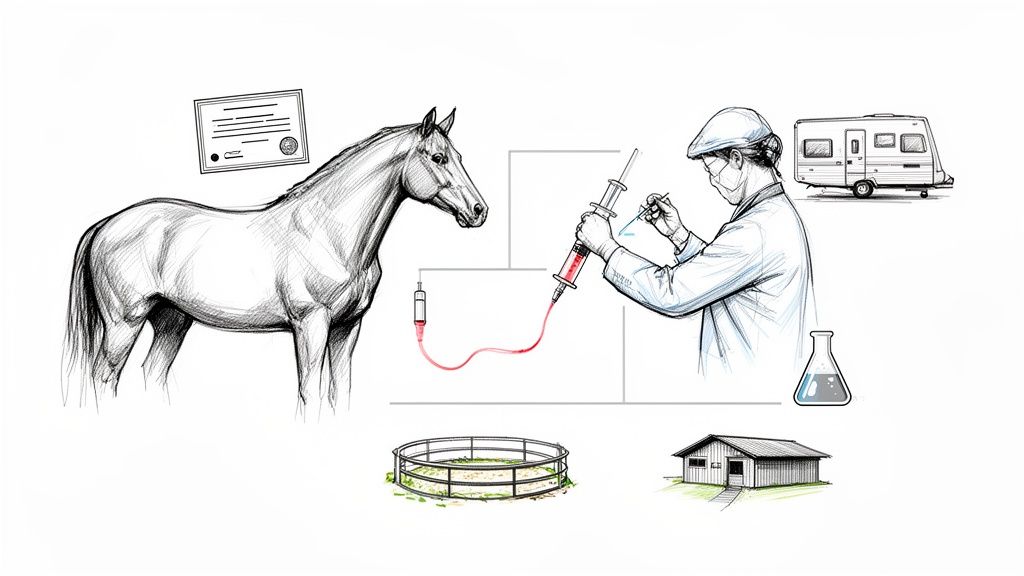
The process starts when your vet arrives at the barn. First things first, they have to positively identify your horse. This is an important step to make sure the right animal is on the paperwork, so they'll carefully note all unique markings, brands, tattoos, or microchip information. Think of it as creating a very detailed equine ID card.
From Blood Draw to Lab Analysis
Once your horse’s identity is confirmed, your vet will draw a small blood sample, usually from the jugular vein in the neck. It’s a quick procedure that’s over in just a moment. Your horse will barely have time to give you a long face about it.
With the sample collected, the vet fills out the official Coggins form. This document includes:
Your contact information as the owner.
Your horse's detailed description (age, breed, color).
Hand-drawn diagrams of all markings, like stars, snips, and socks.
The blood sample and the completed form are then sent together to a state-approved laboratory for analysis.
What Happens at the Lab
At the lab, technicians perform a USDA-approved test to look for EIA antibodies. The traditional method is the Agar Gel Immunodiffusion (AGID) test, which is the original "Coggins" test. There's also a faster option called the Enzyme-Linked Immunosorbent Assay (ELISA) test, which often gets you results more quickly.
This infographic breaks down exactly how the EIA virus—the very thing the Coggins test screens for—is transmitted.
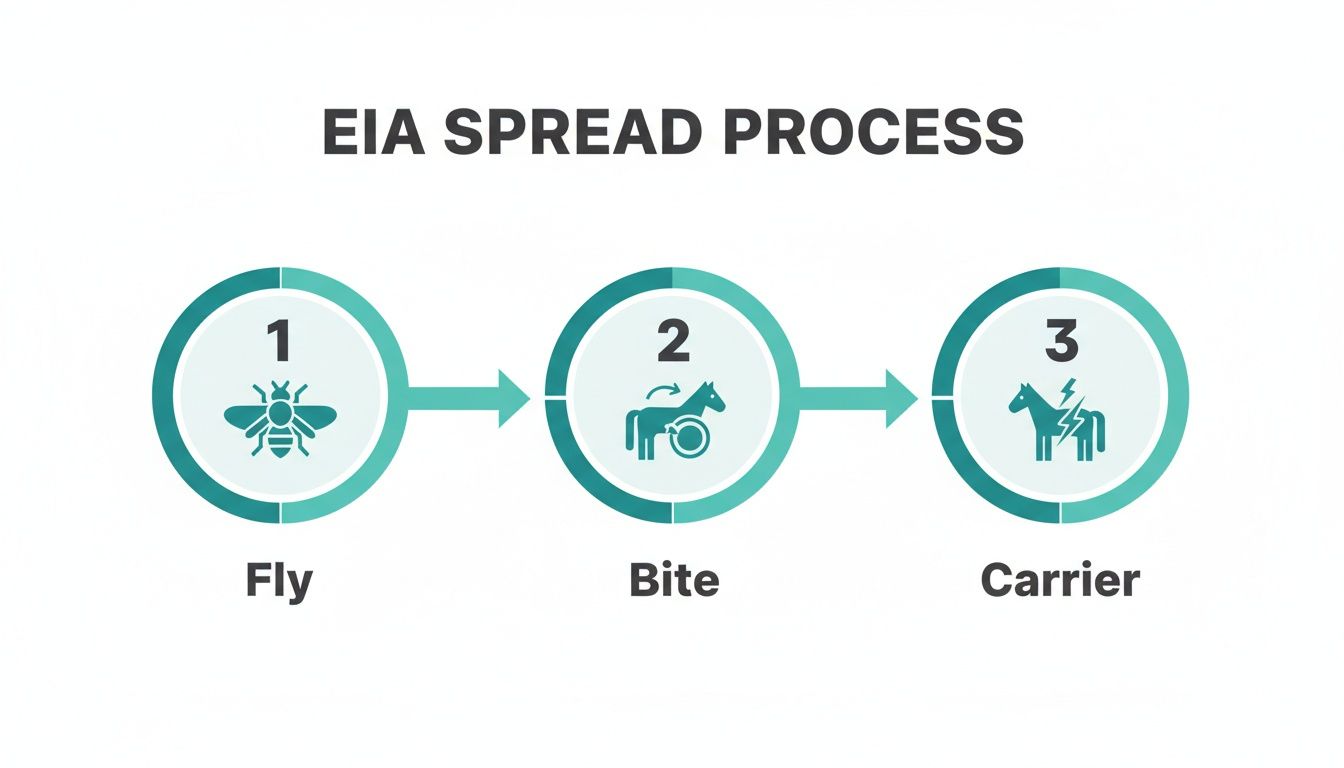
As you can see, it just takes one bite from a common fly to pass the disease from an infected horse to a healthy one. The whole testing process is simple, efficient, and very important for herd health. Understanding it can also help when you're getting ready for other travel needs; you can learn more about managing your animal's travel documents in our guide to pet health certificates for travel.
So, the results are in, and you're holding your horse's Coggins certificate. It might look a little complicated at first with all its technical details, but it's actually pretty simple to understand. Think of it as a report card for one very specific subject: Equine Infectious Anemia.
The single most important part of that paper is the test result. This is the line that gives your horse the green light for travel, shows, and boarding. It’s the news every owner waits for, and thankfully, almost all tests come back with the best possible outcome.
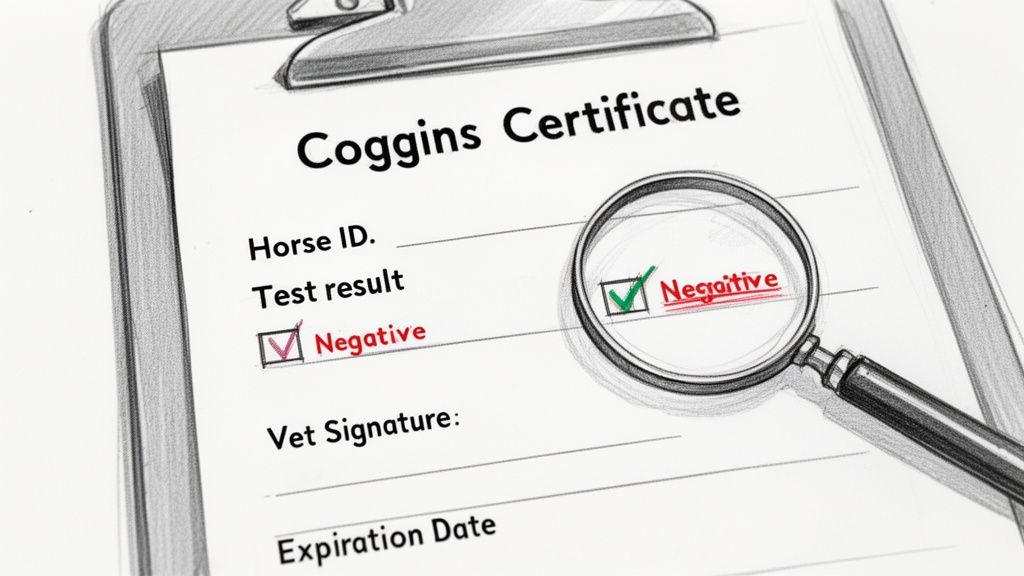
Understanding the test outcome is important, as it determines what happens next for you and your horse. Let's break down what each result really means.
| Coggins Test Result Interpretation |
| :--- | :--- | :--- |
| Test Result | What It Means | Next Steps for the Owner | | Negative | This is great news. The lab found no detectable antibodies for EIA, clearing your horse as a non-carrier. | You're good to go! Use this certificate for travel, shows, and boarding. Keep the expiry date in mind for renewal. | | Positive | This is a rare but very serious result. It means EIA antibodies were detected, indicating an active infection. | Your vet will need to report this to state and federal authorities, who will guide you on the difficult next steps. |
As you can see, the outcomes are night and day, which is why this test is taken so seriously across the equine industry.
Negative Coggins: The All-Clear
A negative result is exactly what you want to see. It means your horse's blood sample showed no signs of EIA antibodies. Your horse is officially considered clear and not a risk for spreading this disease.
With a negative Coggins, your horse is ready for adventure. You can confidently trailer to shows, cross state lines, or move to a new barn knowing you have the paperwork to prove your horse is healthy.
Positive Coggins: Understanding the Next Steps
Receiving a positive Coggins result is every horse owner's nightmare. It’s rare, but it’s serious. A positive test means EIA antibodies were found, confirming the horse is infected. Since EIA has no cure, this result starts a series of official actions.
Your veterinarian is usually required to report the positive test to both state and federal animal health authorities. Officials will then work with you on the next steps, which may involve a lifetime of strict quarantine or humane euthanasia. This is precisely why routine testing is so important—it protects the entire horse community from this devastating outcome.
Beyond the result, your Coggins certificate is a key piece of identification. Always double-check that your horse's markings, age, and breed are described perfectly. Officials will use this to confirm the paperwork actually matches the animal standing in front of them.
Checking the Certificate's Fine Print
The test result is the headliner, but the other details on the certificate are just as important for it to be valid. Take a moment to review everything carefully.
Horse Identification: Make sure the drawings and written descriptions of your horse’s markings—like stars, snips, and socks—are spot-on.
Veterinarian Signature: The form must be completed and signed by a federally accredited veterinarian.
Expiration Date: A standard Coggins is valid for 12 months, but don't get caught out. Some states, events, or facilities may require a test performed within the last six months.
This certificate often goes hand-in-hand with other travel documents, like an interstate health certificate. To make sure all your papers are in order for your next trip, check out our guide on the APHIS 7001 health certificate.
When Your Horse Needs a Coggins Test
Trying to figure out exactly when your horse needs a Coggins test can feel a bit confusing. But once you know the common situations, you’ll never find yourself stuck at the gate of a show or a new barn. Think of this as your go-to checklist for staying prepared.
The biggest and most common reason for needing a Coggins is travel. If you and your horse are planning to cross state lines, a current negative Coggins certificate is usually needed. It’s often the first thing officials will ask to see, and without it, your trip might end before it begins.
Common Scenarios Requiring a Coggins
But travel is just the starting point. Plenty of everyday horse activities require you to have that certificate ready. Don't get caught by surprise; a Coggins is almost always needed for:
Public Events and Competitions: Whether you're heading to a horse show, rodeo, clinic, or even just an organized group trail ride, event organizers will likely require proof of a negative Coggins to protect all the horses participating.
Boarding Stables: Most boarding facilities won't let a new horse on the property without seeing a current negative test first. It's a basic safety measure that keeps every resident horse safe.
Buying or Selling a Horse: A recent negative Coggins is a standard part of many pre-purchase exams and sales agreements. It gives the new owner important peace of mind about the health of their new partner.
International Travel: Moving a horse to another country involves a whole new level of health requirements, and a negative Coggins is a foundational piece of that puzzle.
Why Even Backyard Horses Need Testing
It's easy to think a horse that never leaves your property doesn't need testing, but that can be a risky assumption. Biting flies certainly don't respect property lines, and an asymptomatic carrier can silently spread the disease to neighboring horses without anyone knowing.
The USDA helps oversee rules for imported horses, while individual states manage rules for movement and sales within their borders. This system is designed to stop the silent spread of EIA before it starts.
And this strategy works incredibly well. In 2022, over 1.3 million tests were conducted in the U.S., which identified just 96 positive cases—a rate of only about 0.007%. This statistic, found in the USDA's annual EIA report, really highlights how routine testing successfully contains the disease. Keeping your horse's Coggins current is a simple, yet important, way you contribute to this national safety net.
Keeping Your Horse's Health Documents Organized
Let's be honest, managing your horse's paperwork can sometimes feel like trying to herd cats. Between the Coggins certificate, vaccination records, and various health papers, it’s easy for that neat folder to turn into a mess. But keeping everything straight isn't just for convenience—it's very important, especially when you're getting ready to hit the road.
Juggling different state requirements while making sure every document is up-to-date can be a massive headache. Forgetting a single piece of paper, like your horse’s current negative Coggins, can bring your travel plans to a screeching halt. This is exactly where a modern approach can make all the difference.
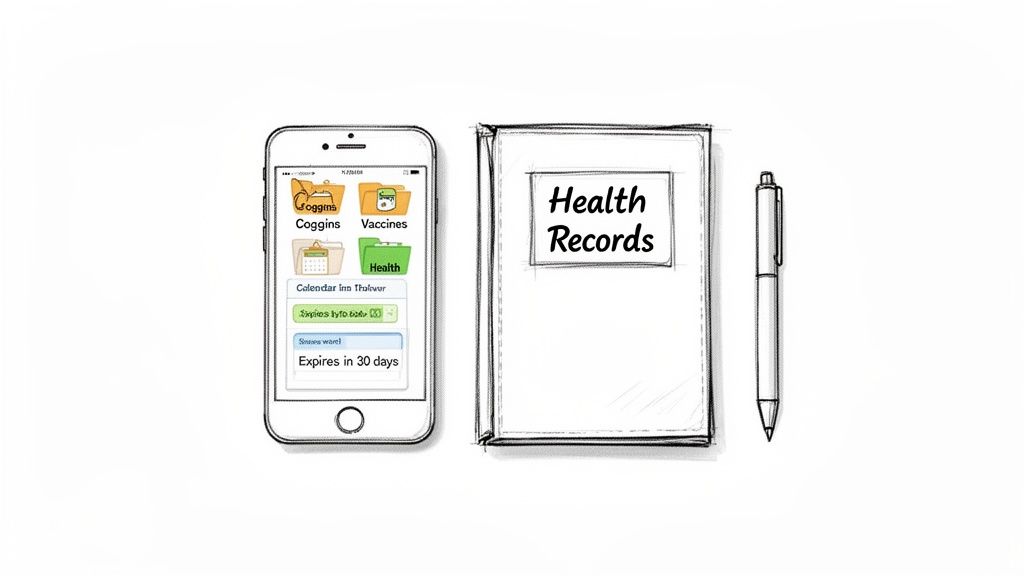
Why Digital Organization Is a Game Changer
While many pet travel platforms have traditionally focused on cats and dogs, the same idea is a perfect fit for the equine world. Using a digital system to keep all your horse’s documents in one secure, accessible place can be a lifesaver. It helps you track expiration dates, store records safely, and pull up vital info from anywhere with a cell signal.
Having all your horse’s records at your fingertips offers some serious advantages:
Instant Access: Pull up your horse's negative Coggins certificate on your phone in seconds for a health official or show secretary.
Automated Reminders: Get a heads-up before a document expires so you're never caught off guard and scrambling for a last-minute vet appointment.
Zero Stress: Say goodbye to that frantic, last-minute search for a misplaced piece of paper.
Think about it: Coggins papers, health certificates, and vaccination records all living together in one digital hub. It completely simplifies things and brings incredible peace of mind. You’re always prepared, not just for the big shows, but for any unexpected journey that comes your way.
Ultimately, getting organized means you can stop wrestling with paperwork and spend more quality time with your horse. The world of travel documents for pets is so much easier to navigate when you have the right tools in your corner. By embracing an organized system, you ensure every trip starts on the right hoof.
Coggins Test FAQs
Even after you've got the basics down, a few questions always seem to pop up about Coggins tests. Let's clear the air and tackle some of the most common things horse owners ask. Getting these details straight helps you stay prepared and confident.
How Long Is a Coggins Test Valid?
Generally, a negative Coggins test is valid for 12 months from the date the vet drew the blood sample. This annual schedule is the standard for most boarding barns, shows, and state-to-state travel.
But you can't always bank on that one-year rule. Some specific situations may need a more recent test.
Stricter Venues: High-traffic events or elite competitions might ask for a test taken within the last 6 months.
International Travel: Exporting a horse to another country often comes with a much shorter validity window, sometimes as little as 30 days.
State-Specific Rules: A handful of states have their own unique requirements that can differ from the 12-month standard.
The best advice? Always double-check the rules for your specific destination or event well in advance. It's the easiest way to avoid last-minute surprises.
Other Common Coggins Questions
Let's trot through a few more frequently asked questions to round out your understanding. These cover everything from young foals to the shift toward digital paperwork.
The core purpose of Coggins testing has always been proactive disease control. Since there is no vaccine for Equine Infectious Anemia in the U.S., identifying carriers is the only effective way to stop its spread.
Can a foal get a Coggins test? Yes, but there's a catch. For up to six months, a foal can carry antibodies from its mother's milk. This can trigger a "false positive" result even if the foal isn't actually infected. Because of this, many vets advise waiting until a foal is over six months old to get a truly reliable test.
What's the difference between a paper and digital Coggins? A paper Coggins is the traditional carbon-copy form your vet fills out by hand. A digital Coggins, on the other hand, is a secure electronic version you can keep right on your phone or computer. Digital copies are quickly becoming the new normal because they're easier to share, harder to lose, and simplify record-keeping for everyone involved. It's much easier than horsing around with a stack of papers!
Managing your horse's travel documents doesn't have to be a complicated chore. Passpaw provides a simple, reliable platform to keep all your pet’s health and travel certificates organized and ready to go. Learn more about simplifying your next trip at https://passpaw.com.
More articles
From regulatory changes to best practices for veterinarians and pet owners, our resources keep you ahead of the curve.