Are you a team member in a veterinary practice?
Are you a pet parent planning a trip with your furry pal?
Your Guide to United Airlines Pet Carriers for 2026
So, you’re planning to fly with your furry co-pilot on United. That’s wonderful! But before you get too far into your travel plans, let's talk about the single most important piece of gear for your trip: the pet carrier.
Getting this one detail right from the start can make the difference between a smooth journey and a ruff last-minute travel problem.
First Things First: In-Cabin vs. Cargo
Your first decision is figuring out where your pet will be during the flight. United, like most airlines, has a clear line between pets traveling in the cabin with you and those flying in the cargo hold.
In-Cabin: This is the go-to for small dogs and cats. Your pet stays with you the whole time, safely stowed in their carrier under the seat in front of you. It offers the most peace of mind for both of you.
Cargo (PetSafe): It's important to know that United's PetSafe program for the general public is currently on hold. Cargo transport is mostly limited to active-duty U.S. military members and State Department employees on official orders.
Since most people will be flying with their pet in the cabin, that's what we'll focus on. Your pet's carrier is basically their boarding pass—it has to meet every single one of United's rules.
United Airlines In-Cabin Pet Carrier Rules at a Glance
To make things easier, here's a quick rundown of the essential carrier requirements. Getting these details right is key for a successful flight.
Requirement | Hard-Sided Carrier Specs | Soft-Sided Carrier Specs | Key Details |
|---|---|---|---|
Max Dimensions | 17.5" L x 12" W x 7.5" H | 18" L x 11" W x 11" H | Dimensions are firm. Measure carefully! |
Material | Must be hard plastic. | Must be water-resistant, padded material. | Must be leak-proof on the bottom. |
Ventilation | Needed on at least two sides. | Needed on at least two sides. | Proper airflow is a safety must-have. |
Pet Movement | Pet must be able to stand and turn around inside. | Pet must be able to stand and turn around inside. | This is a key comfort and safety check at the gate. |
Remember, these rules aren't just suggestions. A gate agent will check your carrier, and if it doesn't meet these specs, you might not be allowed to board.
Why The Rules Are So Strict
Airlines haven't always had the best history when it comes to pet safety. In fact, data from 2015 to 2020 showed United had a higher rate of pet incidents compared to some competitors. This, along with public pressure, pushed the entire industry to get much more serious about animal welfare.
That history is why you’ll find gate agents and flight attendants are trained to be very thorough. They aren't trying to give you a hard time; they're following safety guidelines made to protect your pet. Using a carrier that doesn't follow the rules is the number one reason pets get turned away at the gate.
Key Takeaway: The single most important step you can take is to choose a carrier that follows all of United's rules. Your entire travel plan depends on this one piece of equipment.
For more tips on keeping your feline friend calm and collected, check out this excellent guide on how to travel with cats without the stress.
Finally, remember that you have to reserve your pet's spot in advance. United only allows a limited number of pets in the cabin per flight, so call and add them to your reservation as soon as you book. For a complete walkthrough of the booking process and fees, see our helpful United Airlines in-cabin pet policy guide.
Choosing the Right United-Compliant Pet Carrier
Picking out a pet carrier for a United flight isn't just about finding one that looks nice—it's about meeting strict requirements that ensure your pet’s safety and your own peace of mind. Getting this wrong can stop your travel plans right at the gate. Let’s walk through exactly what you need to know.
First, you need to know how your pet will be traveling. United has a few different programs, and the one you use decides which carrier you'll need.
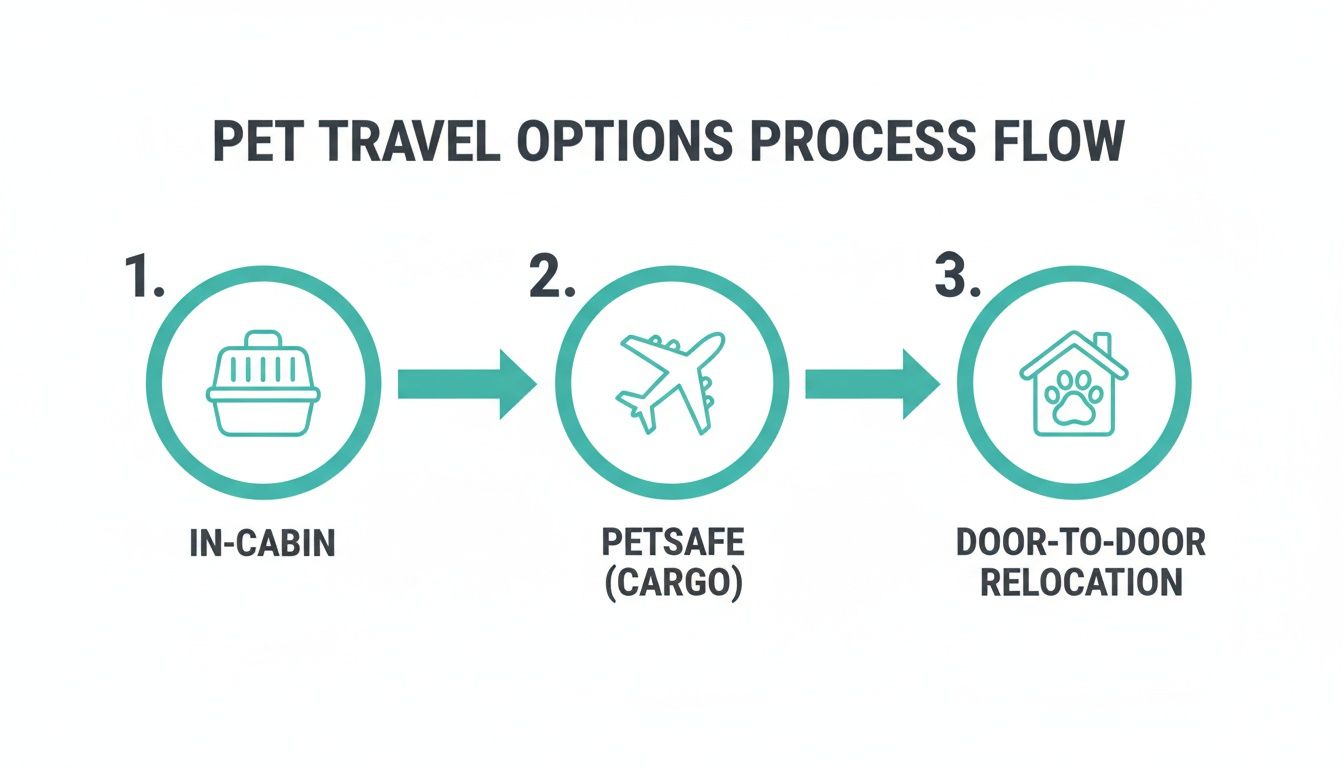
As you can see, for most people flying with a small pet, traveling in the cabin is the main option. This makes your choice of an under-seat United Airlines pet carrier incredibly important.
Hard-Sided vs Soft-Sided Carriers for United Flights
You've got two main choices for in-cabin travel: a hard-sided kennel or a soft-sided carrier. Each has its pros and cons, and the best one really depends on your pet and your specific flight.
Feature | Hard-Sided Carrier | Soft-Sided Carrier |
|---|---|---|
Max Dimensions | 17.5" L x 12" W x 9" H | 18" L x 11" W x 11" H |
Flexibility | Rigid and sturdy; offers more protection | Bendable; can be "squished" to fit tight spaces |
Comfort | Can feel more like a den | Often lighter and cozier for anxious pets |
Best For | Pets who are chewers or need extra protection | Flights on smaller planes with less under-seat space |
While soft-sided carriers are generally more popular for their flexibility, a sturdy hard-sided kennel might be better for a pet who gets anxious and tries to claw or chew their way out. The key is to measure carefully and think about your pet's personality.
Getting the Dimensions Right
United is firm on carrier dimensions because the space under an airplane seat is fixed. These measurements aren't suggestions; they are maximums based on the aircraft in their fleet.
Hard-Sided Maximum: 17.5" L x 12" W x 9" H
Soft-Sided Maximum: 18" L x 11" W x 11" H
These differences matter. The slightly taller allowance for soft-sided carriers is because they have some give and can press down a bit to slide under the seat.
Here's a pro tip: your aircraft type makes a huge difference. A Boeing 737 MAX 9, for instance, often has an under-seat height of just 10 inches. Always check your specific flight details after booking and have that tape measure ready.
Measuring Your Pet for a Proper Fit
It's not just about the carrier's outside size. United staff will definitely check that your pet can comfortably stand up and turn around inside. This isn't just a rule; it's an important welfare check.
To make sure your pet has enough room, grab a tape measure:
For Length: Measure your pet from the base of their neck (where their collar rests) to the base of their tail. Your carrier should be at least a few inches longer than this.
For Height: While your pet is standing naturally, measure from the floor to the top of their head or the tips of their ears, whichever is higher. The carrier needs to be an inch or two taller.
Don't be tempted to fudge the numbers. A carrier that's too snug is not only uncomfortable and stressful for your pet, but it's also a fast way to be denied boarding at the gate. If you're looking for more general guidance, our broader airline pet travel carrier guide is a great resource.
Essential Carrier Features for Air Travel
Once you've nailed down the size, focus on the carrier’s construction. Certain features are a must for a safe and rule-following journey.
Look for these three things:
Excellent Ventilation: This is a top priority. The carrier must have ventilation on at least two sides. Mesh panels are perfect for this, as they provide airflow while keeping your pet secure.
A Leak-Proof Bottom: Accidents can happen, especially when pets are nervous. A waterproof base is a firm requirement and contains any messes. Most quality carriers come with a removable, washable absorbent pad.
Secure Zippers or Latches: Check for locking zippers or safety clips. This tiny detail is a lifesaver, preventing clever escape artists from nosing or pawing their way out mid-flight.
Keep in mind that United limits the number of pets in the cabin—often up to four in economy and two in premium cabins on common aircraft like the Airbus 319/320 and Boeing 737s. Some flights, like certain 757-200 routes, even restrict pet carriers to window seats.
While we're mostly talking about cats and dogs, these rules apply to other small household pets, too. If you're traveling with a feathered friend, a great guide on choosing a bird travel cage offers more specific advice on materials and features for avian travelers.
Ultimately, your goal is to find a carrier that makes your pet feel safe and secure. The right one acts like a familiar den, greatly reducing their stress—and yours—on travel day.
Ready to get your pet’s spot on a United flight? Booking their ticket isn't quite as simple as getting your own, but with a little know-how, you can make sure your furry co-pilot is all set for a smooth journey.
Think of it as reserving a VIP (Very Important Pet) seat.
The most important thing to know is that you have to act fast. United only allows a handful of pets in the cabin on any given flight—usually just four in economy and two in premium classes. These spots are first-come, first-served and get snatched up quickly, sometimes weeks or even months ahead of time on popular routes.
So here’s the golden rule: add your pet to your reservation the moment you book your own flight. If you wait even a day, you might find all the pet spots are gone, which could throw a major wrench in your travel plans.
Adding Your Pet to Your Reservation
The easiest way to book your pet's travel is directly on United's website while you're making your own reservation. Just look for the “Travel with a pet” option and follow the steps. This is the quickest way to see if there's even space available on the flights you want.
If you've already booked your ticket or just prefer talking to a person, you’ll need to call United’s customer service. To make that call go smoothly, have this info ready:
Your flight confirmation number
Your pet’s breed and total weight (pet + carrier)
The exact dimensions of your United Airlines pet carrier (length x width x height)
The agent will check for pet availability on your flight. If there’s an open spot, they'll add your pet to your reservation. This is the crucial step—without this official confirmation from United, you won't be able to bring your pet on board.
The fee for an in-cabin pet on United is currently $150 each way for most flights. You can often pay this when you book or handle it at the airport when you check in.
Planning for Special Scenarios
Bringing more than one furry friend? If you're traveling with two small pets, United has a very specific rule you need to follow. You can't just show up with two carriers under one person's ticket.
Instead, you must purchase an additional, next-door seat for your second pet. This ensures each pet gets their own dedicated under-seat space, and each carrier must meet the size requirements on its own. For example, you might book a window and a middle seat for yourself and your two companions. And yes, each pet will still be charged the $150 per-way fee.
Insider Tip: Not all airplane seats are pet-friendly. When you book, always avoid bulkhead and exit rows. These seats have no under-seat storage, leaving you with nowhere to safely place your pet’s carrier. Use the seat map to pick a standard seat with space in front of it.
Before You Fly: Confirm Everything
Once you have your pet officially added to the reservation, you're almost done. But there's one last, important step. A week or two before you fly, it’s a smart move to double-check everything.
Log into your United reservation and look for the "pet in cabin" notation. If you don't see it, or if you just want that extra peace of mind, give United a call. Airline systems can have glitches, and taking a few minutes to confirm your pet’s spot can save you from a huge headache at the check-in counter.
For even more tips on the whole process, from booking to boarding, feel free to check out our guide on how to book a flight for your cat. The advice is practically identical for small dogs and will help you feel even more confident on travel day. A little bit of prep goes a long way.
Preparing Your Pet and Documents for Travel Day
A smooth travel day with your furry co-pilot starts long before you even think about packing. Getting it right is all about preparation—for both your pet and their paperwork. With a little planning, the journey can feel more like an adventure and less like a stressful event.
Let’s be honest: to your pet, a carrier can look like a strange, scary box. Your first job is to turn it from a source of anxiety into a familiar, safe den. This getting-used-to-it process is probably the single most important thing you can do for a calm travel day.
Making the Carrier a Happy Place
Don't wait until the night before your flight to introduce the carrier. Start weeks ahead of time, making it a normal, non-threatening part of their environment.
Here’s how you can make that United Airlines pet carrier feel more like a fur-st class lounge:
Leave it open: Place the carrier in a room where your pet hangs out, and just leave the door open. Let them check it out on their own terms, no pressure.
Make it comfy: Add their favorite blanket or an old t-shirt that smells like you. Familiar scents are incredibly comforting.
Use positive reinforcement: Start feeding them near the carrier. Over time, move the food bowl just inside the door, and then all the way to the back. Every now and then, toss a high-value treat inside for them to find.
The goal is to build a positive association. You want your pet to see the carrier as the place where good things—like dinner and special snacks—happen. This simple training can make a world of difference on the day of the flight.
On the Day of Your Flight
The morning of your trip has its own mini-checklist. A few small changes to your pet’s routine can make a big impact on their comfort during the flight.
It's best to hold back on food for about four to six hours before leaving for the airport. This helps prevent an upset stomach or the need for a potty break mid-flight. Small sips of water, however, are perfectly fine.
Before you head out the door, get them moving. A long walk for your dog or a fun play session for your cat helps burn off that nervous energy, making them much more likely to rest and settle down once you're on the move.
The Paperwork Side of Pet Travel
Now for the part that trips up so many travelers: the documents. Getting your pet’s paperwork in order is not optional. Missing or incorrect forms can get you denied boarding at the gate—a truly heartbreaking and stressful situation.
The most critical document is often the Certificate of Veterinary Inspection (CVI), also called a health certificate. This is an official form signed by an accredited veterinarian confirming your pet is healthy and up-to-date on its shots. While not always required for domestic U.S. flights, it’s a must-have for most international destinations and for travel to Hawaii.
Key Insight: These strict rules exist for a good reason. In 2018, United Airlines experienced a 27% drop in the number of pets it transported following several high-profile incidents, one of which sadly resulted in a pet's death due to improper stowing. According to Upgraded Points, these events pushed airlines to double down on safety protocols. Following every guideline to the letter isn't just about following rules; it's about your pet's safety.
Streamlining Your Document Management
Juggling all these documents and their strict expiration dates can feel overwhelming. This is where a service like Passpaw can be a lifesaver. Instead of a messy folder of papers and constant worry about timelines, Passpaw keeps everything organized in one digital space.
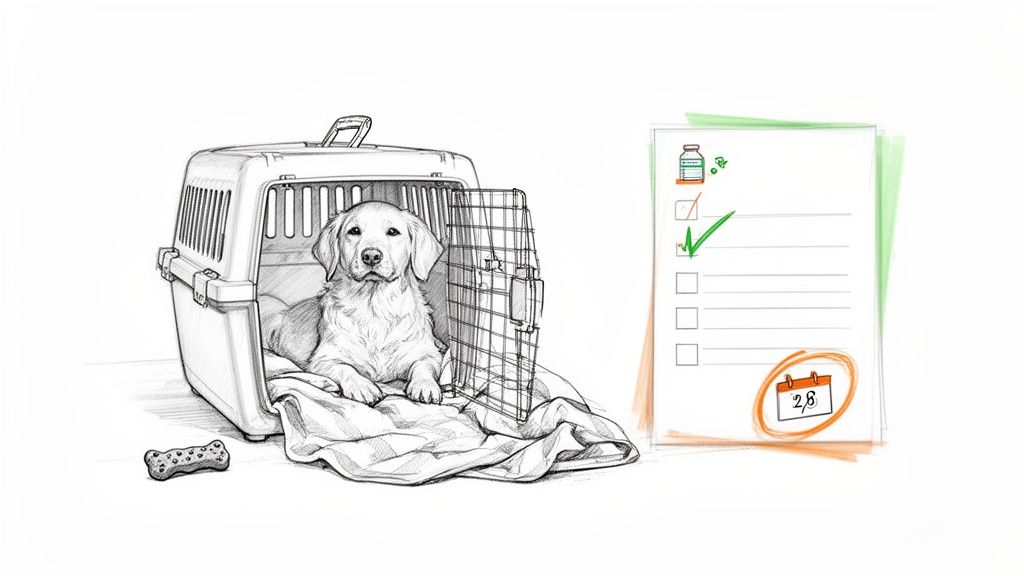
The platform guides veterinarians and pet owners to ensure every document—from rabies certificates to the final health certificate—is filled out correctly and checked against your destination's unique rules. It helps cut down on human error and gives you the peace of mind that you won't face any last-minute surprises at the check-in counter.
For a closer look, you can learn more about the ins and outs of the vet health certificate for travel and see why it’s so critical. Taking the time to properly prepare both your pet and their paperwork sets everyone up for a much smoother journey.
Navigating the Airport and Boarding Process With Your Pet
You’ve sorted out the carrier, organized the paperwork, and prepped your pet. Now for the main event: travel day. An airport can be an overwhelming place for a pet, but if you know the drill, you can make the experience calm and controlled for both of you.
First things first, you can’t use curbside check-in when flying with a pet. You'll need to head straight to the United Airlines ticket counter inside the terminal. This is where your pet’s journey officially begins.
The Check-In Counter Inspection
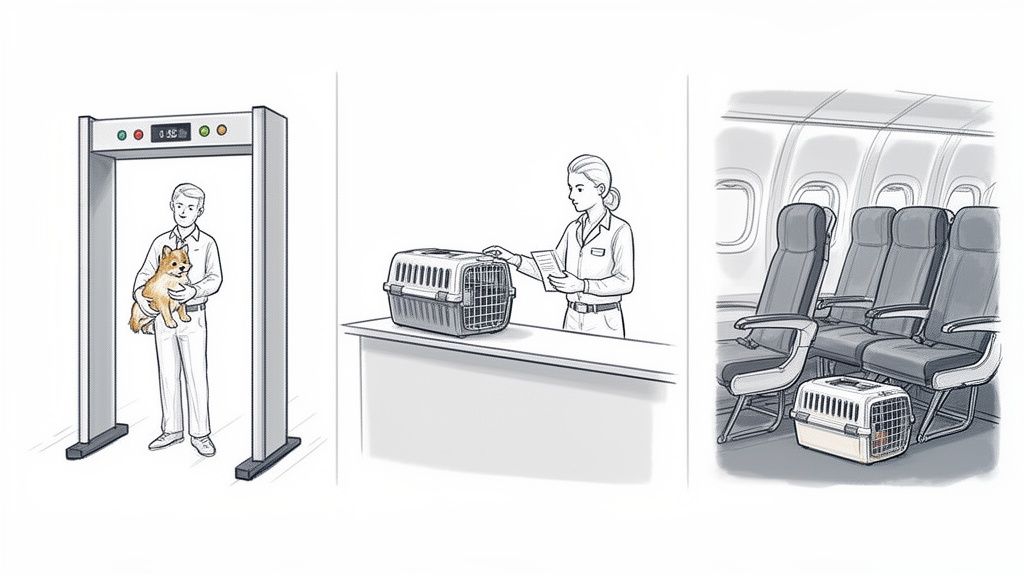
At the counter, a United agent will pull up your pet’s reservation and ask to see your carrier. They’re trained to check its dimensions and make sure your pet can comfortably stand up and turn around inside. This is also when you'll pay the pet fee if you haven't already.
Once you get the green light, the agent will put a bright yellow tag on your carrier. This tag is critical—it’s a universal sign to all airline staff that a live animal is on board, telling them to take extra care. This tag needs to stay on the carrier for your entire trip, even if you pop into a United Club lounge.
Key Takeaway: Check-in is your first major checkpoint. Arrive with your pet already in their carrier and have your documents ready. A smooth check-in really sets a positive tone for the rest of your day.
Getting Through Airport Security
For many pet owners, the security screening is the most stressful part of the day. It doesn't have to be. The most important rule to remember is that your pet can never go through the X-ray scanner inside their carrier.
Here’s how the process usually goes:
You’ll put your shoes, electronics, and liquids in the bins just like any other trip.
Next, you'll collapse the pet carrier (if it's a soft-sided model) and send it through the X-ray machine with your other belongings.
You must carry your pet in your arms as you walk through the metal detector. I can't stress this enough: use a secure harness and leash. It’s a busy environment, and the last thing you want is a daring escape attempt.
After you’re both through, you can get your pet settled back into their carrier and grab your things.
If your pet is too anxious to be held, you can always ask for a private screening room. TSA agents are familiar with this request and will lead you to a quieter, more secure space to complete the screening.
Layovers and Finding Pet Relief Areas
If you have a layover, a potty break will be at the top of your pet's list. Most major airports now have designated pet relief areas. These are typically small, fenced-in spaces, often with turf and waste disposal bags provided.
Check the airport maps or just ask an employee for the nearest location. Giving your pet a chance to stretch their legs and relieve themselves makes a huge difference in their comfort for the next flight. Just be sure to leave plenty of time to get from the relief area to your connecting gate.
Boarding the Plane and Settling In
When your boarding group is called, it’s time to go. There’s no special pre-boarding for pets; you’ll board with your assigned group. Make sure your pet is securely inside the carrier as you head down the jet bridge.
Once at your seat, the carrier goes on the floor, fully under the seat in front of you. It can't be on your lap or an empty seat next to you, and it can’t block the aisle.
The carrier must stay there for the entire flight—from takeoff until you’ve landed and the plane is at the gate. A flight attendant will likely double-check that it’s stowed correctly before departure. Now, you and your furry co-pilot can finally sit back and get ready for the flight.
Common Questions About United Airlines Pet Carriers
Even after you've measured your carrier and booked the flight, a few nagging questions can pop up. It's completely normal. Let's tackle some of the most common ones we hear from travelers flying with their pets on United Airlines.
Can I Bring Two Pets in One Carrier on a United Flight?
This comes up a lot, but the answer is almost always a firm no. United's policy is strict: one pet per carrier. This isn't just a space issue; it's about making sure each animal can travel safely and comfortably without being stressed or cramped.
There's one tiny exception to the rule. United might allow two very small puppies or kittens of the same species in a single carrier. You can't just show up at the airport like this, though. You should call United directly when you book to get specific approval. Don't try to book this online.
What if My Pet Carrier Is Slightly Larger Than the Official Dimensions?
It’s tempting to bend the rules by an inch or two, but this is a gamble you don't want to take. While a soft-sided carrier has a bit of flex, the final say always belongs to the airline staff at check-in and the gate. They’re trained to enforce the maximum dimensions, and their main concern is whether the carrier will fit securely under the seat.
If an agent feels your carrier is too big, they can deny boarding for your pet. That's a heartbreaking and expensive way to end a trip before it even starts. The safest bet is always to stick to the exact dimensions for United Airlines pet carriers.
Do I Need a Health Certificate for a Domestic Flight?
For most flights within the continental U.S., United doesn't typically ask for a health certificate. That said, airline policies and state rules can shift, so having your pet's recent health and vaccination records on hand is just smart travel practice.
Important Note: This changes entirely for certain destinations. If you're flying to Hawaii or anywhere internationally, a valid health certificate from an accredited veterinarian is non-negotiable. Always double-check the specific entry requirements for your final destination well in advance.
Are Any Dog or Cat Breeds Banned From Flying in the Cabin?
Here's some good news. United does not have a "banned breed" list for pets traveling with you in the cabin. If your pet and its carrier meet all the size, weight, and behavior rules, they're welcome aboard.
This policy is great, but it's important to think about the well-being of short-nosed (brachycephalic) breeds like French Bulldogs, Pugs, and Persian cats. These pets can be more prone to breathing problems at high altitudes. We highly recommend a pre-flight chat with your vet to make sure they're fit for air travel and to get their professional sign-off.
Juggling pet travel documents can feel like a full-time job. Passpaw takes that stress off your plate by organizing all your pet's paperwork, checking it against your destination's rules, and making sure everything is filled out correctly. See how we can help you stay compliant and confident by visiting https://passpaw.com.
More articles
From regulatory changes to best practices for veterinarians and pet owners, our resources keep you ahead of the curve.