Are you a team member in a veterinary practice?
Are you a pet parent planning a trip with your furry pal?
Travel Certificate for Pets: A Paws-itively Simple Guide
So, what exactly is a travel certificate for pets? You'll often hear it called a health certificate, and for good reason. It's an official document signed by a special vet confirming your pet is healthy enough for the journey and meets all the specific entry requirements for your destination.
Think of it as your furry friend’s passport. It’s arguably the single most important piece of paper you'll need for your trip together. Nailing this certificate is the critical first step to ensuring your travel is smooth and stress-free for everyone involved.
What Is a Travel Certificate for Pets
Planning an adventure with your pet is exciting, but the to-do list involves a lot more than just packing their favorite toys and treats. Right at the top of that list should be the official travel certificate. This document is the formal proof that your pet is in good health and has received all the necessary vaccinations and treatments required by the airline and your destination country.
And this isn't just about airline rules; it's a global standard. These certificates are important for preventing the spread of animal diseases across state and international borders. Without a valid one, you could be facing a travel nightmare—airlines and border officials may deny your pet entry.
Why This Document Is So Important
A travel certificate isn't a suggestion—it's a key requirement for most kinds of commercial travel. Both airlines and countries enforce these rules to protect their local animal populations.
To get a clearer picture, let's break down what's usually inside one of these certificates and why each piece of information is so important.
Key Components of a Pet Travel Certificate at a Glance
Information Category | What It Means | Why It's Needed |
|---|---|---|
Identification | This includes your pet's microchip number, breed, age, color, and other special features. | It confirms the pet being examined is the same one traveling, preventing mix-ups. |
Vaccination Status | A detailed record of all current vaccinations, with a major focus on rabies. Dates are crucial here. | This is the main defense against the spread of serious diseases like rabies across borders. |
Health Examination | A veterinarian's official signature confirming the pet was healthy and free of contagious diseases at the time of the exam. | Provides official assurance to authorities that your pet poses no immediate health risk to other animals or people. |
Parasite Treatments | Documentation of specific treatments for fleas, ticks, or internal parasites like tapeworms. | Many regions, especially islands, have strict rules to prevent the introduction of new pests and parasites. |
This formal verification gives authorities the confidence that your pet isn't carrying any communicable illnesses. With more people traveling with their pets than ever before, these safeguards are very important.
In fact, with an estimated 53% of owners planning to travel with pets in 2025, getting the paperwork right has never been more important. Unfortunately, a staggering 6% of U.S. pets face boarding denials each year due to documentation issues—a completely avoidable problem with proper certification.
Who Issues the Certificate
Here’s a detail that trips up a lot of pet owners: not just any veterinarian can sign off on these forms. For official travel, especially internationally, the certificate must be completed and signed by a USDA-accredited veterinarian.
This special accreditation means the vet has completed specific federal training and is authorized by the U.S. government to certify animals for travel.
A common mistake is assuming any vet can issue a travel certificate. Always confirm your vet has the necessary USDA accreditation. Not doing so can invalidate the entire document and bring your travel plans to a screeching halt.
Understanding the role of these specialized vets is a huge part of the process. If you want to dive deeper, check out our guide on what veterinary accreditation involves. Getting this part right from the start ensures your pet's journey begins on the right paw.
How to Prepare for the Health Certificate Appointment
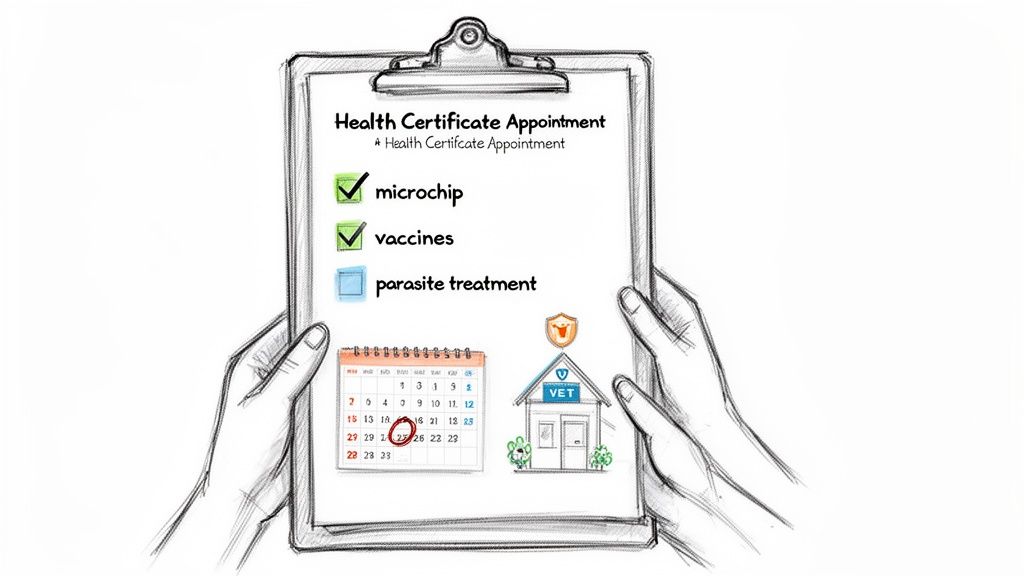
Getting your pet's travel certificate is much more than a quick trip to the vet. It actually requires a bit of homework to make sure the appointment goes off without a hitch. By preparing ahead of time, you can turn what often feels like a frantic process into a smooth and organized one.
Think of yourself as the lead detective in your pet's travel case. Your mission is to gather all the important evidence—documents, dates, and details—that your vet will need to fill out the official paperwork correctly. A well-prepared file doesn't just help your veterinarian; it's your best defense against errors that could derail your trip.
Finding the Right Veterinarian
First things first: not every veterinarian can issue an official travel certificate for pets. You need a specific type of professional, a USDA-accredited veterinarian. This is a key requirement for international travel and many domestic flights. These vets have completed specialized training and are authorized by the federal government to certify animals for travel.
You can usually find a list of accredited vets on the USDA's Animal and Plant Health Inspection Service (APHIS) website. Or, you can just call local clinics and ask directly if they have an accredited vet on staff. My advice? Don't wait until the last minute. Their schedules fill up fast, especially with other globetrotting pets.
Your Pre-Appointment Document Checklist
Once you've found and booked with an accredited vet, it's time to get your documents in order. Walking into that appointment with a complete, organized folder is the single best thing you can do to ensure accuracy and avoid frustrating return visits.
Here’s what you should have ready to go:
Microchip Information: Have the full 15-digit ISO-compliant microchip number written down, along with the date it was implanted. Your vet needs this exact number for the certificate.
Complete Vaccination Records: This means a full history of all shots, but the rabies vaccine is the star of the show. You'll need the date it was given and, crucially, its expiration date.
Parasite Treatment History: Jot down the dates and products used for recent flea, tick, and deworming treatments. Some countries are very particular about this.
Travel Details: Know your exact destination address and your travel dates. This isn't just for your own reference; this info often goes directly on the health certificate itself.
Your pet’s rabies vaccination is the cornerstone of the health certificate. Make sure you have the official, signed rabies certificate—not just a line item on an invoice. If you need a refresher, you can learn more about securing a proof of rabies vaccine in our detailed guide.
The Critical Role of Timing
When it comes to a travel certificate for pets, timing is everything. I can't stress this enough. Many international health certificates have a very short validity period. For travel to the European Union and many other places, the certificate may need to be completed and signed by your vet within 10 days of your pet's arrival.
This tight window means you have to schedule your appointment strategically. Book it too early, and the certificate could expire before you even land. Book it too late, and you’re left scrambling if any last-minute issues pop up.
When you call to make the appointment, be crystal clear that it's for an international health certificate. This alerts the clinic staff that it’s not a routine check-up and requires a specific doctor and a longer time slot. A little proactive communication here makes the process so much less stressful for you, the clinic, and your furry co-pilot.
Navigating Country-Specific Pet Travel Regulations
Once you’ve got the vet visit on your calendar, the next big hurdle is figuring out the rules for where you're going. Every country rolls out the welcome mat for pets a little differently, and getting these specific regulations right is absolutely essential for a smooth arrival. This is where things can start to feel overwhelming, but don’t worry—we’ll break it down.
Think of it this way: just as you need a valid passport to enter another country, your pet needs its own specific set of paperwork to meet that destination's unique health and safety standards. There’s no such thing as a one-size-fits-all travel certificate for pets; the requirements are always dictated by your final stop.
Your Destination Sets the Rules
The single most important factor determining your pet's travel requirements is where you're landing. A trip from Texas to France involves a completely different rulebook than flying from California to Japan. Some countries have very strict protocols to protect their disease-free status, while others have more straightforward processes.
Let's look at a few real-world examples of how much the rules can vary:
The European Union: The EU has a largely consistent system. For travel between member states, it's often called a "pet passport." But for pets coming in from a non-EU country like the U.S., you'll need a specific EU Health Certificate that follows a standard format.
Rabies-Free Countries: Places like Japan, Australia, and Hawaii are famously strict. They often require a rabies titer test—a blood test proving the rabies vaccine is effective—months before you travel. If you miss this crucial step, your pet could face a long and expensive mandatory quarantine upon arrival.
United Kingdom: After Brexit, the UK set its own rules. While they're similar to the EU's, pets entering from the U.S. now need a specific Great Britain Pet Health Certificate, which is not the same as the one for the EU.
Don't ever assume the rules are the same, even for neighboring countries. A simple mistake, like using an EU certificate for a direct flight to London, could get your pet denied entry right at the border. Always, always research the specific country you are landing in.
Where to Find Official Pet Travel Information
So, where do you get this important info? While plenty of blogs and forums offer advice, you should go straight to the official source. Your number one resource should be the government agency of your destination country that handles animal imports—usually their Ministry of Agriculture or a similar department.
For anyone traveling from the U.S., the USDA APHIS Pet Travel Website is a fantastic and reliable tool. You can just select your destination country from a dropdown list, and it will generate a detailed, step-by-step checklist of everything you need, from microchip standards to specific vaccination timelines and the correct forms.
This need for careful planning is growing. The global pet travel services market is expected to explode to $5.9 billion by 2034, and a big reason is the simple "humanization" of our pets. With over 70% of U.S. households now owning a pet, millions of these international journeys depend on getting the paperwork exactly right. You can read more about the growing pet travel market and its impact.
To give you a clearer picture of how much requirements can differ, here’s a quick comparison of a few popular destinations.
Common Pet Entry Requirements by Region
Requirement | European Union (EU) | United Kingdom | Australia / New Zealand | USA / Canada |
|---|---|---|---|---|
Microchip | ISO 11784/11785 required | ISO 11784/11785 required | ISO 11784/11785 required | Recommended; may be required by state/province |
Rabies Vaccination | Required; must be given after microchip | Required; must be given after microchip | Required; must be given after microchip | Required; state/provincial rules vary |
Rabies Titer Test | Required for certain non-EU countries | Required for certain non-EU countries | Required; strict timeline (180+ days) | Not typically required for entry from most countries |
Health Certificate | EU Health Certificate | Great Britain Health Certificate | Varies; requires import permit | Not typically required for US/Canada travel |
Parasite Treatment | Tapeworm treatment for select countries | Tapeworm treatment required for dogs | Extensive internal & external parasite treatments | Varies; screwworm check from some regions |
Quarantine | Not usually required | Not usually required | Mandatory quarantine period (10+ days) | Rare; only in specific disease outbreak cases |
This table is just a snapshot, but it clearly shows why you can't make assumptions. Always dig into the specific rules for your exact destination.
The Final Step: Government Endorsement
For almost all international trips starting in the United States, there's one last, important step after your accredited veterinarian fills out the health certificate. The document must be endorsed—stamped and signed—by the USDA's Animal and Plant Health Inspection Service (APHIS).
This endorsement is the U.S. government's official seal of approval, confirming that your pet's paperwork is accurate and meets the destination country's import rules. This isn't a suggestion; it's a firm requirement. Without that official USDA stamp, most countries will consider the travel certificate for pets completely invalid.
You can get this endorsement by either mailing your paperwork to the correct USDA office or booking an in-person appointment. Timing is everything here, as you have to build this final step into your pre-travel schedule. To keep all these moving parts organized, our pet travel planner can be a huge help. A little planning ahead makes this final hurdle feel like a breeze.
A Practical Timeline for Getting Your Pet's Certificate
Getting a travel certificate for pets isn't a one-and-done task; it's a series of carefully timed steps. When it comes to international pet travel, waiting until the last minute is your worst enemy, since so many of the requirements are time-sensitive. Mapping out a timeline helps you stay organized and avoid that last-minute panic, ensuring your pet is ready for takeoff without any ruff patches.
Let’s walk through the entire journey, from the moment you book your flight to the final, government-stamped document. This roadmap will make the process feel less like a maze and more like a manageable project.
This breakdown shows the key phases of pet travel prep—what to do months, weeks, and just days before your trip.

As you can see, the biggest and most time-consuming tasks, like rabies titer tests, have to be started months ahead. The final health exam, on the other hand, is one of the very last things you'll do.
Months Before Your Trip: The Planning Phase
The moment you start dreaming of your destination, the clock starts ticking on your pet’s travel preparations. This early phase, usually 2-6 months before you leave, is all about research and laying the groundwork for everything else to fall into place.
First things first: check that your pet’s microchip is an ISO-compliant 15-digit chip. If it isn't, or if your pet doesn't have one, now is the time to get it implanted. This is important because many countries require the microchip to be implanted before the rabies vaccination is given.
Next, dive into your destination's specific rules. The best sources for this are the official USDA APHIS website or the country's ministry of agriculture site.
Here are the key tasks for this phase:
Rabies Titer Test: If your destination requires a rabies titer test—a blood test proving the vaccine is working—this is your absolute top priority. The process can take months, often with a mandatory waiting period of 90 days or more after the blood is drawn before your pet is even allowed to travel.
Booking Flights: Don't forget to check the airline's pet policies and book your pet's spot on the flight. Space for pets is often limited, so getting this done early is a must.
Finding an Accredited Vet: You’ll need a USDA-accredited veterinarian to handle the paperwork. Locate one and get an initial consultation on the books. Their schedules fill up fast, so don't wait.
Weeks Before Your Trip: The Action Phase
With about 2-4 weeks to go, it's time to shift from planning to action. This is when you'll be scheduling appointments and getting the final treatments your pet needs. All that early research now guides exactly what needs to be done.
This is also the time to buy an airline-approved travel crate if you haven't already. You'll want to give your pet plenty of time to get comfortable with it. The goal is to make it a safe, happy space with familiar blankets and toys.
During this period, your focus will be on:
Parasite Treatments: Many countries require specific internal or external parasite treatments, like for tapeworm or ticks, within a very precise window before arrival. For example, some destinations require a tapeworm treatment be given between 24 and 120 hours before you land.
Gathering Records: Pull together all of your pet’s medical records—vaccination history, microchip details, everything—into one organized folder. You’ll be glad you did.
One of the most common pitfalls we see is miscalculating treatment windows. A tapeworm treatment given a day too early or even a few hours too late can invalidate the entire health certificate. Always double-check these timelines with your vet against the official country requirements.
Days Before Your Trip: The Final Countdown
The last 10 days before your flight are the most critical. This is when the official health examination takes place and the travel certificate is finally issued and signed. Most international health certificates are only valid for a very short period—often just 10 days—so this final vet visit has to be timed perfectly.
When you're at the vet's office for that final exam, be ready to review the completed certificate with a fine-toothed comb before you walk out the door.
Look for these common but costly errors:
Legibility: Is all the handwriting clear and easy to read? Unclear writing can cause major problems.
Ink Color: Believe it or not, some countries require the certificate to be filled out in a specific ink color, usually blue. Using black ink when blue is required could lead to rejection.
Corrections: There should be absolutely no white-out, cross-outs, or scribbled corrections on the document. If a mistake is made, the vet has to start over with a fresh form.
Once the vet signs the certificate, your final stop is getting the USDA APHIS endorsement. You can do this by mail or with an in-person appointment. This final government stamp is what makes the document official and your pet ready to fly. A little planning really does make this whole process feel less like a sprint and more like a perfectly paced journey.
Using Modern Tools to Simplify Pet Travel Paperwork

After looking at the manual timeline, it's easy to see how getting a travel certificate for pets can feel like a full-time job. You're juggling strict deadlines, confusing country-specific rules, and vet appointments—it's a lot to handle.
Thankfully, we're not stuck in the era of fax machines and snail mail anymore. Modern tools are stepping in to completely change the game, turning this tangled web of tasks into a clear, manageable process.
Platforms like Passpaw were built specifically to take the guesswork and administrative headache off the shoulders of both veterinary clinics and pet owners. This isn't just about making things faster; it's about adding a serious layer of security and confidence to your pet’s travel plans.
How Technology Helps Veterinary Practices
For any vet practice, managing international travel paperwork is a huge time sink, especially when you have multiple pets traveling at once. Every country has its own quirky rulebook, and one tiny mistake can derail an entire trip. This is where a dedicated platform truly shines.
With Passpaw, clinics can:
Prioritize Like a Pro: The system automatically sorts travel cases by departure date, so the most urgent certificates are always front and center. No more last-minute scrambles.
Catch Errors in Real-Time: As a vet enters information, the platform is constantly checking it against the destination country's requirements. It flags potential mistakes on the spot, long before they can become a real problem.
Keep Communication in One Place: Every message, update, and document shared with the pet owner is logged in a single, easy-to-access thread.
By pulling all these pieces together, the technology essentially becomes a digital assistant for the vet team. It helps ensure every "i" is dotted and every "t" is crossed, so the final document is accurate.
This approach drastically cuts down on the risk of human error—the number one reason pets get denied travel at the airport. You can get more details on how digital tools are improving the process of getting a pet health certificate online.
A Clearer View for Pet Owners
As a pet owner, the worst part of this whole process is the feeling of being in the dark. Did the clinic send the forms to the USDA yet? Did I type in the right microchip number? With the right tools, that uncertainty is a thing of the past.
Instead of calling the clinic for updates, you get automatic notifications as each key step is finished. This kind of clear communication means you always know where your pet’s paperwork stands, from the first vet visit to the final government stamp of approval. It turns a confusing, behind-the-scenes process into a transparent partnership.
Using an automated document workflow handles all the tedious tasks of preparing and submitting your pet's travel forms. This automation helps ensure every little detail is correct and lets your vet focus on what they do best—caring for your pet’s health. The result is a journey that starts smoothly and safely for every single member of your family, furry or not.
Your Top Questions About Pet Travel Certificates, Answered
Even with the best planning, a few questions always pop up when you’re dealing with travel certificates for pets. It’s a process with a lot of moving parts, and one small detail can feel like a huge question mark. We get it.
So, we’ve put together a quick rundown of the most common questions we hear from pet owners. Think of this as your go-to guide for those "what if" moments, helping you clear up any final doubts before your trip.
How Long Is a Travel Certificate for Pets Valid?
This is a big one, and the answer isn't always simple. The validity of your pet's health certificate is set by your destination country, and these timeframes can be tight.
For many international destinations, especially those in the European Union, the health certificate may need to be issued by a USDA-accredited veterinarian within 10 days of your pet's arrival. That’s a very specific window. Some countries have different rules, and don't forget that airlines often have their own requirements, too.
It is very important to confirm the timeline with both your destination country's authorities and your airline. The best move? Plan your final vet visit to land comfortably inside that window to avoid any last-minute panic.
What Is the Difference Between a Pet Passport and a Health Certificate?
This is a great question and a common source of confusion. While they sound similar, they're not the same and serve very different functions.
An EU "Pet Passport" is a reusable document designed for travel between EU member countries. It holds all your pet's essential info, like their microchip and vaccination history. As long as their rabies shots are current, it’s good for life—perfect for anyone who travels frequently within that region.
An International Health Certificate, which is what most people mean by a travel certificate for pets, is almost always a one-time document for a single trip.
Think of the health certificate as a 'travel visa' for one specific journey. The pet passport, on the other hand, is more like a multi-entry pass that only works for a specific group of countries.
Most countries outside of the EU, including the United States when welcoming pets from abroad, will require a specific health certificate for entry, not a pet passport.
What Happens If There Is a Mistake on My Pet's Travel Certificate?
Honestly, even a tiny mistake on a pet travel certificate can create huge headaches. We’re talking about simple things—a typo in a microchip number, a wrong date, or even using white-out to fix an error. Any of these can lead to the document being rejected by airline staff or border officials.
If an issue is flagged at the airport, your pet could be denied boarding on the spot. If it’s caught upon arrival, the consequences can be even more serious.
Here’s what you could be up against with a faulty certificate:
Immediate Return: Your pet could be sent back home on the next available flight, all at your expense.
Lengthy Quarantine: Your pet might be placed in a mandatory quarantine facility. This is not only stressful for them but also very costly for you.
Entry Denial: In the worst-case scenario, your pet could be refused entry into the country entirely.
This is exactly why accuracy is so important. Always take a few extra minutes to double-check every single detail with your veterinarian before the document is finalized and sent off for government endorsement. That final review is your best defense against a travel day disaster.
Can I Use the Same Certificate for Multiple Countries?
In most cases, the answer is no. A health certificate is typically issued for entry into a single country or a specific region like the EU. If your trip includes multiple stops with different entry rules, you will almost certainly need a new certificate for each one.
For example, let's say you're flying from the U.S. to France and then hopping over to the United Kingdom a month later. You'd need an EU Health Certificate for your arrival in France. But for the next leg of your journey, you'd need a separate Great Britain Pet Health Certificate, because their rules are different now.
The bottom line: research the requirements for every single country on your itinerary. Each border has its own set of rules, so don’t assume one document covers everything. Getting the right paperwork for each part of your trip will keep you from hitting a frustrating and unexpected roadblock.
Feeling more confident about your upcoming trip? With Passpaw, you don't have to manage these details alone. Our platform simplifies the entire process, helping your vet clinic prepare accurate, compliant travel documents every time. Visit https://passpaw.com to see how we make pet travel a walk in the park.

More articles
From regulatory changes to best practices for veterinarians and pet owners, our resources keep you ahead of the curve.