Are you a team member in a veterinary practice?
Are you a pet parent planning a trip with your furry pal?
Your Rabies Certificate Cat Travel Guide
If you're staring at airline rules, vet records, and a half-packed carrier while your cat naps like none of this matters, you're in good company. The phrase rabies certificate cat sounds simple, but the document sits right at the intersection of health care, travel paperwork, and timing. One missing detail can turn a smooth plan into a last-minute scramble.
Most owners don't need more jargon. They need a clean answer to three questions. What is this certificate, what has to be on it, and what do you do if something has gone off track, especially a lapsed vaccine. That's where careful planning helps your trip land on its feet.
Your Guide to the Cat Rabies Certificate
A cat rabies certificate is the official record showing your cat received a rabies vaccination from a licensed veterinarian. It isn't just a receipt. It connects your cat's identity, the vaccine used, and the veterinarian who gave it.
That matters at home and during travel. Landlords, groomers, boarding facilities, airlines, and border officials may all ask for proof that the vaccine was given properly and is still valid. If your records are scattered, start by pulling together your cat's full vaccine history in one place. A clear cat vaccination record guide can help you organize what you already have before you book anything.
What the document really does
Think of the certificate as the foundation document for rabies compliance. It answers basic questions officials care about:
Who is the cat: Your pet's identity details need to match the rest of your records.
What vaccine was used: Product information shows the shot can be traced.
When was it given: Dates control whether a certificate is valid for travel or local rules.
Who administered it: The veterinarian's signature confirms the record is official.
Practical rule: If your travel plans depend on a rabies certificate, treat the certificate like a passport, not like a handout you can hunt for later.
A lot of stress comes from timing, not from the vaccine itself. Owners often assume, "My cat got the shot, so we're fine." Sometimes you are. Sometimes the certificate is missing a key field, the dates don't line up, or the vaccine lapsed at the worst possible moment. That's why getting the paperwork right the first time saves far more trouble than trying to fix it at check-in.
Anatomy of a Cat Rabies Certificate
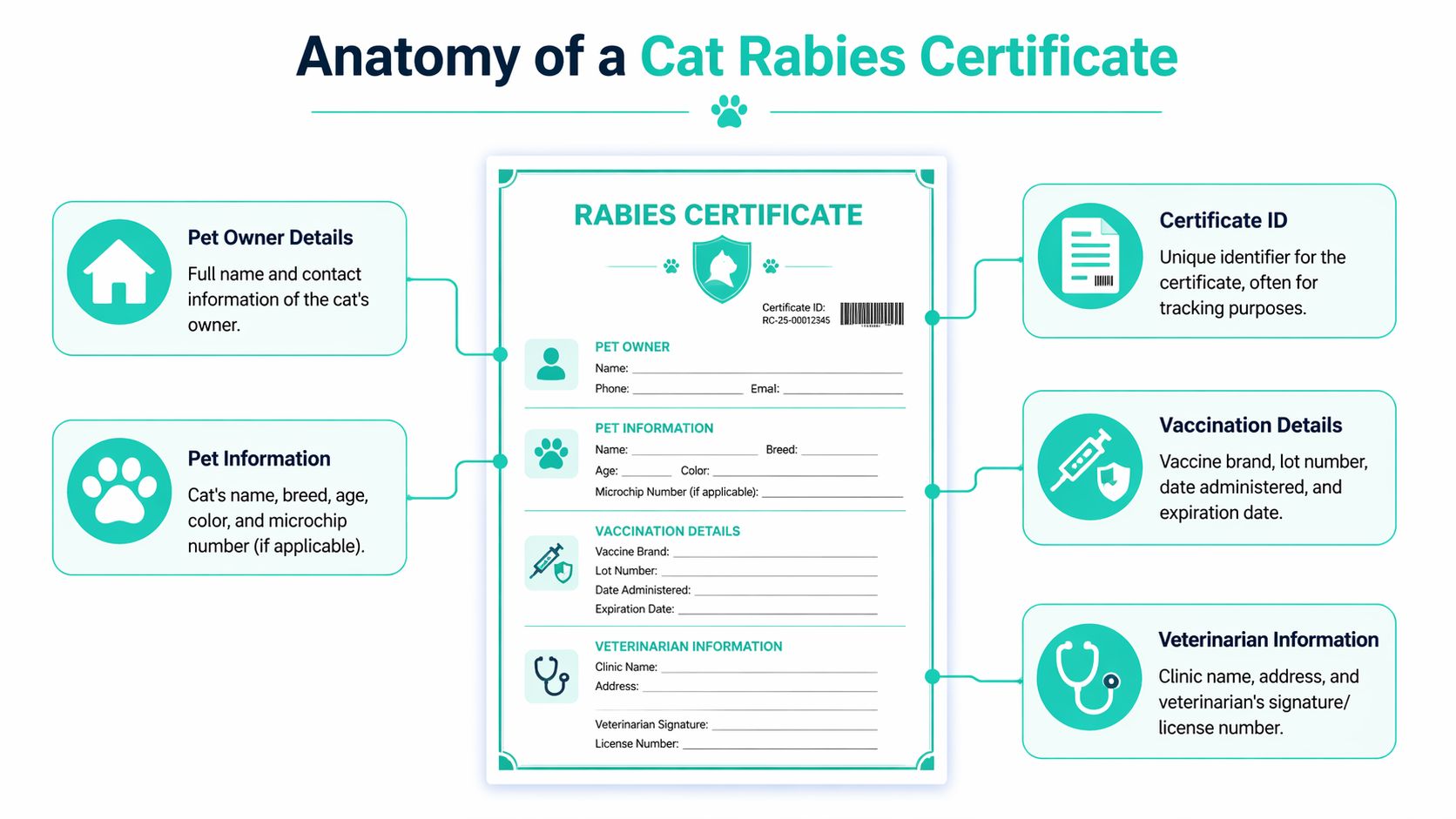
A proper rabies certificate works like a vaccine passport. Every line on it has a purpose, and officials tend to notice the fields owners overlook. If you know what belongs on the form, you can spot problems before they become expensive or stressful.
The fields that must be correct
A valid international certificate needs the ISO-compliant microchip number, and that chip must be implanted before the vaccine. It also needs the exact vaccination date, the vaccine manufacturer, the serial or batch number, and the veterinarian's signed attestation, as described in this overview of pet travel rabies certificate requirements.
Here is the practical breakdown.
Microchip number
This is your cat's identity anchor. If the chip was placed after the vaccine, some destinations may treat the vaccine as disconnected from the animal now presenting for travel.Cat description
Species, breed, sex, color, date of birth, and owner details help match the certificate to the correct animal. Small errors matter more than people expect. "Gray tabby" and "brown tabby" can trigger follow-up questions when documents are reviewed side by side.Vaccine details
The vaccine name, manufacturer, and serial or batch number show exactly what product was used. Batch information is one of those tiny lines that causes outsized headaches when it's missing.Vaccination date and validity
These dates tell officials whether your cat is inside the accepted protection window. They also matter for waiting periods tied to travel entry rules.Veterinarian information
The certificate should identify the issuing veterinarian clearly, including signature and clinic details. A signed form carries the medical attestation.
What owners should check before leaving the clinic
Don't just fold the paper and head home. Read it in the exam room.
A quick review catches the most common errors:
Certificate item | What to verify |
|---|---|
Microchip | Matches the number scanned from your cat |
Vaccine date | Exact date is present and legible |
Product details | Manufacturer and serial or batch number are listed |
Pet identity | Name and description match your records |
Veterinarian attestation | Signed and complete |
Missing details, especially batch information or signature issues, are the kind of paperwork mistakes that can stop a trip before it starts.
What works and what doesn't
What works is simple. Scan the chip, compare every number, and make sure the printed document matches the medical record before you leave.
What doesn't work is assuming the clinic can "fix it later" after you've already submitted forms elsewhere. Corrections are often possible, but timing gets tight fast. In pet travel, paperwork has a nasty habit of becoming urgent on Friday afternoon.
Why Your Cat Needs This Document
You are packing carriers, checking flight times, and then the question hits. Is your cat's rabies paperwork current, signed, and usable? That is the moment a rabies certificate stops feeling like routine clinic paperwork and starts acting like the document that keeps a plan on track.
It protects more than your travel plans
Rabies is still treated as a public health issue because once symptoms appear, the disease is almost always fatal. Cats matter in that picture. The CDC's rabies surveillance summaries consistently show that cats are reported rabid more often than dogs in the United States, which is one reason state and local rules take feline vaccination seriously.
Owners are often surprised by where the risk starts. It does not require a feral lifestyle. A screened porch, an open garage, a bat in the house, or a brief escape into the yard can be enough to create a legal and medical problem.
It is often the document that proves you complied
A rabies vaccine in the medical record helps. A certificate is the proof other people ask to see.
That includes boarding staff, landlords, rescue groups, groomers, local animal control, and travel officials. For travel, especially international trips, paperwork is judged on what is written, signed, and dated. Staff are not verifying your intentions. They are checking whether the file meets the rule in front of them.
The timing rules start early. The American Veterinary Medical Association explains that rabies vaccination schedules are set by state and local law, and many jurisdictions require vaccination for cats beginning around 12 weeks of age, followed by revaccination based on the product used and local requirements. The certificate is the proof that ties that legal requirement to your specific cat.
The hard part is what happens when the paperwork is not perfect
Owners often lose time. Not because the cat is unvaccinated in the broad sense, but because the certificate is expired, missing, inconsistent with another form, or based on a vaccine that lapsed during trip planning.
A lapsed vaccine does not always ruin the entire plan, but it changes what you can do next. Some destinations restart waiting periods after a booster if the previous vaccination was not kept current. Some will accept a current revaccination only if the history is documented cleanly. Others require extra forms completed by a USDA-accredited veterinarian for pet travel paperwork, not just your standard vaccine record.
That is the trade-off owners need to understand. Fixes are often possible, but they usually cost time, appointments, and sometimes a change of itinerary.
Why people get stopped
Problems usually show up in familiar places:
At airline review: Staff need current proof that matches the rest of the booking file.
At border or entry inspection: Officials compare dates, identity details, and supporting forms.
After an exposure or complaint: Local authorities may ask for the certificate to confirm current vaccination status.
A calm cat and a truthful explanation do not solve a paperwork gap. A correct certificate often does.
For owners, that brings real peace of mind. If your vaccination is current and the certificate is usable, one major part of the trip is under control. If it is not, it is far better to find out early, while there is still time to correct the record or rebuild the schedule.
How Vets Issue and Owners Manage Certificates
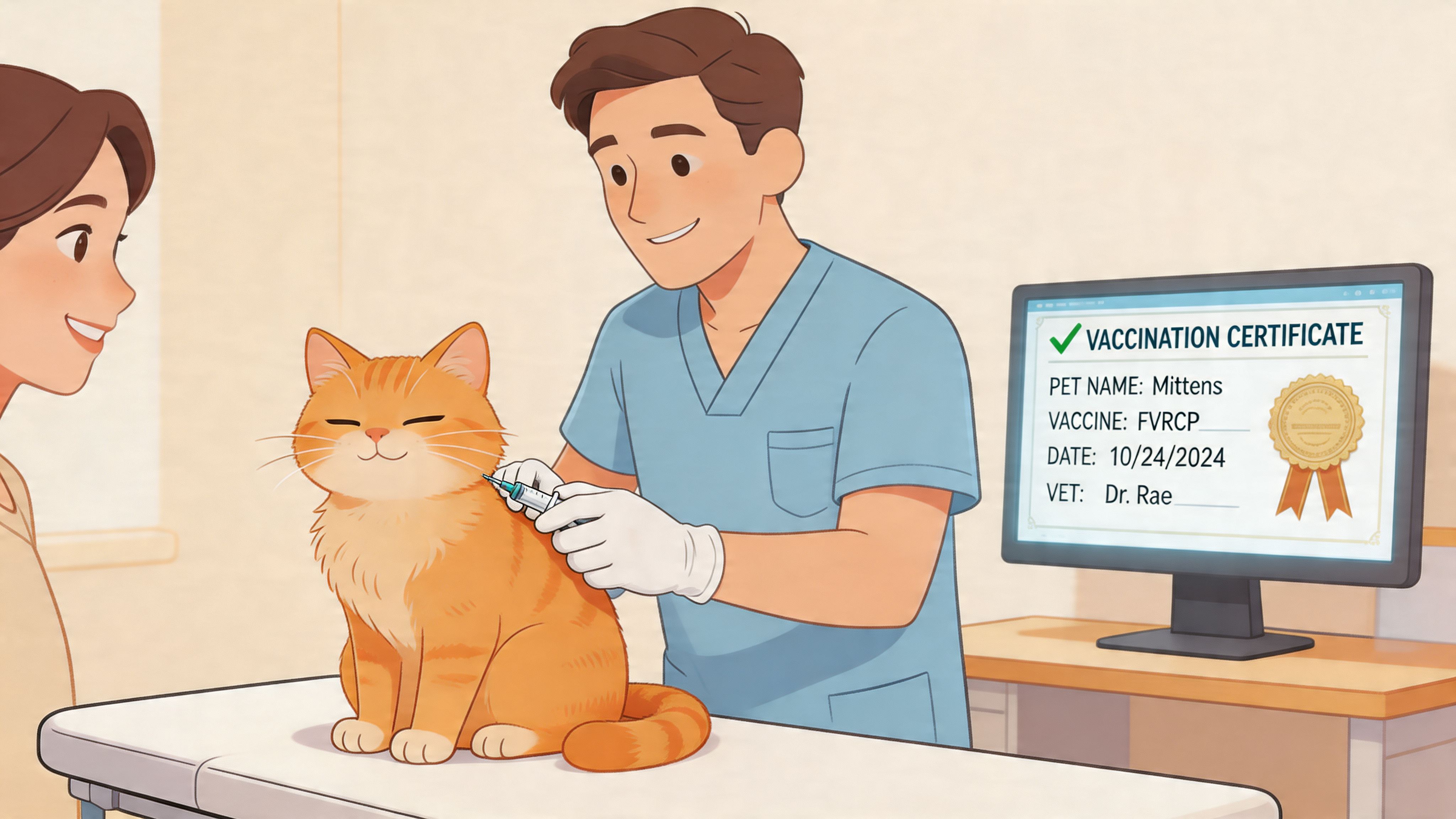
The normal process is straightforward. Your veterinarian confirms your cat's identity, gives the rabies vaccine if due, records the product information, and issues the certificate. Most of the trouble starts after the appointment, when owners assume the paper will take care of itself.
What happens at the vet visit
A clean appointment usually includes these steps:
Identity check
The clinic confirms your cat's details and, if relevant, scans the microchip.Vaccination
The veterinarian administers the rabies vaccine using the product appropriate for your cat's age and prior history.Documentation
The record is completed with the vaccine date, product details, and veterinarian attestation.Certificate issue
You receive the certificate. If you're planning international travel, ask whether additional forms or government endorsement steps may apply. Clinics that handle travel cases often have staff familiar with USDA veterinary accreditation and can tell you what comes next.
How to store and replace the certificate
Owners do best when they keep both paper and digital copies. Save a scan in a folder you can access from your phone and email. Keep the original in a travel document sleeve, not clipped to the fridge with last year's boarding invoice.
If you lose the original, call the veterinary clinic that gave the vaccine. In most cases, the clinic can reissue the record from the medical file if the vaccination details are documented clearly.
What to do if the vaccine has lapsed
This is the problem that catches people off guard. If your cat's rabies vaccination expires, even by a day, many countries may invalidate prior vaccinations for import purposes, which can mean starting over with microchipping, revaccination, and a new 21 to 30 day waiting period before travel, based on this guidance about rabies vaccination certificate requirements.
That doesn't mean panic. It means act quickly and assume nothing.
Use this recovery approach:
Call your vet first: Ask whether the previous vaccine history still helps locally, but don't assume it will satisfy import rules.
Review the microchip sequence: If the destination expects the chip before vaccination, confirm the dates now.
Revaccinate promptly: Delaying the new shot only pushes your travel timeline farther out.
Rebuild the schedule: Count forward from the new valid date, not from the old certificate.
If a vaccine has lapsed, the safest planning assumption is that your travel clock may need to restart.
What doesn't work is arguing with the destination's timeline after you already bought tickets. What does work is treating a lapse like a new compliance event and rebuilding the file carefully.
Using a Rabies Certificate for International Travel
For international trips, the rabies certificate is the base layer. It rarely stands alone. In most cases, it becomes one ingredient in a larger travel packet that may also include an international health certificate, destination-specific declarations, and sometimes additional testing or endorsements.
Think of it as a recipe, not a single form
Owners often focus on getting the rabies certificate and assume that solves the travel problem. It solves only one part. The certificate feeds information into the broader file, especially the pet health certificate for international travel that many destinations or airlines require.
The practical trade-off is time versus certainty. If you start early, you can verify each requirement in order. If you start late, every missing signature feels urgent, and even fixable issues become trip-threatening.
A careful travel file usually depends on consistency across documents:
Travel document area | Why consistency matters |
|---|---|
Microchip details | Must match the cat presented for travel |
Rabies vaccine data | Must align with the certificate and travel forms |
Owner information | Name differences can trigger manual review |
Vet attestation | Incomplete signatures can delay processing |
The high-stakes pitfall owners miss
Exposure during travel planning is one of the least understood problems. For a vaccinated cat exposed to rabies, the CDC recommends an immediate booster and a 45-day observation period, and some destinations such as Japan or New Zealand may void a certificate if there's any post-vaccination exposure event, according to CDC guidance for veterinarians handling rabies exposure scenarios.
That means a bite, scratch, or suspicious wildlife incident before departure isn't just a medical issue. It can become a document issue.
What works in real planning
When owners are preparing for international travel, the smoothest cases usually share the same habits:
They build a timeline backward from travel day: That leaves room for waiting periods and approvals.
They keep one master folder: Every certificate, scan, and form stays together.
They report exposure events immediately: Trying to "wait and see" can create larger problems later.
A common mistake is assuming a current vaccine automatically survives every travel scenario. It doesn't. If a cat has a possible exposure after vaccination, ask your veterinarian how that changes both the medical plan and the travel plan before you move forward.
Simplify Pet Travel Documents with Passpaw
Paperwork problems usually aren't dramatic. They're small. A serial number was omitted. A date was entered in the wrong format. The owner has one scan, the clinic has another, and the airline asks for a version no one can find. That's why digital workflows help.
For clinics and organized owners, systems that collect vaccine details, track deadlines, and flag missing fields are easier to manage than email chains and phone photos. If you're pulling information from scanned forms, a PDF parser for efficient document extraction can help turn static records into usable text so you can review dates, product details, and names more reliably.
Where a workflow tool helps
A tool like Passpaw features for pet travel document management can support the process by organizing travel tasks, validating required details, and keeping the cat's rabies information tied to the broader international paperwork. That matters most when a clinic is managing multiple travel cases at once or when owners need a clearer timeline.
What tends to work well with any system is a simple routine:
Start with the rabies certificate: Make sure the core vaccine record is complete.
Centralize files: Keep scans, originals, and travel forms in one workflow.
Check for mismatches early: Names, dates, and microchip numbers should line up before submission.
Track deadlines actively: Waiting periods don't bend because a flight is booked.
What doesn't work is building the file from memory a few days before departure. Travel paperwork rewards boring habits. In this area, boring is good.
Common Questions About Cat Rabies Certificates
Below are the questions owners ask most when the certificate is already in hand and they're trying to avoid a paperwork hairball.
Quick answers that help in real life
Question | Answer |
|---|---|
Can I travel with a photo of my cat's rabies certificate? | Sometimes a digital copy helps for reference, but many travel situations still go more smoothly when you carry the printed original. Keep both. |
What if the certificate has a typo? | Ask the issuing clinic to correct it as soon as you notice it. Small errors in names, dates, or microchip numbers can cause bigger review problems later. |
Is a rabies tag the same as a rabies certificate? | No. A tag may show your cat was vaccinated, but the certificate contains the detailed medical and administrative information officials usually need. |
A few final pointers make life easier:
Check the certificate the day you receive it: Errors are easiest to fix while the appointment is still fresh.
Don't assume old records transfer cleanly: If you changed vets, verify that the current clinic has the full vaccine history.
Treat timing as part of the medical plan: For travel, dates matter almost as much as the vaccine itself.
A complete, current certificate solves more problems than owners realize. An incomplete one creates more questions than anyone wants at the airport.
If you're unsure whether your cat's record is usable, ask your veterinarian to review it as if they were seeing it for the first time. Fresh eyes catch the details familiar eyes skip.
If you're preparing your cat for travel and want fewer document surprises, Passpaw can help you keep vaccination records, travel forms, and timing requirements organized in one place. It's a practical option for clinics and owners who want a clearer path from rabies certificate to ready-to-travel file.
More articles
From regulatory changes to best practices for veterinarians and pet owners, our resources keep you ahead of the curve.