Are you a team member in a veterinary practice?
Are you a pet parent planning a trip with your furry pal?
How Do I Take My Cat With Me To Spain A Complete Guide
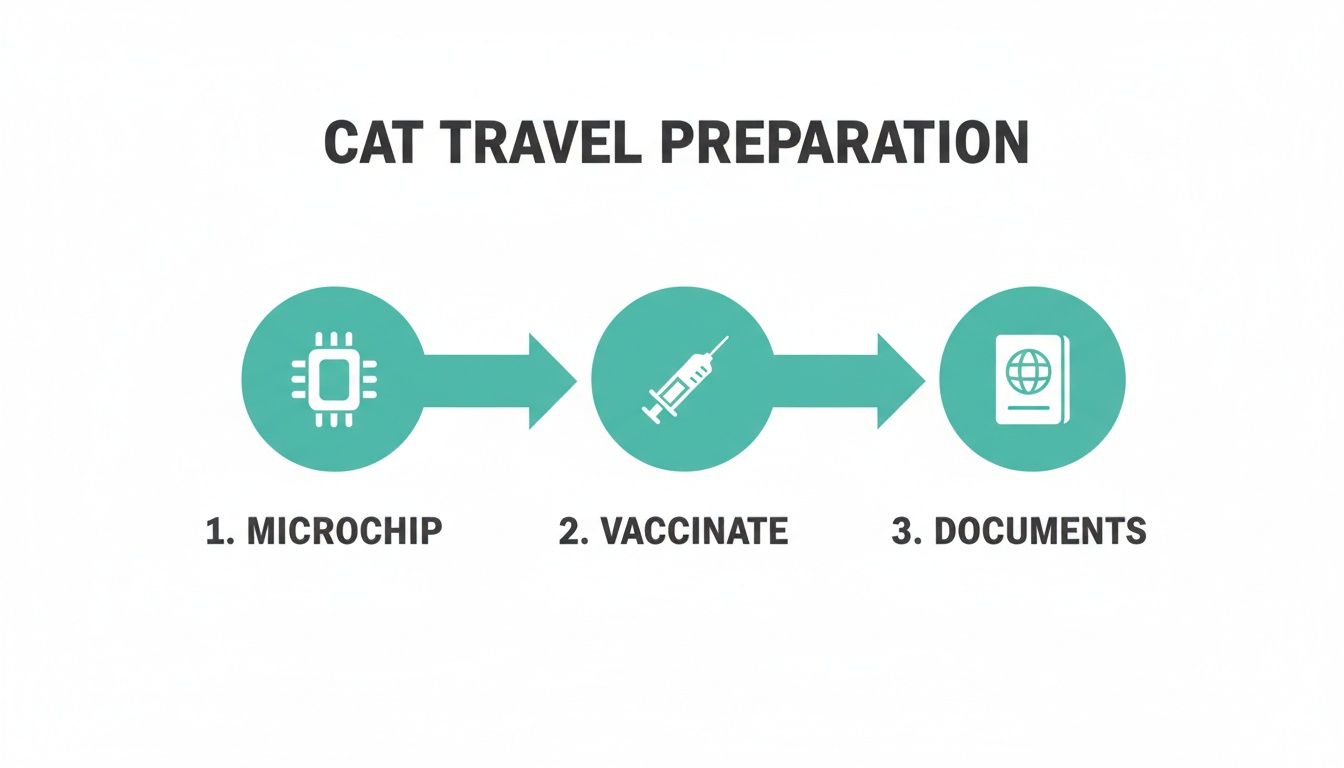
Dreaming of sun-drenched afternoons in Spain, with your cat purring contently by your side? Making that dream a reality is totally doable, but it takes some solid preparation. The secret to a smooth move is getting the timing right for a specific sequence of events: microchipping, rabies vaccinations, and getting the correct international health documents before you even think about booking a flight.
Your Cat's Journey to Spain Starts Now
Moving a pet to another country can feel like a mountain of a task, but if you break it down into a timeline with a few key milestones, it becomes much more manageable. This guide is here to walk you through it, step-by-step, so you and your furry co-pilot are ready for a seamless transition.
The good news? Spain is incredibly pet-friendly. You’re definitely not the first person to bring your cat along, which means the process is well-established—it just requires a sharp eye for detail.
Why You Need to Plan Way Ahead
The single biggest mistake people make is not allowing enough time. There are certain waiting periods, especially after the rabies vaccination, that are completely non-negotiable. It's a good idea to start the process at least three to four months before your planned travel date.
This buffer gives you breathing room for vet appointments, paperwork, and booking travel without that frantic, last-minute panic.
Relocating a pet internationally is a careful dance between veterinary rules, government endorsements, and airline logistics. Starting early is the difference between a smooth move and a stressful, last-minute scramble over what should be simple paperwork.
For a deep dive into the specific timeline and requirements for traveling from the US, our guide on moving your pet from the United States to Spain breaks it all down.
To give you a clearer picture, here’s a quick overview of what your timeline might look like.
Your Cat's Relocation Checklist
This table lays out the essential tasks and the recommended timeline for getting everything in order for your cat's trip to Spain.
Requirement | Key Action | Start At Least |
|---|---|---|
ISO Microchip | Verify current chip is ISO-compliant or implant a new one. | 4 Months Out |
Rabies Vaccination | Administer rabies vaccine after microchipping. | 4 Months Out |
21-Day Wait Period | Mandatory wait after the primary rabies vaccination. | 3 Months Out |
Health Certificate | Schedule vet appointment for the international health certificate. | 1 Month Out |
USDA Endorsement | Submit the health certificate to APHIS for official endorsement. | 2 Weeks Out |
Airline Booking | Confirm pet policies and book your cat's spot on the flight. | 1-2 Months Out |
Think of this as your roadmap. Ticking these items off in the right order is the key to a stress-free journey for both you and your cat.
Embracing Spain's Pet-Friendly Vibe
Spain’s warm welcome for pets has turned it into a major destination for animal lovers. In fact, the Spanish pet travel services market hit USD 52.9 million in revenue in 2024, which just goes to show how many people are making the same move you are. With nearly half of all Spanish households owning a pet, your cat will fit right in.
Proper planning isn't just about your cat's health and safety—it’s about preserving your own sanity so you can actually enjoy the excitement of your move. And remember, beyond the pet-specific tasks, any international move requires serious organization. For more general tips, it's worth reading up on how to prepare for international travel.
Now, let's get this journey started on the right paw.
Essential Health and Identification Steps
Before you even think about booking flights, there are a couple of basic steps that are absolutely non-negotiable for taking your cat to Spain. Getting these right—and in the correct order—is the key to a smooth process.
Think of it this way: this is the foundation for your cat's travel paperwork. If the foundation isn't solid, nothing else will stand up to review from the authorities.
The Critical Order of Operations
First things first: your cat's identification. Spain, like the rest of the EU, suggests that every incoming cat have an ISO-compliant 15-digit microchip. This tiny chip is your cat's permanent ID and gets scanned at every official checkpoint.
If your cat already has a microchip, you need to confirm with your vet that it’s an ISO 11784/11785 compliant chip. If not, or if your cat doesn’t have one at all, you'll need one implanted. It’s a simple and quick procedure, much like a routine shot.
Here’s the part that trips up so many pet owners: the microchip should be implanted before the rabies vaccination is given. If the rabies vaccine is given first, it may be considered invalid for travel, and you might have to get your cat revaccinated after the microchip is in place.
This sequence is very important. The microchip number has to be recorded on the rabies certificate to prove that specific vaccine belongs to your specific cat.
Navigating the Rabies Vaccine and Waiting Period
Once the microchip is in and scanned by your vet, it’s time for the rabies shot. This isn't just a simple vaccination; it comes with its own set of rules and a strict timeline that directly impacts your travel date.
Spanish regulations suggest a cat should be at least 12 weeks old to receive its primary rabies vaccination. This is a key detail for anyone traveling with a younger cat.
After that first-time rabies vaccine is given, you hit a mandatory 21-day waiting period before your cat is allowed to enter Spain. This wait gives the vaccine enough time to become fully effective.
Timeline Example: If your vet administers the rabies vaccine on March 1st, the 21-day clock starts. The earliest your cat can travel to Spain would be March 22nd.
This 21-day rule is a classic reason for last-minute travel delays. Make sure you factor it into your plans and don't book any flights that fall inside this window. For a more detailed look, you can learn more about keeping your cat's vaccination records organized for just this kind of trip.
A key rule to remember is that kittens under 15 weeks of age may not be authorized to enter Spain. This number comes directly from the minimum vaccination age (12 weeks) plus that mandatory 21-day (3 week) waiting period. You can look into the official guidelines yourself on the Spanish government's website.
Understanding Your Cat's Travel Documents
Figuring out the paperwork for taking your cat to Spain can feel like a maze, but it’s actually pretty straightforward once you know which path to take. The right document depends entirely on where you’re starting your journey. Getting this right isn’t just a detail—it’s the key that unlocks your cat's entry into the country.
The two main documents you'll hear about are the EU Pet Passport and the International Health Certificate. One is for travel within the European Union, while the other is for cats arriving from anywhere else. They serve the same basic purpose but have completely different rules for how they’re created and validated.
For Cats Traveling from an EU Country
If your cat is already living in an EU member state, you're in luck—the process is wonderfully simple. All you generally need is a European Pet Passport, that little blue booklet that acts as your cat’s all-in-one ID and health record for moving around the EU.
This isn't a DIY document. It should be issued by a veterinarian who is authorized by the official authorities in your EU country of residence.
The pet passport contains all the key details in one place:
Owner's Information: Your name and contact details.
Cat's Description: Specifics about your cat, like breed, sex, and age.
Microchip Information: The 15-digit ISO-compliant microchip number and the date it was implanted.
Rabies Vaccination Details: Official proof of a valid rabies shot, including the administration date and when it expires.
With this little blue book, hopping between EU countries is a breeze. As long as that rabies vaccination is up-to-date, you’re generally good to go.
For Cats Coming from Outside the EU
If you're wondering how to take your cat with you to Spain from a non-EU country—think the United States, Canada, or the UK—you’ll likely need an official International Health Certificate. This document is a formal declaration from an accredited veterinarian confirming your cat is healthy and appears to meet Spain's import rules.
This is where your timing becomes absolutely critical. Unlike the EU Pet Passport, this certificate has a very strict and short lifespan.
The International Health Certificate should be completed by your vet and then endorsed by a national governing body (like the USDA in the US) within 10 days of your cat's arrival in Spain. Missing this window can be a problem, so scheduling your final vet appointments is crucial.
Getting this certificate is a multi-step dance. First, your accredited vet performs a final health check and fills out the specific form required by Spain. Then, you have to get that form officially stamped by the veterinary authority in your country—in the US, that’s the USDA's Animal and Plant Health Inspection Service (APHIS). That final government endorsement is what makes it official.
For a deeper dive, check out our article on what an international health certificate for your pet entails.
The global pet travel services market is booming, with a projected compound annual growth rate of 8.5% between 2025 and 2032. As international rules get more complex, managing all these requirements is a real challenge for vets and owners alike. It’s exactly why automated platforms can make a huge difference in getting it right. You can learn more about the growth of the pet travel market here.
Document Requirements EU vs Non-EU
Feeling a bit tangled in the details? This table breaks down the key differences between the two main travel documents for your cat.
Feature | EU Pet Passport | International Health Certificate |
|---|---|---|
Origin Country | Any EU member state. | Non-EU countries (e.g., USA, UK, Canada). |
Issuer | An authorized EU veterinarian. | An accredited vet in your home country. |
Endorsement | Not required for EU travel. | Should be endorsed by a government body (e.g., USDA). |
Validity | Valid for life, as long as the rabies vaccine is current. | Typically valid for a short period, often just 10 days. |
Main Purpose | Facilitates easy travel between EU countries. | Certifies health for a single entry into the EU. |
In the end, whether you need a passport or a certificate, the goal is the same: showing that your cat is healthy, properly identified, and vaccinated against rabies. It’s the final, crucial piece of the puzzle that makes your Spanish adventure paws-sible.
Choosing a Pet-Friendly Airline
Once your cat’s paperwork is in motion, it’s time to tackle the flight itself. This is about more than just finding a cheap ticket—it’s about finding an airline that you trust with your cat's safety and well-being. Policies can vary wildly from one airline to the next, so doing your homework now will save you a world of stress on travel day.
Your first big decision is whether your cat will fly in the cabin with you or travel as manifest cargo in a specialized, climate-controlled hold. Neither is inherently "better"; the right choice depends on your cat's size, personality, and what the airline allows.
In-Cabin Travel: The Co-Pilot Seat
For most cat owners, having their furry friend under the seat in front of them is the ideal scenario. It’s reassuring to have them close by where you can check on them throughout the flight. But this option comes with some very strict rules you can’t bend.
Airlines are sticklers for carrier size and weight limits, and the exact dimensions can differ. The carrier usually needs to be soft-sided and small enough to slide completely under the seat, meaning no part of it can jut out into the aisle.
To figure out if your cat can fly in the cabin, you need to do two things:
Measure your cat: Get their height (floor to shoulder tops) and length (chest to the base of their tail). They need enough room to stand up and turn around easily inside the carrier.
Check the airline's rules: Compare your cat’s measurements to the maximum carrier dimensions on the airline’s website. Don’t forget to weigh your cat and the carrier together—there’s almost always a combined limit, often around 8 kg or 18 lbs.
When Cargo is the Only Way
If your cat is a larger breed or if the few in-cabin pet spots are already booked, they’ll have to travel in the cargo hold. I know that sounds intimidating, but it's not like they're being thrown in with the suitcases. Pets travel in a pressurized, temperature-controlled section of the plane designed specifically for live animals.
For cargo travel, you’ll need a hard-sided, IATA-approved travel crate. These are built for safety, with solid construction, ventilation on all four sides, and a secure lock your cat can’t pop open. The crate must be big enough for them to stand, sit, and turn around without feeling cramped.
It's a common misconception that cargo travel is unsafe. The reality is that thousands of pets fly this way every year without a problem. The key is using the correct, IATA-compliant crate and choosing an airline known for its animal transport services.
Questions to Ask Before You Book
Never assume anything when booking a flight for your cat. Get on the phone with the airline and ask some pointed questions. This isn’t just about following their rules; it’s about ensuring your cat’s journey is as smooth as possible.
Here's a checklist of what to ask:
What are the exact dimensions and weight limits for in-cabin carriers?
How many pets are allowed in the cabin on each flight? (These spots fill up fast!)
Are there any breed restrictions for cats? (Some flat-faced breeds can face limitations.)
What’s the check-in process like with a pet?
Can you confirm the total pet fee?
For a deeper dive, check out our guide on which airlines allow pets in the cabin. Getting these details locked down early means no last-minute surprises when you're trying to get your cat to Spain.
Nailing the Final Stretch: Your Pre-Travel Game Plan
The last few days before your flight are when all your careful planning comes together. The goal is simple: keep things calm and straightforward. This is your chance to get organized, tie up loose ends, and reduce stress for both you and your cat before the big day.
Think of this final week as the home stretch. By tackling a few key tasks each day, you'll ensure both you and your feline friend land in Spain relaxed and ready for your new adventure.
The Carrier: From Scary Box to Safe Haven
For a cat, a travel carrier can be a pretty intimidating object. The secret to a peaceful trip is to make it a familiar, safe space long before you head to the airport. This takes a little patience and a whole lot of positive reinforcement.
Start at least a week ahead of time. Just place the carrier in a main living area with the door wide open and let your cat get acquainted with it on their own terms. To sweeten the deal:
Make it cozy: Tuck in a favorite blanket or an old t-shirt that smells like you. Familiar scents are incredibly comforting to cats.
Create positive vibes: Start feeding your cat near the carrier. After a day or two, put the food bowl just inside the door, then gradually move it further back each day.
Reward curiosity: Whenever your cat ventures near or inside the carrier, give them a tasty treat and some gentle praise.
The aim is to help your cat see the carrier as their own little den, not a cage. This one step can make a world of difference to their stress levels on travel day.
The Sedation Question: To Sedate or Not to Sedate?
It's completely normal to worry about your cat's anxiety during a long flight, which leads many owners to consider sedation. But here's the thing: most vets and nearly all airlines strongly advise against it. Sedatives can mess with a cat's ability to regulate their body temperature and keep their balance, which is a real risk at high altitudes.
Instead of medication, look into natural calming options. Products like a Feliway spray, which mimics calming feline pheromones, can be spritzed in the carrier about 15-20 minutes before your cat gets in. Calming treats with ingredients like L-theanine or chamomile can also help take the edge off.
Always chat with your vet before trying any calming aids, even the natural ones. They’ll know what’s safest and most effective for your specific cat and their health history.
Your Cat’s Carry-On: What to Pack
Just like you pack a bag with in-flight essentials, your cat needs one, too. You'll want to keep this easily accessible, especially for getting through security and during the flight.
Here’s what to include in your cat’s travel kit:
Absorbent Pads: Line the bottom of the carrier with a puppy pad or two. It’s always better to be prepared for accidents.
A Comfort Item: A small blanket or toy that smells like home provides a sense of security in an unfamiliar environment.
A Few Treats: Pack a small, zip-top bag of their usual kibble. While you shouldn’t feed them a full meal, a few pieces can be a comforting snack.
Travel Water Bowl: A small, collapsible bowl is perfect for offering a little water. Don't be surprised if they don't drink much, though.
Wipes: Pet-safe wipes are a must-have for any quick clean-ups.
Arrival in Spain: The Final Checkpoint
Once you've landed and cleared immigration, your last stop is customs. This is where you'll officially introduce your cat and their paperwork. Have your original, endorsed health certificate (or EU Pet Passport) ready to go.
Customs officials will likely review the documents and scan your cat’s microchip to verify their identity. A smooth arrival is the final piece of the puzzle when figuring out how do I take my cat with me to Spain. When everything is in order, the process is usually quick, and you'll be on your way to your new home.
Common Questions About Moving Your Cat To Spain
Even the most organized travel plans can leave you with a few nagging questions. It’s completely normal. When it comes to moving your cat to Spain, a few topics pop up over and over again. We've gathered the most common ones here to help you get those last-minute details sorted.
Think of this as your final pre-flight check. Getting these answers will give you the peace of mind to focus on the adventure ahead.
How Much Does It Cost To Take A Cat To Spain?
The final bill can swing pretty wildly, but it's smart to budget anywhere from a few hundred to over a thousand dollars. This isn't one single charge, but a bunch of smaller costs that add up. What you'll actually pay depends on your starting point, your timeline, and the choices you make along the way.
Here’s a quick look at where the money goes:
Veterinarian Visits: This covers the final health exam and the time it takes your vet to carefully complete the international health certificate.
Government Endorsement: If you're coming from outside the EU, you'll have a fee for the official government stamp of approval (like from the USDA in the States).
Airline-Approved Carrier: Don't skimp here. A high-quality, IATA-compliant carrier is a must-have investment for your cat's safety and comfort.
Airline Pet Fee: This fee varies hugely between airlines and depends on whether your cat can fly in the cabin with you or needs to travel as manifest cargo.
Does My Cat Need A Rabies Titer Test?
This is a big one, and the answer comes down to where your journey begins. For most people wondering how to take their cat to Spain, the good news is no.
A rabies titer test—which is a blood test to check for rabies antibodies—is not required if you're traveling from another EU country or a country the EU considers "low-risk." This list currently includes the USA, Canada, and the UK. But, if you're starting from a country classified as "high-risk" for rabies, this test is an important step.
It's a good idea to check the official Spanish or EU government websites for the most current list of high-risk countries. These classifications can and do change. Factoring in a titer test can add several months to your preparation timeline, so you need to know this upfront.
Should I Use A Pet Shipper?
The classic DIY vs. pro question. Handling all the logistics yourself is totally doable and will definitely save you some money, but it demands serious organization and a significant chunk of your time. You'll be the one booking the flights, triple-checking every line of the paperwork, and figuring out the government endorsement process.
A reputable pet shipper, on the other hand, just takes all of that off your shoulders. These folks are experts in the art of international pet travel. They handle everything from coordinating with your vet to booking the best flights. If you're feeling swamped by the regulations or are trying to manage a complicated family move, hiring a shipper can be an incredible, stress-busting decision.
Planning an international move for your pet is a puzzle with a lot of moving pieces. Passpaw is designed to simplify the trickiest part: getting the international health certificate right. Our platform helps your veterinarian manage every deadline and paperwork detail with confidence, freeing you up to focus on your new life in Spain. Learn more about how Passpaw can streamline your pet's move.

More articles
From regulatory changes to best practices for veterinarians and pet owners, our resources keep you ahead of the curve.