Are you a team member in a veterinary practice?
Are you a pet parent planning a trip with your furry pal?
A Pet Parent's Guide to the USDA Certificate for Pet Travel
So, what exactly is a USDA certificate for pet travel? Think of it as an official health document—often called an international health certificate—that’s needed anytime you're taking your pet from the United States to another country. It’s the formal confirmation that your pet is healthy and meets all the specific import rules for your destination.
Your Pet's Passport to the World
Taking your furry co-pilot on an international trip sounds exciting, and it absolutely is. But we get it—the paperwork can seem like a huge hurdle. The USDA certificate is basically your pet's passport, and it's the single most important document for a smooth journey.
Getting this document right is a team effort. Once you understand who does what, the whole process becomes much less intimidating.
There are three key players on this team:
You, the Pet Owner: You're the trip captain. Your job is to research what your destination country needs and make sure everything happens on schedule.
Your USDA-Accredited Veterinarian: This is your expert partner. They're specially trained to perform the required exams, give any necessary treatments, and fill out the official forms correctly.
USDA APHIS: This is the government agency—the United States Department of Agriculture’s Animal and Plant Health Inspection Service—that provides the final, official stamp of approval on the certificate. This is known as the endorsement.
That official endorsement is what makes the health certificate valid internationally. Without it, your pet could be quarantined or even denied entry when you arrive.
A Quick Look at the Process
The whole process, from that initial vet visit to getting the final stamp, follows a clear path. You’ll start by digging into your destination’s specific rules—some countries just need updated vaccines, while others need blood tests that have to be done months ahead of time. Staying organized is absolutely critical, which is why a dedicated pet travel planner can be a lifesaver for tracking every deadline and document.
Once you know the rules, you'll work side-by-side with your accredited vet to check every box. After your vet completes and signs the certificate, the last step is sending it to USDA APHIS for that final endorsement. You can handle this by mail, in person, or online.
Each step builds on the last, all to make sure your pet is ready for takeoff. We've laid out the critical milestones below to give you a clear roadmap of what to expect.
To make it even clearer, here's a quick summary of the critical steps and why they matter.
Key Milestones in the USDA Pet Travel Certification Process
Milestone | Who Is Involved | Primary Goal |
|---|---|---|
Country Research | You, the Pet Owner | To find out all import needs like microchips, vaccines, and tests. |
Vet Exam & Paperwork | You & Accredited Veterinarian | To confirm your pet's health and complete the official health certificate. |
USDA Endorsement | You & USDA APHIS | To get the final government stamp that makes the health certificate valid. |
Final Travel Prep | You, Airline, & Pet | To make sure all documents are in order for a stress-free departure. |
Think of this table as your cheat sheet. As you move through your travel preparations, you can come back to it to see where you are in the process and what's next on the agenda.
Preparing Your Pet for the Journey
Before you even think about the paperwork for a USDA certificate for pet travel, let's get back to basics: your pet. Nailing down their health needs first is the single most important step for a stress-free trip. A little prep work here will save you a world of headaches later on.
Think of it as your pet's pre-flight checklist. These are the absolute must-haves that nearly every country will ask for before rolling out the welcome mat for your companion.
The Mighty Microchip
First up: the microchip. This tiny implant is your pet’s permanent ID, and it’s the very first thing officials will look for. But it's not enough to just have a microchip—you need the right one.
The global standard is an ISO-compliant 15-digit microchip. If your pet has an older, non-ISO chip, you might get away with bringing your own scanner, but implanting a new, compliant chip is almost always the simpler, safer bet.
Pro Tip: Ask your vet to scan the microchip at your next visit just to make sure it’s working perfectly and is easy to read. A chip that won’t scan is useless to a border agent.
Once you've confirmed the chip is good to go, log into the registry and make sure your contact information is current. An old phone number isn't going to help you if you and your pet get separated.
Vetting the Vaccinations
Next on the list are vaccinations. You're probably used to your pet’s routine shots, but international travel plays by a different set of rules, and the timing is everything.
Rabies is the big one, but the details are what trip people up. Many countries are incredibly strict about the order in which the microchip and vaccine are done.
For a lot of destinations, the process has to go like this:
Implant the microchip first. This number has to be on all the paperwork that follows.
Give the rabies vaccine after the chip is in. A shot given before the microchip might not be accepted for travel.
Respect the waiting period. Many countries require a 21- or 30-day waiting period after the primary rabies shot before your pet can even leave the country.
And it’s not just about rabies. Your destination might require other vaccines, like distemper or parvovirus. Always, always check the official import rules for a full list. Keeping it all straight is a job in itself, which is why our guide on how to provide proof of rabies vaccine can be a lifesaver.
Decoding Rabies Titer Tests
For many rabies-free or rabies-controlled regions—think the EU, Japan, or Australia—just having the vaccine isn't enough proof. They want to see a rabies titer test. It’s a blood test that shows the vaccine worked by measuring the level of rabies antibodies in your pet’s system.
This test is a major factor in your travel timeline, so you need to plan for it.
Timing: The blood draw must happen at least 30 days after the rabies vaccination was given.
Waiting Period: After the lab gives you a passing result, you’re often looking at a mandatory three-month waiting period before your pet is allowed to enter the country.
Approved Labs: You can’t just send the sample anywhere. It has to go to a government-approved laboratory for analysis.
When you add it all up, the titer test process alone can easily take four months or more. Procrastination is the enemy of international pet travel. Start early—it's the best advice anyone can give you.
Working With a USDA-Accredited Veterinarian
When you're getting ready for an international trip, your veterinarian becomes more than just your pet's doctor—they're your co-pilot for the entire USDA certificate for pet travel process. But here’s a critical point: not just any vet can sign off on these official forms. This job is exclusively for a USDA Accredited Veterinarian.
Think of them as specialists with extra federal training. While your family vet is perfect for routine care, an accredited vet has been authorized by the government to handle the specific, and often tricky, requirements of international travel. They are the only ones who can complete and sign an official health certificate.
Finding one is your first real step. If your regular clinic doesn't have an accredited vet on staff, they can almost certainly refer you to one nearby. This partnership is essential, so confirming their accreditation should be one of the very first calls you make.
What to Expect During the Final Health Exam
The final health exam is the moment of truth. This is usually the last major step before your paperwork is sent off for the final USDA endorsement. Timing here is absolutely everything, and it’s where many pet owners get tripped up.
Most destination countries, especially those in the European Union, require this examination to be completed within a very tight 10-day window before your pet is scheduled to arrive. That leaves almost no room for error. It's a high-stakes appointment.
During this visit, your accredited vet will perform a thorough nose-to-tail check-up to confirm your pet is healthy and shows no signs of communicable diseases. They will carefully review and verify every single detail your destination country requires.
This includes:
Scanning the microchip: They'll confirm the chip is present, working, and that the number matches all your documents.
Verifying vaccinations: They will double-check that every required shot, especially rabies, is current and was given within the correct timeframes.
Confirming parasite treatments: If your destination needs specific internal or external parasite treatments (like for tapeworms), they will administer them and record the details precisely.
Completing the forms: The vet will fill out the official health certificate with extreme care, making sure every date, signature, and detail is perfect.
This isn't just a standard check-up; it's a detailed documentation process. Your vet has a lot of responsibility in signing these forms, so they will be incredibly thorough.
Making Your Vet's Job a Little Easier
You can help this crucial appointment go much more smoothly by showing up prepared. Vets who handle these certificates are often experts, but they aren't mind readers. Arriving organized is the best way to prevent last-minute scrambles and costly mistakes. It's a team effort, and doing your homework helps everyone succeed.
Bring a simple checklist of your destination's rules, which you can find on the APHIS website. This allows you and your vet to cross-reference every requirement together, making sure nothing gets overlooked. This simple act can be a game-changer and is something your vet will greatly appreciate.
The complexity and constant changes in regulations are a big reason why some veterinary practices hesitate to offer these services at all. You can learn more about why practices should offer health certificates and how platforms like Passpaw make it easier. Being a proactive partner in the process helps ensure the paperwork is done right the first time, saving you from a ruff situation later.
The Special Role of Accredited Vets
The USDA pet travel certification process relies on a network of accredited veterinarians trained to issue health certificates for international export. There are thousands of USDA-accredited veterinarians across the United States, forming the frontline for preparing pets for global journeys. When you decide to travel abroad with your pet, the USDA's official guidance is to contact one of these vets immediately to get the process started. You can learn more about finding an accredited vet on the official APHIS site.
Ultimately, your accredited vet is your most important ally. They bridge the gap between your pet’s health and complex international rules. By choosing the right partner and working together, you can confidently navigate the paperwork and get one step closer to your adventure.
How to Get the Final USDA Endorsement
Once your accredited veterinarian has signed off on the health certificate, you’re in the home stretch. But there’s one last, crucial step: getting the official USDA APHIS endorsement.
Think of this as the government's seal of approval. It’s the official stamp that makes your pet's travel documents valid and internationally recognized—essentially, it’s getting your pet’s passport validated before their big trip. This final check confirms a federally authorized professional has reviewed and approved everything.
Luckily, you’ve got a few ways to get this done. The right choice really comes down to your timeline, where you live, and how comfortable you are with online systems.
This quick decision tree shows that first big step you already took with your vet.
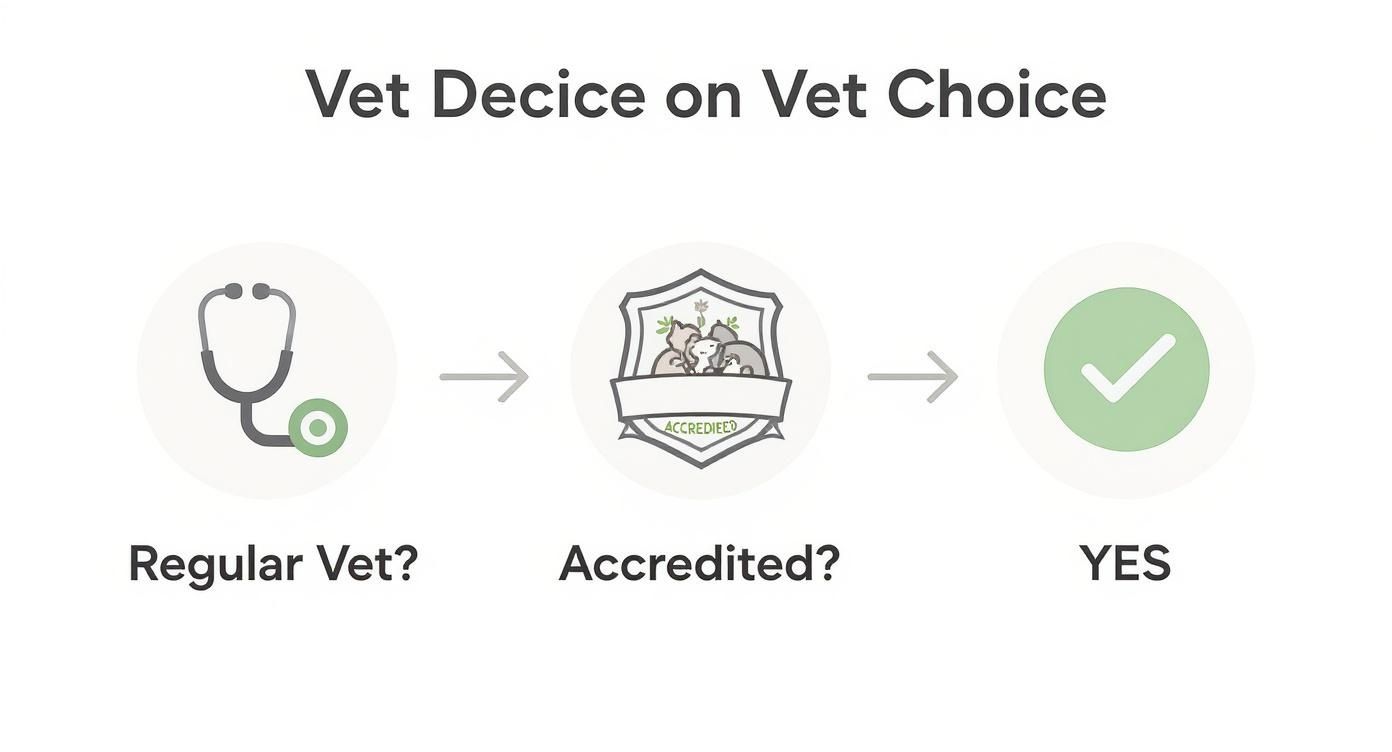
As the graphic shows, the road to a valid USDA certificate for pet travel always starts with a specially accredited veterinarian.
Choosing Your Endorsement Path
You have three main options for getting that all-important USDA stamp on your pet's health certificate. Each moves at its own speed and follows a different process, so it pays to know which one fits your travel schedule.
Mail-In (The Traditional Route): This involves sending your original, signed health certificate and all the supporting paperwork by mail or courier. It's reliable but definitely the slowest. You'll need to include a pre-paid return shipping label to get your endorsed documents back.
In-Person (The Hands-On Approach): If you're lucky enough to live near a USDA APHIS Endorsement Office, you can often book an appointment to get everything handled on the spot. This is fantastic for peace of mind, but appointments can be hard to come by and must be scheduled in advance.
Online via VEHCS (The Digital Option): The Veterinary Export Health Certification System (VEHCS) is the USDA's online portal. Your vet can upload everything directly, making it the fastest and most efficient method. Digital review and endorsement can save you precious time when you're up against a deadline.
Choosing the right submission method is a key decision in your pet's travel planning. The best option depends entirely on your specific situation—how much time you have, your budget, and how you prefer to handle important documents.
Comparing USDA Endorsement Methods
An overview of the different ways to submit your pet's health certificate for USDA endorsement, helping you choose the best option.
Method | Typical Processing Time | Best For | Key Consideration |
|---|---|---|---|
Mail-In | 5-10 business days + shipping | Planners with plenty of time | Slowest option; risk of mail delays |
In-Person | N/A | N/A | No longer offered |
Online (VEHCS) | 1-3 business days | Travelers on a tight schedule seeking efficiency | Requires your vet to be set up on the system |
No matter which path you take, always be mindful of that 10-day travel window. Mail-in services can easily eat up several business days, while VEHCS can sometimes turn things around in just a day or two. Factor this in!
Understanding the Costs Involved
Getting the final USDA stamp isn't free, and the fees saw a big jump recently. An update from APHIS increased the base endorsement fee.
What used to be $38 is now $101. And if your destination requires specific lab tests, your total cost could climb to $173 or even higher. These fees cover the administrative work of making sure your paperwork meets the destination country’s standards.
Common Submission Errors to Avoid
A simple mistake can cause frustrating delays and put your whole trip at risk. A little extra attention to detail here will save you from a last-minute panic.
Here are a few common pitfalls we see all the time:
Incomplete Paperwork: Forgetting a rabies certificate or crucial lab results is a classic error. Make a checklist and physically tick off every single item before you submit it.
Missing Signatures or Dates: Make sure both you and your accredited vet have signed and dated every required spot. An unsigned form is an automatic rejection.
Incorrect Payment: Sending the wrong fee amount or using a payment method they don't accept will bring the whole process to a halt. Always double-check the current fee schedule on the APHIS website.
Hard-to-Read Information: If your handwriting isn't perfectly clear, fill out a new form. This is another reason the online VEHCS submission is so great—it completely eliminates any handwriting issues.
By carefully choosing your endorsement method and reviewing your paperwork, you can handle this final step with confidence. For a more detailed walkthrough, check out our complete guide on how to get a USDA-endorsed pet health certificate. It will help ensure your pet’s documents are perfect, setting you both up for a smooth journey.
Common Pet Travel Mistakes to Avoid
Getting a USDA certificate for pet travel can feel like a tricky process. With so many moving parts, one tiny misstep can cause a massive headache and delay your entire trip. But don't worry—a little bit of inside knowledge goes a long way.
Knowing the common tripwires is the best way to sidestep them. We’ve seen it all, and far too many travelers get caught up in simple, preventable errors that put their plans in jeopardy. Here's how you can avoid the most frequent slip-ups for a smooth journey.
Misreading Country Requirements
This is probably the biggest one. People skim the rules or misunderstand a key detail, not realizing that a destination country's import regulations are non-negotiable. Even a small oversight can have big consequences.
For example, say you're headed to the UK and you see the tapeworm treatment requirement. Great, you get it done. But you missed the fine print: it must be given by a vet between 24 and 120 hours (that’s 1 to 5 days) before you arrive. If you get the treatment six days before you leave, it's invalid. Just like that, your pet could be denied entry or sent to quarantine. A tiny detail with huge implications.
Our best advice? Always print out the official APHIS pet travel requirements for your destination. Treat it like a physical checklist, and go over every single line with your accredited veterinarian. This one simple habit can save you from a world of trouble.
Getting the Timing Wrong
International pet travel runs on a very strict timeline. It's often unforgiving. Many of ahe most common mistakes we see boil down to bad timing—starting the process too late, or missing a critical deadline by even a single day.
A classic timing blunder involves the microchip and rabies vaccine. Let's say a cat owner gets their pet's rabies shot during a routine check-up. A few weeks later, they decide to move abroad and then have a microchip implanted. For most countries, especially in the EU, that sequence is backward. The rule is microchip first, then vaccinate. A rabies vaccine given before the microchip is implanted is usually not accepted for travel, forcing the owner to start the entire vaccination process all over again and wait another 21-30 days.
Documentation and Paperwork Blunders
Even if you nail the timing and understand all the rules, a simple error on the paperwork can bring everything to a screeching halt. These forms are carefully checked by officials, and there is absolutely zero room for mistakes. This is no time for a cat-astrophe.
Here are a few specific blunders to watch out for:
Using the Wrong Date Format: Some countries use a Day/Month/Year format, while the U.S. uses Month/Day/Year. Writing "10/11/2024" could mean October 11th or November 10th, depending on who is reading it. Your best bet is to always write out the month (e.g., 11 October 2024) to eliminate any confusion.
Messy Handwriting: If an official can't read what your vet wrote, they might just reject the form. This is one of the best reasons to use the online VEHCS system—it completely removes this risk.
Missing Signatures or Stamps: Every single required signature and clinic stamp has to be in the right spot. A missing signature from you or your vet can invalidate the whole document.
By knowing where the pitfalls are, you can be extra careful. Double-check every date, confirm every requirement, and stay in close communication with your accredited vet. That proactive approach is the key to making sure your pet's journey is a success from start to finish.
Your USDA Certificate Questions Answered
Feeling a little lost in the paperwork maze? You’re not alone. The process for getting a USDA certificate for pet travel can feel like navigating a foreign language. Let's clear up some of the most common questions we hear from pet owners every day.
How Long Is a USDA Pet Health Certificate Valid For?
This is a fantastic question, and the answer almost always surprises people. The validity of your pet’s health certificate isn't up to the USDA—it’s determined entirely by your destination country's rules.
For example, most countries in the European Union require the final vet exam to be done within 10 days of your pet’s scheduled arrival. But another country might give you a 30-day window. There's no one-size-fits-all answer, which is why you absolutely have to check the official APHIS Pet Travel Website for your specific destination's timeline.
Here's the critical detail: The countdown starts the day your accredited veterinarian signs the form, not the day the USDA endorses it. Missing this window is one of the most common and heartbreaking reasons a pet is denied travel at the last minute.
What Is the Difference Between a Regular and an Accredited Vet?
While your regular veterinarian is wonderful for routine care, only a USDA-accredited veterinarian is federally authorized to complete and sign international health certificates. It’s not just a title; it’s a specific qualification that requires extra training on animal import and export rules.
Your family vet might already be accredited—many are—but you have to ask and confirm. If they aren't, they can still handle things like vaccinations or microchipping. But for the final health exam and the official signature on those APHIS forms, you’ll need to see a vet with that specific accreditation.
Can I Use One USDA Certificate for Multiple Countries?
In almost all situations, no. Each health certificate is carefully tailored to the unique import requirements of a single country. The regulations for entering Japan, for instance, are worlds apart from the rules for Mexico.
If your travel plans include stops in more than one country, you will almost certainly need a separate, correctly prepared certificate for each one. It's so important to research the rules for every single country your pet will enter—even for a brief layover. Some countries have surprisingly strict transit rules. It’s always better to be over-prepared than to be caught by surprise. Don't find yourself in a ruff spot by making assumptions.
What Happens if My Paperwork Has an Error at the Airport?
Discovering a mistake in your pet's paperwork at the airport is every traveler's worst nightmare. Unfortunately, the consequences can be just as bad as you'd imagine.
Depending on the airline, the destination country, and how significant the error is, a mistake could lead to a few terrible outcomes:
Denied Boarding: The airline might simply refuse to let your pet on the flight.
Mandatory Quarantine: Your pet could be forced into a long and very expensive quarantine facility upon arrival.
Return to Origin: In the worst-case scenario, your pet could be sent right back to the United States on the next available flight, all at your expense.
Common mistakes range from incorrect dates and missing signatures to a microchip number that's hard to read or a form that was never endorsed by the USDA. This is why it’s so critical to review every single line of the document with your vet and double-check it against the country's requirements long before you head to the airport.
Feeling overwhelmed by the paperwork? Let Passpaw take the lead. Our platform simplifies the entire process, guiding you and your veterinary team through every step to ensure your pet's travel documents are perfect. Learn more at https://passpaw.com.
More articles
From regulatory changes to best practices for veterinarians and pet owners, our resources keep you ahead of the curve.